When I first started trading off options flow, I never knew what to actually pay attention to.
Every platform showed me the same thing: thousands of trades, and I had no way to tell which ones were real bets.
Most traders who use flow run into the same wall. So I spent the last year building something that filters this out first, then tells you what to do with what's left.
Instead of 250k options flow alerts a day, Nightglass gives you 50-75.
Instead of guessing which alerts hold up, Nightglass grades every one in public.
Instead of guessing where to enter or exit, Nightglass gives you the trade plan.
Introducing Nightglass — it cuts the 98% of flow that's noise and shows you the 2% worth noticing.
It's available now.
Introducing Nightglass — the options flow platform built to filter out the noise and show you the 2% of trades worth noticing.
Hedge funds and institutions place bets through options every day, and their trades are public. You just have to know how to spot them.
The problem: 98% of options flow is noise. That's why we built Nightglass — it doesn't show you more flow, it shows you less. Then it gives you the plan to trade it.
-Institutional support and resistance levels on any US-listed stock
-Real-time flow alerts
-Pre-market report of the prior session's institutional positioning
-Live SPX gamma exposure levels
-Earnings setups with defined trade structures
-A morning brief before every open with key news, sell side research, top flows, and more.
Live today.
@Melon_Trades Thanks for taking a balanced view. I think that’s the point. Our job is to take in information and make decision. Ideally with minimal bias. And if the data conflicts be aware and prepared to act on either scenario once it confirms.
@WJLEWIS97 I traded it a few times last year. I was hoping it could turn into a long term holding but as you said price was fucked so I let it go sadly. The data center bubble combined with crypto death didn’t help
$GLXY | Galaxy Digital CEO Michael Novogratz acquired 86,913 Class A Common Stock shares on 11/25/2026 at $10.994 per share, totaling approximately $955,000
@TedHZhang Ted - you’re well known on x as a great trader. Which means you’re willing to be objective and take in new information. That being said you may find this analysis insightful and a good devils advocate to your observations / bias https://t.co/YMgbz9NGnH
The lows may be in. At least that's what the data says.
$SPY just ripped 4.6% after falling 9% in seven sessions, 11.4% off its October high.
Naturally, everybody's wondering whether to trust this rally. Fear is everywhere. The VIX just hit 36.
So instead of guessing, here's the data.
We've seen a low like this 9 times since September 2022, including the Liberation Day low and the 2022 bear market bottom.
Seven are old enough to check six months later. SPY was higher in all seven, by 9% to 22%.
Read that again.
The one stretch where it failed was the 2022 bear market. From January to August, the same setup showed up 11 times, and SPY was higher six months later just 3 times.
It also doesn't mean straight up. Three of the nine broke the low within a month.
So here's what to watch for confirmation: is SPY above its 10-day average on Dec 1? That's about 720 if it holds here.
So the question remains, are you buying this rally?
The best part is that this wasn't a hindsight call. No Monday morning quarterbacking, and no throwing out 1,000 ideas, then pointing to the one that worked.
They put their reputation on the line before the move and said crypto was going to pump.
Pretty cool to watch the confluence play out in real time.
We called today's bottom in crypto. Here's how some of our members made 24% intraday trading the move.
This setup shows what Nightglass does best: high-quality flow and precise price levels working together.
Into the open, our models flagged unusual flow in $BMNR, the first we'd seen there in a while. Minutes later, unusual flow hit $BITX, another name our models hadn't surfaced in months.
That was the first sign. A theme was brewing.
Crypto is still structurally weak, but institutions were finally ready to buy the dip.
This tells you there’s an opportunity to get long crypto, but now you have to execute.
That's where our price levels come in.
Our charting software automatically plots supply and demand levels on every stock.
On the $BMNR chart, the flow came in near the lows. Price popped, then pulled back to retest our support level.
It tagged support almost perfectly. That was the entry.
From there, it ran 12% into the close, resulting in a 24% gain on $BMNU.
Our models find the trade, then our levels help you execute.
That's the edge.
If you’re confused by this weeks action and want an objective view based on data, then read this post. There’s a decent chance this market bottomed and we’re setting up for a liberation day type capitulation rally.
$TWST rallied 4% in 30 minutes after Strix fired a long signal.
Get Strix alerts as they fire, plus access to the full Nightglass toolkit.
Our free trial and 20% discount are available through the end of the week.
Tomorrow is the day before Thanksgiving.
The S&P 500 has been up on it in 58 of the last 76 years.
But it's down 5% this month. In the ten other Novembers down 4%+ going into that day, it was up only 6 times.
GameStop is one of the most misunderstood companies on Wall Street.
Five years after the squeeze, people still talk about $GME like it’s a 2021 meme company. And their ignorance is your opportunity.
GameStop went from a $26M operating loss to a $232M operating profit in a year. It ended last quarter with $5B in cash and marketable securities, plus an eBay stake worth another $4.9B.
Its big bet on collectibles is paying off, too.
Collectibles sales grew 61% year over year in the first half and made up 43% of revenue. Trading cards alone are an estimated $10–20B U.S. market. GameStop is becoming a destination for buying, selling and grading them.
GameStop is becoming a more profitable business with a growing collectibles engine. I think the valuation still reflects the company people remember, rather than the business it’s becoming.
What’s been missing is Wall Street paying attention.
That’s finally changing.
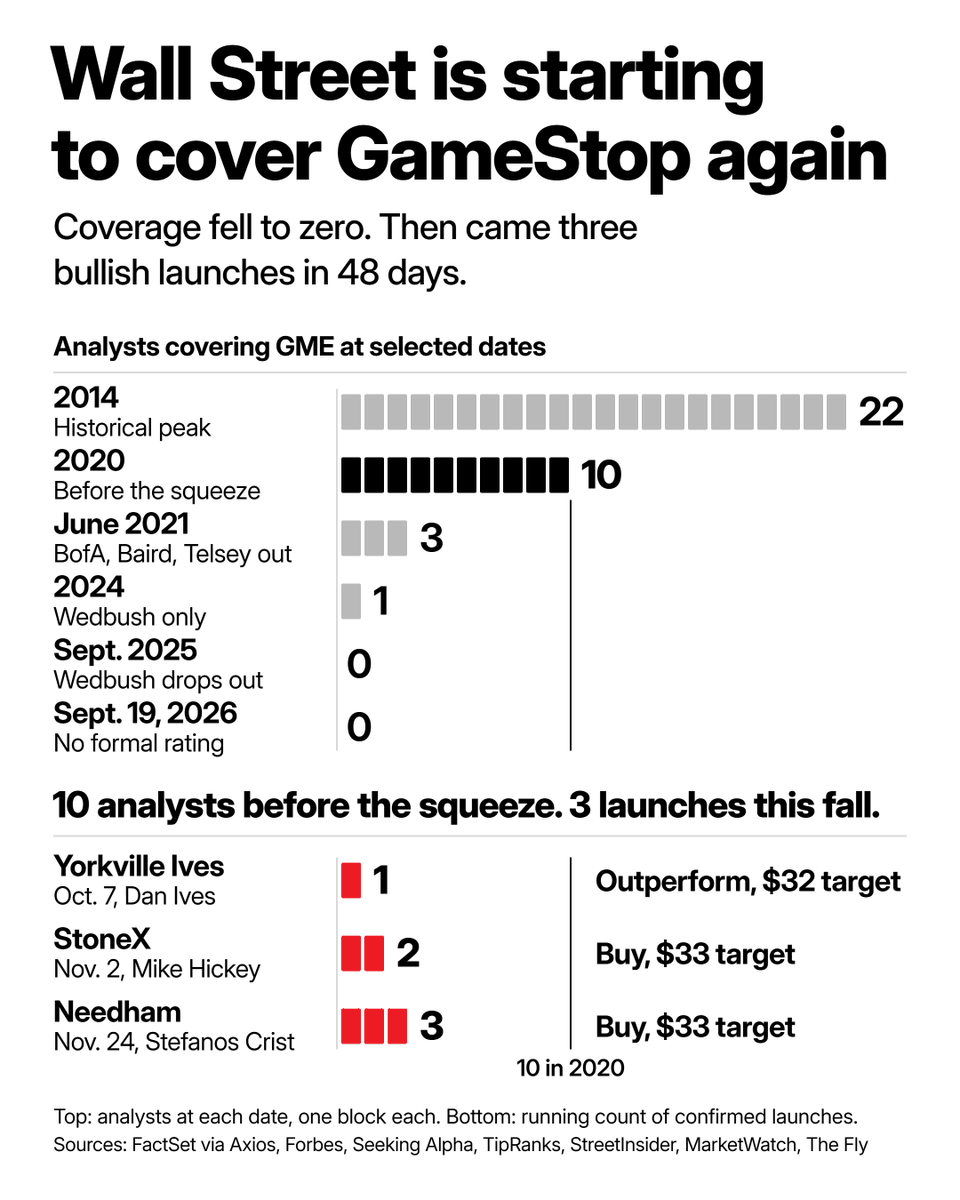
When Wedbush dropped coverage in 2025, $GME went about a year without traditional Wall Street coverage.
Then Yorkville Ives, StoneX and Needham picked up coverage in 48 days. All three came in bullish.
Wall Street is finally waking up to GME. Have you?
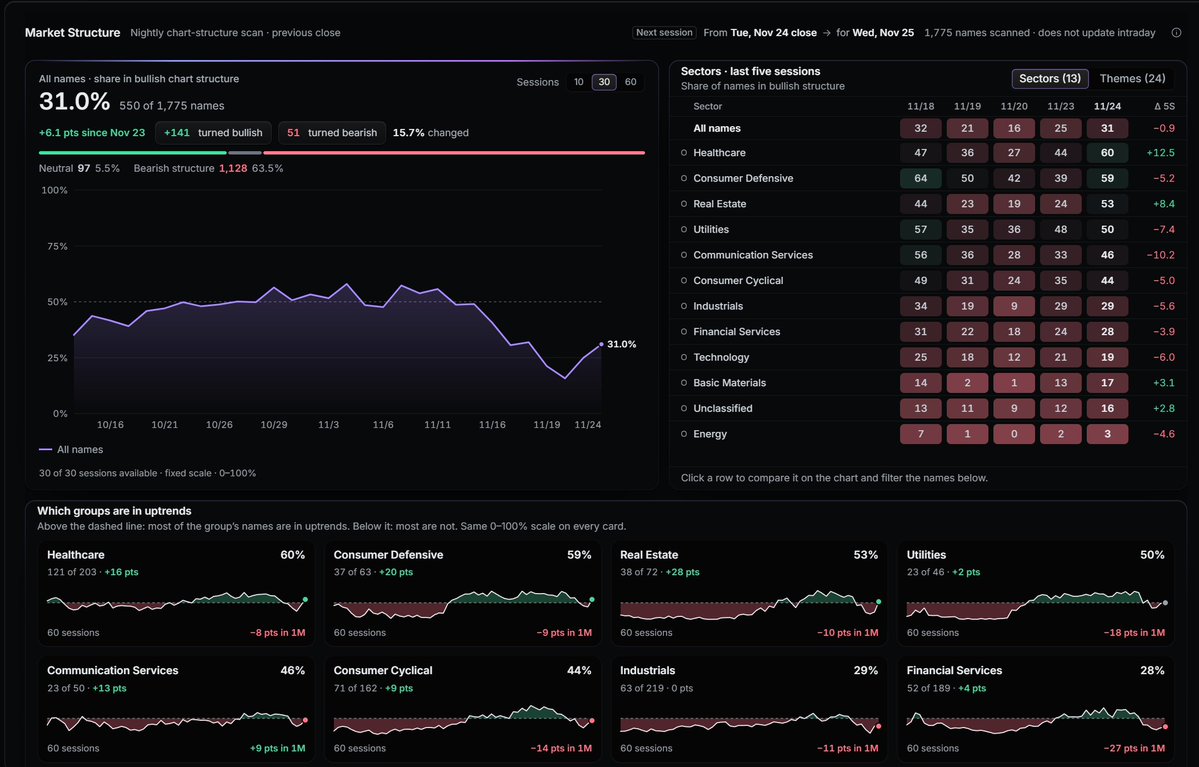
You probably didn't realize with $SPY down .49% and $QQQ down 2%, but breadth improved today.
But if tech and SPY were down, where did leadership form?
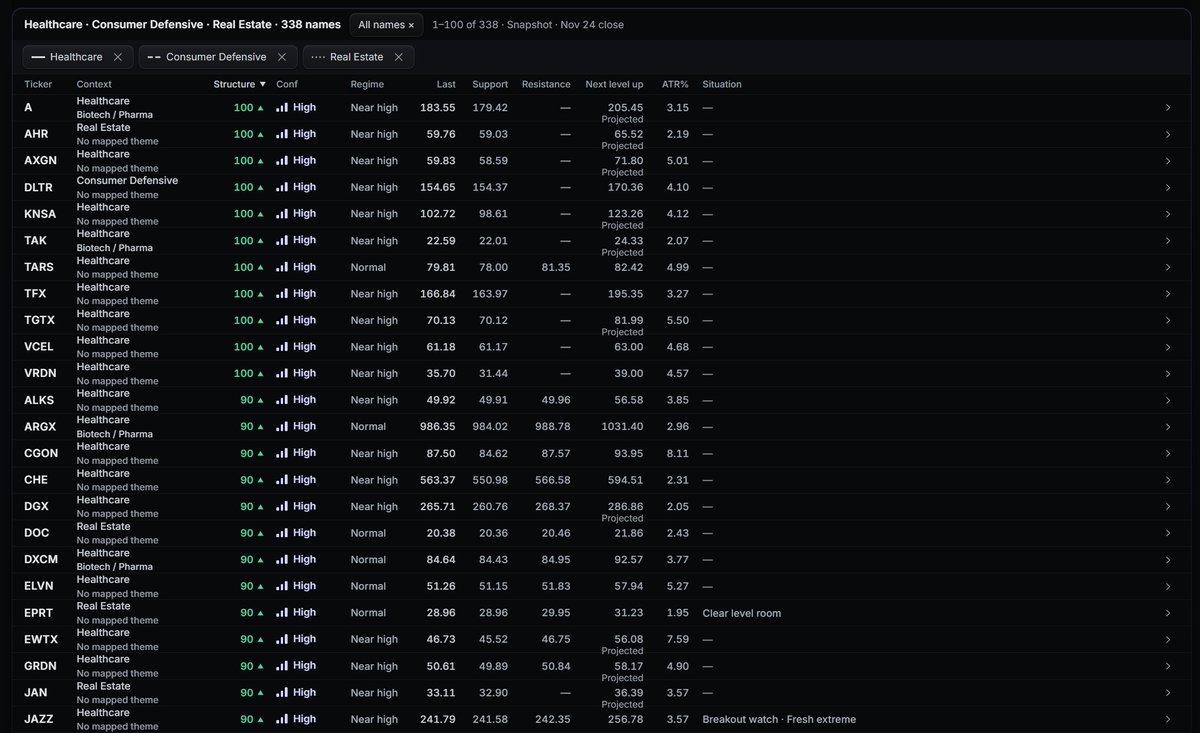
Healthcare, consumer defensive, and real estate.
And here's a list of the strongest technical set ups amongst these leaders:
$A
$AHR
$AXGN
$DLTR
$TGTX
$VCEL
$DOC
$DXCM
$JAZZ
$TGT