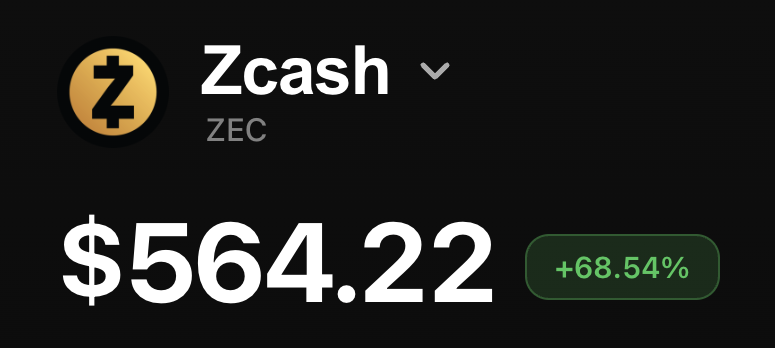
Why $ZEC > $100B
Answers from industry best minds:
1) ZEC gives real privacy, others can't see your "toys" or transactions like on public chains
2) Privacy isn't a "Narrative", it's a human right against government and AI
3) Quantum-resistant, encrypted Bitcoin that actually hides your money
4) Shielded ZEC lets you send funds with zero paper trail or wallet links (no CEX needed)
5) The most expensive shills in the game "big names hold it"
6) Has the most advanced ZK privacy tech (forked from BTC 10+ years ago for this exact reason)
7) Institutions and high-net-worth individual need private on-chain options now that crypto is regulated
8) Supply is tightly held by long-term believers after years of distribution
In short > it's the same ad as with "Bitcoin", but "It's better" and "Private"
Are you buying and believe it's better than Bitcoin?
Zcash Quantum Recoverability ZIP 2005 merged as Proposed.
Our first major buffer against quantum soundness problems is now headed toward wallet integration. As wallets update to support the ZIP, user funds will migrate.
No network upgrade necessary for this step.
ZEC up 110% in 30 days, 4.9x relative strength vs BTC. two regulated US entities building infrastructure simultaneously. gemini (BitLicense holder, NYDFS regulated) launched ZEC credit card rewards creating persistent buy pressure on every swipe. foundry (30% of BTC hashrate, DCG backed) adopted zebrad for ZEC mining operations. for years privacy coins got delisted everywhere. now a BitLicense entity is making ZEC the default cashback reward. that's not sentiment, that's compliance teams greenlighting privacy coin exposure for US cardholders. ZEC's optional transparency is exactly why it threads the regulatory needle where XMR cannot. t-addresses for audits, z-addresses when you need them. tachyon shipping quantum-resistant shielded transactions by late 2026 before any other major chain has a concrete timeline. sub $1B market cap for the only privacy chain with active US regulatory clearance and a quantum resistance roadmap
More than half of Zcash appear to be in "long term storage."
- In the transparent pool 30.4% of coins have not moved in more than a year
- 20% have not moved in more than 3 years.
- 30.8% are in the shielded pools
Either way you add these two numbers up (20% + 30.8% or 30.4% + 30.8%) you end up at more than half.
Why I'm genuinely excited about Zcash $ZEC
Nearly everyone has Bitcoin regrets, and everyone has fantasized about what could have been. But it can only be a fantasy until Bitcoin faces an existential dilemma.
And here we are. Quantum has more questions than answers. It's a rare opportunity for social consensus to fracture and the crypto community to reorganize.
Bitcoin has almost no direct competitors anymore. All previous attempts failed and the market moved on to building venture-backed faster, cheaper, proof-of-stake chains with highly concentrated token ownership.
The Zcash genesis block was nearly 10 years ago. It's one of the few remaining proof-of-work chains, the earliest to implement zero-knowledge proofs at scale, and it's now accelerating development for speed, privacy, and quantum resilience. It's such a strange feeling to see a Bitcoin alternative enthusiastically develop modern upgrades.
In a rare moment when social consensus for Bitcoin is fracturing, the social consensus for Zcash is compounding. It's hard not to look at this moment like a flash back. The first time you heard about Bitcoin or sold it too soon. What you fantasized about doing differently, if only you had known where Bitcoin was going and had the patience to weather the storm.
I think the roadmap for $ZEC is even more reflexive that we are used to. At $50 or even $500, the skeptical voice in your head says this a manufactured narrative. Just like mainstream media viewed Bitcoin as a tulip-style bubble when it traded at these prices. But as $ZEC gains ground, the price reflects a growing social consensus, and the probability of a flippening grows. It seems impossible until we reach an inflection point, and I think we each have personal inflection points layered throughout. The moment $ZEC hits the price you first heard about $BTC you will be infected with the mind virus. The fantasy to do it all over again from your original starting point. The fantasy to weather the storm, holding until Blackrock is selling your coins, if not forever. And the enthusiasm to be part of something you believe in again, at the frontier of crypto technology and a nostalgia for crypto culture. I miss it just writing about it.
I don't know if it works. Obviously NFA/DYOR. But this is why I'm personally excited about the project. The past few years felt like we really lost our way and I'm looking forward to something that feels like it's ours again.
Fast, private, quantum-resistant Bitcoin that Saylor (and Satoshi's wallets) can't sell seems like a good starting point to me.
Aave is my life's work and we're working nonstop to find the best possible outcome for users.
I’m personally contributing 5000 ETH to DeFi United as we continue working together with partners on formalizing more commitments. I’m working to see this resolved and market conditions normalized as soon as possible.
DeFi United.
It seems that Tom Lee(@fundstrat)'s #Bitmine just bought another 100,000 $ETH($233.7M).
3 newly created wallets likely linked to #Bitmine just received 100,000 $ETH($233.7M) from #BitGo.
https://t.co/VnKrwzQHZl
https://t.co/NrHBKt8qHT
https://t.co/4719alwDwy
The past few days have been intense, but I wanted to give some updates as we continue to work on this. Our priority is our users, and every decision we are making is aimed at an orderly return to normal market conditions and the best possible outcome for everyone involved.
Working around the clock, the team has made progress on multiple paths forward with several partners. The Arbitrum Security Council also recovered $70 million in ETH, which could meaningfully reduce the potential exposure, and multiple discussions and solutions are being considered. I am confident we will move towards a strong resolution.
Reviewing what happened and learning from it matters. But pointing fingers is not something that gets us to the other side of this.
Every bit of my energy right now is focused on the outcome for Aave users and the protocol. Aave has been my life's work, and this is an important moment for DeFi as much as it is for Aave. I am deeply grateful for the support and collaboration we have received from builders and partners across the industry.
We’ll get through this together and we’ll continue to publish updates on @aave as they happen.
Whales/institutions are buying $ETH.
A newly created wallet withdrew 35,000 $ETH($80.7M) from #Binance over the past 2 hours and transferred it to #BitGo.
https://t.co/qZAbazGZYM
🔴 Throughout this entire cycle, Ethereum has faced unusually heavy selling pressure on derivatives markets.
Net taker volume, which measures the difference between buy and sell market order volumes in the order book on derivatives exchanges, remained almost consistently negative.
→ This was particularly visible when ETH attempted to break into a new all time high above $4,000 in December 2024. At that time, net taker volume fell to -$511 million.
It became even more extreme when ETH later printed its all time high just below $5,000, as sell-side pressure heavily dominated with -$568 million in net taker volume.
Today, however, the dynamic looks very different.
💥 Since March, buy-side volumes have finally taken control, with +$102 million recorded today.
The last time Ethereum saw such a strong level of buying pressure on derivatives markets was during the previous bear market in 2022, when ETH was trading around the $1,000 area.
If this trend manages to persist and buyers continue to absorb selling pressure, it could mark the early stages of a stronger structural recovery for Ethereum.
The CLARITY Act is "Close To Completion" Says JP Morgan.
According to a CoinDesk report, banking giant JPMorgan has said the controversial CLARITY Act is getting very close indeed.
Per a 'policy official', the list of difficult issues are areas of discussion has been reduced from as many as 12, to just 2-3, adding that the legislation is now "in a good place".
The CLARITY Act has been stalled on several occasions, allegedly due to disagreements on whether stablecoin issuers should be able to issue yield-like rewards on idle balances.