PE Consulting → Tech Finance | @Wharton MBA CFA CPA | Concentrated Bets Only In Misunderstood Businesses | $UBER $OPEN | Opinions Are Strictly My Own | NFA
@CapexAndChill Powerful lesson! We are somewhat good at near term forecasting but out years is a toss up. We live in a world of probabilities, not certainties
@ariaradnia They are one of the best in the game! Hard working, hyper focused, exceptionally bright, incredibly sharp, visionary bunch! I sleep like a baby, holding $UBER in size!
@bpolla4@oguzerkan FleetCos that will own and operate the cars, and will do commercial demand deals w/ uber to guarantee utilization of their fleets of cars. This model is already operational in every major region around the world. It will be plug and play once AVs start scaling meaningfully
@WOLF_Financial He is back in $UBER with size! We have come a long way since his 2024 interview on CNBC when he announced he had sold off Uber when the whole Tesla will disrupt Uber within 6 months narrative was at its peak
Next time, just write more clearly. Your original note related float from mobility insurance resevres and buybacks, suggesting the former was funding the latter. They have nothing to do with each other.
“If the reserve line goes away in AV, so does that contribution to cash available for buybacks” Again way OFF! AVs are going to be safer than human powered rides. Insurance expense will structurally come down for AV rides which effectively means the accrued insurance line will eventually peak and then will start trending down. The accrued insurance line in the OCF section is adding back the non-cash insurance expense for that period. In the AV world, the insurance expense will be low to begin with. In simple words, more of UBER’s operating cash will be available to it for deployment elsewhere (ie will no longer need to be restricted)….not the other way around.
Re SBC, all major tech companies issue RSUs as comp. Uber is NOT juicing its FCF (as you are suggesting) by issuing RSUs to its employees. The buybacks are happening because the stock is dislocated. It’s not only offsetting SBC but it’s meaningfully starting to shrink its share count which is a good thing and will continue.
You are again off about the $10B AV commitment. A lot of that money is funding equity stakes in AV partners (ie lucid, Rivian, Aurora etc) which are all publicly traded and in future, Uber can liquidate to recover its capital plus a return. The vehicle purchase is separate and it’s most likely that $UBER will use its fleet partners to fund such purchases. They already do that in multiple countries around the world including emea, apac and increasingly in the US. You are just not aware.
@TemptInvest @TheWiseIC@nuro You have to solve unit economics before you go for scale. UE for a fixed fleet are ugly. You can’t solve variable mobility demand with fixed supply. $UBER
Taking a @Waymo is one of the most delightful new product experiences of the past few years, and they're now ramping to considerable scale (500,000 rides/week). I was excited to host co-CEO @dmitri_dolgov on Cheeky Pint. He’s been working on self-driving since the very beginning, and I got to ask all my questions about how Waymo works underneath the hood.
00:00:22 Russia
00:02:51 Waymo architecture
00:09:59 Why now?
00:19:46 Driving nuance
00:29:37 Stripe Agentic Commerce Suite
00:30:17 Hardware
00:40:20 Emergent behavior
00:46:36 Scaling
00:57:56 Google
I often wonder why so many investors hold just a handful of shares in their highest-conviction stocks.
Positions that small won’t build real wealth; they’re more like a symbolic bet than a serious allocation. True conviction demands meaningful sizing: if you genuinely believe a company will compound at an exceptional rate over the long term, a token position is just hesitation in disguise.
Small stakes dilute your upside and leave you playing defense instead of offense. To create wealth, you must embrace discomfort: bet boldly on your very best ideas, size them to matter, and accept the volatility that comes with real skin in the game!
There is an orders of magnitude improvement in Uber’s competitive positioning in the AV context today relative to only one year ago and in that time, the simplistic bear narrative has already gone from ‘uber is dead’ to ‘uber is not doomed but….’
$UBER
Some bits are too theoretical. The embedded logic feels a bit linear and likely misses nuances.
1/ $UBER will remain asset light. There is plenty of credit sloshing around globally that will sign up to be assetcos and underwrite av fleet purchase for guaranteed yield once av economics are proven… only a matter of time
2/ point re $UBER drifting to low margin tasks is an oversimplification and misses that the av p&l has both puts and takes. Even if market compresses Uber’s gross take on av trips, consider that $UBER will also not have to incur a bunch of other direct costs that it incurs on regular human trips (incentives, background checks, lower insurance etc) that will more than preserve its net margins.
3/ disintermediation risk is there but is getting managed. Waymo being first mover incentivizes the second third and fourth movers to add 3P distribution (see zoox announcement as example) to not miss the boat. In time, once there is competitive pressure on Waymo and balance of power shifts, they will reconsider adding 3P distribution more broadly.
4/ $UBER also has the M&A lever. It has a very strong balance sheet and enough fcf to go acquire and become full stack if it wants to but it is not because partnership is the absolute right call given AV tech commoditization!
Some bits are too theoretical. The embedded logic feels a bit linear and likely misses nuances. 1/ $UBER will remain asset light. There is plenty of credit sloshing around globally that will sign up to be assetcos and underwrite av fleet purchase for guaranteed yield once av economics are proven… only a matter of time 2/ point re $UBER drifting to low margin tasks is an oversimplification and misses that the av p&l has both puts and takes. Even if market compresses Uber’s gross take on av trips, consider that $UBER will also not have to incur a bunch of other direct costs that it incurs on regular human trips (incentives, background checks, lower insurance etc) that will more than preserve its net margins. 3/ disintermediation risk is there but is getting managed. Waymo being first mover incentivizes the second third and fourth movers to add 3P distribution (see zoox announcement as example) to not miss the boat. In time, once there is competitive pressure on Waymo and balance of power shifts, they will reconsider adding 3P distribution more broadly. 4/ $UBER also has the M&A lever. It has a very strong balance sheet and enough fcf to go acquire and become full stack if it wants to but it is not because partnership is the absolute right call given AV tech commoditization!
Uber Is Quietly Winning the AV Rideshare Setup
If 2025 was the proof point that consumers will actually take autonomous rides at scale, 2026 is starting to look like the year the strategic map gets redrawn. For the last few years the AV debate has mostly been framed around who has the best self-driving technology. That still matters of course. But increasingly that is the wrong question for investors.
The more important question now is: who is best positioned to turn AV supply into a scaled rideshare network? That is a different question entirely.
To level set: this is no longer just about the best AV stack
@Waymo is the only player that has really crossed from demo to scaled commercial reality.
The company said in February it was already doing more than 400,000 paid rides per week across its operating markets, and it raised another $1.6 billion while laying groundwork for expansion into more cities. Its new Arizona manufacturing facility with $MGA is designed to produce “tens of thousands” of autonomous vehicles per year at full capacity. That is the most real robotaxi business in the U.S. by a mile.
But the leap from “best AV operator today” to “winner of AV rideshare economics” is not automatic.
Because scaled rideshare is not just a software problem. It is a supply problem, a dispatch problem, a maintenance problem, a financing problem, and maybe most importantly a utilization problem. That is where $Uber's setup starts to look much more interesting than the market gives it credit for.
Uber is not trying to win autonomy. It is trying to win the network.
Uber’s strategy now looks pretty clear: let others build the autonomous brain, while Uber becomes the default marketplace, demand layer, and utilization optimizer. That may end up being the smarter economic position.
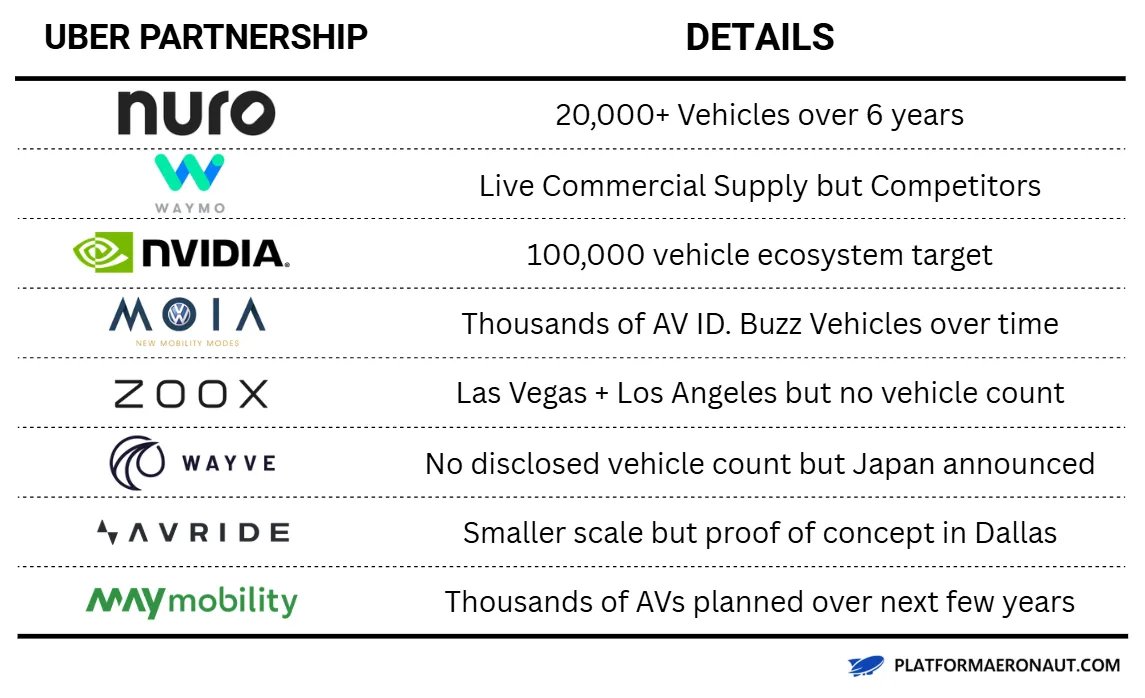
A lot of commentary around AV tends to sloppily bundle “partnerships” together as if they are equal. They are not, some partnerships are real supply, some are geographic options, but Uber increasingly has both.
$UBER
Speed as a competitive edge is not talked about enough. Here is what $UBER has done just in the past couple of months. This is what elite-level execution looks like.
Operating momentum
1/ Delivered solid Q4 results, compounding a global business at 20%+ topline and 30%+ bottom-line growth, largely organically
Strategic M&A / investments
2/ Acquired (announced, not completed) SpotHero in the US
3/ Acquired (announced, not completed) the Turkish delivery business, Getir, consolidating its presence in a large and growing delivery market
4/ Strategic investments in cutting-edge AV players like Avride, Waabi and Wayve
Building the AV operating layer
5/ Launched Uber Autonomous Solutions, a full menu of infrastructure and services needed to run AV fleets at scale.
This work has been underway for years. $UBER is only now pulling back the curtain
Global AV partnerships
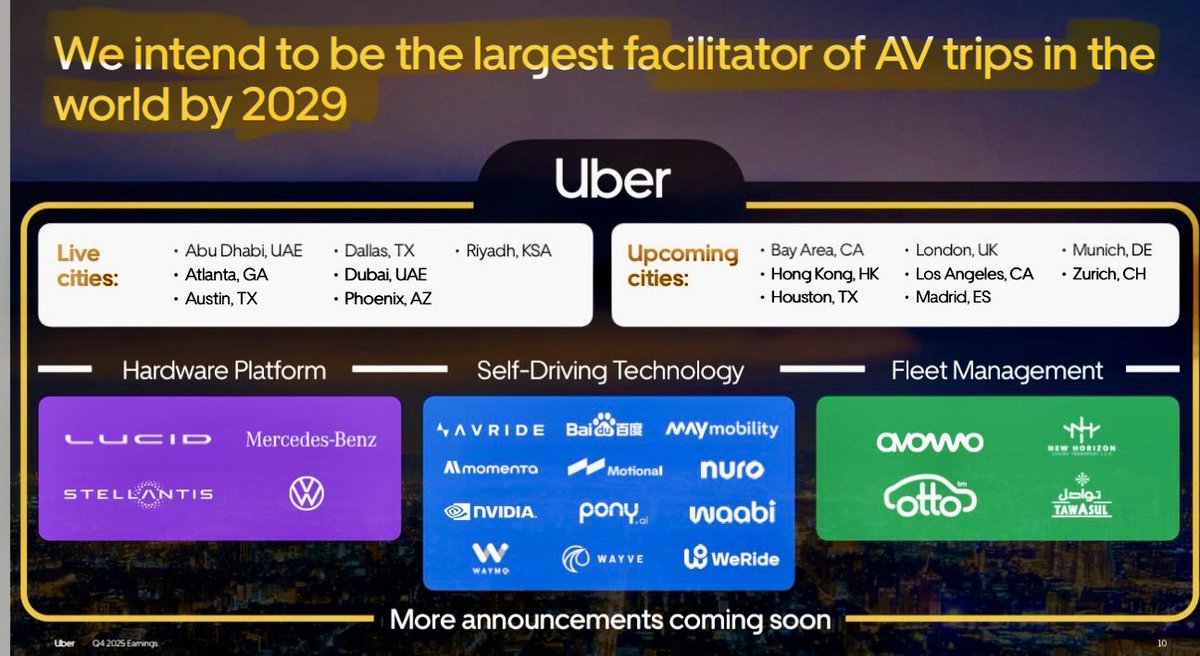
6/ Expanded partnership with WeRide and Baidu to bring robotaxis to the Middle East (Dubai & Abu Dhabi) with further expansion planned - this has been operationalized already.
7/ Commercial alliance with Zoox, effectively shutting down the bear narrative that major AV labs will bypass Uber and distribute purely 1P
8/ Three-way partnership with Wayve and Nissan Motor for robotaxi deployment starting with Tokyo and London
9/ Operationalizing the previously announced partnership with Nuro and Lucid Motors, starting with robotaxis in the Bay Area in April
10/ Robotaxi service launch in Dallas with Avride
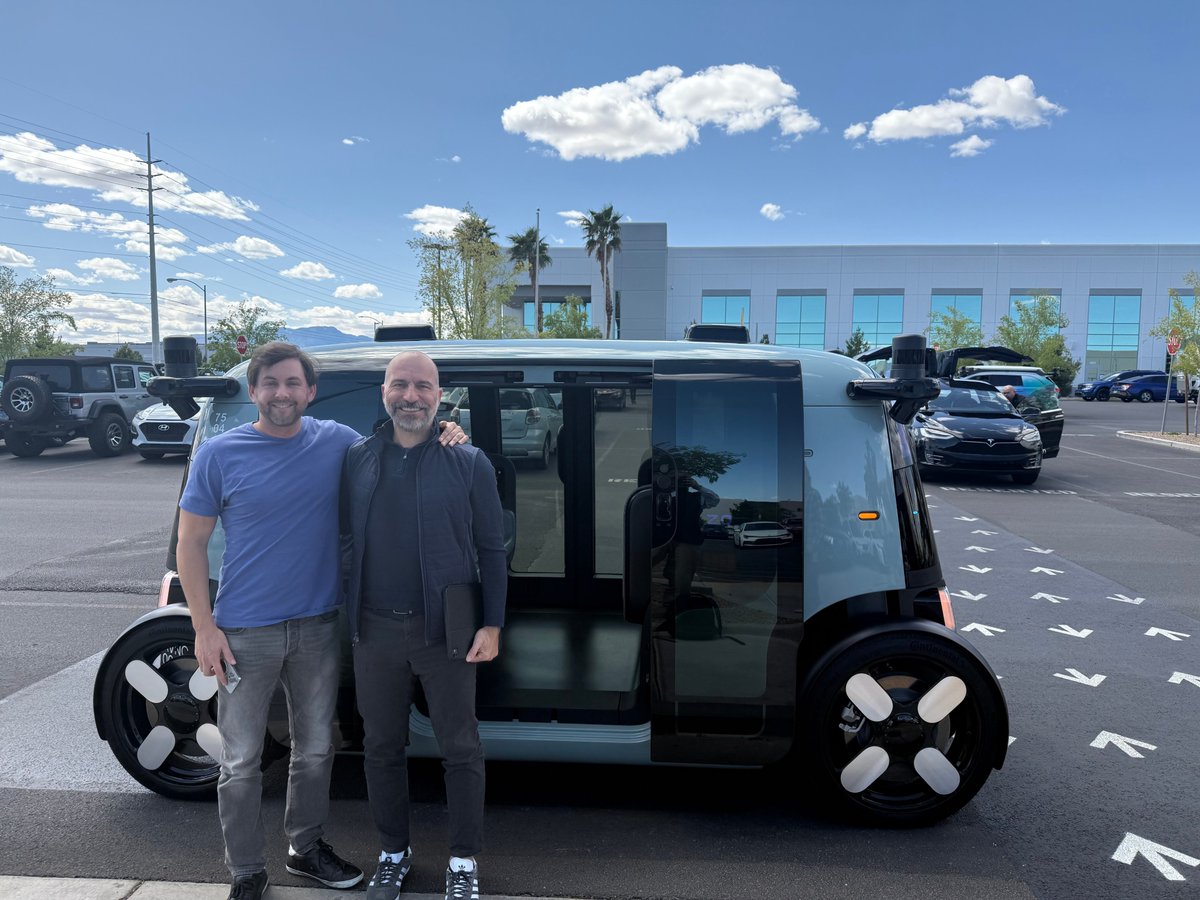
It’s not a car! A few months ago, I took my first ride in a @Zoox robotaxi with co-founder and CTO Jesse Levinson. It was clear from the start that their commitment to safety and purpose-built AV tech would make them an incredible partner for @Uber. Coming to Vegas this summer, LA next year!