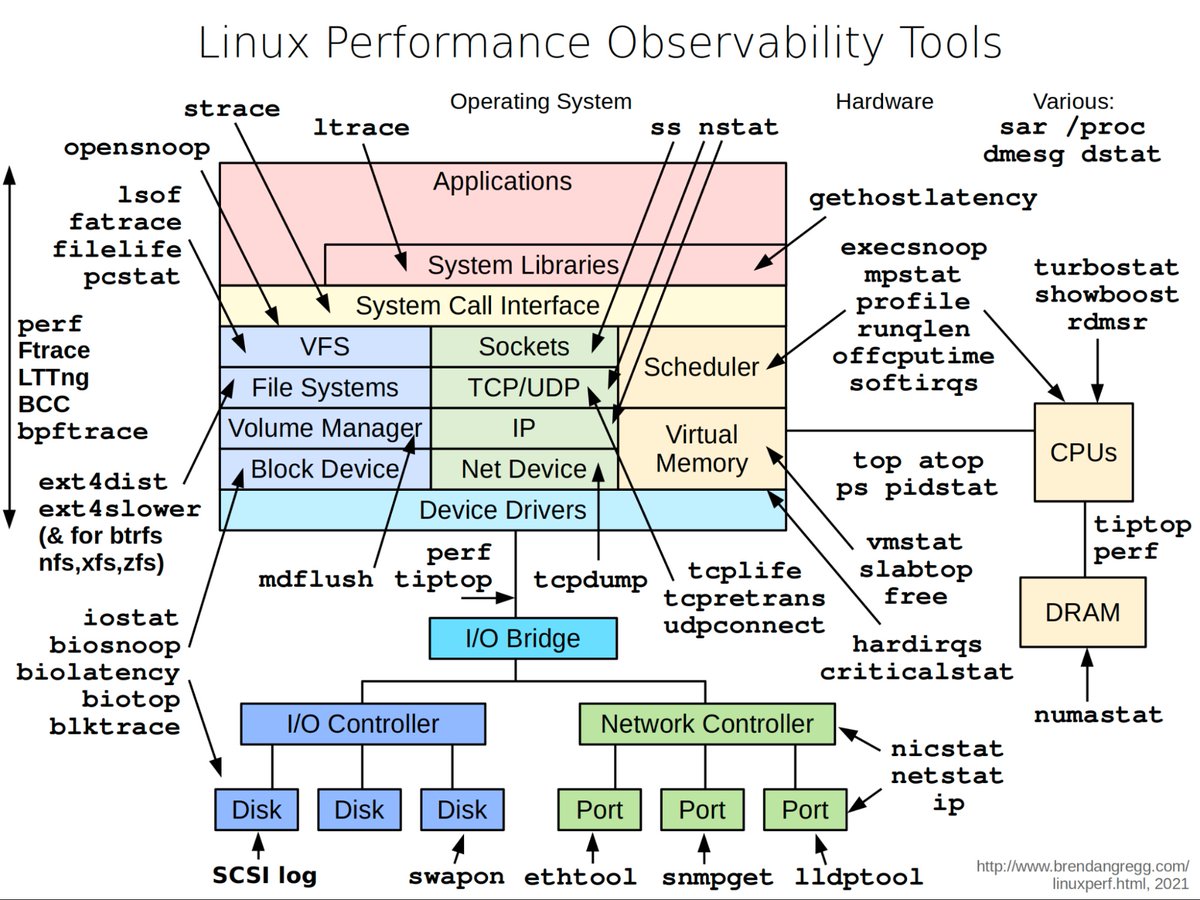
Popular interview question: how to diagnose a mysterious process that’s taking too much CPU, memory, IO, etc?
The diagram below illustrates helpful tools in a Linux system.
🔹‘vmstat’ - reports information about processes, memory, paging, block IO, traps, and CPU activity.
🔹‘iostat’ - reports CPU and input/output statistics of the system.
🔹‘netstat’ - displays statistical data related to IP, TCP, UDP, and ICMP protocols.
🔹‘lsof’ - lists open files of the current system.
🔹‘pidstat’ - monitors the utilization of system resources by all or specified processes, including CPU, memory, device IO, task switching, threads, etc.
Credit: Diagram by Brendan Gregg
--
Subscribe to our weekly newsletter to get a Free System Design PDF (158 pages): https://t.co/eVEdOFSYPY
Linux file system explained.
The Linux file system used to resemble an unorganized town where individuals constructed their houses wherever they pleased. However, in 1994, the Filesystem Hierarchy Standard (FHS) was introduced to bring order to the Linux file system.
By implementing a standard like the FHS, software can ensure a consistent layout across various Linux distributions. Nonetheless, not all Linux distributions strictly adhere to this standard. They often incorporate their own unique elements or cater to specific requirements.
To become proficient in this standard, you can begin by exploring. Utilize commands such as "cd" for navigation and "ls" for listing directory contents. Imagine the file system as a tree, starting from the root (/). With time, it will become second nature to you, transforming you into a skilled Linux administrator.
Have fun exploring!
Over to you: which directory did you use most frequently?
--
Subscribe to our weekly newsletter to get a Free System Design PDF (158 pages): https://t.co/FIzCeaWsZV
⚡️ Excited to share that I am starting an AI+Education company called Eureka Labs.
The announcement:
---
We are Eureka Labs and we are building a new kind of school that is AI native.
How can we approach an ideal experience for learning something new? For example, in the case of physics one could imagine working through very high quality course materials together with Feynman, who is there to guide you every step of the way. Unfortunately, subject matter experts who are deeply passionate, great at teaching, infinitely patient and fluent in all of the world's languages are also very scarce and cannot personally tutor all 8 billion of us on demand.
However, with recent progress in generative AI, this learning experience feels tractable. The teacher still designs the course materials, but they are supported, leveraged and scaled with an AI Teaching Assistant who is optimized to help guide the students through them. This Teacher + AI symbiosis could run an entire curriculum of courses on a common platform. If we are successful, it will be easy for anyone to learn anything, expanding education in both reach (a large number of people learning something) and extent (any one person learning a large amount of subjects, beyond what may be possible today unassisted).
Our first product will be the world's obviously best AI course, LLM101n. This is an undergraduate-level class that guides the student through training their own AI, very similar to a smaller version of the AI Teaching Assistant itself. The course materials will be available online, but we also plan to run both digital and physical cohorts of people going through it together.
Today, we are heads down building LLM101n, but we look forward to a future where AI is a key technology for increasing human potential. What would you like to learn?
---
@EurekaLabsAI is the culmination of my passion in both AI and education over ~2 decades. My interest in education took me from YouTube tutorials on Rubik's cubes to starting CS231n at Stanford, to my more recent Zero-to-Hero AI series. While my work in AI took me from academic research at Stanford to real-world products at Tesla and AGI research at OpenAI. All of my work combining the two so far has only been part-time, as side quests to my "real job", so I am quite excited to dive in and build something great, professionally and full-time.
It's still early days but I wanted to announce the company so that I can build publicly instead of keeping a secret that isn't. Outbound links with a bit more info in the reply!
I just put all my technical threads in one big PDF. It has 75 topics and 158 pages!
Here are some sample topics:
🔹 Why is Redis fast?
🔹 Design Google Maps
🔹 How does HTTPs work?
The PDF Link is in the first post of my newsletter: https://t.co/PczMAd8Jdb
Hope it's helpful.
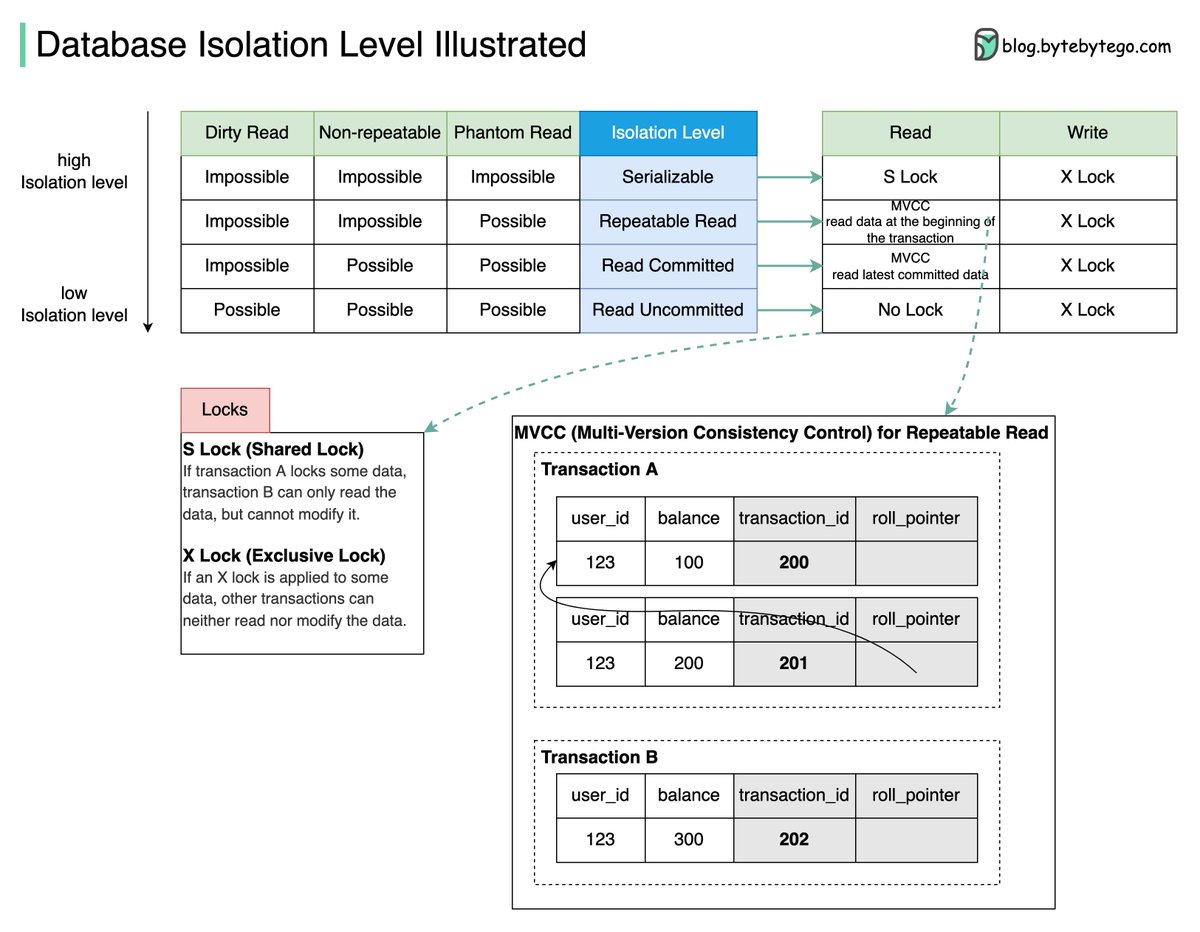
Popular interview question: What are database 𝐢𝐬𝐨𝐥𝐚𝐭𝐢𝐨𝐧 𝐥𝐞𝐯𝐞𝐥𝐬? What are they used for?
Database isolation allows a transaction to execute as if there are no other concurrently running transactions.
The diagram below illustrates four isolation levels.
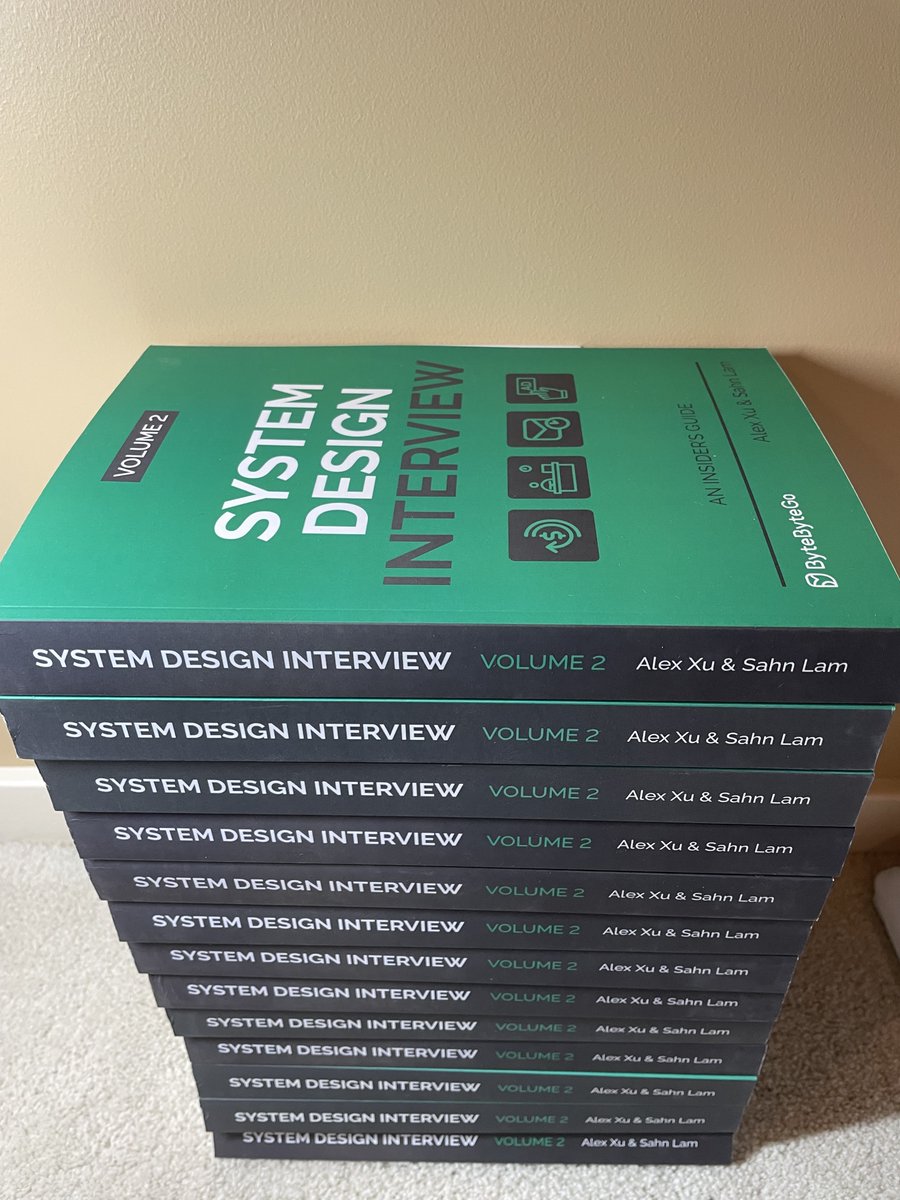
Signed Book GIVEAWAY!
@sahnlam and I will be giving away 10 signed copies of the SDI book (Volume 2).
Shipping is on us. Yes, we do 𝐢𝐧𝐭𝐞𝐫𝐧𝐚𝐭𝐢𝐨𝐧𝐚𝐥 shipping as long as USPS supports it.
𝐅𝐨𝐥𝐥𝐨𝐰 𝐦𝐞 & 𝐑𝐞𝐭𝐰𝐞𝐞𝐭 𝐭𝐨 𝐞𝐧𝐭𝐞𝐫 🤗.