The Dangote Refinery share, which is ₦525 per share now, will reach ₦10,000 per share. Your ₦5 million investment now will become over ₦50 million.
- Aliko Dangote
“Those small investors who want to buy with ₦50,000 or ₦100,000 will get approval first, then the rest will share.
“The share now is ₦525. This share will one day become ₦10,000. So if you buy and it becomes ₦10,000, and you put in ₦5 million, it becomes ₦50 million plus. You have become rich, and there is no need to sell. You don’t have to fear devaluation. You can choose dividend in naira or in dollars.”
- Aliko Dangote, in an interview with Abis Fulani
@MTN180@MTNNG I hv DM as requested, kindly chk & resolve becos am sad at such waste of my data plan & money, I ddnt get value for my money . Hoping for ur soonest resolution. Tnx
@MTNNG, I must admit here, ur network is terrible in Omadino, Delta state. Poor signals, U Sub. & can't use it till it expires.
Poor terrible network .
Cristiano Ronaldo and Georgina Rodriguez married Tuesday in a civil ceremony described by the public relations team that represents the Portuguese soccer star as "a private and intimate moment attended by their five children." https://t.co/1Mnb1y8l6d
BREAKING: A Nigerian-American engineer and Harvard graduate, Yinka Ogunbiyi, has developed HaloBraid, described as the world’s first braid-assist robot designed to ease the physical strain on hairstylists and save time for salons.
The innovation had raised $7m and attracted more than 7,000 salons to its waitlist.
Every year, thousands of people announce that they are starting a company. Social media celebrates entrepreneurs as heroes, venture capital rounds become headlines, unicorns become legends, and successful founders are presented as symbols of freedom, wealth, and influence. The narrative is attractive: identify an idea, build a product, raise money, scale rapidly, ring the bell on a stock exchange, and retire wealthy.
Unfortunately, that is not how entrepreneurship works for most people. Entrepreneurship is not a vacation job. It is one of the most demanding professions in the world, and before anyone decides to enter it, the person must understand one simple reality: building a company is a commitment to solving problems every day for many years!
There will be difficult days. There will be disappointments, uncertainty, rejection, and sacrifice. But when a company genuinely reduces a market friction and consistently creates value for customers, the market can reward it. The entrepreneur’s mission is not merely to launch a business. It is to redesign a market by making a friction disappear.
And if you get it wrong, there will be wahala. Many people venture into entrepreneurship because they dislike their jobs, desire more freedom, or believe owning a business will give them greater control over their time. The reality, however, is very different. Running a company is almost always harder than working for one.
If you remember your Integrated Science classes in junior secondary school, you will recall the concept of optical illusion where what appears to be true is not actually true. Entrepreneurship has its own version of that illusion.
From a distance, owning a business looks like freedom. You become your own boss, set your own schedule, and answer to no one. But look more closely, and the picture changes. Instead of working for an employer, you now work for your customers, your employees, your investors, your suppliers, your regulators, and your mission. The business begins to dictate your priorities, consume your time, and demand your attention.
In other words, you gain the freedom to build a company, only to become accountable to that company and everything it represents. The freedom is real, but so is the responsibility. And for many entrepreneurs, that responsibility is far more demanding than the job they left behind.
In summary, entrepreneurship is not a vacation job. It is one of the hardest jobs in the world. Yet for those who are prepared to endure, learn, build, and serve, it can also be one of the most meaningful. Good luck if you've picked that lane!
To God be all the glory! 🏆
I'm excited to share that I emerged as Nigeria's 2026 JAMB Highest Scorer with an aggregate score of 372/400!
English — 98
Chemistry — 98
Physics — 94
Biology — 82
@DailyEdConsult@JAMBHQ@legitngnews#JAMB2026#UTME2026#TopScorer
I saved for my first car, a secondhand Honda Accord imported from Amsterdam, during NYSC. I earned the money through a business opportunity built on observation.
Those were the days when being “technical” meant assembling computers from scratch. You bought the motherboard, RAM, hard drive, power unit, and installed Windows yourself. That was the engineering side. But the real lesson was not the technology; it was the positioning.
One day, then President Obasanjo announced a major payment package for university lecturers. Early every morning, I would tune to FRCN to listen to Orji Ogbonnaya Orji, then State House Correspondent at the Villa. One morning, he announced that the payments had hit the lecturers’ accounts.
Immediately, I saw a market signal.
That afternoon, I began visiting lecturers at the University of Jos with a simple proposition: “I will help you buy your first family computer.” I knew liquidity had entered the system. Orders started coming in. I traveled to Lagos multiple times, purchased computer parts, assembled the systems myself, and delivered them. It became a thriving business.
Years later, while working in the banking sector, I noticed another pattern. The IT skills that once made professionals special were becoming commoditized. Tasks that once required deep technical expertise were becoming easier, standardized, and widely accessible. I quickly realized the moat was shrinking, and I made the decision to pivot back toward electronics and deeper engineering systems. Looking back, that was one of the best decisions I made because much of that earlier IT market eventually became heavily commoditized.
Today, I see another pattern emerging in Nigeria. And that pattern is this: the Investment and Securities Act (ISA) 2025 will create immense wealth opportunities in Nigeria during the 2030s. I consider that legislation one of the most important economic and business documents Nigeria has produced in decades. It is upon that thesis that the vision for Contisx Securities Exchange Plc was built.
Today, Nigeria’s capital market already accounts for more than 30% of GDP. But the real transformation is ahead. Why? Because ISA 2025 has the potential to move Nigeria from being merely a nation of money into becoming a nation of capital. And nations rise when they operate at the level of capital.
Money stored without productive deployment creates limited prosperity. Capital deployed into enterprises, infrastructure, innovation, housing, sovereign instruments, and businesses creates compounding prosperity.
That is the shift I see coming. If you are looking for business inspiration in Nigeria, read ISA 2025 carefully. Study it. Nigeria’s capital market is evolving. And I believe abundance is ahead.
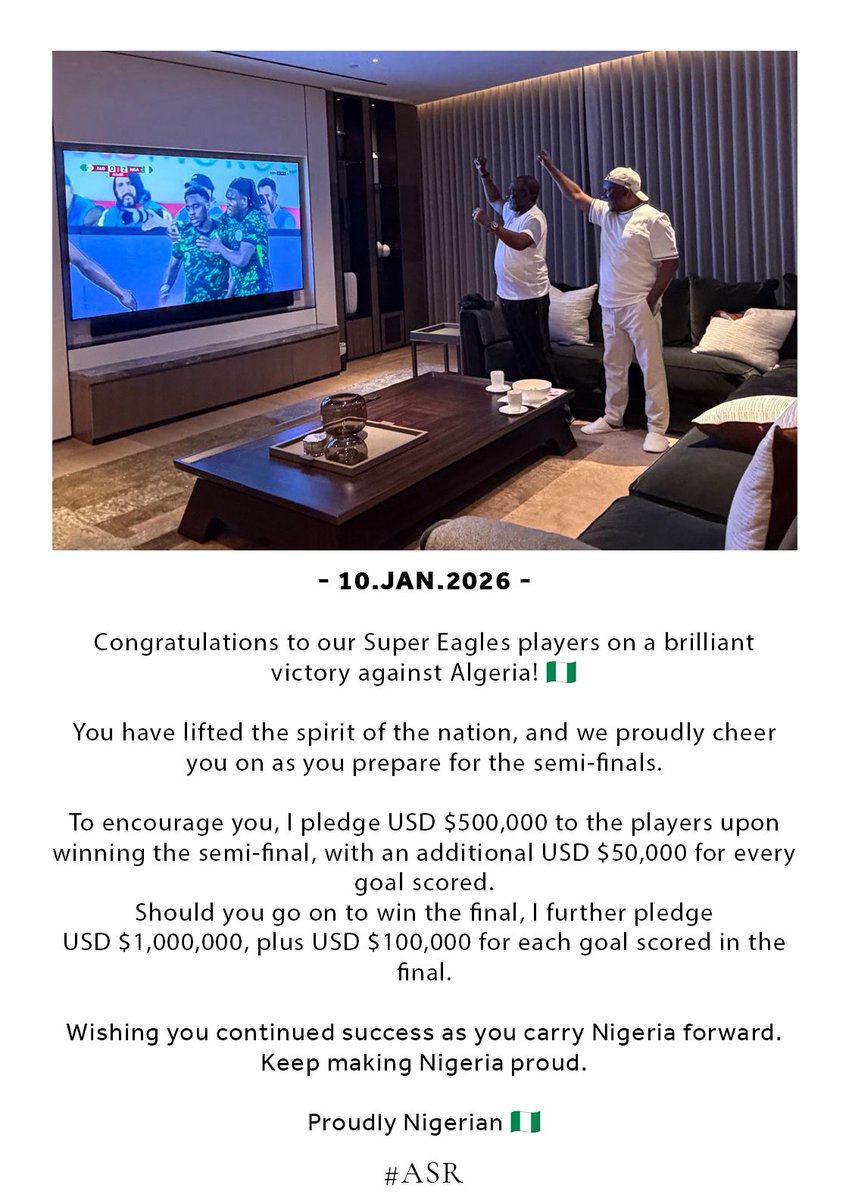
- 10.JAN.2026 -
Congratulations to our Super Eagles players on a brilliant victory against Algeria! 🇳🇬
You have lifted the spirit of the nation, and we proudly cheer you on as you prepare for the semi-finals.
To encourage you, I pledge USD $500,000 to the players upon winning the semi-final, with an additional USD $50,000 for every goal scored.
Should you go on to win the final, I further pledge USD $1,000,000, plus USD $100,000 for each goal scored in the final.
Wishing you continued success as you carry Nigeria forward.
Keep making Nigeria proud.
Proudly Nigerian 🇳🇬
#ASR
This young lady has explained the new Nigerian tax laws in a simple, fluent and easy-to-understand language.
Pls watch and share this video everywhere.