Kashmiri Pandit Sangarsh Samiti is an organization which primarily addresses the concerns of resident Kashmiri Pandits / Hindus who stayed back in the Valley.
"All the Maulvis are asking us to declare cow as National animal
We can't declare that, Cow is our mother hence Mother & son bond needs no declaration."
Are bhai saaf saaf bol na ke "Meri Rajneeti band ho jayegi" agar asia kar diya to.
Peak Hypocrisy!!
हरिद्वार में गंगा करीब ढाई सौ किलोमीटर की दूरी तय करती है उतने में ही यह हाल है
हरिद्वार से आगे गंगा को करीब 2,500 किलोमीटर का सफर तय करना होता है सोचिए क्या स्थिति होती होगी गंगा की
यह स्थिति उस देश की है जो देश नदियों को माँ बोलता है।
क्या आपको पता है धुएँ कि भी जाति होती है 👇
मध्य प्रदेश में एक दलित की चिता जलने से केवल इसलिए रोक दी गई क्योंकि उसका धुआं “ब्राह्मणों के श्मशान” तक चला जाता…
उस पर भी शर्मनाक ये कि पुलिस भी दलित परिवार पर ही दवाब डाल रही है क्यूं की पुलिस प्रशासन खुद जातिवाद से अंदर तक सड़ा हुआ हैं।
शर्म आनी चाहिए ऐसे समाज पर, जहां मौत के बाद भी दलित को सम्मान नहीं मिलता।
ज़िंदा था तब दलित होने नाम पर भेदभाव, नफ़रत, ज़लालत, छुआछूत,
और जब मर गया तो उसकी चिता का धुंआ भी "अछूत" हो गया जो ब्राह्मणों के शमशान तक नहीं पहुंचना चाहिए वरना बेचारे मरे हुए ब्राह्मण भी अशुद्ध हो जाएंगे।
ये सिर्फ भेदभाव नहीं, ये इंसानियत की लाश पर खड़ा ब्राह्मणवाद है।
जिस समाज में मृतक की चिता का धुआं भी जाति देखकर स्वीकार किया जाए, उस समाज को सभ्य कहलाने का कोई अधिकार नहीं।
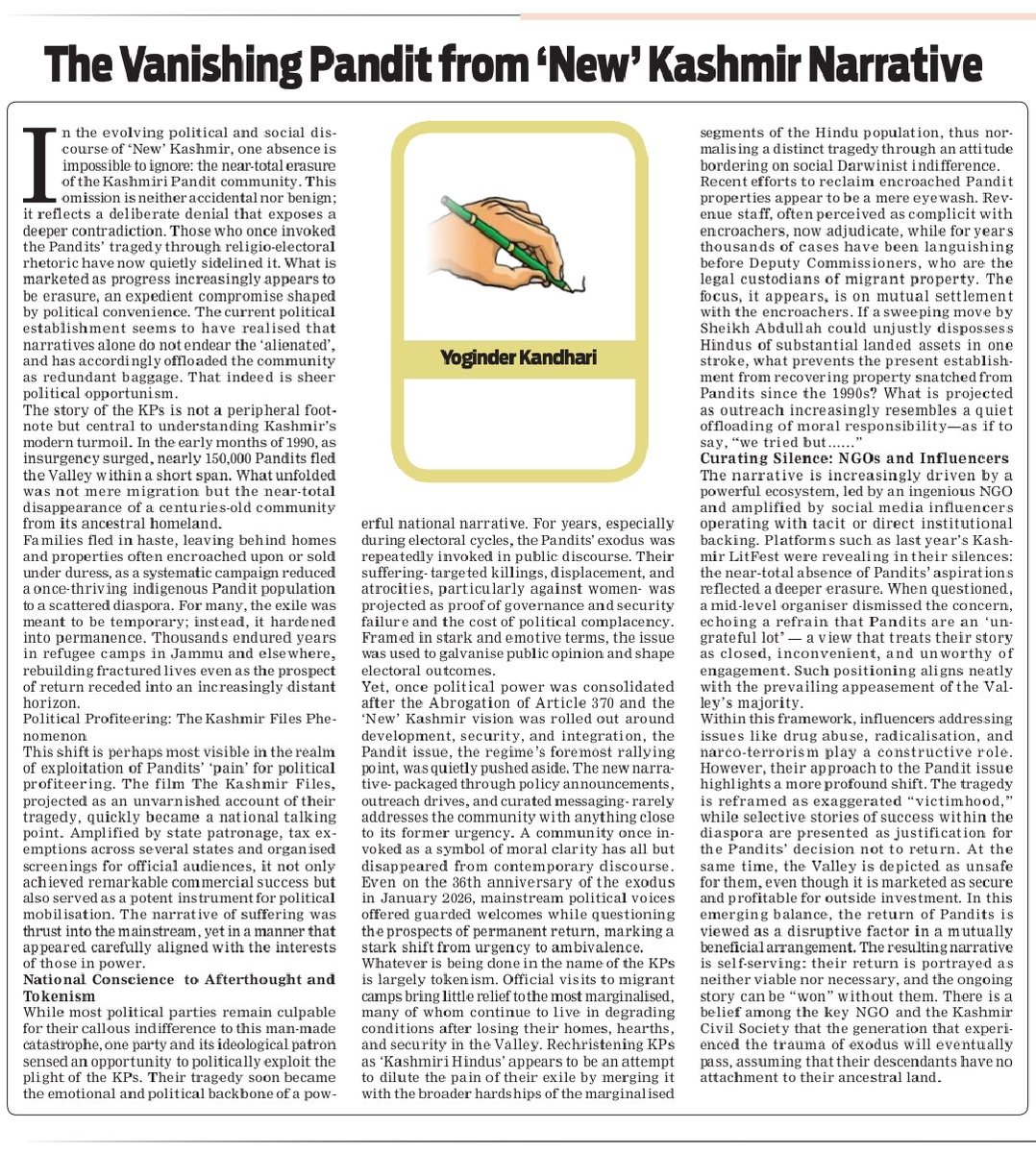
Policy developments already hint at such a transition. The inclusion of economically weaker migrant families within wider national welfare frameworks like the National Food Security Act may appear routine, yet it effectively begins diluting the separate legal and political identity of the displaced. Simultaneously, the Relief Organisation’s social media blitzkrieg projects carefully curated images of satisfaction and gratitude among select beneficiaries. For many, this appears less an effort to resolve suffering than an attempt to manage public perception. Meanwhile, protests demanding equitable implementation of promised relief measures are often met with the administration’s iron lathis.
Speculation is also growing that the next phase may involve a formal call for a “return to roots.” Discussions around reconciliation, cultural outreach, and symbolic return initiatives have become increasingly visible, preparing the ground for a narrative of closure and restored normalcy in the Valley. Such efforts could ultimately culminate in a symbolic resolution advocating return and reconciliation — perhaps in the mould of a “Margdarshan Resolution-2026.”
If this trajectory unfolds, those willing to return may receive incentives and assurances, while those unwilling or unable to do so could gradually lose recognition as migrants altogether. The state would then be positioned to declare the issue resolved — not through justice, restitution, or restored confidence, but through administrative finality and political exhaustion.
In this backdrop, Jagti Township has acquired profound symbolic significance: not merely as a housing colony, but as a visible monument to a painful national failure that unsettles triumphant narratives of complete normalcy and restored harmony. Over time, however, even this enduring scar may gradually be effaced in favour of symbols more compatible with the imagery of a transformed, stable, and confident “New India.”
A Question That Refuses to Disappear
The tragedy of the Kashmiri Pandits was never only about displacement; it was fundamentally about the collapse of trust in institutions, politics, and the state’s promise of equal protection in times of crisis. Over the decades, the displaced Pandit appears to have moved from victimhood to symbolism, and from political utility to gradual marginalisation.
The central question, however, remains unresolved: was the Kashmiri Pandit meant to return as an equal stakeholder in Kashmir, or merely remain a lasting symbol in a wider political narrative? The answer may ultimately lie not in speeches or commemorations, but in the quiet language of policy — in what is slowly diluted, withdrawn, and eventually forgotten.
The next group of tattvas governs human action and interaction with the world. Speech, hands, feet, elimination, and reproduction symbolize the ways consciousness expresses itself outwardly through bodily activity. Closely related are the organs of knowledge through which experience is received: hearing, touch, sight, taste, and smell. These are not merely physical organs but channels through which consciousness experiences manifestation.
The tattvas then move into the deeper psychological structure of individuality. Ahamkara represents ego, the sense of “I” that creates individuality and separation. Buddhi symbolizes intellect and discernment. Prakriti represents primordial nature, the matrix from which material and psychological existence emerges. Purusha symbolizes the individual experiencer who perceives itself as separate from the whole.
One of the most remarkable aspects of Kashmir Shaivism appears in the next five tattvas known as the Kanchukas, or limiting sheaths. These explain how infinite consciousness appears finite without ever truly losing its infinity. Through these limitations, infinite power becomes limited action, omniscience becomes partial knowledge, fullness becomes desire, eternity becomes time, and absolute freedom becomes causality and circumstance. These limitations create the human experience of individuality and separation.
At the threshold between limitation and pure consciousness stands Maya Tattva. In Kashmir Shaivism, Maya does not simply mean illusion. Rather, it is the power through which infinite consciousness voluntarily veils its own totality and experiences multiplicity. Maya creates the perception of separateness between subject and object, self and world. Yet this separation is not imposed from outside. It is a self-contraction of consciousness undertaken for the purpose of experience and divine play.
Beyond Maya begin the pure tattvas, where consciousness increasingly recognizes its own true nature. Shuddhavidya represents balanced awareness of unity and diversity. Ishvara emphasizes the universe as divine expression. Sadashiva represents the luminous awareness of pure being. Above these stands Shakti, the dynamic energy of consciousness itself, and finally Shiva Tattva, the highest principle of absolute, undivided awareness beyond all limitation and distinction.
The image also points toward a mysterious thirty-seventh state beyond the traditional thirty-six tattvas. This supreme reality is known as Anuttara, the Absolute beyond all categories, concepts, and metaphysical structures. Here even the distinction between Shiva and Shakti dissolves into pure ineffable unity. It is the final transcendence beyond language, philosophy, and conceptual thought.
Thus, the entire movement from 1 to 37 represents the complete journey of existence itself. It is the story of how infinite consciousness descends into matter, mind, ego, and individuality, and how the same consciousness may awaken through recognition and rediscover its eternal nature. The tattva system therefore serves not merely as a philosophical explanation of the cosmos, but as a spiritual roadmap guiding the seeker from limitation toward Bhairava realization.
Ultimately, this image stands as one of the most extraordinary visual expressions of metaphysical thought ever created. It unites cosmology, psychology, yoga, tantra, theology, meditation, and nondual philosophy into a single coherent vision. More importantly, it carries a deeply human message. Beneath fear, suffering, limitation, and the endless noise of individuality, there exists an eternal consciousness that is infinite, radiant, indivisible, and free. According to Kashmir Shaivism, that consciousness is Bhairava itself. The final revelation of the tradition is both simple and profound: the seeker and the Absolute were never truly separate.
4/3
Vijay Sas
@highlight
The image before us is not merely a religious illustration, a symbolic drawing, or an artistic expression of ancient spirituality. It is one of the deepest visual representations of consciousness ever conceived within human philosophical thought. The diagram belongs to the profound tradition of Kashmir Shaivism, a spiritual and metaphysical system that emerged from the intellectual and mystical soil of ancient Kashmir. Every line within the image carries meaning. Every figure represents a state of awareness. Every number reflects a stage in the unfolding of existence itself. The image is not simply meant to be observed with ordinary sight; it is meant to be contemplated inwardly, because it attempts to explain the relationship between the human being, the universe, and the Absolute Consciousness that permeates all existence.
At the heart of Kashmir Shaivism lies a revolutionary insight: the entire universe is nothing but the self-expression of Consciousness. Unlike philosophies that divide God from creation or spirit from matter, Kashmir Shaivism teaches that existence itself is divine. The world is not viewed as an illusion to be rejected, nor is the body considered a prison of the soul. Instead, the universe is understood as the living manifestation of an infinite, radiant awareness known as Bhairava. Everything that exists, from stars and mountains to thoughts and emotions, is an expression of the same eternal consciousness. Human beings are therefore not separate from the divine. They are manifestations of the same infinite awareness, temporarily forgetting their own true nature under the veil of limitation and individuality.
The upper section of the image presents three supreme dimensions of reality: Para, Parapara, and Apara. These are not separate gods in the ordinary mythological sense. Rather, they represent different states or modes of consciousness. Para is the highest and most transcendental state. It symbolizes pure, undivided awareness beyond time, form, thought, and distinction. It is the infinite stillness from which all existence emerges. In Kashmir Shaivism, this state is identified with Bhairava, the supreme consciousness that is limitless, eternal, and self-luminous. Nothing exists outside this reality because it is the very essence of all existence.
Parapara represents the intermediate state between transcendence and manifestation. It is the mysterious threshold where infinite consciousness becomes aware of its own creative potential. Here, consciousness still remains unified, yet within it arises the subtle vibration that eventually unfolds as the universe. This vibration is known as Spanda, one of the central concepts of Kashmir Shaivism. Spanda does not mean physical movement alone; it refers to the living pulsation of consciousness itself. The universe is therefore not created mechanically, like a machine producing objects, but emerges through the joyful vibration of consciousness expressing itself.
Apara represents the manifested world of multiplicity and individuality. Here consciousness appears fragmented into countless forms, beings, minds, and material realities. Yet Kashmir Shaivism insists that this apparent fragmentation is never an actual separation from the Absolute. Just as waves rise upon the surface of the ocean without ever becoming separate from the water, all beings arise within consciousness without ever leaving it. The divine is therefore not distant from the world. The world itself is divine manifestation. This insight gives Kashmir Shaivism its profoundly life-affirming character. Nature, the body, emotions, relationships, and worldly existence are not obstacles to spirituality; they are expressions of the same sacred consciousness.
4//
The feminine forms depicted in the image hold extraordinary importance. In Kashmir Shaivism, Shakti is inseparable from Shiva. Shiva represents pure consciousness, while Shakti represents the dynamic power through which consciousness manifests itself as creation. Without Shakti, consciousness would remain inactive and unexpressed. This understanding gave rise to the ancient Shaiva insight that Shiva without Shakti becomes Shava, meaning a lifeless corpse. Shakti is therefore not merely a goddess in symbolic form; she is the living energy of existence itself. She is movement, creativity, vibration, manifestation, and bliss. Through Shakti, the infinite becomes the universe.
Descending downward from these higher states are flowing currents resembling streams of energy. These lines symbolize the descent of consciousness into embodied existence. They also represent the subtle pathways through which spiritual awakening occurs within the human body. In yogic understanding, the body is not merely a biological structure of flesh and bones. It is a sacred field containing the entire architecture of the cosmos. The meditating figure seated below symbolizes the human being as a microcosm of the universe itself. Within the human body exists the same consciousness that pervades all existence.
The vertical channel running through the center of the body symbolizes the Sushumna Nadi, the central pathway of spiritual ascent. Through this subtle channel, consciousness rises from contracted individuality toward expanded awareness and realization. The seated posture of meditation signifies stillness, discipline, inward awareness, and recognition of one’s true nature. In Kashmir Shaivism, liberation is not achieved by escaping the world or rejecting the body. Rather, liberation is attained through awakening within embodied existence itself. The body becomes a temple of realization, and life itself becomes a field of spiritual recognition.
One of the most mysterious aspects of the image is the reclining corpse-like figure positioned above the yogi’s head, identified as Mahapreta. This figure carries immense philosophical significance. It symbolizes the dissolution of ego and the death of false identification. In tantric symbolism, the corpse represents the ending of the illusion that one is merely a limited individual. Yet this “death” is not destruction or annihilation. It is the awakening into one’s true nature as infinite consciousness. Spiritual realization in Kashmir Shaivism is therefore not the acquisition of something new; it is the recognition of what has always existed within.
The image also incorporates the profound system of the thirty-six tattvas. The word “tattva” means the essential principle or fundamental reality underlying existence. These tattvas are among the most refined metaphysical concepts ever developed in human thought. They describe the stages through which infinite consciousness gradually contracts itself into individuality, mind, senses, and matter. At the same time, they also represent the reverse spiritual journey through which the individual ascends back toward recognition of the Absolute.
The lower tattvas represent the gross physical elements that constitute material existence. Earth symbolizes solidity and structure. Water represents fluidity and emotional flow. Fire signifies transformation, energy, and illumination. Air represents movement and life-force. Ether symbolizes space and vibration. Together these five elements form the visible universe and the human body itself.
Beyond these gross elements arise the subtle sensory principles known as the Tanmatras. These include the subtle potentials behind smell, taste, sight, touch, and sound. In Kashmir Shaivism, sound possesses immense importance because existence itself is understood as vibration emerging from consciousness. The mind, represented as Manas, coordinates these sensory experiences and creates ordinary mental perception.
4/2