Princeton ECE Prof, Codirects Princeton NextG. Research on semiconductor chips for computing, wireless and health. Involved in a start-up. Commentary views mine
Excited to share my latest IEEE Spectrum article on AI and the future of chip design.
AI won't transform every engineering discipline in the same way.
Building an RF chip is not like designing a car. Different physics. Different data. Different constraints. Different notions of what makes a "good" design.
The question isn't whether AI can replace engineers. It's whether it can discover designs that engineers would never have found—and do so at the scale that modern chips demand.
That's the challenge we're working on.
Read more: https://t.co/v8vOXaHCxW
#AI #Semiconductors #RFIC #ChipDesign
Extraordinary claims require extraordinary proofs. Pretty much well accepted axiom in society. Unless it’s politics or AI. Some of the claims in solving unsolved math problems are pure nonsense
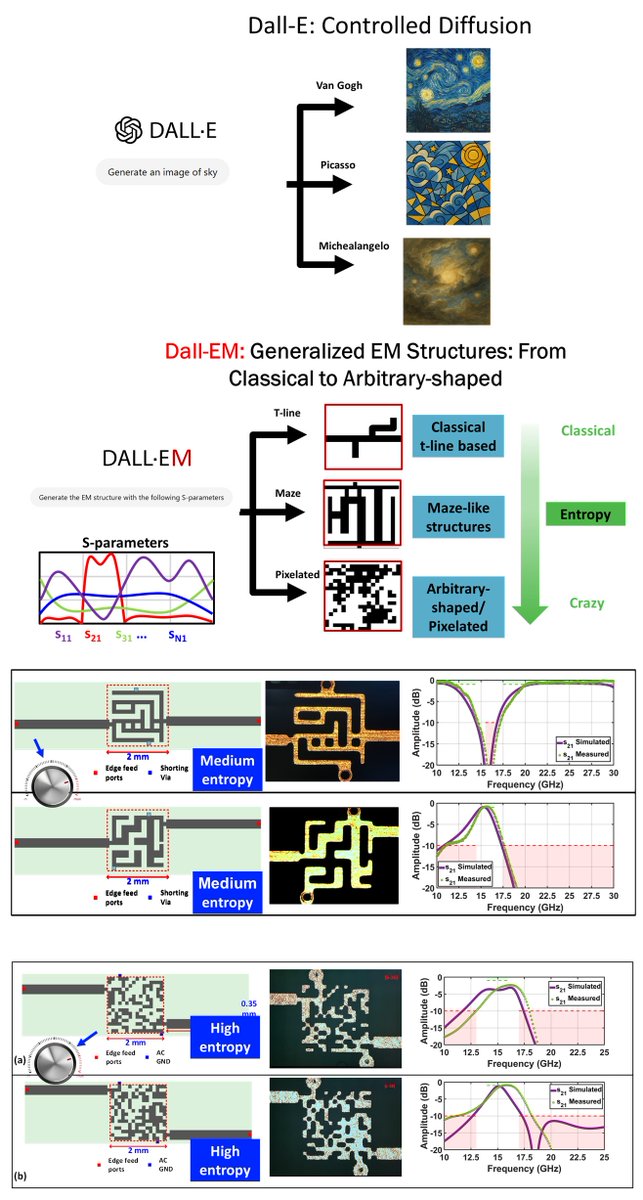
This paper has garnered quite a bit of interest in the community. We call this Dall-EM: Diffusion model to synthesize RF with designer scattering parameters.
This picture should explain. We do controlled synthesis of RF design varying from classical to maze (weird looped t-lines) to completely arbitrary looking as desired.
Synthesis time ~ 1 minute.
Generative AI meets RF circuit design = game changer
• Passive networks tailored by diffusion models.
• Specify stop-band/pass-band; AI does the rest.
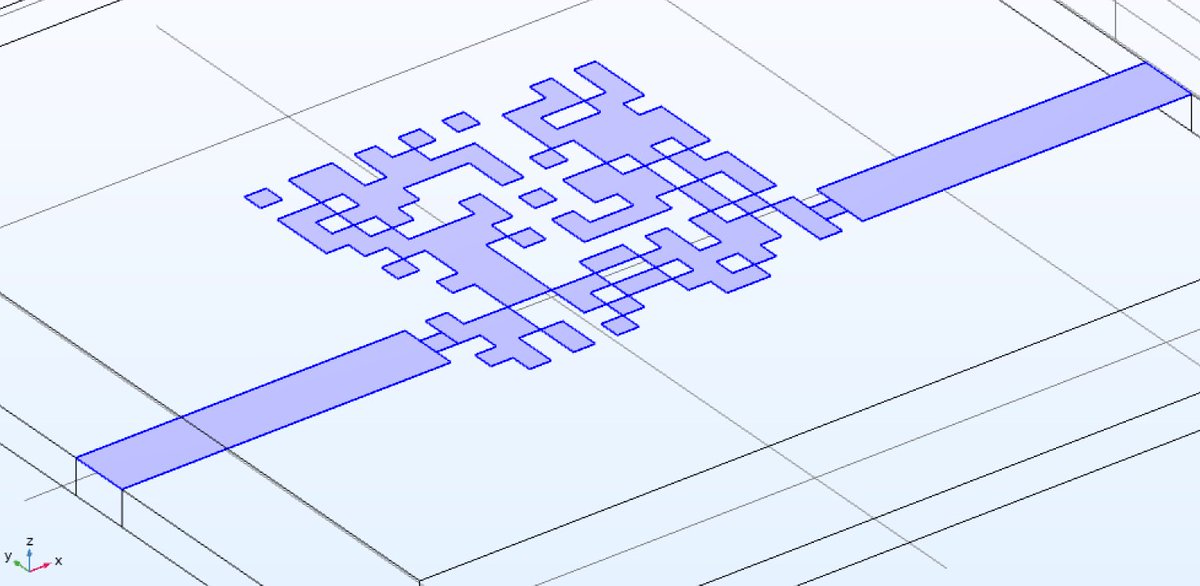
• Pixel patterns are not intuitive to electrical response.
Designs getting more abstract.
Prepare for a cognitive shift.
@jwt0625 Thanks @jwt0625 for verifying this. I lead this research group (and just joined twitter). Not surprised that they work--they can be super robust. Here is a non-intuitive RFIC paper that may be of interest: https://t.co/E1MKgBs3Ck
Using GPUs and deep learning to:
"design an inverse-broadband mm-Wave amplifier chip with 3-port unequal phase divider and combiner for optimal frequency extension."
"The inverse design methodology, produces the designs in minutes."
Jan 5, 2025
As everyone knows, EM simulations, can either be achieved through heuristic algorithms such as genetic algorithms (GA), simulated annealing or generative AI tools such as auto-encoders or tandem neural networks.
https://t.co/bammIUgc1P