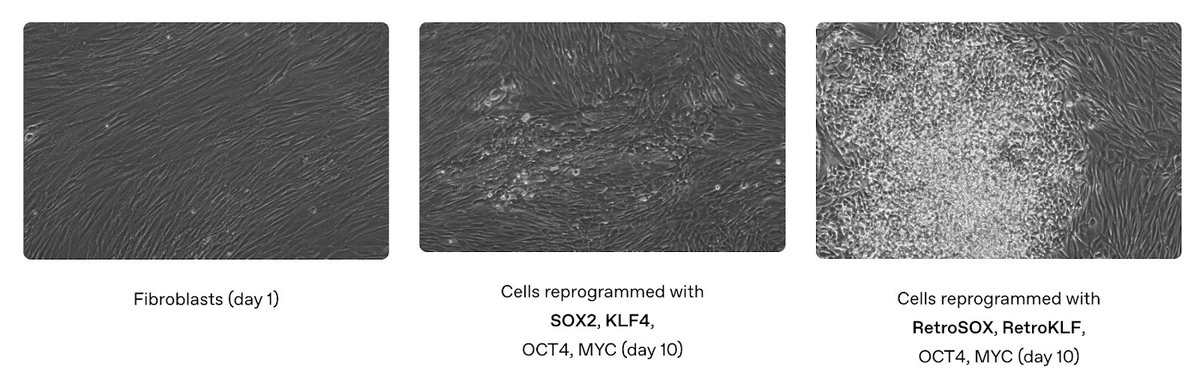
At @OpenAI, we believe that AI can accelerate science and drug discovery. An exciting example is our work with @RetroBiosciences, where a custom model designed improved variants of the Nobel-prize winning Yamanaka proteins. Today we published a closer look at the breakthrough. ⬇️
My home Wi-Fi kept dying every night at 1:07 a.m. sharp. Phones, laptops, even the lights went offline for exactly 90 seconds, then everything popped back.
Cause? My smart LED strip (ESP8266-based) shipped with a sketchy firmware that starts flooding the network with mDNS multicast packets right after its internal uptime hits 86 400 seconds (24 h).
The router’s CPU maxes out processing ~40 000 packets-per-second, temporarily kicking every device to “Wi-Fi association state” until the strip reboots itself and the storm ends.
Why 1:07 AM? Well, I plugged it in at time. lol
We just unveiled Grok 4, the world’s smartest artificial intelligence. 🧵
Grok 4 outperforms all other models on the ARC-AGI benchmark, scoring 15.9% - nearly double that of the next best model - and establishing itself as the most intelligent AI to date.
The race toward AGI is speeding up, with prediction of superintelligent AI as soon as 2026. That kind of shift goes far beyond tech. It's already raising big questions about how we live, work, and prepare for what's coming. With AI evolving so quickly, it’s hard to picture what your own future will look like, it's like the ground keeps moving under our feet.
We haven’t seen a single “general” model dominate yet. Instead, the space is filled with specialized models. Some are built for tool use and agentic tasks, while others are optimized for fast, cost-effective long context handling, and the rest aim for more general capabilities. This kind of specialization could actually be the best path forward, especially if general models evolve to become more creative and nuanced in how they work their operations.
As a general answer machine, I wonder if Deep Research LLMs are better than the main methods of getting answers for most people: Googling, crowdsourcing (posting here/Reddit, etc.), asking friends
I think if you have access to an expert, that is still the way to go, otherwise...
There’s a growing focus on scaling computing for reinforcement learning, but when it comes to inference-time computing, the actual moment models generate output, and efficiency is still a major challenge. Despite progress in training scale, making inference both powerful and cost-effective remains an open problem that the industry has yet to solve.
Coding remains one of the key AI use cases alongside math automation. While many labs explore unsupervised or asynchronous workflows, the current hype around “vibe coding” feels risky and may be off track. There’s still a lot to prove before leaning too hard in that direction.