Ukraine has discovered a new economic sector: the anti-corruption industry.
It has its own investigators, prosecutors, specialised courts, private foundations, NGOs, investigative media outlets, international consultants, donor-funded projects, conferences, annual reports and, of course, an impressive collection of acronyms.
NABU. SAPO. HACC.
And this industry is hardly a start-up anymore.
Ukraine’s specialised anti-corruption infrastructure has been developing for 11 years. NABU and SAPO were established in 2015, while the High Anti-Corruption Court began operating in 2019.
Eleven years is a respectable age. Long enough to move beyond start-up presentations and begin asking serious questions about performance.
As a former central banker, I have a professional weakness for performance indicators.
According to NABU’s own figures, in the first half of 2026:
360 new investigations.
107 individuals notified of suspicion.
76 people convicted under judgments that entered into force.
UAH 2.06 billion in reported economic impact.
These are real results. But after 11 years, an obvious economic question arises:
What is the return on investment in Ukraine’s anti-corruption infrastructure?
And then there is another interesting financial innovation: private charitable foundations as beneficiaries of criminal plea agreements.
In one reported case, the agreement provided for:
UAH 400 million to Come Back Alive.
UAH 100 million to the Sternenko Community Foundation.
UAH 600 million to the state budget, payable over 2.5 years.
The funds are intended to support Ukraine’s Armed Forces. That is an important objective.
But the financial arrangement raises legitimate questions.
Why are private foundations selected as beneficiaries of criminal settlements? Who determines the recipients? Who independently audits the use of these funds? And why is compensation to the state spread over several years?
In banking, we distinguish between gross revenue and net profit, between loans issued and loans actually repaid.
Perhaps anti-corruption statistics deserve the same discipline.
How much public money was actually recovered? How much corruption was prevented? What did the institutions cost taxpayers and international donors over those 11 years?
Opening investigations is an activity. Recovering stolen assets is an outcome. Preventing corruption in the first place is an even better outcome.
Otherwise, we risk creating the world’s first industry whose long-term business model depends on the continued existence of the problem it was established to eliminate.
And unlike most industries, it can always explain disappointing results by requesting a larger budget.
Eleven years in business. Perhaps it’s time for an independent performance audit — including the money flowing through private foundations.
#Ukraine #NABU #SAPO #HACC #Governance #Donornomics
Central Asia Is Growing Faster Than Much of Europe. The Next Test Is Productivity.
The World Bank estimates that Central Asia’s economy will expand by 5.8% in 2026, making it the fastest-growing subregion in its Europe and Central Asia outlook.
Growth is projected at 9.6% in the Kyrgyz Republic and 7.9% in Uzbekistan.
These are impressive figures, but growth rates alone do not establish whether an economy is becoming more productive.
The composition of investment, quality of institutions, depth of domestic capital markets and ability of firms to move into higher-value activities are equally important.
Rapid expansion can be supported by consumption, public investment and external inflows. Sustaining it requires improvements in productive capacity.
For Central Asian economies, the opportunity is to translate current momentum into a more diversified and competitive private sector.
The long-term measure of success will not simply be GDP growth, but how much sustainable income and productive employment that growth creates.
#CentralAsia #EconomicGrowth #Productivity
The World Bank Is Mobilising More Private Capital. The Composition Matters.
The World Bank Group reports that it mobilised $112 billion in private capital in FY2026, compared with $35 billion in FY2022.
That is more than a threefold increase.
The figures illustrate a fundamental change in how development finance institutions are approaching their role.
Rather than relying exclusively on their own balance sheets, they are increasingly seeking to attract private investors into projects that might otherwise struggle to obtain financing.
But mobilised private capital should not be confused with the World Bank’s own lending or with government budget revenues.
The more difficult question is whether this approach can consistently bring investment into countries and sectors with the greatest financing gaps.
The World Bank reports that private capital mobilisation in low-income countries remained around $3 billion.
Scaling capital mobilisation is important. Extending it to markets where risks are hardest to allocate may be the more consequential achievement.
#DevelopmentFinance #PrivateCapital #Investment
The Digital Euro Is Not Intended to Replace Cash. That Distinction Matters.
Speaking to the European Parliament on November 10, ECB Executive Board member Piero Cipollone addressed the future of cash and the proposed digital euro.
The central question is not whether Europe needs another payment application.
It is whether central bank money should remain directly accessible to the public in an increasingly digital economy.
Cash provides a public form of money that does not depend on a commercial bank’s balance sheet. A digital euro would seek to preserve that monetary characteristic in electronic payments, while operating alongside existing private payment solutions.
The design raises difficult questions about privacy, financial inclusion, operational resilience and the relationship between central bank money and commercial bank deposits.
These are monetary architecture questions, not simply technology questions.
The digital euro should ultimately be judged by whether it strengthens the European payment system without unnecessarily disrupting financial intermediation.
#DigitalEuro #ECB #Payments
61,000 Fewer Ukrainians Under EU Temporary Protection. But Did They Leave Europe?
Eurostat reports that the number of people who fled Ukraine and held temporary protection status in the EU fell by 61,055 in September 2026, to 4.37 million.
Poland recorded a decline of 80,850 beneficiaries, while Czechia registered a decrease of 6,640.
Yet the number increased in the other 25 EU member states.
The distinction is important.
Eurostat explains that the Polish decline largely reflects administrative changes, including transitions to standard residence permits and the removal of inactive records.
A reduction in temporary protection registrations therefore cannot be interpreted directly as an equivalent number of people returning to Ukraine.
For economists, this raises a broader question about measuring the long-term integration of displaced Ukrainians into European economies.
Temporary protection statistics tell us about legal status. They do not fully describe employment, tax contributions, household formation or economic participation.
As displaced Ukrainians move into more conventional residence arrangements, our statistical framework for understanding their economic contribution must evolve as well.
#Eurostat #UkrainianRefugees #EuropeanEconomy
Ukraine’s Inflation Is Accelerating. The Underlying Numbers Deserve Attention.
Ukraine’s annual consumer inflation reached 11.0% in October 2026, up from 10.0% in September, according to the State Statistics Service.
Consumer prices rose 1.8% in October alone, following a 2.1% increase in September.
More importantly, core inflation reached 9.7% year-on-year, with core prices rising 1.4% during October.
These figures suggest that inflationary pressure extends beyond the most volatile components of the consumer basket.
Energy costs, supply constraints and exchange-rate developments may all influence price dynamics. But identifying their individual contributions requires more than observing headline inflation.
For the National Bank of Ukraine, the challenge is particularly complex. Monetary policy must contain persistent inflation expectations while operating in an economy facing wartime supply disruptions and substantial dependence on external financing.
The distinction between temporary relative-price adjustments and broader inflation persistence is critical.
The key question is no longer simply why prices are rising, but how much of that pressure is becoming embedded in the economy.
#UkraineEconomy #Inflation #MonetaryPolicy
On This Day in 1494, Accounting Changed Forever.
On November 10, 1494, a Franciscan friar and mathematician, Luca Pacioli, published his Summa de arithmetica in Venice.
Among its pages was a systematic explanation of double-entry bookkeeping: debits and credits, assets and liabilities, every transaction recorded on both sides.
Pacioli did not invent double-entry bookkeeping. Italian merchants had been using it for generations. His achievement was to describe and codify the method, making it accessible to a much wider audience.
As a former central banker, I find the significance of this development difficult to overstate.
Modern banking, corporate finance, financial reporting and prudential supervision all depend, in one way or another, on the discipline of reliable accounting.
Five centuries later, we have digital ledgers, real-time payments and increasingly sophisticated financial instruments. Yet the underlying principle remains remarkably familiar.
Every transaction has two sides. And every financial claim must ultimately be accounted for.
A fitting story for International Accounting Day.
#AccountingHistory #Banking #FinancialHistory
The Federal Reserve Is Looking More Closely at Private Credit
The Federal Reserve Banks of New York and Dallas have opened a pilot survey of the private credit market.
The significance lies in what supervisors are trying to understand.
A growing share of corporate financing now takes place outside traditional bank lending. That can broaden access to capital and diversify the sources of credit.
But it also means that conventional banking statistics capture only part of the financing environment.
Better information about private credit can help policymakers assess lending conditions, borrower behaviour and connections between banks and nonbank lenders.
The issue is not whether private credit is inherently safer or riskier than bank lending.
It is whether policymakers have a sufficiently complete picture of credit creation across the financial system.
When financial intermediation changes its institutional form, economic measurement must change with it.
#PrivateCredit #FederalReserve #CreditMarkets
Inflation Expectations Are Not the Same as Inflation
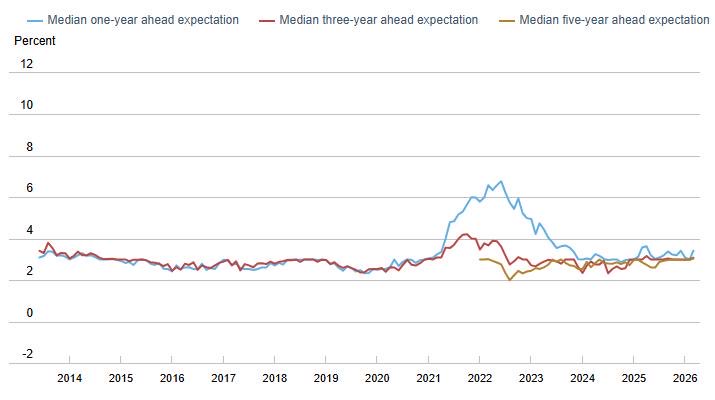
The New York Fed’s latest Survey of Consumer Expectations reports broadly stable inflation expectations, alongside mixed signals from households about the labour market.
For monetary policy, that combination deserves attention.
Actual inflation measures the change in prices. Inflation expectations influence how households negotiate wages, make purchases and assess their future purchasing power.
A central bank may face a difficult environment when inflation remains elevated but confidence in employment prospects weakens.
In that situation, the transmission of monetary policy becomes less predictable.
The key question is not simply whether expectations are rising or falling.
It is whether households continue to regard the inflation shock as temporary — and whether that belief is reflected in their economic decisions.
Anchored expectations are a valuable monetary-policy asset. They should never be taken for granted.
#FederalReserve #InflationExpectations #MonetaryPolicy
Ukraine’s parliament today backed the SEPA alignment bill in its first reading. A step toward faster, cheaper euro transfers—but not SEPA membership yet. The real challenge is implementing EU-standard AML, ownership transparency and financial oversight.
#Ukraine#SEPA#Banking
Who Is Really Providing Your Banking Service?
A customer opens a financial app, receives a payment card and sees the familiar branding of a retailer or technology company.
But the actual banking or payment service may be provided by an entirely different institution.
The European Banking Authority has issued new consumer guidance on these so-called white-labelled financial products.
The issue goes beyond branding.
Customers need to know who holds their funds, which institution is responsible for the service, what protections apply and where to turn if something goes wrong.
Embedded finance is changing how financial services reach consumers. Distribution and regulated financial intermediation are increasingly separated.
That can improve competition and convenience. But it also makes transparency about responsibility more important.
In financial services, the brand on the screen is not always the institution carrying the risk.
#EmbeddedFinance #Fintech #ConsumerProtection
Austria’s Next Financial Stability Test
Tomorrow, the Oesterreichische Nationalbank is scheduled to present its latest Financial Stability Report.
For Austria, several questions deserve particular attention.
How resilient are banks to a prolonged period of elevated financing costs? What is happening to commercial real estate exposures? Are corporate credit risks becoming more concentrated? And how are developments in Central and Eastern Europe affecting Austrian banking groups?
These questions matter because Austria’s financial system is closely connected to the wider European economy.
A bank’s capital ratio is essential, but it is only one indicator of resilience.
Asset quality, funding stability, profitability and the geographical distribution of exposures all influence the capacity to absorb shocks.
The most useful financial stability reports do not simply describe the banking system as it stands today.
They identify where tomorrow’s vulnerabilities may be accumulating.
#Austria #BankingSector #FinancialStability
Europe Is Cutting Bank Stress-Test Reporting by More Than Half
The European Banking Authority has announced a 55% reduction in the data points requested for its 2027 EU-wide stress test.
That is a substantial change in the supervisory process.
The objective is to reduce reporting costs while maintaining the comparability and risk sensitivity of the results. The exercise will also introduce a dedicated climate-risk module for the first time.
There is an important distinction here.
More supervisory data does not automatically mean better supervision. What matters is whether the information allows regulators to identify vulnerabilities, compare institutions and act before risks become systemic.
Reducing redundant reporting can free resources for better risk analysis.
But simplification must not become a reduction in supervisory visibility.
The real test of this reform will be whether European supervisors can obtain better decisions from fewer data points.
#EuropeanBanking #StressTesting #BankRegulation
Japan’s Monetary Policy Has a New Complication: The Stock Market
The Bank of Japan is trying to normalize interest rates while financial markets are questioning the valuations of AI-related companies.
The difficulty is not simply that equity prices are falling.
A prolonged market correction can affect household wealth, corporate investment and confidence — precisely when the central bank is assessing whether financial conditions remain sufficiently accommodative to justify another rate increase.
Japan presents an interesting monetary-policy dilemma. Low real borrowing costs and expanding bank credit can coexist with tightening financial conditions through asset prices.
The BOJ must distinguish between a correction in market valuations and a deterioration in the broader transmission of monetary policy.
Raising rates too slowly risks allowing inflation pressures to persist. Moving too quickly could amplify an adjustment already underway in financial markets.
For central bankers, the lesson is familiar: the policy rate is only one component of financial conditions.
#BankOfJapan #MonetaryPolicy #FinancialMarkets
The Most Important Changes in Bond Markets Are Sometimes Almost Invisible.
The US Securities and Exchange Commission has granted exemptions from certain Treasury-clearing requirements for specified inter-affiliate and non-US repurchase transactions.
This is a technical adjustment with significant implications for how the world’s largest government bond market operates.
Central clearing can reduce bilateral counterparty exposures, improve risk management and increase transparency.
But its implementation also changes collateral requirements, funding costs and the allocation of liquidity across financial institutions.
Applying the same framework indiscriminately to every transaction may create operational costs without delivering equivalent reductions in systemic risk.
The challenge for regulators is to strengthen the resilience of the Treasury market without unnecessarily impairing its capacity to intermediate liquidity.
In financial markets, good regulation is not simply about reducing risk at the level of an individual transaction. It is about understanding where that risk moves across the system.
#USTreasuries #RepoMarkets #FinancialRegulation
A €1 Billion Bond Transaction May Tell Us More About the Future of Finance Than Another Cryptocurrency Rally.
The European Central Bank has confirmed that its Pontes infrastructure successfully settled a €1 billion benchmark bond transaction issued on distributed ledger technology by the European Stability Mechanism.
The important development is not simply that the securities were tokenised.
It is that settlement took place in central bank money.
For institutional markets, this distinction is fundamental. The efficiency gains promised by tokenisation are considerably more valuable when the settlement asset does not introduce additional private credit risk.
The Eurosystem’s earlier exploratory programme involved 64 participants, more than 50 trials and almost €1.6 billion in settlement using central bank money.
Pontes now moves that experimentation into live market activity.
The challenge ahead is interoperability: ensuring that digital securities, collateral and liquidity can move across platforms without creating another generation of fragmented market infrastructure.
The future of capital markets will be determined less by the technology used to record ownership than by the legal and financial certainty of settlement.
#CapitalMarkets #Tokenisation #ECB
More Banking Data Does Not Automatically Mean Better Banking Supervision.
On November 6, the European Banking Authority announced further steps to simplify supervisory reporting, including greater proportionality and extended implementation timelines.
The final technical standards are expected in December.
This may sound like a routine regulatory adjustment. It raises a more fundamental question.
How much information does a supervisor actually need to identify material risks in a banking system?
Excessive reporting requirements impose costs on banks, consume specialist resources and can produce large volumes of information with limited incremental supervisory value.
But reducing reporting indiscriminately can weaken early-warning capabilities.
The objective should therefore be better information, not simply more or less information.
A well-designed supervisory framework should prioritise data quality, comparability, timeliness and the ability to identify emerging risks.
The efficiency of financial regulation should be measured not by the number of forms eliminated, but by whether supervisory insight improves.
#BankingRegulation #EBA #RiskManagement
Financial Integration Does Not Always Begin With a Common Currency. Sometimes It Begins With a Payment.
An interesting development is taking place in the Western Balkans.
According to the ECB, a system based on the Eurosystem’s TIPS instant-payment technology is already operational in Bosnia and Herzegovina and Montenegro, with further launches planned in Albania, Kosovo and North Macedonia.
The infrastructure enables real-time domestic payments in local currencies, around the clock.
This matters for a region where payment costs, settlement delays and financial fragmentation can remain obstacles to economic integration.
A faster payment system does not, by itself, create a single financial market.
But it can reduce transaction frictions, improve cash-flow management for businesses and establish the technical foundations for closer cross-border integration.
For smaller economies, payment infrastructure is not simply a banking service.
It is part of the architecture of economic competitiveness.
#Payments #FinancialInfrastructure #EuropeanIntegration
Asia’s Next Growth Opportunity May Be Less About Factories and More About Services.
The IMF’s October 2026 Regional Economic Outlook estimates that reducing restrictions on services trade could increase Asia-Pacific GDP by close to 1% over the long term.
That is a substantial potential gain from regulatory and structural reform rather than additional fiscal stimulus.
Asia’s integration has traditionally been associated with manufacturing, merchandise exports and increasingly sophisticated supply chains.
But modern production also depends on financial services, logistics, software, telecommunications and professional expertise.
Restrictions in these sectors can increase costs throughout the economy, including for manufacturing exporters.
The IMF’s findings suggest that deeper services integration could become an important source of productivity growth.
The challenge is that removing barriers to services trade often requires more complicated institutional reforms than reducing tariffs on goods.
Asia’s next stage of economic integration may therefore depend as much on regulatory compatibility as on physical infrastructure.
#AsiaEconomy #ServicesTrade #Productivity
Ukraine’s banks: 22.46% ROE. A 50% profit tax may continue into 2027.
The NBU warns of risks to bank capital. But has its leadership done enough to defend the sector?
My latest column on profitability, taxation and institutional failure.
#Ukraine#Banking#NBU
https://t.co/XN9FAqesUe
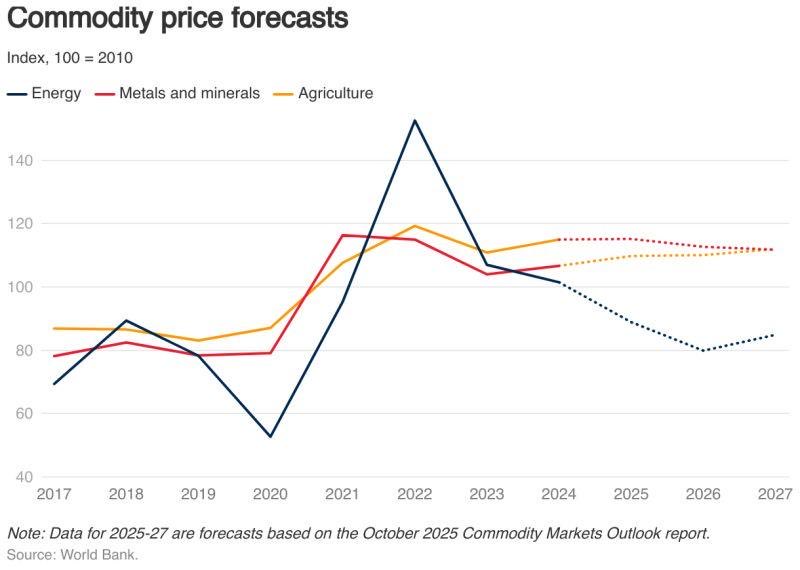
A Commodity Price Shock Is Also a Balance-of-Payments Shock
For commodity-importing economies, rising energy and raw-material prices do more than increase inflation.
They raise import bills, weaken external balances and can intensify demand for foreign currency.
The monetary consequences depend on exchange-rate flexibility, reserve adequacy, domestic expectations and the credibility of policy institutions.
For commodity exporters, the initial effects may be favourable. But higher export prices do not automatically translate into equivalent fiscal revenues.
Production volumes, taxation, ownership structures and the timing of receipts all matter.
The same global commodity shock can therefore produce very different macroeconomic outcomes across countries.
For central banks, the challenge is to distinguish a temporary deterioration in the terms of trade from persistent inflationary pressure.
The appropriate monetary response depends not only on the size of the shock, but also on how it moves through the economy.
#EmergingMarkets #Commodities #MonetaryPolicy