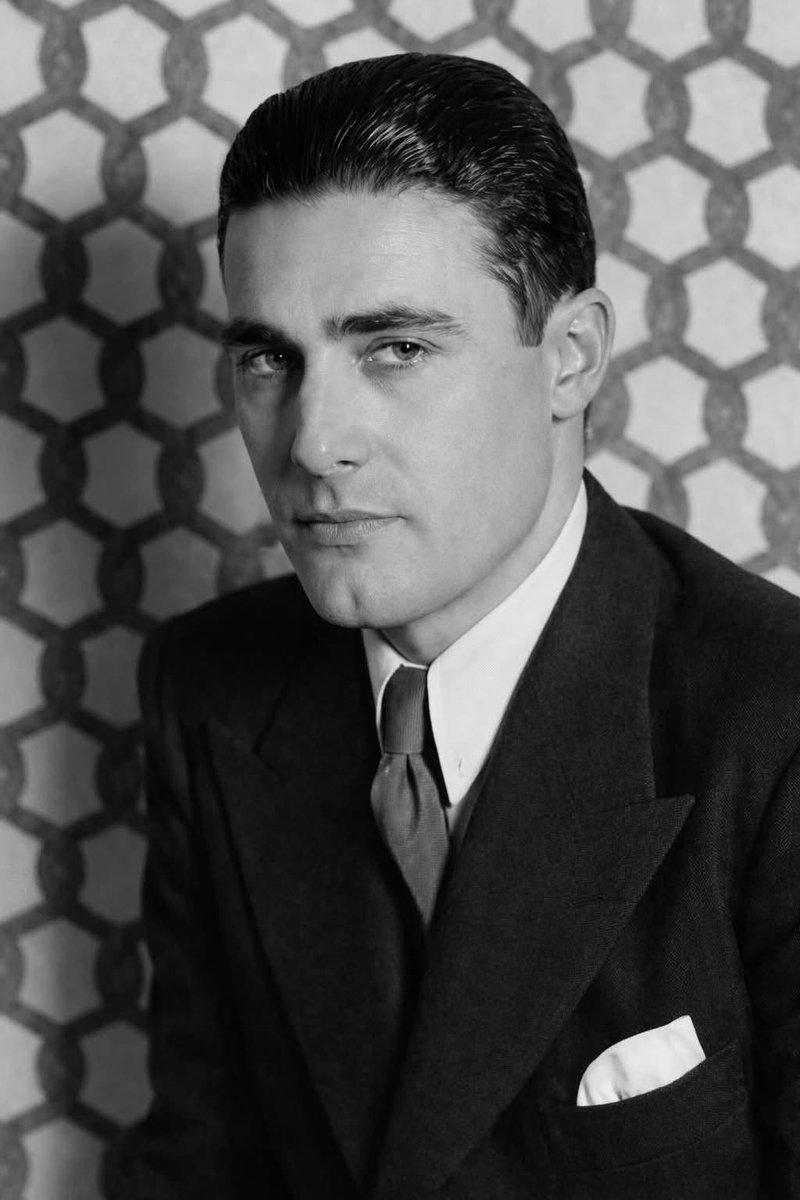
In 1942, a drunk German officer sat at dinner and bragged about the Jewish woman he had selected from the brothel the Nazis had forced open in town. He said her name out loud. The Tunisian Arab sitting across from him stayed calm, smiled, poured more wine, and finished the meal. Then he drove the officer home, sped through the dark streets, and knocked on a door close to midnight. That night, he hid 25 people for four months. He never spoke about it again.
His name was Khaled Abdul-Wahab. He was 31 years old, a wealthy Muslim Tunisian who had studied art and architecture in New York and spoke fluent German. Nazi officers trusted him. They invited him to their dinners.
Tunisia was the only Arab country directly occupied by Nazi Germany during the war. Jewish families were pushed from their homes. More than 5,000 Jewish men were sent to forced labor camps. Yellow stars marked every chest.
That December night in the coastal town of Mahdia, Khaled listened as the officer boasted. The woman he named belonged to a family Khaled had known all his life.
He left immediately. He drove through the night. He knocked on their door at midnight.
Pack nothing. Come now.
He gathered 25 people — mothers, fathers, cousins, and children — and drove them nearly 20 miles to his family farm, hiding them inside the olive press, stables, and storage buildings.
This was not one brave act. It was four straight months of courage.
He fed them while supplies grew scarce. He kept babies quiet. He trusted his servants to stay silent. When German soldiers arrived to count Jewish families, the hidden people pinned yellow stars onto their clothes and stood motionless. When the soldiers left, the stars came off again.
One night, a drunken soldier wandered onto the farm and discovered them. An eleven-year-old girl hiding under a bed watched him laugh and threaten to kill everyone there. Then Khaled appeared. She remembered him her entire life as a guardian angel. He calmly walked the soldier outside, took away his weapon, and sent him off the property.
Nobody on that farm died.
In May 1943, British forces liberated Tunisia. All 25 people returned home alive.
Khaled went back to a quiet life. He married, raised daughters, painted, and worked in government service.
He never told anyone what he had done. Not his wife. Not his children. No one.
He died on September 4, 1997, at the age of 86. His story was buried with him.
Ten years later, his daughter Faiza was sitting in a café in Paris reading a Sunday newspaper when she came across an interview with an American historian describing a Tunisian Arab who had hidden 25 Jews in 1942.
The historian mentioned her father by name.
She was 45 years old and had never heard the story before.
She contacted the historian. One of the children saved on the farm had left behind 83 pages of testimony before her death. Every detail matched.
“I rediscovered my father,” Faiza later said.
Khaled was nominated for Israel’s highest honor given to non-Jews who saved Jewish lives. He would have been the first Arab to receive it.
The committee declined, saying he had not risked his own life enough.
Faiza answered with a line history should never forget:
“My father opened his home to Jews. They did not open theirs to us.”
Today, the 25 people Khaled saved have hundreds of descendants living across Israel, France, America, and Tunisia. The little girl hidden beneath the bed grew up, moved to Paris, and built a family of her own. None of them would exist if Khaled had stayed silent that night.
He had everything to lose. He acted anyway. Then he spent the rest of his life saying nothing about it.
The world nearly forgot him twice. Now you know his name.
BREAKING: LOL! Trump's election-eve speech takes a BIZARRE detour into algae, water, and his favorite reflecting pool conspiracy theories.
With all the polls indicating that the Republican Party is facing massive defeat in the mid-term elections tomorrow, all eyes were on Donald Trump as he made what was expected to be his closing arguments meant to turn the tide on the blue tsunami headed his way.
Instead, Trump wound up spending the first 20 minutes of his speech talking about one of his favorite obsessions, the place where the event was being held — the Lincoln Memorial Reflecting Pool.
He began by announcing the reopening of the long-shuttered pool, originally due to have its renovations and repairs completed in time for Trump’s grand America 250 celebration in July. In making the announcement, he also added this ill-advised joke: “We’re giving serious thought to changing the name to the Trump reflecting pool. We’ll announce that sometime tomorrow. I’m sure Secretary Burgum will have a lot of fun in announcing that.”
Trump quickly retracted the renaming idea, adding, “I’m only kidding. I’m only kidding. Please don’t report it.” Apparently, he’s beginning to catch on to the fact that people aren’t exactly fond of his renaming spree.
Still, he hasn’t quite realized that people are equally sick of his phony claims that it was vandalism, not the crappy job done by the no-bid contractor that he hired to apply the coating to the pool, that was the problem that delayed the reopening until now.
“We went through a lot with vandalism. The vandalism was unprecedented,” he claimed despite the fact that both investigators and the contractor found that the damage was caused by installation errors and the flawed chemical design of the coating used on the pool.
Still, Trump droned on about the dimensions of the pool, its water sources, and the algae that has plagued the pool (something he blamed on Obama and Biden, conveniently forgetting his own first term that took place in between those administrations), even using photos of the algae as a visual aid.
He then went back to accusing vandals of slashing the pool’s lining: ���The vandals went to work, but we also went to work on the vandals.”
Trump apparently missed the fact that every attempt by the DOJ to prosecute anyone for Trump’s fantasized vandalism was thrown out of court, with prejudice, for lack of evidence. He continued to claim that he has “pictures’ of the vandals at work, and cited a Fox News segment by Jesse Watters as his proof.
Trump eventually moved on to repeating his lies about his own performance as president, fraudulent elections, and about Democrats, all in hopes of salvaging his minion’s electoral chances. But you could tell his heart wasn’t really into it, and he eventually returned to the only things he seems truly interested in these days with his spiral into dementia: his plans to remodel Washington DC with his grotesque triumphal arch/military complex and the renovation of the city’s public golf course.
If Trump hoped to change any voters’ minds with his speech today, his failure to do so will become obvious tomorrow once the election results start arriving. In the meantime, his rambling remarks only proved to demonstrate why he’s unfit to continue as president.
Please like and share if you think so too!
After Patrick Stewart's death, Marvel Studios president Kevin Feige made three decisions.
No one realized that less than 6 hours after Patrick Stewart's death, Marvel Studios president Kevin Feige made three heartbreaking decisions.
October 28, 2026, Patrick Stewart, best known for playing Professor X, passed away at his home in Los Angeles. He was 86. The news sent countless fans around the world into mourning.
As one of his most important collaborators, Marvel Studios president Kevin Feige was among the first to respond.
First, Feige released a heartfelt tribute on behalf of Marvel. He made it clear that Patrick brought Professor Charles Xavier to life in a truly unforgettable way. From the first X-Men movie in 2000 to the upcoming Avengers: Doomsday, he defined the character for generations of fans. Feige called him a one-of-a-kind collaborator. Working with him was an honor for Marvel.
Second, following Patrick's passing, Doomsday became the final film he ever appeared in. Kevin wanted fans to be able to see his final performance in the film. He also decided to include a special moment at the end of the movie to honor him, giving audiences one final chance to say goodbye to him on screen.
Finally, Feige also instructed the team to make sure Patrick's scenes in Doomsday remained intact and were presented with the utmost care. No post-production edits or changes should diminish this legendary actor's final appearance. His performance must be preserved in its fullest form so it can remain part of film history.
May he rest in peace.
In 1952, an English teacher named Cecil Dormand secretly paid for a dirt-poor 11-year-old to take a drama course.
He never told him and the boy didn’t find out until decades later.
By then, he was a knight, that little boy’s name was Patrick Stewart.
He was born into a poor family in Mirfield, a small mill town in Yorkshire and his father came home from World War II a violent man, and he was violent toward Patrick’s mother.
Young Patrick learned exactly when to step between his father’s fist and his mother.
An English teacher put a copy of Shakespeare in his hand and told him to get up and perform.
He never stopped and left school at 15.
By 19 he was completely bald... most agencies told him he'd never make it because of that.
In 1987, the LA Times called him an “unknown British Shakespearean actor” when he was cast as Captain Picard.
Then he became one of the most famous faces on Earth.
You’ve probably heard that part.
Here’s the part you haven’t:
He spent decades as a patron of Refuge, sheltering women and children from domestic violence.
But he never stopped trying to understand his father.
He dug up a 1940 newspaper clipping that said his dad had come home with severe shell shock.
He went to France and walked the ground where his father’s unit was pinned down under bombing for hours.
He learned his father had PTSD, and nobody ever helped him.
So Patrick became an ambassador for Combat Stress, a charity that helps veterans.
In 2013, a young woman at a Texas convention told him she was a survivor of domestic violence.
He asked, “My dear, are you okay?”
Then he hopped off the stage, held her, and told her: “You never have to go through that again, you’re safe now.”
At Dragon Con, a Make-A-Wish girl dressed as Spock came to meet him.
2,000 people were waiting for him to speak... he sat down and talked with her for 15 minutes, making all of them wait.
He told her that since they were friends now, whenever she saw him on screen she could wave and say, “Hello Patrick.”
After 9/11, he felt helpless, so he brought his one-man A Christmas Carol back to Broadway for a full week of charity shows.
He played every character himself and donated every cent.
In 2019 he did it again, and every dollar went to feeding hungry New Yorkers.
In 2017, he fostered a pit bull named Ginger, who had been rescued from a dogfighting ring.
She was his first dog in more than 50 years.
He couldn’t bring her home to England, so he found her a family.
Then he kept fostering more.
When he said he was done with Star Trek so many people told him the show had gotten them through the hardest times of their lives.
So he wanted to see if Picard could do it one more time.
Rest in Peace, Sir Patrick 🖖
In 1987, Patrick Stewart refused to unpack his suitcase for six straight weeks.
My throat still tightens every time I read why.
Every Hollywood insider told the 47-year-old British stage actor that Star Trek: The Next Generation would be a disaster. Even his closest friend, Ian McKellen, begged him not to throw away his Shakespearean career on a television gamble.
Stewart kept his bags packed by the door, waiting to be fired and sent home to London.
That "six-week failure" lasted 36 years.
Watching him late at night here in Japan, we saw something Hollywood never expected.
In Japan, we call this quiet, unbreakable spirit "Fudoshin," an immovable heart under fire.
Most action heroes scream and fire weapons to look strong.
Captain Picard never needed to raise his voice.
Born into deep poverty in Yorkshire, terrified of a violent home, he left school at age 15 and lost all his hair by 19, convinced his life as an actor was over before it began.
Yet one English teacher, Cecil Dormand, handed that frightened 12-year-old boy a copy of Shakespeare, said "Read it out loud," and secretly paid for his first drama course.
Never forget what happened decades later.
On the morning Queen Elizabeth II knighted him as Sir Patrick Stewart, he invited that same retired schoolteacher to sit beside him at his knighthood luncheon.
No suitcase left unpacked.
No rage on the bridge.
Just a cup of Earl Grey tea, a tug of his uniform, and three quiet words that commanded the galaxy:
"Make it so."
He passed away at 86 surrounded by live music, prayer, tears, and laughter.
And this December, in Avengers: Doomsday, Professor X will grace the screen one final time.
A boy who thought he wouldn't last six weeks in Hollywood gave the world an eternity of nobility.
From Japan, with tears and our deepest salute:
Thank you, Captain. Engage. ✨🖖🇯🇵
In 1992, Douglas Coupland envisioned what North America would look like in 2092. Lots of funny details here.
Interesting historical photos: https://t.co/VL9mxUrlIW