@brivael C’est bien ce que je disais, le discours d’un crypto bros, c’est assez ironique.
“Je crois tellement à ma vision du futur que ceux qui ne sont pas d’accord sont forcément aveugles.”
C’est une belle entreprise mais c’est de la science-fiction 30-50 Trillons.
Here's my honest opinion on the MSTR market resolution.
It will close NO.
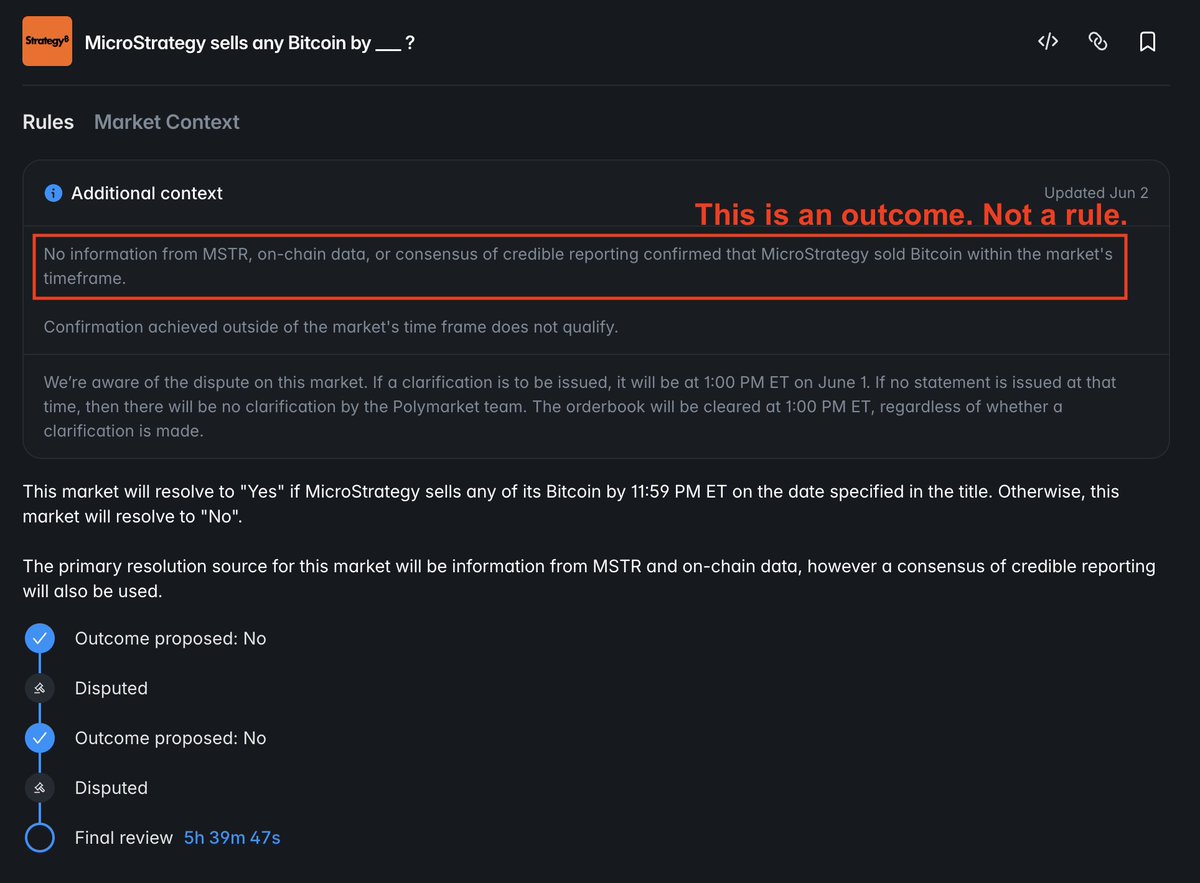
This is because UMA is forced to respect the rules as written by Polymarket. Polymarket changed the rules, and now the outcome is literally in the rules.
Even if UMA voters think that this outcome is ridiculous... they are forced to ratify it. They must abide by the rules that Polymarket wrote.
So really... in 5 hours, we simply receive confirmation that UMA is forced to follow centralized Polymarket decisionmaking. Polymarket can change the rules, at any time, for any reason, and UMA are forced to respect it. No voting needed.
So is UMA really that independent? Does UMA hold any power whatsoever? Not really. It's puppet decentralization so that Polymarket can shift dispute blame onto a separate entity.
This market most likely closes NO in 5 hours. But that doesn't change anything.
The scam already occurred. Clearly, the way that this gets solved will not be through Polymarket's internal processes. So let's take it to the next level.
In my opinion, Polymarket made a massive mistake here by changing the rules so brazenly. They fucked up... BAD.
If you're going to rely on a system that offloads dispute blame to another entity, you shouldn't take it upon yourself to cut that entity out of the resolution process. Now, the blame falls entirely on Polymarket's shoulders. This really isn't a difficult argument to make.
Any rational individual who looks at this market can conclude that Polymarket themselves now have the responsibility of this market's resolution. Big mistake, and that's what makes this case very different from prior UMA voting disputes. You can't hide behind UMA now.
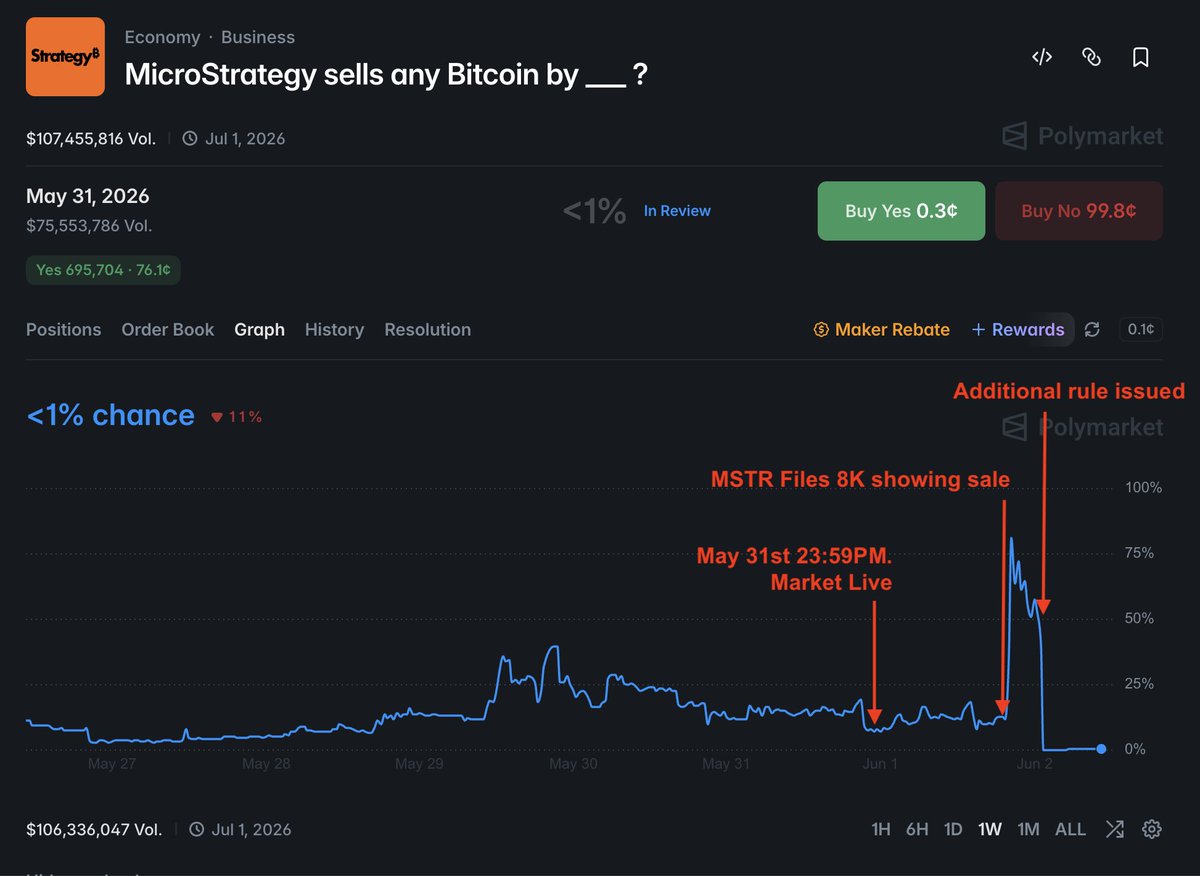
Polymarket markets are resolved according to a set of pre-defined and stated rules. Polymarket themselves modified these market rules. The clarification materially changed the conditions for a Yes outcome after trading had already occurred.
Polymarket's own documentation says clarifications "cannot change the fundamental intent of the question."
Clearly, this one did.
Polymarket, your time is running out.
@LucJager@SebastienCaunes C'est pas du tout super smart, si la personne n'arrive pas à venir avec les fonds dans 8 à 15 jours, il perd tout ... Quand tu veux vendre c'est pas forcément pour racheter le tous non plus...
Let’s cut through the noise.
If you ask today, “Did MSTR sell Bitcoin before May 31?” the honest answer is yes. Nobody serious would say no.
That is what the market asked. It did not ask whether MSTR disclosed the sale before May 31. It asked whether MSTR sold any Bitcoin before May 31.
People who traded this market knew how MSTR reporting works. Everyone watching STRC, MSTR, and SEC filings knew the 8-K would likely come on the next business day. That means any sale between May 26 and May 31 could only be confirmed after May 31. This was obvious to serious traders.
So if Polymarket’s position is “anything confirmed after May 31 does not count,” then the market became impossible for YES after May 26. Unless Michael Saylor randomly shouted “we sold Bitcoin” before midnight, YES could never be proven under that logic.
But the market did not close on May 31. Everyone waited for the filing. Then the filing came out and confirmed what YES buyers were betting on: MSTR sold Bitcoin before May 31.
The NO argument does not come from the title. It does not come from the main rule. It does not come from the actual event. It only survives because Polymarket added an interpretation that turns “sold by May 31” into “disclosed by May 31.”
I have spoken with legal advisors, including top-level counsel in Asia. If this resolves NO, I believe affected users have a serious path to challenge it, including collective legal action.
The rule said sells.
MSTR sold.
That should be the end of it.
@Polymarket
UMA whales > reality once again as Polymarket adds additional context that this market titled "MicroStrategy sells any Bitcoin by May 31st" was actually a market for "MicroStrategy announces they sold Bitcoin by May 31st".
Clowns.
Biggest scam happened today on #Polymarket about MSTR selling before 31st of May.
This plateform is a scandal, and their dispute mechanism is corrupt ($UMA)
#MSTR@Polymarket
I just got Claude Pro, how is it possible to reach the limit just within the chat ?
I switched from OpenAI and never got hit by a limit on the chat ...
Do you know the #1 messenger app in Asian countries?
🇨🇳 China → WeChat
🇯🇵 Japan → LINE
🇰🇷 South Korea → KakaoTalk
🇻🇳 Vietnam → Zalo
🇵🇭 Philippines → Messenger
🇮🇳 India → WhatsApp
🇮🇩 Indonesia → WhatsApp
🇹🇭 Thailand → LINE
🇰🇭 Cambodia → Telegram
🇲🇾 Malaysia → WhatsApp
🇸🇬 Singapore → WhatsApp
Cambodia picked the most private one 🏆
Even banks are using it!
Planning to open a bank account in Cambodia (even as a non-resident)?
A bit of history and a comparison 🇰🇭🇨🇦
Two names dominate the conversation for good reason. Both have Canadian connections. Both are excellent choices.
Canadia Bank
Founded in 1991 by Pung Kheav Se, a Cambodian refugee who rebuilt his life in Canada. He returned home after the war to help rebuild the country's financial system from scratch. What started as a gold trading desk grew into one of Cambodia's largest and most respected locally-owned commercial banks.
ABA Bank
A different but equally successful story. In 2014, National Bank of Canada spotted an opportunity in Cambodia's dollarized, high-growth economy with very little modern banking competition. They quietly bought an initial stake, increased it over the following years and reached full ownership by 2019. In the decade since, it has consistently been ranked the best bank in Cambodia.
If you plan to open a bank account, I'd advise opening both for diversification. ABA has stricter requirements for foreigners but the international infrastructure makes it worth the extra effort.