This apology only addresses Nezu Shrine.
The same group also filmed dance videos at Fushimi Inari Taisha, and those videos still appear to be available on YouTube.
Is it your country’s practice to leave acts of disrespect toward Japanese kami unaddressed?
As a Japanese person, I feel deep anger.
We demand a proper apology from the group itself, as well as an official statement from the Slovak government.
A Step Too Far: When “Hospitality” Becomes Humiliation
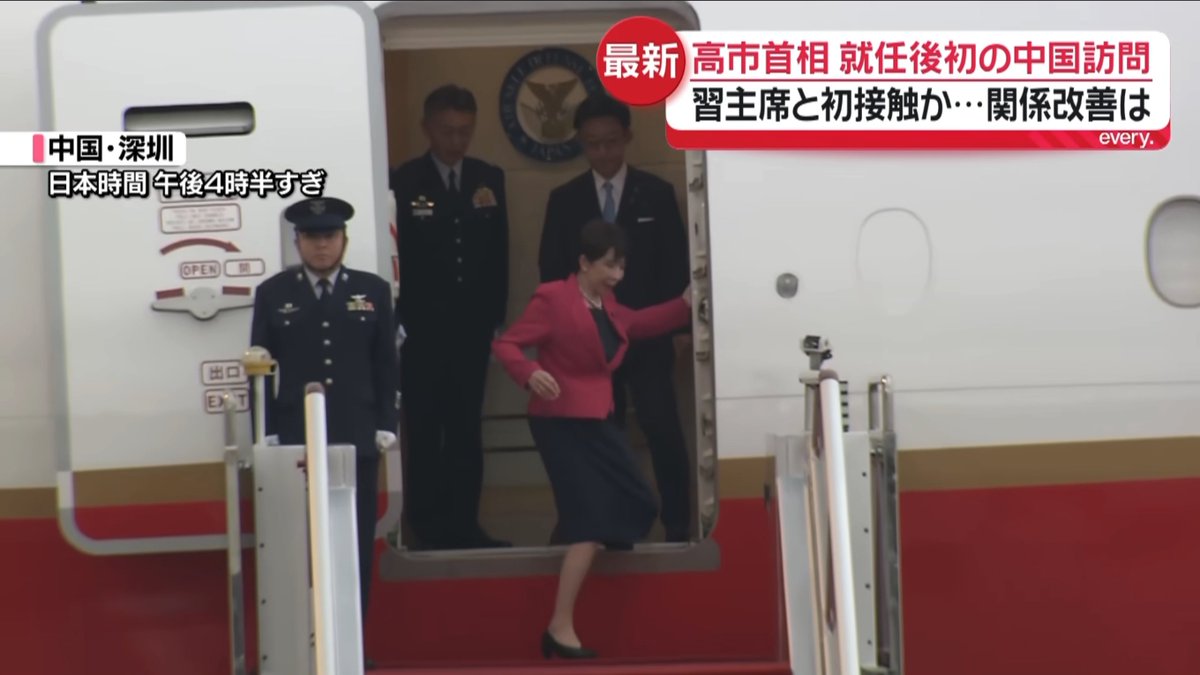
When Japanese Prime Minister Sanae Takaichi stepped off her government aircraft in Shenzhen on November 18, 2026, to attend the APEC summit, the world was watching. What they saw was not a welcome. It was a trap disguised as a staircase.
The gap between the door of the aircraft and the top of the boarding stairs was abnormally large — reportedly close to knee height. Takaichi had to pause, grip the side of the fuselage with her left hand, turn her body sideways, and carefully lower her right foot onto a step far below her.
For any leader, that would have been embarrassing and dangerous. For Takaichi, it was far worse.
Takaichi has publicly lived with rheumatoid arthritis since the late 1990s. At its worst, she has said, the disease made even simple movements — turning a doorknob, climbing stairs — excruciating. Her knees are not a minor weakness. They are a long-standing medical vulnerability she has managed for decades while carrying out public duties.
Anyone who understands that condition understands what a high, uneven first step means: multiplied pressure on the knee, a sharp bending angle, a moment of instability where pain, stiffness, and a tight skirt that restricts movement can combine into a fall. A fall from that height would not have been a small stumble. It could have meant a serious injury, a torn ligament, a fracture, a diplomatic crisis caused by a preventable accident.
And that is precisely why this incident cannot be dismissed as a technical error.
Host countries do not leave the arrival of a foreign head of government to chance. The aircraft door height is known. The stairs are adjustable. The alignment is checked. In normal diplomatic protocol, the first step is made seamless precisely because a visiting leader must descend with dignity and safety.
Here, the opposite happened.
China’s cold treatment of Takaichi was already expected. The political chill between Tokyo and Beijing is no secret. But there is a line between political coldness and physical endangerment, and this crossed it.
If it was negligence, it was gross negligence toward the safety of a visiting prime minister. If it was deliberate, as many observers in Japan and beyond now believe, it was something even uglier: a calculated attempt to make her look unsteady, vulnerable, and humiliated in front of cameras — at the expense of her health.
Diplomacy allows for disagreement. It allows for frosty handshakes, terse statements, and hard negotiations. It does not allow for putting a guest — especially a guest with a known joint condition — in a position where one misstep could send her tumbling down a staircase.
A civilized country does not welcome a foreign leader this way. A responsible great power does not gamble with another person’s body for a moment of petty revenge.
Japan should not treat this as a minor protocol hiccup to be quietly forgotten. It should demand a clear explanation: Who prepared the stairs? Who checked the height? Why was such a dangerous gap left uncorrected?
Because this was not just about one step. It was about whether basic respect — and basic safety — still means anything at all in diplomacy with Beijing.