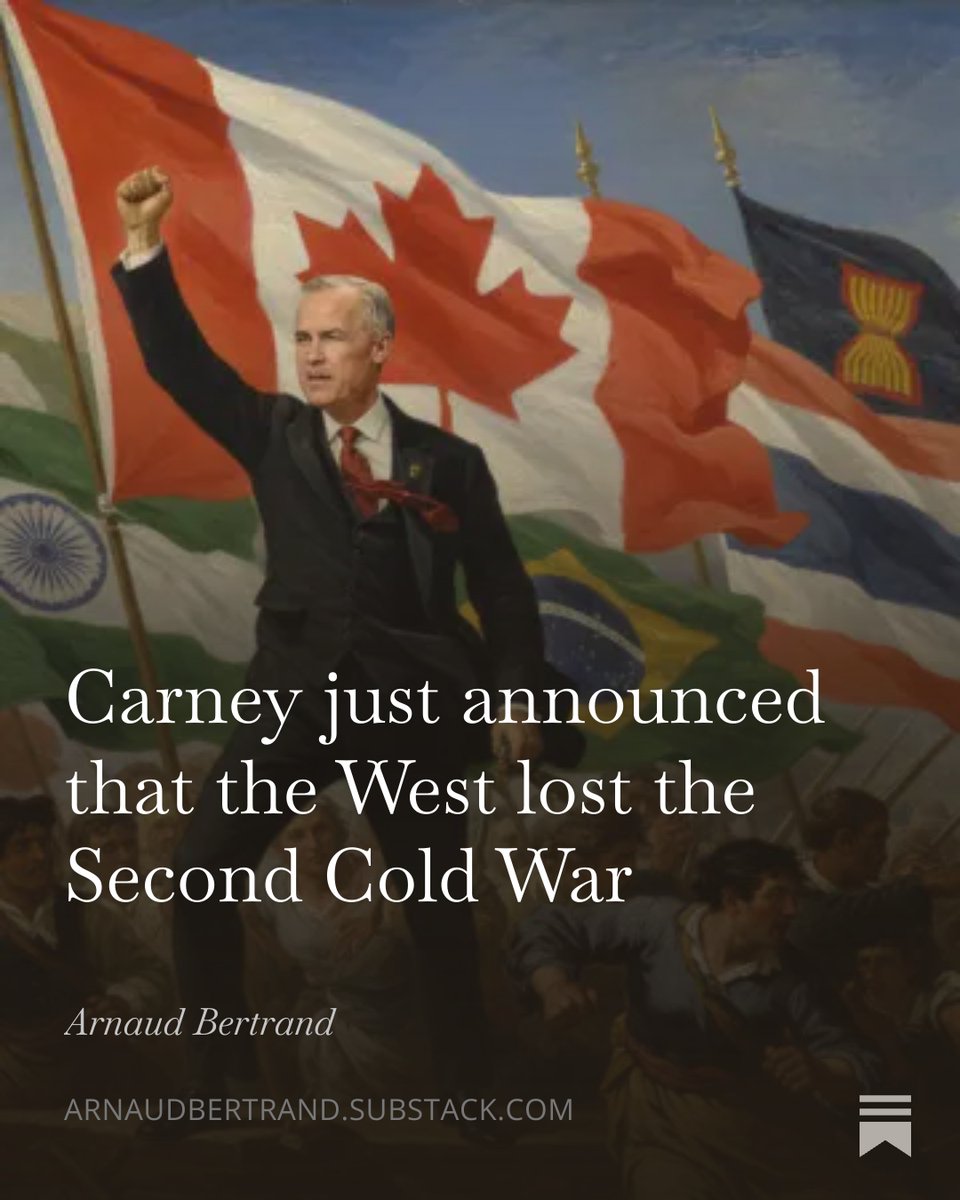
Who could have expected Mark Carney, a liberal establishment figure if there ever was one, to be the flag-bearer for the end of the US-led order? And from a podium at Davos, of all places?
The more you think about it, though, the more it makes sense.
Carney is, at heart, a central banker. As such he understands the power of words and beliefs better than anyone: when you strip things down to their core, a world order - like trust in a currency or a financial system - fundamentally relies on the maintenance of belief. Systems of power exist because participants act as if they exist. That's pretty much it: perception is reality.
Once participants acknowledge the fiction as Carney just did (he literally started his speech announcing he'd "end the pleasant fiction" of the US-led order), the system itself unravels. This is incidentally a formal concept in game theory: the shift from private knowledge to common knowledge is what triggers cascades.
Carney, with his background, ought to have known this was his most potent weapon facing Trump's America: "Trump has the economic and military might. But I have something his power rests upon: I can shatter the collective belief that sustains it."
He's even explicit about this being his thinking: his entire speech revolves around Vaclav Havel’s famous shopkeeper analogy and the fact that the power of the Soviet Union rested on "everyone’s willingness to perform as if it were true," on "living within a lie."
As Carney puts it, "when even one person stops performing, the illusion begins to crack" and the entire "system’s power" starts to crumble.
Today, that "one person" was him.
Make no mistake, Carney’s speech at Davos may prove to be one of THE most important speeches made by any global leader over the past 30 years. This is genuinely epochal stuff.
More than anything, what it means is that, to the extent it even existed at all, the West irremediably lost the Second Cold War: a Cold War requires two competing systems. Carney just announced that one of them simply no longer exists.
This is the topic of my latest article: an in-depth analysis of Carney's speech and its immensely consequential implications for what comes next.
Enjoy the read here: https://t.co/Vf5heHU1OV
Broadly, there are two diametrically opposed models for understanding the evolution of the international order since the late 1940s: the one articulated by @FukuyamaFrancis, and the one championed by the Nazi jurist Carl Schmitt, @BennSteil explains. https://t.co/dD0wDDbjiY
Oil. Copper. Semiconductors. Foreign direct investment (FDI) has seeded and transformed many global industries. While tomorrow’s trade map is still being drawn, patterns are emerging from major companies’ announcements of greenfield FDI.
🔍MGI research explores shifts underway in FDI and offers foresight for decision makers:
https://t.co/spbE57vh2i
As America is about to turn 250, its politics are raw, fractured and volatile. History can provide context for the country’s current predicament https://t.co/RZCFyuVC4O
Illustration: Cristiana Couceiro
The fight to limit “screen time” cannot be won, @ibogost argues. To recognize that fact—and to understand how it happened—is a small, important step toward salvation:
https://t.co/NZw0Gw5QAm
I said these people need us more than we need them. And Mandela said, “Release [Robert] McBride or there’ll be no negotiations!”- Dr Gomolemo Mokae
Video Credit @AbbeyMakoe
RIP The People’s Doctor, Dr Mokae