@MinuteofZombie@JohnKiriakou Depends on your understanding of air gapped.
Many facilities still tunnel to these networks over public infrastructure. Including JWICS.
GRUSCH LOSES FOIA LAWSUIT AGAINST DEFENSE DEPARTMENT
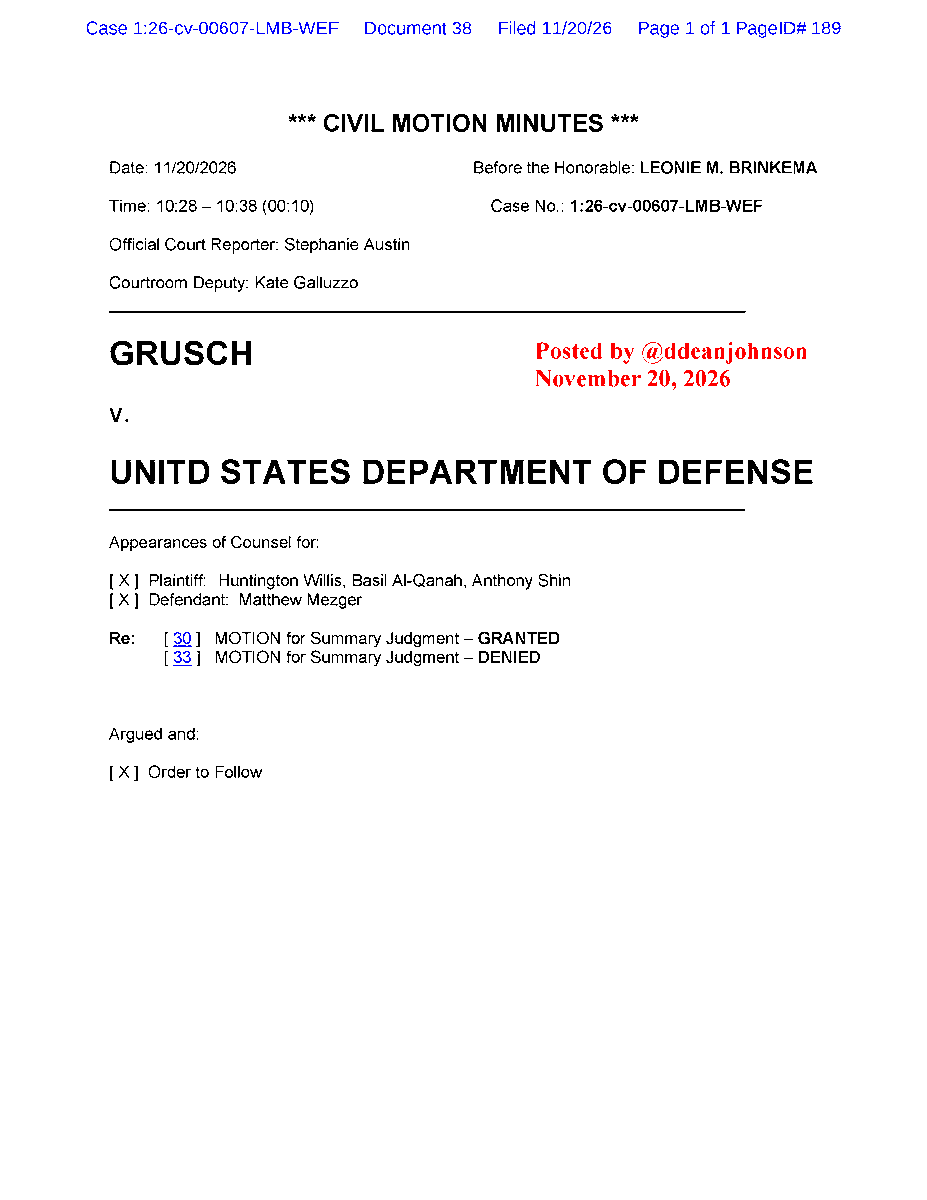
Former intelligence officer David Grusch today (November 20, 2026) lost his federal lawsuit against the Department of Defense (DoD), challenging the DoD's handling of his October 2024 FOIA request, pertaining to an apparently short-lived security inquiry about Grusch in 2023.
After months of written briefs and a live hearing today with lawyers from both sides, Federal District Judge Leonie M. Brinkema issued summary judgment in favor of the government. (See attached "Civil Motion Minutes.") Judge Brinkema will issue a written order later, which might include some analysis of why she rejected Grusch's claims that the DoD conducted an inadequate search for responsive records.
In his lawsuit, Grusch claimed that the DoD conducted an inadequate search in response to his October 2024 FOIA request for certain documents related to a purported "unauthorized disclosure complaint" about Grusch, or related to any "unauthorized disclosure complaint" involving UAP/UFO, both limited to April 1 through December 31, 2023.
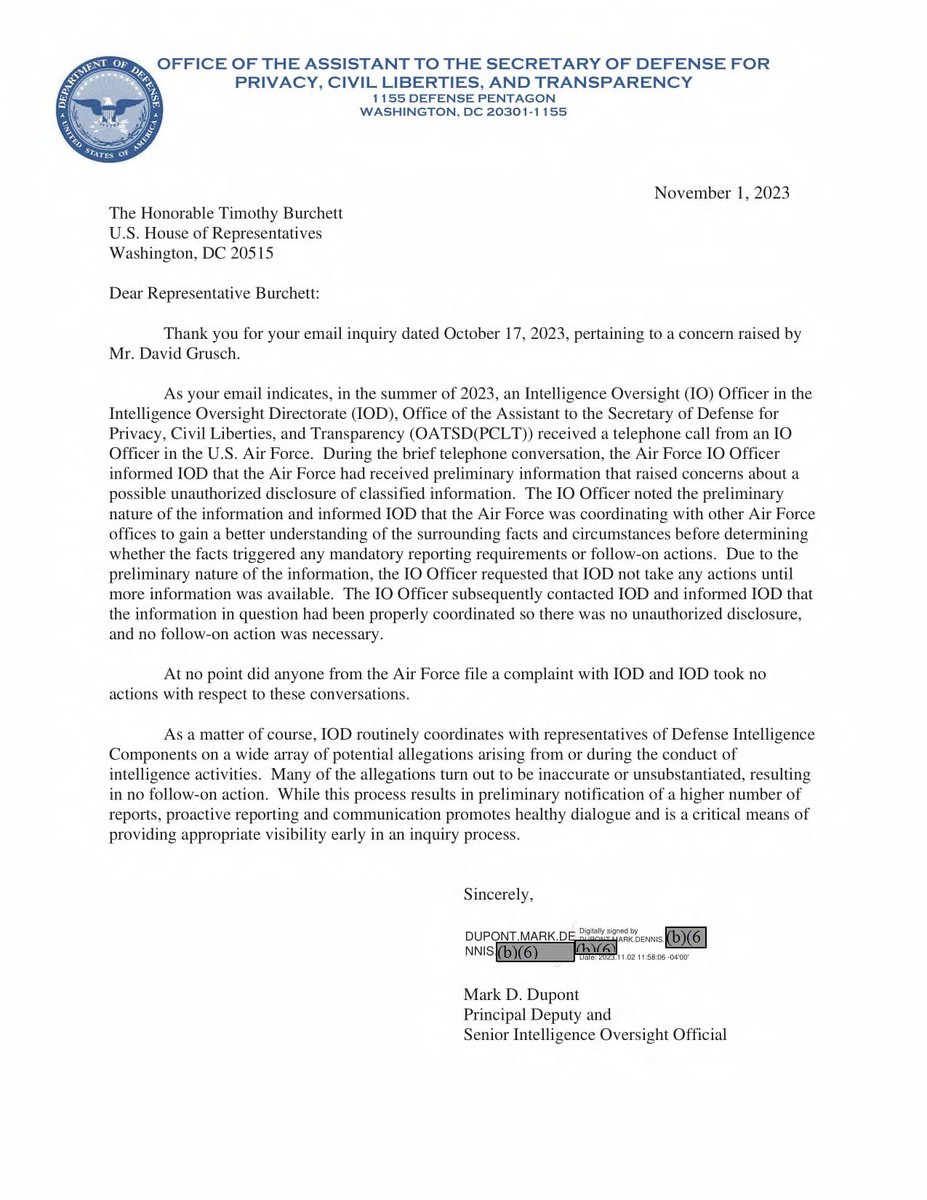
In May 2026, the Department turned over 40 pages of partly redacted documents to Grusch, but Grusch did not make those documents public at the time. On June 25, I obtained a version of the same packet through my own FOIA request and published it. That release included a copy of a letter (attached below), dated November 1, 2023, to Congressman Tim Burchett (R-TN), from Mark D. Dupont, Principal Deputy and Senior Intelligence Oversight Official in the Office of the Assistant to the Secretary of Defense for Privacy, Civil Liberties, and Transparency.
The Dupont letter was sent in response to an inquiry on Grusch's behalf from Burchett's office. In the letter, Dupont related that an unnamed Air Force Intelligence Oversight (IO) officer had reported that "the Air Force had received preliminary information that raised concerns about a possible unauthorized disclosure of classified information" by Grusch, but also that the same officer "subsequently contacted IOD [Intelligence Oversight Directorate] and informed IOD that the information in question had been properly coordinated so there was no unauthorized disclosure, and no follow-on action was necessary. At no point did anyone from the Air Force file a complaint with IOD and IOD took no actions with respect to these conversations."
In my view, Dupont's letter described an incident markedly less dramatic than Grusch's later characterization, in a May 5, 2026 interview, that "the Air Force, I think, was very afraid when I went public.... it's come to my attention that when I went public in June 2023, the Department of the Air Force filed an unauthorized disclosure Espionage Act complaint against me." [See attached video clip.]
Although Rep. Burchett, and presumably Grusch, received the Dupont letter in November 2023, it was never made public until I published it on June 25, 2026. To my mind, this entire episode is an example of something I wrote in a long article published on October 30, 2026, as follows: Some of the UAP whistleblowers have spoken in testimony and on podcasts regarding their actions in submitting claims to inspectors general, law enforcement agencies, AARO, and courts, but few have been forthcoming in sharing documents on the end products of the ensuing inquiries. Regarding the outcomes of independent inquiries, what has come into the public domain mostly has not been through voluntary disclosures by the attestants or the "disclosure" organizations, nor through reports flowing from any congressional investigations properly so called, but piecemeal through independent, time-consuming Freedom of Information Act (FOIA) requests and other forms of investigatory journalism. Notably, when authoritative documents have come to light through FOIA or other means, they have on multiple occasions conflicted with the widely disseminated narratives of certain prominent storytellers. Perhaps this is one reason why most of the current array of publicly identified UAP "whistleblowers" assiduously avoid any public venue in which they would be subjected to sustained lines of questioning from well-informed persons who are not already cheerleaders.
Grusch has still not released what he wrote on the form that he filled out for Rep. Burchett's office on October 4, 2023, in response to the question, "Briefly explain how the Congressman can be of assistance to you. Please attach additional copies of any relevant information:" Grusch's written explanation to Burchett was redacted on privacy grounds in the copy that I received via my FOIA request (see attachment; there was another following page that was also fully redacted in the copy that I received). Thus, we are not going to see Grusch's 2023 explanation to Burchett, unless Grusch chooses to release it.
Most of the key documents in the Grusch FOIA lawsuit (Grusch v. Department of Defense, U.S. District Court for the Eastern District of Virginia, Alexandria Division, No. 1:26-cv-607) are available for free from CourtListener at
https://t.co/EdmQTOY90x
I went and tested the VASCO catalog to disprove the original Watters critique regarding the Shadow-null findings.
-------------------------------------------------------
Her team reported about 39% fewer dots than expected inside Earth’s shadow, at 7.6σ significance. They interpreted that as STRONG evidence for objects reflecting sunlight: such objects should stop glinting when Earth blocks the Sun.
Watters’ central criticism is that the dots are distributed unevenly across the photographic plates. A shortage can look extraordinary if the comparison underestimates those variations.
I tested that criticism on the released 107,875 entry catalog, retaining 107,863 candidates within reconstructed plate boundaries. I recovered the original 349 dots in the shadow, then moved the same shadow shapes across other plates while preserving their actual dot patterns.
Across 1,000,000 randomized comparisons, counts as low as 349; or lower appeared about 19% of the time. Roughly once in five comparisons.
The shortage remains: 349 is about ~36% below the shuffled average of 548. But the real plate counts vary enough that this shortage is NOT statistically unusual under the comparison.
That substantially weakens the specific VASCO claim and supports Watters’ statistical criticism: the shadow test no longer supplies strong evidence for reflecting objects under this model.
Although, TO BE FAIR. The dots’ origin remains open, and the separate alignment and nuclear-test claims require their own tests.
====================================
ELI5 for the normies
In plain terms. Imagine checking whether a stain on a dirty window is really in the shape of Earth’s shadow. If you only look at the total amount of dirt on the window, the missing patch looks striking.
But the dirt isn’t evenly spread, some areas are already cleaner than others. When you slide the same shadow-shaped stencil around the real dirty window a million times, a gap that big shows up about one time in five. So the “missing sunlight” pattern isn’t rare enough to count as strong evidence that something was blocking the light. The plates are simply too uneven for that claim to hold under a fair comparison. Other features in the data (alignments, timing with nuclear tests) still need their own checks.
Declassified footage shows the moment that “Bravo,” the injured WSO was finally picked up by U.S. forces, specifically by two members of Air Force Pararescue, following the use of technology by the CIA to detect his location. All together, over 90 special operators were involved in the operation that successfully saved the two downed pilots.
As the WSO said, truly a “testament of God’s provision.”