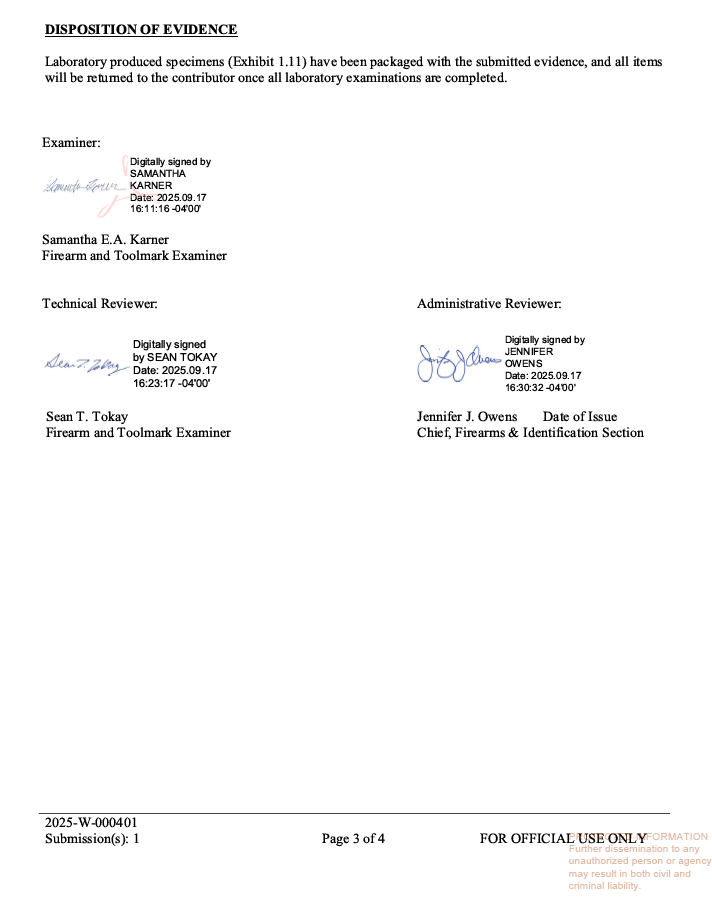
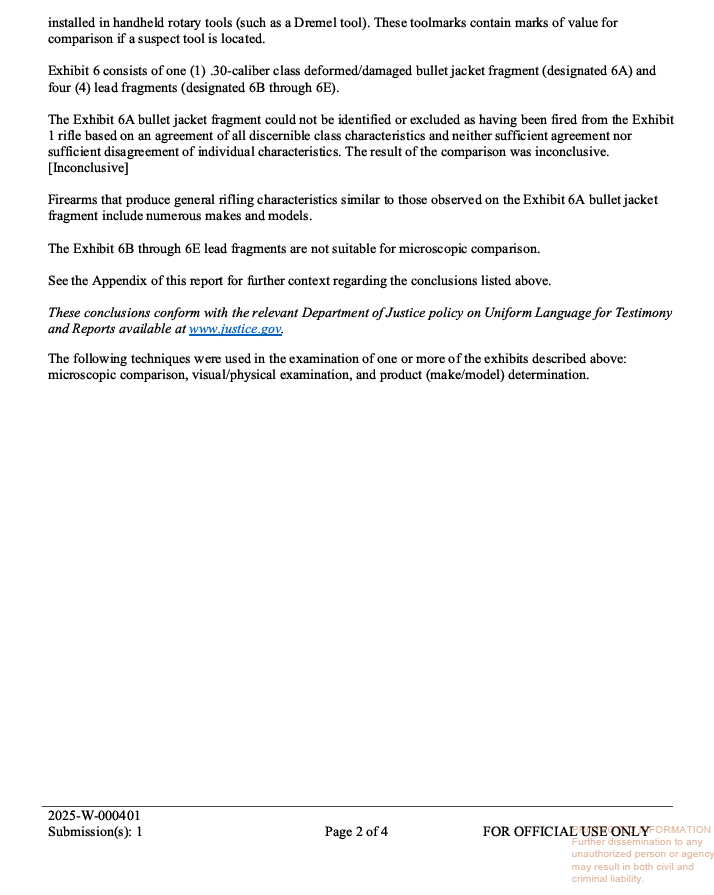
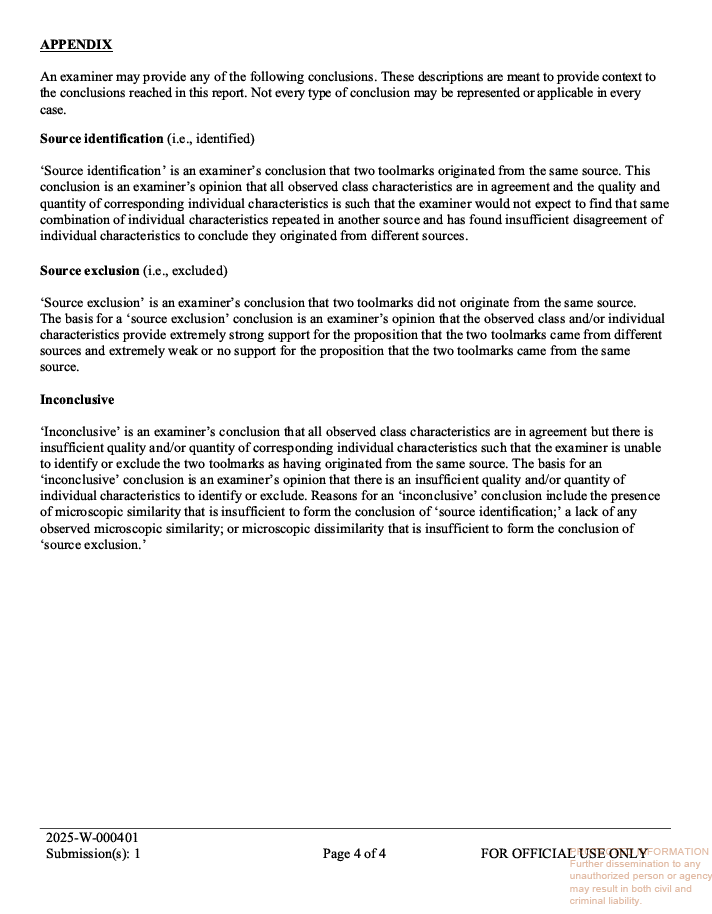
The ATF Report in Tyler Robinson's case is now available. It's clearly a summary report that doesn't provide great detail but it does have new information:
1 bullet jacket fragment and 4 lead fragments were recovered during Charlie's autopsy,
The jacket is identified as coming from a .30 caliber class bullet.
The jacket fragment shared class characteristics with Tyler Robinson's Mauser 98 rifle, so the rifle couldn't be excluded as having fired the bullet. But the fragment lacks individual characteristics permitting identification of one rifle to the exclusion of all others in the class.
The engravings on the cartridge casings are consistent with a rotary tool like a Dremel.
According to the motion, the State now wants to conduct Virtual Comparison Microscopy (VCM) on the jacket casing, a new technology in which the item is 3D scanned and virtually compared to a test fire. This might require the analyst to "unfold" deformed portions of the jacket, which could leave marks from the tool used to unfold the material. It could also potentially affect the structural integrity of the jacket fragment; an FBI analyst who received the fragment from the ATF noted that part of the jacket fragment has become detached in the packaging.
The State also wants to do "metallurgical" testing of a lead fragment, the precise nature of which is unspecified.
The defense filed the January 9th motion after they requested to be able to photograph the jacket casing in its current state and to attend or photograph any future testing, and its requests were denied. The motion is requesting that testing not be allowed to proceed without these conditions in place to protect the defense's ability to evaluate the testing.
Document available here: https://t.co/iVUhbTiOJw
🧵 NEW EVIDENCE — and this one's simple to understand.
A professional broadcast camera (Canon XA55) was recording at UVU on September 10. Unlike every phone in the crowd, this camera records UNCOMPRESSED audio on 4 separate microphone channels at 48,000 samples per second. The Canon was roughly 46m away from the tent which provided a acoustic buffer between the onset of the events. This distance has provided clarity to the event that was missing with the other camera angles.
Think of it this way: phone recordings are like looking through a foggy window. This camera is like a clean window with the lights on.
Here's what that clean window shows:
THE SOUND ARRIVED IN ORDER — HIGH TO LOW
When a supersonic bullet passes, the crack arrives before the boom. High-pitched sounds hit first, low-pitched sounds hit last.
A bomb going off? Everything originates from the blast and arrives at the camera at the same time.
The Canon proves the high frequencies arrived FIRST — spread out over 100+ milliseconds. Followed by muzzle blast then a detonation which originates from the stage.
THREE SEPARATE BOOMS — NOT ONE
This is the big one.
Phone recordings near the stage smear everything together into one big noise. The Canon's professional audio separates THREE distinct low-frequency events:
• +114ms — Early energy (Mach cone)
• +202ms — Muzzle blast from ~120 meters away
• +321ms — DETONATION AT THE STAGE
That third event — the stage detonation — is the LOUDEST of the three. It's not an echo. It's not a reflection. It is the strongest low-frequency peak in the entire recording, and it originates approximately 46 meters from the camera.
Right at the tent. Right were Charlie was seated.
Something EXPLODED there. The Canon captured it separately from the rifle blast for the first time.
WHY THIS MATTERS
If a rifle was fired from 120 meters away, and a separate detonation occurred at the stage approximately ~185ms later — those are two different events at two different locations.
A single shooter doesn't produce a detonation under a tent 120 meters from the rifle. A device detonation doesn't produce a muzzle blast from 120 meters away.
The Canon separated what the phones couldn't: proof of events at MULTIPLE locations.
733 SUPERSONIC SIGNATURES
A supersonic bullet creates tiny pressure waves called N-waves. The Canon's shotgun microphone captured 733 of them in under 200 microseconds each.
The best phone recording? 123.
That's 6x more. The phones weren't broken — their compressed audio just can't preserve these. Uncompressed audio can. And it did.
THE SHOTGUN MIC WAS POINTED AT IT
The external microphone clipped 122,844 audio samples — it was overwhelmed because the sound source was directly in its line of fire. Meanwhile the built-in mics captured clean audio with almost zero clipping.
Zero correlation between the two signal paths. Same conclusion.
MUZZLE BLAST CONFIRMS THE DISTANCE
The +202ms blast puts the rifle at ~120 meters from the camera. The 10-camera analysis estimated 127 meters. That's within 6%.
Two completely independent methods. Same answer.
But the stage detonation at +321ms? That's only ~46 meters from the camera. That's the tent.
A rifle 120 meters away. A detonation at the tent. Two locations. Captured separately for the first time on professional uncompressed audio.
This is the 11th recording to independently confirm the same findings. Professional grade. No codec excuses. And now, for the first time, the stage detonation is isolated from the rifle blast.
Full analysis + raw audio downloads at https://t.co/P13PV3dlww
🚨HUNDREDS of studies now confirm COVID-19 “vaccines” are one of the largest carcinogenic exposures in HISTORY
They increase your risk of 7 major cancers — based on 2 studies involving 8.7 MILLION people.
CDC data shows over 138,000 excess cancer deaths in the U.S. since 2021.