Periodista: ¿Del amor entiende, Borges?
Borges: Sí. Desgraciadamente, sí.
Periodista: ¿Cómo desgraciadamente?
Borges: Porque desgraciadamente pienso que trae más pesares que placeres. Ahora claro que la felicidad que da el amor es tan grande que más vale ser desdichado muchas veces para ser feliz algunas. ¡Es también una cuestión de estadística!
Periodista: ¿Vale la pena entonces ser desdichados muchas veces para ser felices un minuto?
Borges: Sí. Yo creo que sí. Yo creo que todos nosotros hemos sido muy felices con el amor alguna vez y también creo que todos hemos sido muy desdichados muchas veces.
El amor le ofrece a uno esa incertidumbre, esa inseguridad del hecho de poder pasar de una felicidad absoluta a la desdicha; pero también de poder pasar de la desdicha a la brusca, a la inesperada felicidad. Pienso que es una experiencia y uno no debe rehusar experiencias.
Julio 1976 - Entrevista a Jorge Luis Borges realizada por Bernardo Neustadt para su programa "Tiempo Nuevo".
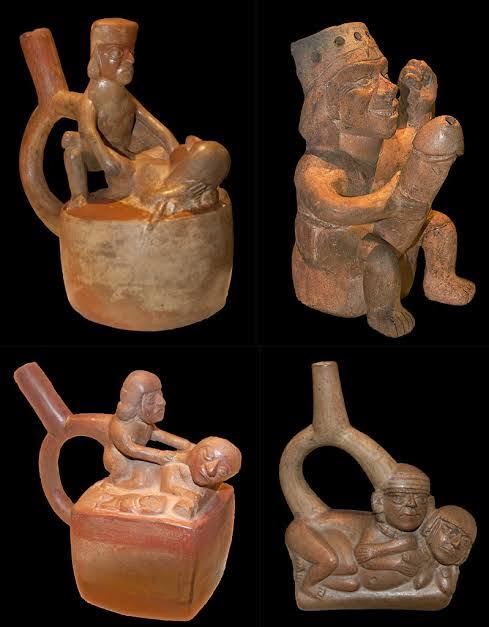
The scenes of intercourse, oral sex, and masturbation on the pots could be ripped from the pages of an erotica novel written today, but, instead, they’re depicted on traditional ceramics sculpted over 1,500 years ago in Peru, now one of the most conservative Catholic places on the planet. Moche, who lived from 100-800 AD, pre-dating more celebrated Inca sculpted tens of thousands of ceramics, an estimated 100,000 of which remain. Of those, at least 500 are pots depicting sexual acts.
To Spanish colonizers who uncovered Moche sex pots in indigenous spiritual temples and royal tombs scattered up and down Peru’s North Coast, the pieces were manifestations of something sinful. The Spanish were scandalized by the ceramics’ graphic detailing of sex between humans, skeletons, and animals—with infants also sometimes present as non-participants. Shaken to their Catholic core, they smashed the pottery to pieces and criminalized the premarital and non-reproductive sex acts depicted on their surfaces.
In years, decades, and centuries following the arrival of the Spanish, hundreds more sex pots were dug up by looters and archaeologists, dispersing to private and public collections around the world. But the pots in Lima, housed at the bottom of the Museum of Archaeology, were kept under lock and key, reserved for only the most educated of eyes: those of social scientists and scholars. For the rest of the population, the erotic pottery was deemed far too provocative.
The absence of vaginal penetration, for instance, has been interpreted by some as to illustrate birth control methods, while some suggest it emphasizes male dominance and male pleasure. While modern viewers may find the presence of the child during a sexual act distasteful, according to Mary Weismantel, it suggests that the Moche believed that the seminal fluid that transfers from men to woman is the same vital substance that transfers from the mother to the child. Weismantel argues that like many cultures, Moche saw sexual reproduction not as a single event or act but as a series of practices that occur over long periods of time, involving various transfer of bodily fluids into various orifices. Similarly, pots depicting women masturbating skeletons may show the transfer for vital bodily fluids that came from their long-dead ancestors.
Many ceramics also feature giant erect penises, sometimes sculpted into, fittingly enough, fully functional spouts for pouring liquid. Others show figures bearing rather goofy-looking grins. The sex appears pleasurable and unabashed. From Museo Larco’s sex pot gallery, it’s common to hear reactions escape in outbursts of gasps and giggles. For Peruvians, though, these sex pots represent something more serious: a reality that cannot be reduced to mere iconography. To them, the story of the pottery might be symbolic of their own—a culture that has been devalued while at the same time appropriated for profit and for power.
As Caril Phang, a researcher of indigenous cultures of the Western Hemisphere, puts it:
That Moche pottery presented the physical act of sex was an affront to the Catholic faith. However, the art also proved advantageous to the colonizing ideal. It suited the Spanish need to define indigenous peoples as ‘carnal,’ ‘lustful,’ ‘pagan’ tribes on whom ‘just war’ would be declared, to expand Spanish territory and the tenets of the Roman Catholic Church.
What the Spanish viewed as barbarian art, however, actually spoke of a highly organized civilization that in some ways might have been more socially and politically progressive than the one that centuries later came after it.
In some experts’ opinions, the sex ceramics could emphasize a sort of equality between men and women that is feminist in interpretation. Weismantel sees this in the representation of “their bodies, faces, tattoos, or body paint and adornments” which “are often shown as similar or even identical, so that they can be distinguished only by their genitalia.”
The Moche were a mysterious civilization who ruled the northern coast of Peru beginning 2,000 years ago. The Moche lacked written language, but were incredibly skilled in pottery and ceramics which they used to communicate ideas and express their lives by depicting detailed scenes of hunting, fighting, sacrifice, ceremonies, and sexual encounters in startlingly explicit detail. Little was known about the Moche civilization until 1980s when archaeologists began uncovering monuments and tombs containing detailed murals, and incredible ceramics that depicted detailed scenes of hunting, fighting, sacrifice, ceremonies, and explicit sexual encounters. The erotic pottery left behind by the Moche represent one of the most detailed accounts of sexual customs ever left by ancient people. This last item, the so called “Sex Pots”, have been the subject of much research and study of sexual values in pre-Columbian Peru.
Of the thousands of ceramic vessels that have been recovered from Moche tombs, at least 500 of them display sexually explicit imagery, typically rendered as free-standing three-dimensional figures on top, or as part of, a vessel. Moche Sex Pots are actually functional clay post, with hollow chambers for holding liquid and stirrup-shaped spouts for pouring, often in the form of a phallus. They depict men, women and animals engaging in a variety of sexual acts, the most common of which is anal sex. Many of pottery bottles thus symbolized the emission of sexual fluids and would probably have been used in ceremonies and rituals. When Spanish invaders discovered them, the unabashed depiction of sodomy and masturbation so affronted their Christian belief that they had the posts smashed.
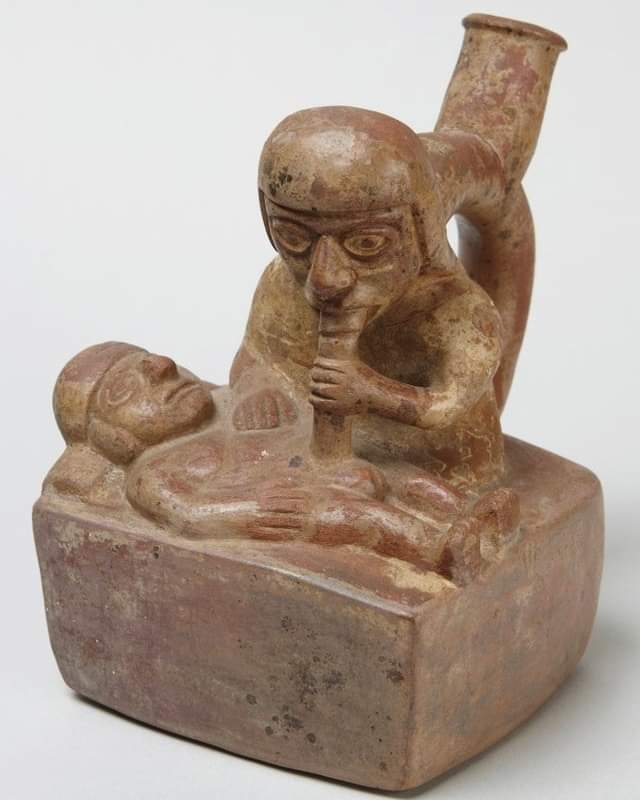
The anal sex in particular is reproduced over and over, in a variety of styles, indicating that it was produced by different artists over a long period of time. To remove any doubt that may arise in minds of the viewer regarding the gender of the penetrated figure, the artist often carved the genitalia carefully, despite their small scale, so as to demonstrate that it is the anus, not the vagina that is being penetrated. Scenes of vaginal penetration are itself extremely rare. Sometimes, accompanying the couples, one can see an infant suckling onto the breast of the female while she is having sex. There are also figures depicting women administering fellatio or masturbating. Some depict male skeletons masturbating, or being masturbated by living women.
“These pots clearly reflect very different notions of sex and reproduction from ones that prevail in the West, and, because of this, a lot of researchers have had trouble making sense of them,” writes UNEARTHING.
The Larco Museum (Museo Larco) in Lima, Peru, displays the largest collection of pre-Columbian erotic pottery. According to Museum, it presents “a conception of sexuality and eroticism inextricably linked to an integrated understanding of the world and its animating vital forces. In the Andean worldview, life is made possible through a generative encounter (tinkuy) between opposite complementary forces (yanantin). Female and male bodies are an expression of this duality.” The images below all come from their collection.
📷 : Stirrup vessel with fellatio scene; Peru, Moche civilization, 300-600 AD. (Larco Museum, Lima 🇵🇪)
#archaeohistories
#ElTestDeBolivar
Ella es @AmarantaHankTw
Aspira al Senado. Apoya a Iván Cepeda.
Conozca que piensa sobre Venezuela, EEUU, el fracking, la Eutanasia…
20 preguntas a quemarropa. Se sorprenderán de sus respuestas.
@swBogotaEsposos@Aiden_Umza Felicitaciones, es muy interesante encontrar estas narrativas del erotismo, la sexualidad y lo transgresor, tan bien tratadas y retratadas, que da envidia no estar en Bogotá y participar. Muchos saludos.
¿Qué fue el Index Librorum Prohibitorum?
Fue una lista de autores y libros que la Iglesia Católica catalogó como heréticas, inmorales o perniciosas para la fe, y que los católicos no estaban autorizados a leer.
Fue promulgado por primera vez por el papa Pío IV en 1564. Tuvo más de 40 ediciones, e incluyó a autores como Rabelais, Hume, Diderot, Balzac, Dumas padre e hijo, Zola, Anatole France, Montaigne, Gide o Sarte entre muchos otros.
También prohibió obras como: Rojo y Negro de Stendhal, Los Miserables o Notre Dame de París de Hugo y Madame Bovary de Flaubert.
La lista es interminable.
El Index Librorum Prohibitorum estuvo vigente hasta que en 1966 Pablo VI lo suprimió.
¿Qué opinan? ¿Algún libro o temática debería estar prohibido?
Periodista: ... ¿y del amor entiende, Borges?
Borges: Sí. Desgraciadamente, sí.
Periodista: ¿Cómo desgraciadamente?
Borges: Porque desgraciadamente pienso que trae más pesares que placeres. Ahora claro que la felicidad que da el amor es tan grande que más vale ser desdichado muchas veces para ser feliz algunas. ¡Es también una cuestión de estadística!
Periodista: Vale la pena entonces ser desdichados muchas veces para ser felices un minuto?
Borges: Sí. Yo creo que sí. Yo creo que todos nosotros hemos sido muy felices con el amor alguna vez y también creo que todos hemos sido muy desdichados muchas veces. El amor le ofrece a uno esa incertidumbre, esa inseguridad del hecho de poder pasar de una felicidad absoluta a la desdicha; pero también de poder pasar de la desdicha a la brusca, a la inesperada felicidad. Pienso que es una experiencia y uno no debe rehusar experiencias.
Julio 1976 - Entrevista a Jorge Luis Borges realizada por Bernardo Neustadt para su programa Tiempo Nuevo.