Nvidia just agreed to pay $290M to settle a shareholder lawsuit tied to its crypto mining exposure.
The lawsuit alleged that Nvidia downplayed how much cryptocurrency mining contributed to gaming chip sales during 2017 and 2018.
- Shareholders argued Nvidia failed to adequately disclose its exposure to crypto mining demand.
- The plaintiffs linked those disclosures to a 28.5% decline in Nvidia shares over just two trading sessions in November 2018.
- Nvidia has now agreed to pay $290M to settle the case.
- The settlement still requires approval from a judge.
This is a reminder of how deeply crypto mining demand was embedded in Nvidia's business during the 2017–2018 bull market.
When crypto demand collapsed, the impact extended far beyond token prices, exposing risks across the broader chip supply chain.
The crypto industry has a history of creating massive opportunities for traditional companies, but its boom-and-bust cycles can be equally costly.
$NVDA
Bitcoin ETFs just recorded their worst month of outflows since launching.
US spot Bitcoin ETFs have seen $4.71B in net outflows in November through November 23, surpassing the previous record of $4.51B set in June 2026.
The selling pressure is accelerating:
ETFs recorded five consecutive sessions of outflows from November 17, totaling $2.37B.
On November 23 alone, $570M left US spot Bitcoin ETFs.
BlackRock's $IBIT accounted for $509M of Monday's outflows, approximately 89% of the total.
Bitcoin traded at $59,667, down 5.0% over the past 24 hours.
Our take: Institutional demand for Bitcoin is deteriorating rapidly. A record $4.71B in monthly redemptions, combined with five consecutive days of outflows, signals that investors are aggressively reducing exposure.
The biggest concern is that selling pressure continues even through the largest institutional ETF vehicles.
We remain cautious on Bitcoin until ETF flows stabilize. A sustained reversal in institutional demand will be critical for rebuilding market confidence.
BREAKING: Bitcoin falls to $61,342 and gives back almost all of this morning's rally as US stocks trade lower.
bitcoin:native is now down 4.5% since the 9:30 AM ET opening bell.
ethereum:native is down 5.2% to $1,739.
Both peaked at 9:25 AM ET, 5 minutes before the open.
Bitcoin now sits just 0.2% above its 8:45 AM ET price, which was its level before the morning jump.
That means nearly the whole rally disappeared in about 4 hours.
Meanwhile, solana:So11111111111111111111111111111111111111112 is down 6.1% and Hyperliquid's $HYPE is down 5.3% over the same window.
The stock market open marked the top for crypto today.
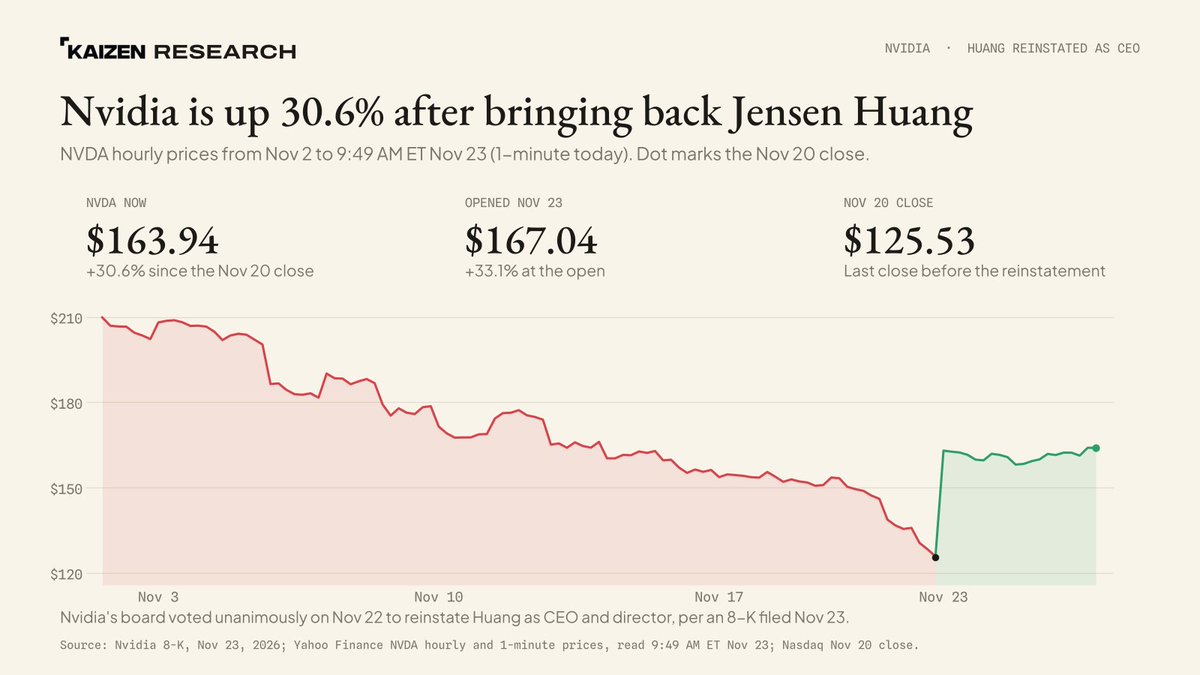
$NVDA is up 30.6% at $163.94 after its board reinstated Jensen Huang as CEO.
- The board voted unanimously on Nov 22, per an 8-K filed Nov 23. On Nov 17, board chair Harvey Jones said it had no plan to bring him back
- The Nasdaq 100 ETF $QQQ is up 6.1% since the Nov 20 close
- Crypto moved over the same stretch: $BTC is up 7.8% at $62,908 and $ETH 11.4% at $1,781 (Coinbase)
ARK Invest bought $90.9M of Anthropic on its first day of trading while selling crypto ETF exposure.
Cathie Wood's funds purchased 934,968 shares of $ANT on November 19, valued at $90.9M at the closing price of $97.17.
ARKK led purchases with 556,777 ANT shares. Five other ARK funds bought the remainder.
$ARKW and $ARKF sold 425,000 shares of 3iQ's Ethereum staking ETF and 200,000 shares of its Solana staking ETF, worth approximately $4.1M combined.
$ARKQ sold 33,430 $NVDA shares, worth approximately $4.9M.
ANT fell 6.6% to $90.74 by 9:45 AM ET on November 20, bringing ARK's stake value down to approximately $84.8M.
ARK is making a clear bet on AI exposure, buying Anthropic aggressively on day one while trimming positions across crypto ETFs and Nvidia.
This is worth watching. Institutional capital is increasingly choosing which parts of the technology trade deserve a premium.
The AI trade continues to attract capital, even as parts of the crypto trade face sustained selling pressure.
Bitcoin ETF investors just recorded their largest single-day exit on record.
BlackRock's $IBIT suffered $541.1M in net outflows on November 19, its worst day since launching in January 2024.
The broader market is showing similar weakness. US spot Bitcoin ETFs recorded $582.3M in combined outflows, marking their third consecutive day of redemptions.
Here's what stands out:
- IBIT's previous record outflow was $528.3M on January 30, 2026.
- November outflows have reached $3.47B, making it the third-worst month since launch.
- IBIT accounts for 85% of November's outflows, totaling $2.94B.
- Morgan Stanley's $MSBT was the biggest bright spot, attracting $49.6M.
- Spot Ethereum ETFs also saw $131.2M leave on the same day.
Institutional demand for Bitcoin is weakening at a critical moment. IBIT alone is responsible for the overwhelming majority of November's ETF outflows, suggesting selling pressure is concentrated in one of the market's largest institutional vehicles.
Three consecutive days of outflows and $3.47B in monthly redemptions are difficult to dismiss.
Until ETF flows turn consistently positive, we remain cautious on the near-term outlook for Bitcoin.
Coinbase just hit its lowest closing price in 3 years. And the broader crypto market is showing little sign of relief.
$COIN closed at $110.51 on November 18, its lowest level since November 22, 2023.
The stock fell 3.9% on the day and is now down 74% from its July 2025 peak of $419.78.
The weakness is spreading across crypto-linked equities:
- Strategy ($MSTR) dropped 6.4% to $90.32.
- Circle ($CRCL) fell 2.4% to $53.31.
- Robinhood ($HOOD) was flat at $69.17.
- $BTC fell 2.2% to $62,534.
- $ETH dropped 2.6% to $1,752.
- $SOL held at $72.98, while $HYPE declined 2.3% to $66.72.
This is becoming more than a Bitcoin selloff. Crypto-linked equities are experiencing significant multiple compression as risk appetite continues to deteriorate.
Coinbase is now back to levels last seen before the 2024 bull market, erasing nearly all the gains from the subsequent rally.
The market is repricing the entire crypto trade. Until Bitcoin stabilizes, we expect pressure to remain across the sector.
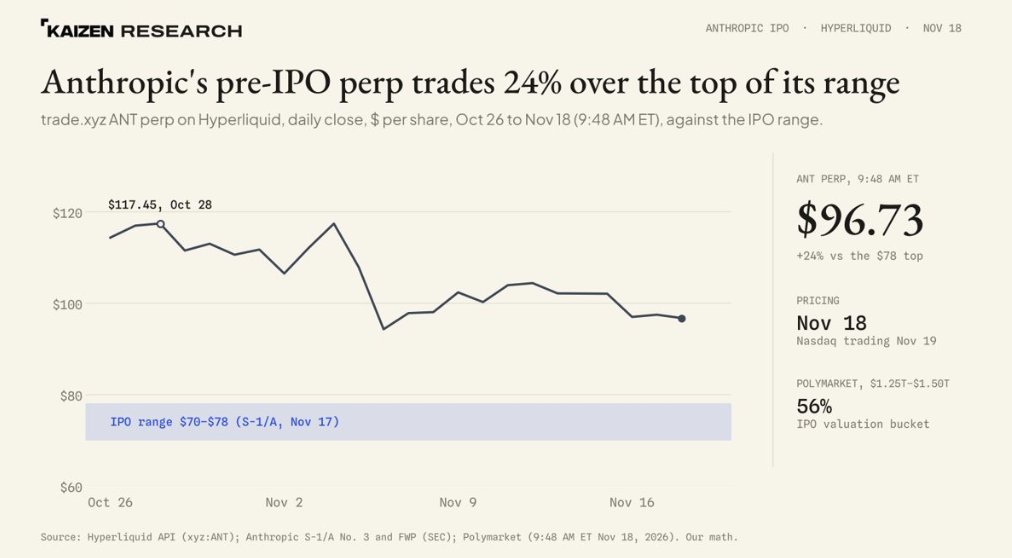
Anthropic's pre-IPO perpetual contract is trading 24% above the top of its expected IPO range.
The ANT perp on Hyperliquid traded at $96.73 as of November 18, compared with the proposed IPO range of $70–$78 per share.
Here's what the market is telling us:
- Anthropic is offering 825M shares at $70–$78, implying a $57.75B–$64.35B capital raise.
- The perp reached a daily closing high of $117.45 on October 28 and is now down 17.6% from that level.
- Traders have already moved $77.5M through the contract in the past 24 hours.
- Polymarket gives a 56% probability to an IPO valuation between $1.25T and $1.50T, with another 35% betting on $1.50T–$1.75T.
Anthropic expects to price its IPO today, November 18, ahead of its Nasdaq debut under ticker ANT on November 19.
Demand for Anthropic exposure is clearly running hot.
The pre-IPO perp is trading at a meaningful premium to the proposed IPO range, while prediction markets are pricing in a valuation that would put Anthropic among the world's largest public companies.
The interesting part is that investors are already bidding up exposure before the company has even completed its IPO.
The AI investment frenzy is moving beyond public markets. And Anthropic could be its next major test.
$ANT
Nvidia just delivered another monster quarter. And the numbers are getting harder to ignore.
$NVDA Q3 earnings:
1. Record revenue of $115.8B, beating expectations.
2. Record Data Center revenue of $107.6B, beating expectations.
3. Record net income of $65.3B, beating expectations.
4. Q4 revenue guidance of $130B, above expectations.
5. Announces a new $150B stock buyback program.
Every major metric came in above expectations, with the company guiding for another record quarter.
The AI trade is not showing signs of slowing down at the infrastructure level. Demand for computing power continues to translate into extraordinary revenue and earnings growth.
The bigger question is no longer whether AI infrastructure spending is real.
It’s how long this level of demand can be sustained, and how much of that growth is already priced into Nvidia’s valuation.
For now, Nvidia continues to set the pace for the entire AI trade.
Backpack just secured the regulatory green light to bring crypto perpetuals trading to the US.
The CFTC approved Backpack's US derivatives exchange and clearinghouse licenses on November 16, clearing two major regulatory hurdles for its planned US launch.
The market reacted quickly. Backpack's BP token surged 31%, from $0.84 to $1.10.
Here's why this matters:
Binance processed $61.3B in perpetuals volume over 24 hours, versus just $1.46B across Kalshi's CFTC-regulated perpetuals. That's a 42x difference.
The CFTC's November 13 order allows Backpack Clearing to clear futures on a margined basis.
Backpack US President Mark Wetjen, a former CFTC commissioner, says the goal is to bring price discovery from offshore venues into the US.
No US launch date or initial contracts have been announced.
Our take: This is a significant step toward bringing crypto derivatives into regulated US markets.
The opportunity is massive: offshore platforms currently dominate perpetuals trading, while US-regulated alternatives remain tiny by comparison.
Backpack now has a regulatory pathway to compete for that volume. The real test will be execution: liquidity, product offering, and whether US traders actually migrate onshore.
solana:BPxxfRCXkUVhig4HS1Lh7kZqV6SPJhzfEk4x6fVBjPCy
Bitcoin ETF inflows just flashed their first sign of life in 12 sessions.
BlackRock's $IBIT attracted $76.5M on Nov. 16, ending an 11-day outflow streak that saw $2.35B leave the fund.
However, the broader picture remains weak. All US spot Bitcoin ETFs recorded just $7.9M in net inflows, with 7 of 12 funds still posting outflows. Grayscale led redemptions at $34.6M, followed by Fidelity at $11.3M.
More importantly, IBIT's latest inflow represents just 3% of the capital it lost during the previous outflow streak. Its last positive flow was October 29.
Our take: One day of inflows does not signal a reversal. Institutional demand remains fragile, and Bitcoin needs sustained, broad-based ETF inflows before we can call this a meaningful shift in sentiment.
Until then, this looks more like a pause in selling than the return of institutional buyers.
bitcoin:native traded at $64,892 as of 9:50 AM ET on November 17.
Kicked out of school at 16, now he is a millionaire (full interview with @thebrianjung)
0:00 trailer
3:55 from credit card hacks
8:05 the best money he's ever spent
18:24 cashcat $80,000 to $1m
38:24 becoming a dad
52:17 quick-fire + advice to younger self
Bitcoin is testing one of its most important long-term technical levels.
bitcoin:native fell to $67,555 overnight, bringing it back to its 200-week moving average near $68,000, a level that has historically been closely watched during major market drawdowns.
The selling pressure is building:
Spot Bitcoin ETFs recorded $284M in outflows on Nov. 12, marking six consecutive days of withdrawals.
Total ETF outflows over that period reached $1.72B.
BlackRock's $IBIT has now recorded 10 consecutive sessions of outflows, totaling $2.21B.
The Crypto Fear & Greed Index has fallen to 20, its lowest reading since July.
The bigger concern is the combination of technical weakness, institutional outflows and deteriorating sentiment.
Bitcoin is now testing a major long-term support level at the same time institutional demand is moving in the opposite direction.
The $68,000 level could prove critical for the next phase of this market.
Gemini's latest earnings reveal a much bigger problem than a revenue miss.
The exchange generated just $4.5B in trading volume in Q3, down 73% year-over-year from $16.4B.
A few numbers stand out:
- Exchange revenue fell 47% YoY to $13.4M.
- 26% of Q3 spot volume came from customers trading with Gemini's own market maker.
- Total trading volume recovered 18% QoQ, but remains nowhere near prior-year levels.
- Services revenue and interest income now account for 59% of net revenue.
The key takeaway: Gemini's core exchange business is struggling to regain traction, while its revenue mix is becoming increasingly dependent on non-trading activities.
The QoQ recovery is encouraging, but the 73% annual decline highlights just how much trading activity has left the platform.
$GEMI shares rose 3.4% after hours.
Nvidia just made a potentially historic mistake.
Jensen Huang should never have stepped down. The board should have slowed down, consulted shareholders, and carefully evaluated the long-term consequences.
There is no obvious replacement for Jensen. His leadership is a massive part of Nvidia’s competitive advantage.
His departure could go down as the most expensive mistake of the AI revolution.
$NVDA
Crypto stocks are outperforming the underlying asset today.
$HOOD is up 5.7%, $COIN 5.0% and $CRCL 5.4%, while bitcoin:native is up just 1.0%.
HOOD is trading at $85.98, up from yesterday’s $81.33 close, as the Nasdaq gains 2.3%.
$MSTR is lagging at +1.6%.
Risk appetite is extending beyond crypto itself.
Investors are bidding up the equity proxies as they provide regulatory certainty, with exchanges and crypto platforms leading the move.
Bitcoin doesn't need to do all the heavy lifting today.
Polymarket puts the odds that MSCI drops Strategy at 83.5%.
MSCI posts its decision shortly after 5:00 PM today.
MSCI's Oct 15 screen marked Strategy ($MSTR) for deletion under its new rules for non-operating companies.
Changes take effect at the close on Nov 30.
- Strategy had a $40.3B float-adjusted market cap on MSCI's Oct 9 data, 93.6% of the value on the deletion screen
- Metaplanet, Yellow Cake, Skel and Upexi are also on that screen. SharpLink is on MSCI's watchlist
- Strategy held 850,364 bitcoin as of Nov 8
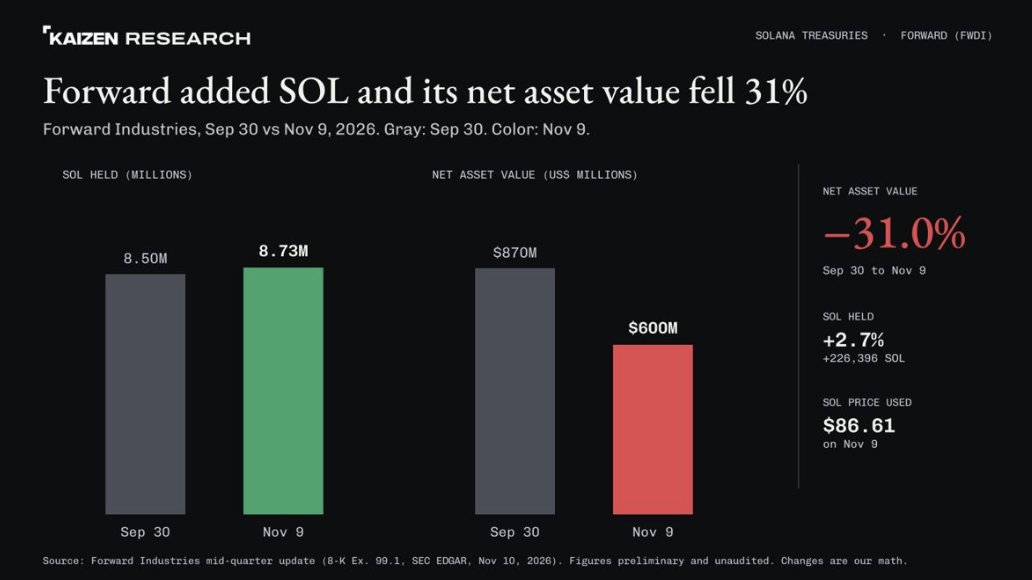
Forward Industries added 226,396 SOL from Oct 1 to Nov 9.
Its net asset value fell 31% to $600.3M.
SOL fell 26.6% from Sep 30 to Nov 9. Forward holds 8.73M SOL.
- solana:So11111111111111111111111111111111111111112 per fully diluted share rose 2.3% to 0.0824
- Forward's common stock traded at 0.70 times net asset value per share on Nov 9
- Forward took a $50M two-year loan at SOFR plus 1.5%, backed by SOL that stays staked
- Upexi booked $89.1M of net income in the quarter to Sep 30 (on a $102.0M unrealized gain) and sold 53,000 SOL
$FWDI
CoreWeave's third-quarter revenue rose 168% to $3.66B. It raised its 2026 revenue forecast to $13.0B to $13.3B.
Its loss of $1.27 a share beat the $1.45 consensus loss listed by Nasdaq.
- The net loss widened to $709M from $110M, as interest expense rose to $846M from $310M
- CoreWeave expects $1.05B to $1.15B of interest expense in the fourth quarter
- Revenue backlog stood at $132.5B on Sep 30
- It now plans $37B to $39B of capital spending in 2026, raising the low end from $35B
$CRWV
$MARA rose 12% this morning after its third-quarter results.
Strategy fell 2.5% and Coinbase 2.3%.
- MARA sold 13,597 bitcoin after the quarter and repaid $750.0M of bitcoin-backed loans
- MARA got back 17,477 pledged bitcoin and now has less than 5% of its holdings loaned or pledged
- Its board authorized a $500M buyback after the quarter