Gemini’s car crash is more than a botched launch or political gaffe, it’s the result of a stark reality: Google is getting disrupted by AI. I first wrote about this shortly after ChatGPT’s launch. The situation has since worsened.
Disruption Theory is quite personal to me. I was lucky enough to (briefly) be taught a class by Clay Christensen, the creator of Disruption Theory and The Innovator’s Dilemma before he died the next year. I then spent much of my second year at Harvard conducting academic study on the Disruption Theory course itself (which admittedly I chose partly because it didn’t require classes and I wanted a three-day weekend). I have been interested in Christensen’s work for some time and am always looking for opportunities to apply it.
Let’s start briefly with the theory itself. The Innovator’s Dilemma states that a market leader (“incumbent”) with a higher margin product and large market share will often struggle to respond to a new entrant (“disruptor”), which offers a product which is lower-margin, cheaper or serves a less attractive segment. The incumbent struggles because they are naturally focused on protecting the scale and margins of their core product and customers, while the disruptor eventually innovates upmarket into the higher-margin categories and steals share.
Some people have argued that this does not apply to Google, because they have a strong incentive to offer AI products to their search users, so they will inevitably use their huge data advantage to eventually ship the best AI.
The problem with this view is that it is based on a misunderstanding of who Google’s customer is. Users are not the customer; advertisers are. Users, as has been clichéd into oblivion, are the product.
Google has limited incentive to develop and promote a good alternative to ChatGPT because AI outputs are not an advertiser friendly product.
10 blue links can easily be injected with relevant ads, while AI outputs cannot. Let’s consider an example. One of the most valuable Google search terms is “best motorcycle accident lawyer”. In search, it would be quite natural to show a relevant ad for a claims lawyer here. What about LLMs? An AI-generated table with the names, phone numbers, a description, case win rate and brief rating of each lawyer would not be as easy to inject an ad into. The beauty of Google’s search ad business is that the organic links themselves share a format with ads (a link), so ads don’t meaningfully change the user interface. Implanting AI outputs, however, with ads would effectively make the entire output an ad, and reduce its trustworthiness in consumers’ eyes. On top of this, Gemini’s bias itself is another Innovator’s Dilemma. Google thinks that offensive AI output could threaten ad spend, so they injected “woke” bias into every response. OpenAI don’t need to do this; its clients are users and enterprises, who want accuracy above ideology.
In other words, Google is being disrupted by AI because AI outputs hinder them from selling more ads. It is classic Christensen disruption.
And how would Christensen predict that Google respond?
In precisely this way:
1. First do nothing, allowing the disruptor to become established
✅ Google waited until after ChatGPT to launch Bard and Gemini, despite inventing transformers first
2. Set up a disappointing sub-product to compete, without changing their core product
✅ Bard and Gemini launches were plagued by bad branding, fake videos and comically inaccurate and biased responses. They have hardly adapted search
3. Prioritise internal battles, failing to adequately understand the threat
✅ Sundar’s letter was more focused on “offensiveness” than the AI threat to Google. Somehow this whole conversation has become about DEI
Google is following the decades-long path to disruption. Once in motion, it’s almost impossible to escape. Replacing the CEO may be a necessary step, but it alone will not be sufficient.
Looking at an investment that several smart VCs I know passed on because the underlying technology is too early.
I don't see that as a bad thing, since if a technology is not generally seen as too early, it's probably too late.
They haven’t, but maybe they should.
Airlines have been consistently going bankrupt since the 1920s, while aerospace manufacturers are among the most durable and high-quality businesses ever.
Position in the value chain matters. Even, and especially, in booming industries.
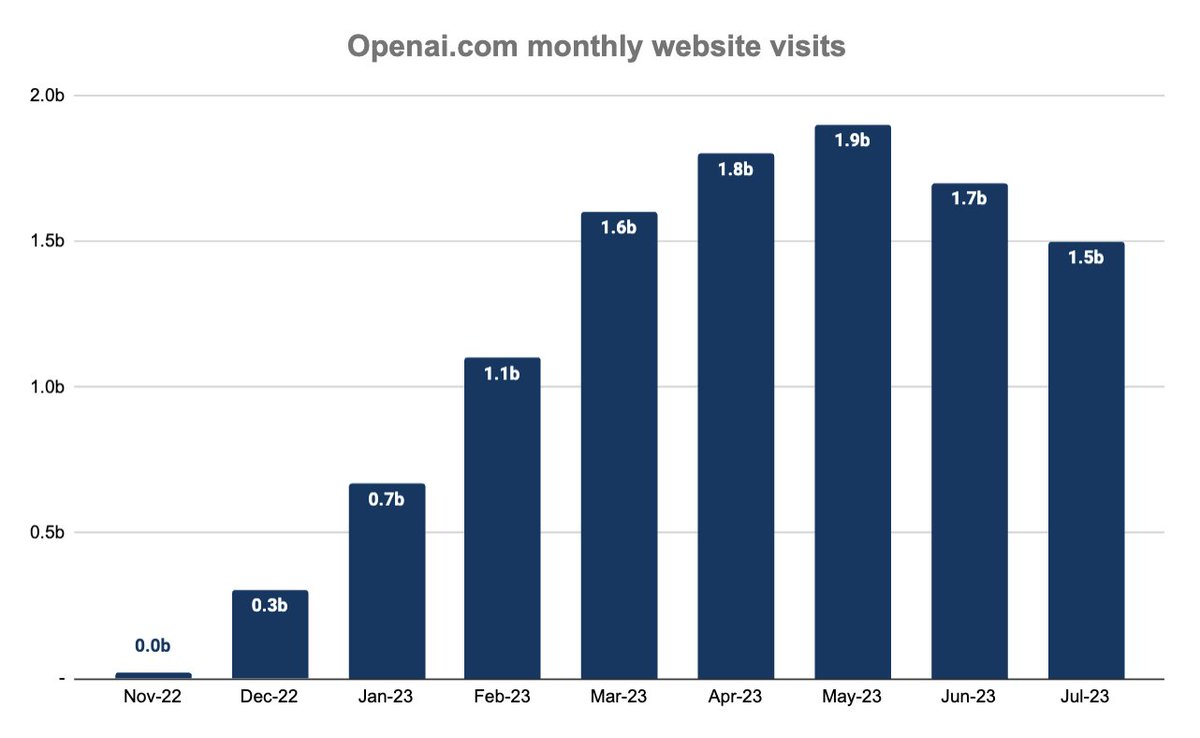
Wow. latest @Similarweb OpenAI / ChatGPT data dropped this morning. Visits fell another 12% MoM from 1.7 billion in June to 1.5 billion in July.
Lower than March (1.6 billion), its 4th ever month...
The LLM churn is real
eSIM is one of the most attractive, highest growth, biggest new markets in the world, and investors are sleeping on it.
It’s not sexy, but there’s a tectonic shift in how users interact with telcos at home and abroad, caused by eSIM.
Many new uni/decacorns are coming.
Intelligence, charisma and integrity rarely coexist in one person. @CornelWest has a superhuman mix of the three.
Briefly studying under him ranks among my greatest sources of pride. Underestimate his candidacy at your peril.
My only fear is the culture war he is wading into.
Inflation coming in high again, despite a continued slowdown in shelter growth but because of a (temporary?) rebound in goods prices. The core CPI at an annual rate:
1 month: 5.0%
3 months: 5.1%
6 months: 4.8%
12 months: 5.5%
@SashaKaletsky Also $TSLA has no chance of maintaining $GOOG, $MSFT, $AAPL-type monopoly, profits or prices, because EV production enjoys ZERO network effects: https://t.co/I3XTt3hRN7
Why $TSLA stock is falling so fast:
A 20% decrease in revenue wouldn’t wipe out 20% of profits, it could wipe out 100% of profits. Operating leverage hurts on the way down.
Last year @caspar_lee + I at https://t.co/u933up3cEJ had a great intern painstakingly map every company founded by a creator/celebrity.
We tracked >500 companies' subsector, Insta audience/growth (creator+co.) + GoogleTrends.
May be useful to some. Pls reply/RT/DM + I'll share.
Boris is out!
Beautifully fitting that in his (hopefully) final statement as a PM candidate, he ended on the lie that he had 100 MPs supporting him -- gotta keep it on brand!
@rafaelbehr But sadly Starmer missed the really important question: Will this huge extra borrowing lead to higher interest rates and/or inflation? Everyone thinks so (although I think this consensus may be wrong). Thus Labour's attack should be against inflation/interest rates, not tax cuts.
@vkbaxi@PJTheEconomist@TheIFS Reducing real incomes, attacking unions, and controlling prices and wages could indeed produce "social/industrial unrest" in the end. But that took many years in the 1960s and 1970s. So why shouldn't these policies work Truss/Scholz etc between now and the elections in 2024?
@georgemagnus1@ProfTimBale@jamesjohnson252 PS Price and wage controls plus huge fiscal spending and borrowing are typical in every major war. Why should this one be different?
@georgemagnus1@ProfTimBale@jamesjohnson252 There's no idle capacity/unemployment at present, but there will be plenty by January as a result of the energy price surge. Energy subsidies will help to avoid this - at the cost of higher interest rates (definitely) and permanently embedded inflation (probably).