Make Africa Great 4Ever. Project Developer. Lead Negotiator of the Africa Group on CC. Former Chair of the Santiago Network Opinions expressed here are my own
COP31 in Antalya: the failure of a decision, not of a line
COP31 ended on Sunday 22 November in Antalya with no cover decision. After two days of overtime, at the close of the longest climate conference ever held, the draft Antalya Pact failed to win the consensus of the roughly 190 countries present. It is the first breakdown on this scale since Copenhagen in 2009 (CNN; IPS, 22 November 2026).
The COP President, Türkiye's Murat Kurum, acknowledged it plainly: parties oppose the text, and there is no consensus. The negotiations themselves were steered by Australia's Chris Bowen, President of Negotiations.
For an African delegation, this failure does not move the line. The multilateral process remains the only arena where a continent with limited individual weight can hold developed countries to their commitments. The delegation's job was to secure the means of implementation. What advanced outside the cover decision must be defended; the essentials, adaptation finance and a financed just transition, are pushed to COP32, which Ethiopia will host in Addis Ababa.
A contested presidency, no consensus
The breaking point was, as so often, two words: fossil fuels. The first draft called for the transition away from fossil fuels in energy systems. Every reference vanished from later versions, despite pressure from more than 130 countries (IPS). The European Union, the United Kingdom, Panama, the Marshall Islands and Norway then rejected the text, with the EU even walking out of the closing plenary (CNN).
This rejection should be read without naivety. Refusing a weak text does not make a bloc a climate champion. The African Group of Negotiators, through its chair Nana Dr Antwi-Boasiako Amoah, took aim at method as much as substance: the presidency's responsibility is to facilitate consensus, not to impose an outcome (MyJoyOnline, 22 November 2026). Civil society voices put it more bluntly: those who decried the absence of fossil fuel language had, for two weeks, blocked the finance that would make such a transition possible beyond Europe.
Adaptation, sidelined
An earlier draft proposed raising adaptation finance to at least 120 billion dollars a year by 2035. The figure was removed; the text that was finally rejected kept only an intention to triple, with no baseline year and no number, and therefore no operational force (IPS; CNN). Because the cover decision collapsed, even that intention carries no legal weight.
The orders of magnitude show why this goes beyond symbolism. UNEP, in its 2026 Adaptation Gap Report, puts developing countries' needs at around 305 billion dollars a year by 2035, and warns that a tripling would still leave more than 70 percent of those needs unmet. The real trajectory runs counter to the speeches: adaptation finance has fallen, from 81.5 billion in 2022 to 64.1 billion in 2024 (UN Climate Yearbook 2026).
Just transition: Africa's conditions
Language on moving away from fossil fuels and on accelerated action also left the text, sending the question to Addis Ababa with nothing secured. For Africa, the transition will be just only on three conditions.
• Energy access first: close to 720 million people still lacked electricity worldwide at the end of 2025, most of them in sub-Saharan Africa (IEA, 12 November 2026). • Local processing of critical minerals next, rather than the export of raw materials. • The protection of workers and farmers last.
A uniform phase-out imposed without means ignores the realities of development.
What the failure changes for Guinea
Guinea presented its NDC 3.0 in Antalya, costed at 17.7 billion dollars, for an emissions cut of 17 percent unconditionally and up to 49 percent with international support by 2035. These ambitions remain largely conditional as long as finance is not delivered.
And the country is exposed: according to the World Bank, climate change could cut its GDP by 11.6 percent by 2050, hitting the poorest first, and adaptation could halve that impact (Country Climate and Development Report, disclosed February 2026). The vulnerability stems above all from an almost carbon-free economy that depends on hydropower, and is therefore sensitive to rainfall variability.
The absence of a decision on a baseline delays the predictable access to public and concessional resources on which the most vulnerable countries depend. For Guinea, climate risk finance, support for a just transition around the mining sector, and effective access to multilateral funds will have to be won back in Addis Ababa. Without means, NDC 3.0 and the adaptation plans remain documents, not programmes.
Staying at the table
The failure of a decision does not invalidate the choice to stay in the process. Africa's line stands: protect the Paris framework, which is not in question, demand delivery of the means of implementation, and hold the table through to COP32. As the African Group put it, implementation needs means of implementation. Multilateralism remains imperfect, but it is the only place where the obligations of developed countries can be made enforceable.
KEY TAKEAWAYS
COP31 closed on 22 November with no cover decision: fossil fuel language and the adaptation figure were stripped from the text, the EU and vulnerable countries rejected it, and nothing was secured in law. • The real gap is finance: adaptation needs are estimated at $305bn/yr by 2035 (UNEP), while flows fell to $64bn in 2024; rejecting a weak text is not the same as delivering the means. • For Guinea (NDC 3.0 at $17.7bn; GDP potentially cut by 11.6% by 2050), the fight is won back in Addis Ababa: a baseline, grants, and effective access.
Alpha KALOGA
Climate finance specialist
Conakry, Guinea
#COP31 #ClimateFinance #Adaptation #Africa #Guinea
COP31 à Antalya : l'échec d'une décision, pas d'une ligne
La COP31 s'est achevée le dimanche 22 novembre à Antalya sans décision de couverture. Après deux jours de prolongation, au terme de la plus longue conférence climatique jamais tenue, le projet de Pacte d'Antalya n'a pas réuni le consensus des quelque 190 pays présents. C'est la première rupture de cette ampleur depuis Copenhague, en 2009 (CNN ; IPS, 22 novembre 2026).
Le président de la COP, le Turc Murat Kurum, l'a constaté sans détour : des Parties s'opposent au texte, il n'y a pas de consensus. La conduite des négociations revenait, elle, à l'Australien Chris Bowen, président des négociations.
Pour une délégation africaine, cet échec ne déplace pas la ligne. Le processus multilatéral reste le seul espace où un continent au poids individuel limité peut tenir les pays développés à leurs engagements. Le métier de la délégation était d'arracher les moyens de mise en œuvre. Ce qui a avancé en dehors de la décision de couverture doit être défendu ; l'essentiel, le financement de l'adaptation et une transition juste financée, est reporté à la COP32, que l'Éthiopie accueillera à Addis-Abeba.
Une présidence contestée, un consensus introuvable
Le point de rupture fut, comme souvent, deux mots : énergies fossiles. Le premier projet appelait à la transition hors des énergies fossiles dans les systèmes énergétiques. Toute référence a disparu des versions suivantes, malgré la pression de plus de 130 pays (IPS). L'Union européenne, le Royaume-Uni, le Panama, les Îles Marshall et la Norvège ont alors rejeté le texte, l'UE quittant même la plénière de clôture (CNN).
Il faut lire ce rejet sans naïveté. Refuser un texte faible ne fait pas d'un bloc un champion du climat. Le Groupe africain des négociateurs, par la voix de son président Nana Dr Antwi-Boasiako Amoah, a visé autant la méthode que le fond : la responsabilité de la présidence est de faciliter le consensus, pas d'imposer un résultat (MyJoyOnline, 22 novembre 2026). Des voix de la société civile l'ont dit plus crûment : les mêmes qui s'indignaient de l'absence de langage sur les fossiles avaient, deux semaines durant, bloqué le financement qui rendrait cette sortie possible ailleurs qu'en Europe.
L'adaptation, reléguée
Un projet antérieur proposait de porter le financement de l'adaptation à au moins 120 milliards de dollars par an d'ici 2035. Le montant a été retiré ; le texte finalement rejeté ne conservait qu'une intention de tripler, sans année de référence ni chiffre, donc sans portée opérationnelle (IPS ; CNN). Comme la décision de couverture est tombée, même cette intention n'a aucune valeur juridique.
L'ordre de grandeur rappelle pourquoi l'enjeu dépasse la symbolique. Le PNUE, dans son Rapport 2026 sur l'écart d'adaptation, évalue les besoins des pays en développement à environ 305 milliards de dollars par an d'ici 2035, et prévient qu'un triplement laisserait plus de 70 pour cent de ces besoins non couverts. La trajectoire réelle va d'ailleurs à rebours des discours : le financement de l'adaptation a reculé, de 81,5 milliards en 2022 à 64,1 milliards en 2024 (Annuaire ONU Climat 2026).
Transition juste : les conditions africaines
Le langage sur la sortie des fossiles et l'action accélérée a lui aussi quitté le texte, renvoyant la question à Addis-Abeba sans acquis. Pour l'Afrique, la transition ne sera juste qu'à trois conditions.
• L'accès à l'énergie d'abord : près de 720 millions de personnes restaient privées d'électricité dans le monde fin 2025, l'essentiel en Afrique subsaharienne (AIE, 12 novembre 2026).
• La transformation locale des minéraux critiques ensuite, plutôt que l'exportation de matières brutes.
• La protection des travailleurs et des agriculteurs enfin.
Une sortie uniforme imposée sans moyens ignore les réalités du développement.
Ce que l'échec change pour la Guinée
La Guinée a présenté à Antalya sa CDN 3.0, dont la mise en œuvre est estimée à 17,7 milliards de dollars, pour une réduction d'émissions de 17 pour cent inconditionnelle et jusqu'à 49 pour cent avec un soutien international d'ici 2035. Ces ambitions restent largement conditionnelles tant que le financement n'est pas livré.
Or le pays est exposé : selon la Banque mondiale, le changement climatique pourrait amputer son PIB de 11,6 pour cent d'ici 2050, en frappant d'abord les plus pauvres, et l'adaptation pourrait réduire de moitié cet impact (Rapport pays climat et développement, divulgué en février 2026). La vulnérabilité tient surtout à une économie quasi décarbonée mais dépendante de l'hydroélectricité, donc sensible à la variabilité des pluies.
L'absence de décision sur une base de référence retarde l'accès prévisible aux ressources publiques et concessionnelles dont dépendent les pays les plus vulnérables. Pour la Guinée, le financement des risques climatiques, le soutien à une transition juste autour du secteur minier et l'accès effectif aux fonds multilatéraux devront être reconquis à Addis-Abeba. Sans moyens, la CDN 3.0 et les plans d'adaptation restent des documents, pas des programmes.
Rester à la table
L'échec d'une décision n'invalide pas le choix de rester dans le processus. La ligne africaine demeure : préserver le cadre de Paris, qui n'est pas en cause, exiger la livraison des moyens de mise en œuvre, et tenir la table jusqu'à la COP32. Comme l'a résumé le Groupe africain, la mise en œuvre exige des moyens de mise en œuvre. Le multilatéralisme reste imparfait, mais c'est le seul lieu où les obligations des pays développés peuvent être rendues exigibles.
À RETENIR
• La COP31 s'est close le 22 novembre sans décision de couverture : fossiles et chiffre d'adaptation retirés du texte, rejet de l'UE et de pays vulnérables, aucun acquis juridique.
• Le vrai déficit est le financement : besoins d'adaptation estimés à 305 Md$/an d'ici 2035 (PNUE), quand les flux ont reculé à 64 Md$ en 2024 ; rejeter un texte faible ne vaut pas livrer les moyens.
• Pour la Guinée (CDN 3.0 à 17,7 Md$ ; PIB possiblement amputé de 11,6 % d'ici 2050), l'enjeu se reconquiert à Addis-Abeba : base de référence, dons, accès effectif.
Alpha KALOGA
Spécialiste de la finance climatique
GreenTransformation2050 (GT2050)
Conakry, Guinée
#COP31 #FinanceClimatique #Adaptation #Afrique #Guinée #JustTransition
The Carbon Markets Africa Summit in Kigali closed last week with a clear instruction: move from potential to delivery. For Guinea, that instruction arrives at a useful moment. The country is only weeks away from COP31 in Antalya and the Green Climate Fund Board meeting in Songdo. The practical question is no longer whether Africa will sell carbon credits. It is under what terms.
The voluntary market remains thin. In 2024, declared transaction value fell to roughly 535 million dollars, down 29 percent in a year (Ecosystem Marketplace, 2025). African credits trade near 7.5 dollars per tonne, against a global average of about 6.3 dollars. European compliance allowances, by contrast, have traded between 60 and 90 euros. The Africa Carbon Markets Initiative’s target of 300 million credits a year by 2030 remains an ambition, not a market reality.
Science imposes caution. A meta-analysis in Nature Communications finds that less than 16 percent of the credits examined, drawn from nearly 2,350 projects, correspond to real emission reductions (Probst et al., 2024). Quasi-experimental work on avoided deforestation reaches similar conclusions for most projects (West et al., 2023). Clean-cooking projects, among the most common in Africa, show particularly large gaps between claimed and measured outcomes (Gill-Wiehl et al., 2024). These are estimates, not final verdicts. They do, however, show that a poorly measured credit sells once and then discounts the entire market.
Ghana and Senegal have already moved under Article 6. In July 2025 Ghana transferred nearly 11,700 ITMOs to the Swiss KliK Foundation for a clean-cooking activity, the first such African issuance for NDC use. In September 2026 Senegal and Switzerland authorised the first credits under a Dakar taxi electrification programme. Both cases rest on corresponding adjustments. Without them the same credit is counted twice.
Guinea starts from a near-blank page. Its NDC 3.0, validated in Conakry in October 2025, estimates needs at 17.7 billion dollars for 2026-2035, of which 8.4 billion is for adaptation, and states an intention to use Articles 6.2 and 6.4. The country is also preparing a carbon price in the mining sector from 2027, which would make it the first in West Africa and the first in Africa to apply it by sector. A national carbon-markets cell is being formed, a registry is planned but not yet operational, and no bilateral agreement has been signed.
That delay is useful. It leaves time to set conditions on quality, traceability, community rights and revenue sharing before the tap is opened. The risk is not selling too little. It is selling too fast and too low an asset the country cannot sell twice.
#gt2050, #MEDD
The Carbon Markets Africa Summit in Kigali closed last week with a call to move from potential to delivery. For Guinea the timing matters: COP31 in Antalya and the Green Climate Fund Board meeting in Songdo are only weeks away. The practical question is now the terms on which Africa sells carbon credits.
The voluntary market is still thin. Declared transaction value fell by 29 percent in 2024, to roughly 535 million dollars (Ecosystem Marketplace, 2025). African credits trade near 7.5 dollars per tonne, above a global average of about 6.3 dollars, while European compliance allowances have traded between 60 and 90 euros. The Africa Carbon Markets Initiative’s target of 300 million credits a year by 2030 is still only a target.
The research gives reasons for caution. A meta-analysis in Nature Communications finds that less than 16 percent of the credits examined, drawn from nearly 2,350 projects, correspond to real emission reductions (Probst et al., 2024). Quasi-experimental studies of avoided deforestation reach similar conclusions for most projects (West et al., 2023), and clean-cooking projects, among the most common in Africa, show particularly large gaps between claimed and measured outcomes (Gill-Wiehl et al., 2024). These figures are estimates and may be revised. Even so, they show that a poorly measured credit can be sold once, after which buyers discount the whole market.
Ghana and Senegal have already acted under Article 6. In July 2025 Ghana transferred nearly 11,700 ITMOs to the Swiss KliK Foundation for a clean-cooking activity, the first such African issuance for NDC use. In September 2026 Senegal and Switzerland authorised the first credits under a Dakar taxi electrification programme. Both transactions rest on corresponding adjustments, without which the same credit would be counted twice.
Guinea is starting almost from scratch. Its NDC 3.0, validated in Conakry in October 2025, puts needs for 2026-2035 at 17.7 billion dollars, 8.4 billion of it for adaptation, and states the intention to use Articles 6.2 and 6.4. The country is also preparing a carbon price for the mining sector from 2027, which would make it the first in West Africa, and the first in Africa, to apply one by sector. A national carbon-markets cell is being set up and a registry is planned but not yet operational. No bilateral agreement has been signed.
The delay works in Guinea’s favour, because it leaves time to set conditions on quality, traceability, community rights and revenue sharing before any credit is sold. The main risk is not that Guinea sells too little, but that it sells too fast and too cheaply an asset it can sell only once.
#PresidenceGN #PrimatureGN #GouvGN #MEDDGN #EnsemblePourLaGuinee #MarchésCarbone #Article6 #FinanceClimatique #CDNGuinée #GT2050 #ClimatAfrique #SouverainetéCarbone
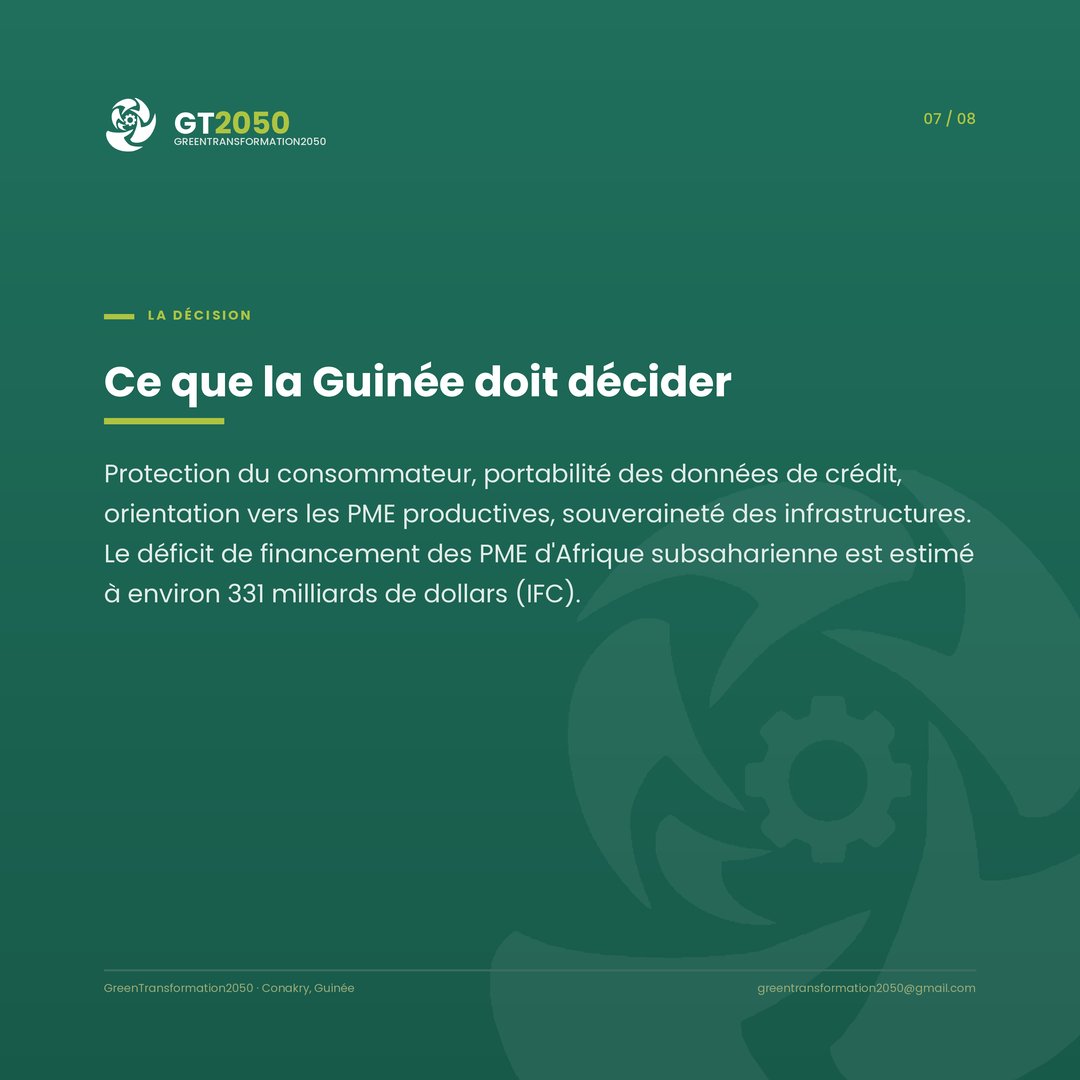
Three decisions Guinea (and every central bank) must make before the platforms do:
Consumer protection — cost caps, transparency, fair recovery, data limits
Data portability — so one mobile-money operator does not own the credit history
Purpose — productive SME investment, not just rapid-rotation consumption credit
Infrastructure sovereignty is the hidden fourth point. The credit will arrive anyway. Its usefulness is still a choice. #PresidenceGN #PresidenceGN #PrimatureGN #EnsemblePourLaGuinee
Algorithmic credit is no longer theory in Africa.
At the Oct 2026 IMF/World Bank meetings, Ajay Banga called transactional data “the new collateral.” With a $4 trillion+ MSME financing gap, the data already exists — the only question is how (and for whom) it gets used.
Guinea’s 2026-2035 AI roadmap makes this the closest, and riskiest, real-world AI use case.#IA #FinTech #Afrique #InclusionFinancière #CréditAlgorithmique #Guinée
The technology works. Neutrality does not.
Kenya’s M-Shwari showed digital credit can help households absorb shocks. It also showed 77 % of digital borrowers failed to repay at least once, while high effective rates and app-stacking created new poverty traps. Same algorithm, opposite development outcomes depending on the rules you set.#Kenya #OverIndebtedness #AIBias #ResponsibleAI #FinancialInclusion
Economic sovereignty won’t be decided at the Simandou Mining Summit.
It will be decided the day mining revenues clearly pay for the school, the road, and the health center in the areas that produce them.
Until then, we’re just extracting faster.
#PresidenceGN#GouvGN #PrimatureGN #EnsemblePourLaGuinee
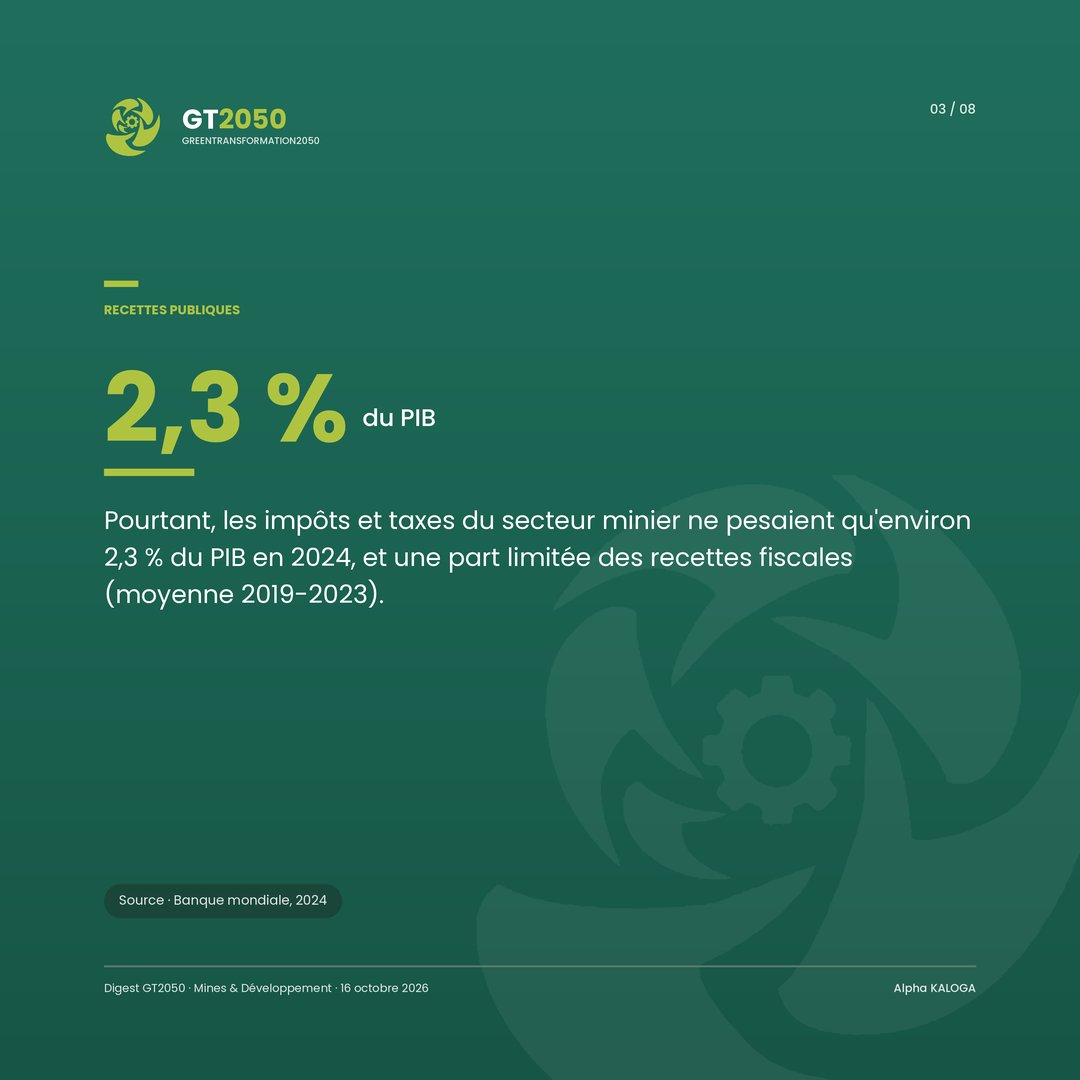
Guinea is set to grow over 11% in 2027 thanks to Simandou. Mining makes up 90%+ of exports, yet delivers only 2.3% of GDP in taxes.
The resource boom is real. The question is who actually captures the value.
Guinea cut the bauxite royalty from 0.55% to 0.15% to attract investors. It got the production. It got far less revenue.
Even with Simandou, World Bank models put public revenues at 15–17% of GDP by 2030 — still below the 20% regional target.
The current tax design has limits.
COP17 biodiversité à Erevan (19-30 oct).
COP31 climat à Antalya (9-20 nov).
La Guinée a déjà inscrit forêts et mangroves dans sa CDN 3.0.
17,7 milliards de besoins sur 10 ans, dont 8,4 pour l’adaptation.
La suite ne se joue plus sur la reconnaissance du lien. Elle se joue sur les dossiers bancables.
En Guinée, la nature est déjà l’infrastructure d’adaptation.
Le Fouta-Djallon alimente le Niger, le Sénégal et la Gambie. Le pays a perdu 92 % de sa forêt originelle (Couch et al., 2025). Ses mangroves stockent 3 à 4 fois plus de carbone que les forêts terrestres (Ofori et al., 2025).
On finance encore le climat et la biodiversité en silos. C’est l’erreur
Deux rendez-vous : Conseil du Fonds vert, 26-29 octobre, et COP31 à Antalya en novembre. La valeur du PNA se mesurera aux dossiers bancables, portés par des entités accréditées et ancrés dans les territoires. Le cadre est posé. Le financement se construit.#MEDDGN#PresidenceGN #GouvGN #PrimatureGN #EnsemblePourLaGuinee
Le 5 août 2026, la Guinée a déposé son premier Plan national d’adaptation à la CCNUCC. Une ligne sur NAP Central, mise à jour fin septembre. Pas de cérémonie. Juste le cadre : eau, littoral, santé, agriculture, infrastructures. Un PNA hiérarchise les vulnérabilités. Il n’est pas un budget.
Le canal manque. Aucune entité nationale n’est accréditée en accès direct au Fonds vert. Access Bank Guinée et l’ANAFIC sont dans la démarche. Aucune n’est encore accréditée. Sans ce chaînon, les 840 millions restent un ordre de grandeur, pas une capacité de décaissement.