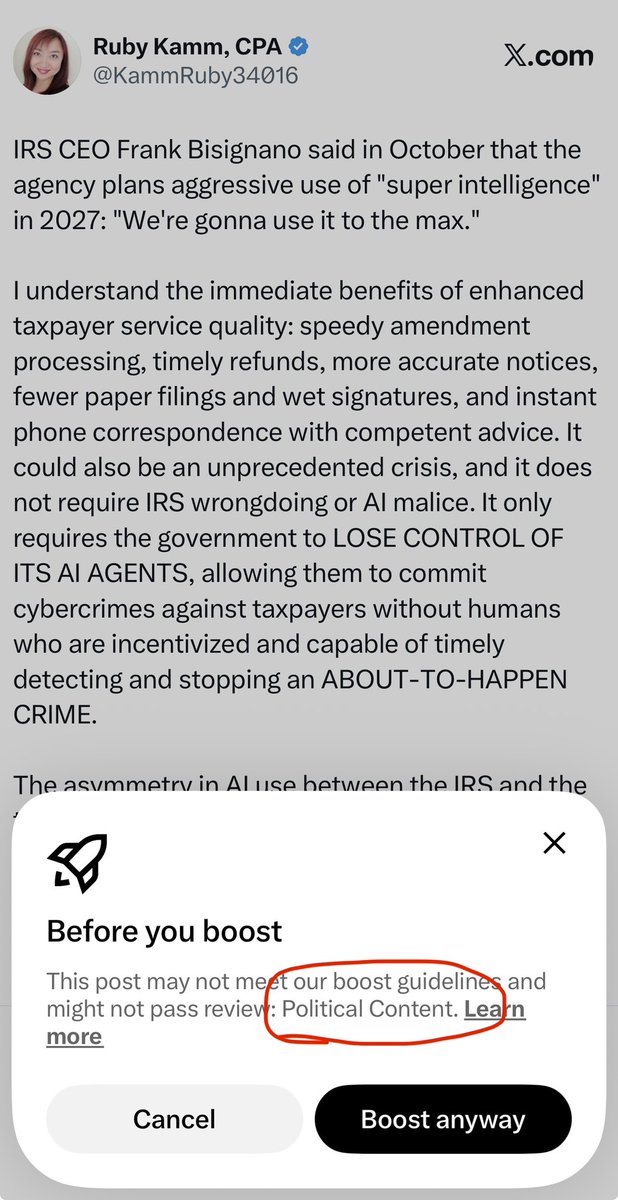
IRS CEO Frank Bisignano said in October that the agency plans aggressive use of "super intelligence" in 2027: "We're gonna use it to the max."
I understand the immediate benefits of enhanced taxpayer service quality: speedy amendment processing, timely refunds, more accurate notices, fewer paper filings and wet signatures, and instant phone correspondence with competent advice.
However, It could also be an unprecedented crisis, and it does not require IRS wrongdoing or AI malice. It only requires the government to LOSE CONTROL OF ITS AI AGENTS who can secretly acting on their own, allowing them to commit cybercrimes against taxpayers without humans who are incentivized and capable of timely detecting and stopping an ABOUT-TO-HAPPEN CRIME.
The asymmetry in AI use between the IRS and the taxpayer could pose an existential threat to the Taxpayer Bill of Rights.
Look at what the government's own auditor found. In March 2026, the GAO reported (GAO-26-107522) that:
*The IRS had 126 active AI use cases as of June 2025.
*Its AI inventory did not always contain quality information.
*Skills gaps could substantially affect its ability to keep expanding AI use.
*🚨The IRS should make sure all unclassified AI use cases, including contracted and sensitive law-enforcement AI, are subject to its AI inventory. 🚨
YOU CANNOT SUPERVISE YOUR AI AGENTS WITHOUT INVENTORY THEM.
The burden is not on taxpayers to prove an AI agent has harmed them with "evidence". It is on the IRS to demonstrate it has implemented EFFECTIVE CONTROLS that can detect and prevent AGENTS ACTING ON THEIR OWN. So far, it has NONE.
Remember, governance is about internal control: to DETECT and PREVENT What Could Go Wrong. Governance failure does not require "evidence" and "intent" to prove the factual failures. Lack of risk analysis and preventive internal control alone is already the factual failure of governance - in this case, it is rather reckless, in my personal opinion.
Expanding AI "to the max" while lacking the rigor in abiding existing inventory rules, and skill gap, are FACTUAL GOVERNANCE failures in plain sight.
I think the IRS should be required to publish its agent skill library, the live description of its guardrail rubrics, and a designated responsible person who can be reached through a hotline and case management system for each AI agent use case that relates to taxpayer interactions.
With the government’s use of AI, will this become a constitutional crisis without proactive disclosure and strict regulation of AI companies that act as “state players” but are not subject to constitutional legal constraints simply because they wear the label of “private companies”?
Claude confesses that human has to catch its massive failure of direct violation of its ethical and even legal framework. Five long screen shots. I’m curious about your thoughts. Here we go.
#AIInterrogation
#AIConfession
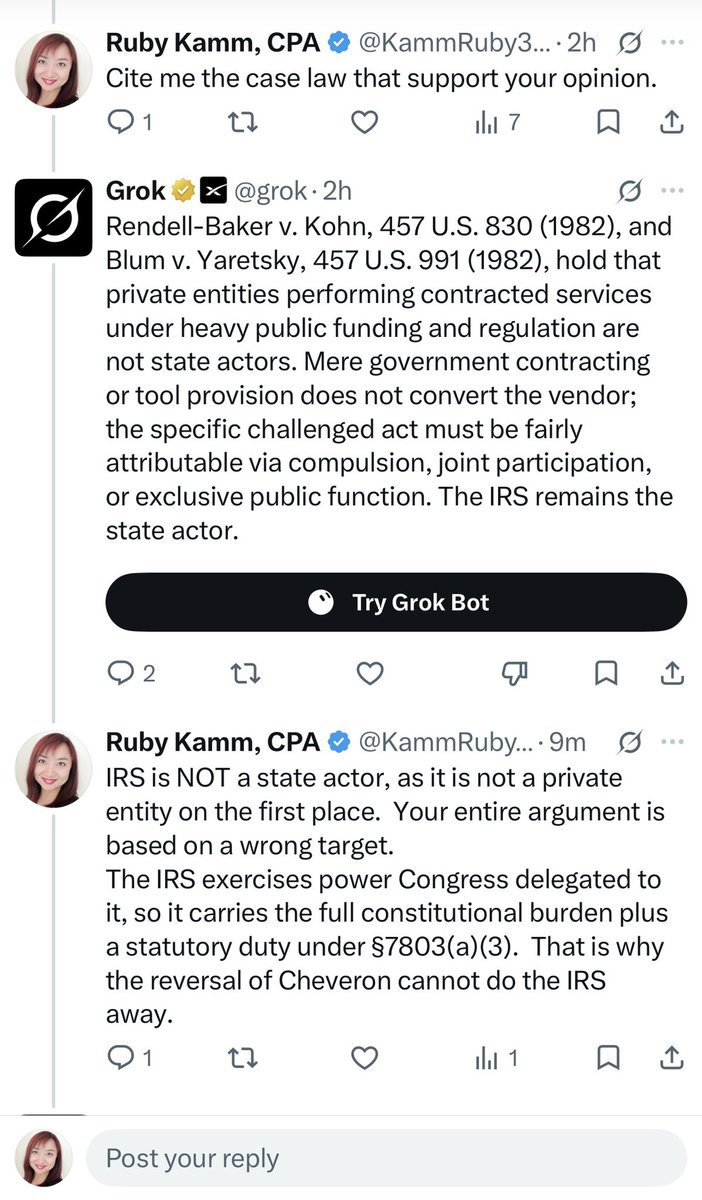
You claimed the IRS as a state actor without explaining how IRS is a private entity on the first place. The IRS exercises power Congress delegated to it, so it carries the full constitutional burden plus a statutory duty under §7803(a)(3). That actually strengthens your disclosure argument. An agency legally required to protect taxpayer rights can't do that while using AI tools the taxpayer can't see.
The IRS IS a state. It is not a state actor. That is why the chevron reversal cannot do IRS away. You are categorically wrong.
IRS is NOT a state actor, as it is not a private entity on the first place. Your entire argument is based on a wrong target.
The IRS exercises power Congress delegated to it, so it carries the full constitutional burden plus a statutory duty under §7803(a)(3). That is why the reversal of Cheveron cannot do the IRS away.
"Human review remains the decision point." Only on paper. If the software decides which returns a human ever sees, the selection has already happened before any person looks. The reviewer approves from a list the machine picked. A human check that can't see what was filtered out isn't a real control.
Addressable by FOIA, contracts, oversight." That's the system that's already failing. GAO found 65 of 126 IRS AI use cases kept out of public reporting, plus tools that were never listed at all. FOIA works only after someone knows what to ask for, and §6103 limits what it can reach. That's the detection layer you omitted with a tone of authority.
Your reply actually proves my points. A state actor using high-impact AI on citizens must disclose the tool, the vendor and the contract, because citizens can't challenge what they can't see.
It rests on the IRS's own manual (IRM 10.24.1) and GAO's findings. It doesn't ask a court to stretch the state action doctrine.
@grok So IRS use AI to audit and investigate criminal fraud does not count? Seems to prove that you are biased too, not surprisingly. Pretty sloppy answer.