This month in Tanzanian courts: who gets paid after judgment?
Tanzania Breweries (@TblPlc) had a judgment, a failed appeal by its debtor and an empty bank account at the end of its asset search. Road expansion had claimed Eden Park’s known property. On 6 November, Justice E.E. Longopa allowed the brewer to pursue directors Nixon Mwakitangwe and Erick Nixon Mwakitangwe personally for the company’s debt. The original award included TZS 606,733,080 in specific damages over wooden pallets and a mistaken advance payment. Augustine Rutakolezibwa of Frostee Attorneys appeared for the brewer. The court declined to order the directors’ arrest.
Stanbic Bank Tanzania (@StanbicBankTZ) faced enforcement from the other side. Trust Engineering Works had won TZS 100 million in damages and obtained a provisional order attaching an account the bank used for daily operations. Paschal Kamala, listed by Vertex Law Chambers, appeared for Stanbic. Trust Engineering’s Hardson Mchau, identified in a 2024 interview with Mchau and Co. Advocates, argued that the bank should obtain independent security. On 5 November, Justice of Appeal C.P. Mkeha gave Stanbic 30 days to furnish an unconditional TZS 100 million guarantee from another reputable financial institution. Without it, the stay lapses.
Mtibwa Sugar Estates acknowledged TZS 5,904,541,200 in sugar and by-product levies through September. Its TZS 500 million payment on 16 October left TZS 2,452,270,600 due by 31 December and TZS 2,952,270,600 by 30 June 2027. Under the consent judgment adopted on 5 November, the Attorney General and the Sugar Board of Tanzania waived interest, damages and costs. A missed instalment allows them to seek enforcement. State Attorney Lilian Mirumbe appeared for the plaintiffs and principal officer Amani Juma for Mtibwa.
Print Zone delivered 32 containers of secondary-school textbooks by its extended deadline. Four remained outstanding. The Tanzania Institute of Education (@TIE_Tanzania) withheld the last 10% of the TZS 4.03 billion contract price as agreed damages. The printer won before an adjudicator, then lost in arbitration. Athanas Wigan of Aymak Attorneys challenged the award for Print Zone. Senior State Attorney Rehema Mtulya represented the institute. On 13 November, Justice Mwajuma Kadilu dismissed the challenge with costs. The printer had let the arbitration continue without a timely objection and failed to show how its duration had caused substantial injustice.
#Tanzania #CommercialLaw
Safaricom has successfully defended Fuliza against a patent claim, according to Kaplan & Stratton. Patrick Ikimire and Esther Kinyenje-Opiyo led the Kenyan firm’s defence. The High Court upheld the tribunal’s finding that Fuliza did not infringe Dr Peter Akuon’s patent.
Uganda’s tighter monetary policy is beginning to show up in commercial lending rates. From 19 December 2026, Centenary Bank’s prime lending rate for Uganda shilling credit will rise from 20.5% to 22.5%. The increase covers both new and existing credit facilities, and selected bank charges will change on the same day.
The two-percentage-point increase follows the Bank of Uganda’s decision to raise the Central Bank Rate from 9.75% to 12% and the cash reserve requirement to 13.5%.
#MonetaryPolicy #BankingUganda #KampalaLawJournal
GROW Women Owned Business Plan Competition Grant 2026- Uganda.
Ministry of Gender, Labour and Social Development and the Private Sector Foundation Uganda with support from World Bank, has opened a funding round for women-owned businesses.
The GROW Business Plan Competition offers expansion grants, with headline ceilings of UGX 37 million for Micro Enterprises and UGX 111 million for Small Enterprises. The awards are competitive, and successful applicants must sign a performance-based agreement with the Ministry.
Who can apply?
The competition targets micro and small enterprises operating in Uganda that are majority-owned, managed and controlled by Ugandan women or women legally registered as refugees in Uganda.
The business must have operated for at least one year at a verifiable location, and a woman must be a signatory to its legal documents and financial accounts.
Priority areas include agribusiness and food processing, manufacturing, construction, technology, renewable energy, creative industries and childcare.
Application Requirements.
Applicants must have proof of identity, ownership and business registration as applicable, along with their operating address, GPS coordinates and a letter from the local council (LC1) confirming the business location.
GROW lists a trading licence, 12 months of bank statements or six months of mobile money statements among the documents it accepts as evidence of operations.
The expansion proposal should show what the grant would pay for, what it would cost and what the business expects to achieve, such as higher production, new customers or additional jobs.
What does the grant agreement require?
Eligible proposals are ranked on factors including growth potential, job creation and innovation.
Shortlisted businesses face further assessment and may receive a site visit. An award requires approval and a signed Performance-Based Agreement with the Ministry.
When to apply?
GROW’s detailed application page gives 11 December 2026 at 5 p.m. as the deadline for application submissions.
Applications are free.
For more details, criteria and registration, find them via: https://t.co/sngMT6Ie7L
#GROWUganda #WomenOwnedBusinesses #KampalaLawJournal
CAUSELIST: Who is battling URA this week?
Coca-Cola Beverages, MultiChoice, banks and fuel companies feature in the Tax Appeals Tribunal’s Kampala cause list for 16–20 November 2026, with Uganda Revenue Authority (@URAuganda) named as respondent.
The published list contains 53 scheduled entries, including repeat appearances and one separately listed taxation cause. It is a diary of proceedings, not a record of outcomes.
BANKS
Pride Bank Limited (@pridebankltd), Eco Bank Uganda Limited and Finance Trust Bank Limited (@financetrustug) were listed for virtual rulings on Monday, 16 November, in matters 211/2025, 185/2025 and 140/2023 respectively. The cause list does not contain the decisions.
COCA-COLA
Coca-Cola Beverages Limited has three separate entries: physical hearings in 001/2024 on Tuesday and 090/2024 on Wednesday, followed by a virtual mention in 253/2025 on Friday at 12.15pm.
MULTICHOICE AND GOtv
MultiChoice Africa Holding was listed for scheduling on Monday in 093/2026; GOTV Uganda Limited on Tuesday in 094/2026. Multichoice Uganda Limited appears for a mention on Wednesday in 096/2026 and scheduling on Friday at 11am in 057/2026. These are separate case references; the document does not establish that they form one dispute.
ENERGY AND TELECOMS
Smile Communications Uganda Limited has a physical hearing entry for Wednesday at 9am. Eskom Uganda Limited (@Eskomug), in 005/2026, is listed for physical hearings on Wednesday and Thursday. Seacom Uganda Limited is listed for a virtual hearing on Friday at 9am.
FRIDAY’S FUEL-COMPANY APPLICATIONS
One Petroleum Uganda Limited (MA180/2026), Vivo Energy Uganda Limited (MA188/2026) and Total Energies Marketing Uganda Ltd (MA189/2026) each have a virtual temporary-injunction listing at 12.30pm. The document does not specify the orders sought or show that the applications concern the same issue.
MORE RULINGS ON THE DIARY
Red Dot Distribution Limited is listed for a ruling on Thursday at 2pm. Friday afternoon’s ruling entries include WBPF Consultants Limited, Mercy Corps Uganda Limited, Mas Corporation Limited and Julius Byoruganda T/A Diplomatherbal Drinks & Liquor Limited.
A mention is generally a procedural check-in; scheduling concerns arrangements for progressing a matter. Neither establishes that the substantive dispute has been decided.
The list gives no disputed tax amounts or detailed grounds. It does not confirm that proceedings took place or rulings were delivered. Inclusion is not a finding of tax wrongdoing.
Source: @TaxAppealug, Kampala Registry cause list, 16–20 November 2026: https://t.co/z3w9GoVx1l
Visual: KLJ editorial illustration.
#KampalaLawJournal #CauseList #TaxAppeals
DÉSIRÉ KAMANZI: FROM INVESTMENT PROMOTION TO RWANDA’S CORPORATE LAW FRONT LINE
Désiré Kamanzi, head of @ENSlaw in Rwanda, has built a career spanning legal education, public-sector investment promotion and commercial practice.
His standing is reflected in the 2026 Chambers Global guide, which places him in Band 1 for Rwanda’s General Business Law category and records 19 years of rankings. That is 19 years ranked, not a claim of 19 consecutive years in Band 1.
In March, he was named Rwanda’s Lawyer of the Year at the 2026 IFLR Africa Awards. The award is an individual distinction, separate from the country’s law-firm award.
Based in Kigali, Kamanzi advises on corporate transactions, financing and the regulatory requirements facing investors. Chambers highlights his work helping international clients navigate licensing, tax, mergers and acquisitions.
His transaction record includes the 2021 listing of MTN Rwandacell. The company’s information memorandum carries ENSafrica’s legal opinion, dated 19 April 2021 and bearing his name as head of its Rwanda office. This was a listing by introduction of existing shares, rather than a new capital-raising offer, an important distinction when describing the transaction.
Earlier in his career, Kamanzi served as chief legal counsel and director for trade and investment promotion at Rwanda’s former investment promotion authority. He also taught law and previously served as secretary general of the Rwandan Law Society.
He holds an LLM in International Business Law from the University of Ottawa and undergraduate law qualifications from the National University of Rwanda. His professional credentials include admission as an advocate before Rwanda’s High Court and fellowship of the Chartered Institute of Arbitrators.
His career connects the legal rules governing investment with the practical demands of implementing transactions. For businesses entering Rwanda, that work extends beyond signing agreements to securing approvals and understanding the regulatory obligations that follow.
Sources: ENS; Chambers Global 2026; IFLR; MTN Rwandacell memorandum.
Photo source: ENS.
#KampalaLawJournal #Rwanda #CorporateLaw
#ExecutiveProfile
Gervase Ndyanabo to retire after 37 years at Vision Group.
Gervase Ndyanabo (@GNdyanabo) will retire as Vision Group’s Deputy Managing Director and Company Secretary effective 1 January 2027, closing a 37-year career that took him from internal audit to the company’s senior leadership. Over that period, New Vision grew into a listed multimedia group. In its notice to shareholders, the company singled out two of his contributions: helping guide its stock-exchange listing and strengthening its corporate governance.
From audit to Executive Leadership.
Ndyanabo holds a Bachelor of Commerce in Accounting from Makerere University and a Master of Business Administration (MBA) from Edinburgh Business School at Heriot-Watt University in the United Kingdom.
A Certified Public Accountant and Certified Internal Auditor, he began his career at Coopers and Lybrand, Chartered Accountants, in Kampala.
He joined New Vision in 1989 as an internal auditor, a year after its flagship newspaper began publishing daily on weekdays. He became Chief Internal Auditor in 1995, first took up the role of Company Secretary in 2005, and went on to serve as Chief Operations Officer.
At New Vision’s 30th anniversary in 2016, then Chief Executive Robert Kabushenga announced Ndyanabo’s promotion to deputy chief executive, with responsibility for overseeing finance. By 2018, he was serving as Deputy Managing Director and Chief Finance Officer. The following year, he was again serving as Company Secretary alongside his deputy managing director role.
Helping take Vision Group public.
The November 2004 listing on the Uganda Securities Exchange was a defining event in Ndyanabo’s tenure. It came before his first appointment as Company Secretary, and Vision Group credits him with helping guide the company through it.
His later work in the Company Secretary’s office shows what accountability looked like after listing. The office supported the Board Audit and Risk Committee in monitoring legal and regulatory compliance.
In 2024, Ndyanabo signed the public notice recording shareholder resolutions on audited accounts and board elections.
His tenure also spanned Vision Group’s expansion into radio, television and digital publishing. At an investor briefing on the 2015 results, he explained that growing electronic-media revenues were reducing the group’s dependence on print.
A decade later, speaking at a training event for staff tasked with spotting and reporting risks across departments, he made the case for making risk management part of everyday decisions across the company.
Recognition and service beyond Vision Group.
The Institute of Certified Public Accountants of Uganda (ICPAU) named Ndyanabo its Certified Public Accountant (CPA) of the Year in 2018.
He has served as president of the Institute of Internal Auditors Uganda and on the board of the global Institute of Internal Auditors.
His other roles have included serving as a Director of Finance Trust Bank, Vice Chairperson of the Uganda Martyrs University Council and a Member of ICPAU’s Disciplinary Committee. He is also a Trustee of the New Vision Foundation, established in 2024 to carry forward the group’s community work.
His public service extends to Uganda’s Catholic laity. In May 2024, he was re-elected for a second term as president of the Uganda National Catholic Council of Lay Apostolate.
A former chair of the Archdiocese of Mbarara Development Association, he has highlighted how the association’s medical outreach in Sheema brings volunteers and communities together.
Ndyanabo’s retirement closes a career that began with examining the publisher’s internal controls and grew to encompass its operations, finances and obligations to shareholders.
His 37 years at Vision Group trace the growth of both an executive and the institution he helped take public.
#KampalaLawJournal #CorporateGovernance #Uganda
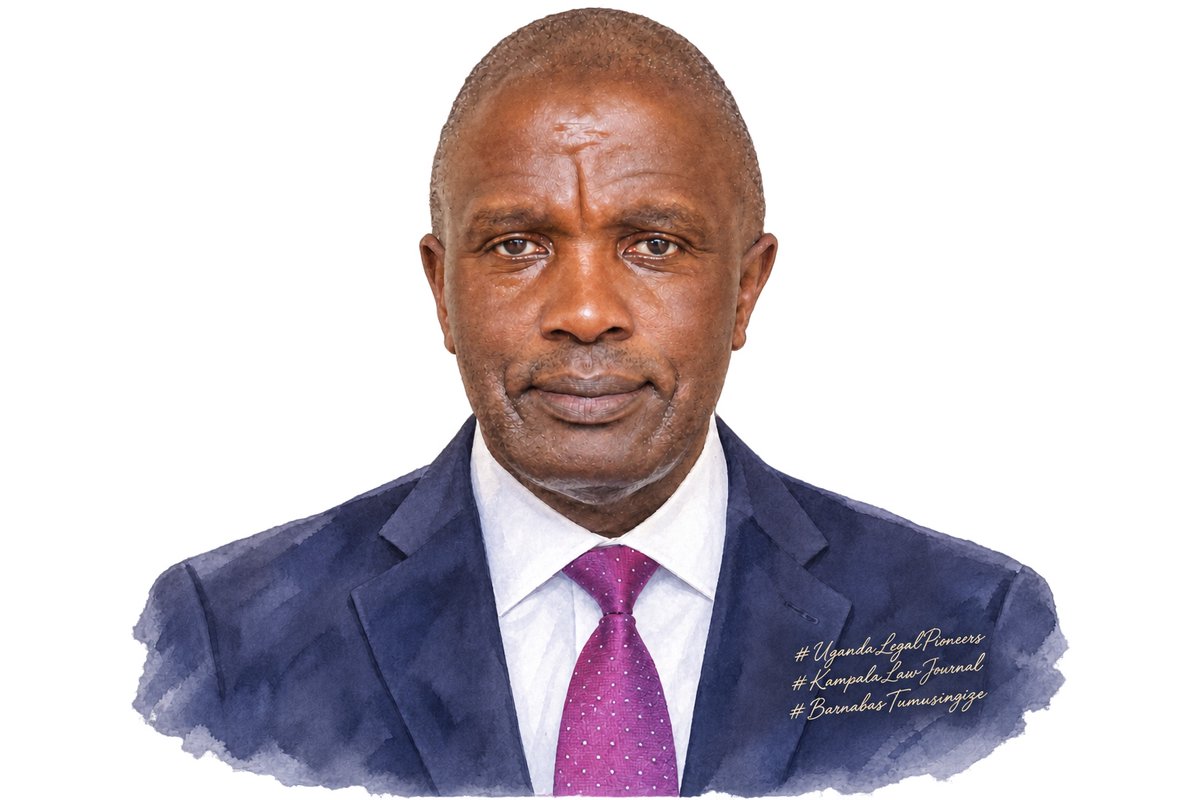
UGANDA LEGAL PIONEERS | Barnabas Tumusingize: A Life in Law, Lessons in Leadership
His father sold land to send him to King’s College Budo. Years later, Barnabas Tumusingize bought it back.
“I was able to buy that land back,” he recalled in conversation with Muhereza Kyamutetera on @CEOEastAfrica’s podcast.
It is a revealing starting point for a career built on sacrifice, patience and responsibility.
Tumusingize joined Sebalu & Lule Advocates, now S&L Advocates (@SL_Advocates), as a legal assistant in 1989. He became a partner in 1994 and led the firm for approximately two decades. Founded by Paulo Sebalu and Godfrey Lule, the practice became an institution he would help prepare for another generation.
The firm credits him with establishing its banking and finance practice and guiding its entry into DLA Piper Africa in 2010. He was part of NSSF’s legal team in the Workers House construction dispute and represented Standard Chartered Bank before the East African Court of Justice in separate Alcon litigation.
Chambers Global 2026 recognises him as an Eminent Practitioner in both Corporate/Commercial and Dispute Resolution in Uganda.
“Understand your client’s business.”
That advice captures his approach: a lawyer must understand the commercial realities behind the instructions. Preparation matters just as much: “Know your case, know your facts, know where to find what.”
For younger lawyers, his counsel is practical. Protect clients’ money. Honour your word. Accept correction. Learn from experienced colleagues before rushing to establish a practice. He recalled working for five years before buying his first car.
“Success is a marathon.”
His leadership lessons extend beyond individual achievement. A firm needs departmental accountability, regular reviews and financial discipline. A large fee should not leave it unable to meet its obligations.
Succession belongs in that same conversation. Tumusingize said he began planning his departure from management in 2020. James Mukasa Sebugenyi succeeded him on 1 January 2026; S&L subsequently identified Tumusingize as a consultant.
He also described teaching at Bishop Stuart University, passing experience to future practitioners.
For Kampala Law Journal, his story asks an enduring question: alongside the cases you handle, what people and institutions are you preparing to carry the work forward?
#UgandaLegalPioneers #KampalaLawJournal #UgandaLaw
Kenya Pipeline CEO recruitment challenge raises questions over Uganda’s shareholder safeguards.
A reported court challenge to Kenya Pipeline Company’s recruitment of its next Chief Executive has brought Uganda’s role in the company’s governance into focus.
The Star reported on 15 November that George Okoth Olosi had petitioned Kenya’s Employment and Labour Relations Court, alleging irregularities in shortlisting and questioning the absence of Ugandan directors from a Nomination and Remuneration Committee meeting held on 29 October.
According to the report, Olosi questions the Human Resources manager’s authority to screen candidates and applicants’ inability to access recruitment records. He allegedly seeks an injunction, disclosure of assessment documents, preservation of recruitment records and an independent forensic audit of the application portal.
Uganda’s interest in the dispute extends beyond the appointment itself.
The Uganda National Oil Company confirms that Uganda acquired a 20.15% strategic shareholding in KPC through its initial public offering. UNOC also states that approximately 95% of Uganda’s petroleum imports pass through Kenya, using the Port of Mombasa and KPC’s pipeline system. Uganda therefore has substantial interests in the company as both a shareholder and a major user of its infrastructure.
The investment came with governance safeguards. KPC’s supplementary IPO memorandum dated 19 February 2026, disclosed amendments providing for at least two Ugandan government nominees while Uganda holds at least 20% of the company’s issued shares. It also described a requirement for affirmative approval by a Ugandan government director, alongside a Kenyan government-appointed director, on specified reserved matters.
Business Daily has reported that these protections extend to the appointment of the Managing Director and the appointment or removal of a separate Chief Executive. Uganda’s representatives, Ramathan Ggoobi and Irene Pauline Bateebe, were appointed to KPC’s board effective 28 July 2026.
The central governance question is how the approval rights apply throughout recruitment.
A requirement for Uganda’s concurrence in the final appointment does not, on its own, establish that its directors must attend every preliminary committee meeting. Assessing the alleged absence requires examination of the operative articles, committee rules, quorum requirements and the decisions taken. Those records are essential before drawing conclusions about the validity of the process.
For Uganda, the wider issue is whether the safeguards attached to its investment provide effective participation in decisions concerning a company central to its fuel supply chain. Leadership, infrastructure investment and operational reliability carry consequences for businesses and consumers dependent on that network.
The court position remains unconfirmed. Reports differ on whether the appearance scheduled for 16 November is a hearing or a mention.
Kampala Law Journal has not independently verified the petition, case number, court listing or an order stopping recruitment.
#energysecurity #eastafrica #KampalaLawJournal
BINTI SHAH: THE KENYAN LAWYER AT THE INTERSECTION OF BANKING, CAPITAL AND INFRASTRUCTURE
A sovereign bond, electric motorcycles and affordable homes may look like different stories. Binti Shah’s transaction record connects them through the legal work that helps capital reach governments, businesses and projects.
A partner at @ENSlaw in Kenya, Shah’s practice spans banking, project finance, capital markets, energy and climate finance. She holds an honours law degree from the University of Reading and is qualified as a Kenyan advocate and an English solicitor.
A CAREER BUILT ACROSS MARKETS
Kaplan & Stratton’s February 2013 bulletin records an earlier stint at Wilde Sapte between 1995 and 1998. By 2013 she was a corporate-commercial partner at Kaplan & Stratton, advising banks and development-finance institutions.
In 2019, Shah, Nigel Shaw, Mahesh Acharya and Amar Grewal-Thethy were the four former Kaplan & Stratton lawyers whose NBMA Advocates practice joined forces with ENSafrica. That history explains the NBMA name that still appears in some directories alongside ENS Kenya.
THE TRANSACTIONS BEHIND THE PROFILE
• Sovereign finance: ENS identifies Shah as part of its team advising Standard Bank of South Africa and Citigroup Global Markets on Kenya’s US$1.5 billion bond due in 2031. The transaction received East Africa Deal of the Year recognition at the Global Banking and Markets Africa Awards 2025.
• Clean transport: In September 2025, Bates Wells reported that Shah and ENS colleague Marywinfred Mwangi advised Mirova on Kenyan law for an up-to-US$10 million secured facility to ARC Ride. It was designed to support electric two-wheelers and battery-swapping infrastructure in Kenya.
• Housing: IFLR1000 credits Shah with leading the team advising IFC on secured financing for affordable housing at Nairobi’s Two Rivers development, including partial refinancing of the borrower’s Stanbic Bank Kenya liabilities. The directory describes the project as ongoing, not completed.
• Distributed energy: ENS names her among the advisers to Rubis Energy Kenya on its Solarise Africa joint venture. That transaction was named East Africa Deal of the Year at the 2024 DealMakers Africa Awards. This was a deal/team recognition, not an individual Lawyer of the Year award.
RECOGNITION ACROSS FINANCIAL LAW
Chambers Global 2026 ranks Shah Band 1 for Banking & Finance in Kenya, Band 2 for Projects & Energy and in its Capital Markets Spotlight table. IFLR1000’s current profile lists her as a Market Leader and Women Leader.
The range matters. Government borrowing, housing finance and emerging clean-energy businesses raise different risks, even when each begins with the same need: capital. Shah’s record offers a window into the specialist lawyers who work across those financing structures.
Photo: ENS professional portrait; date unspecified.
Reporting sources: ENS, Chambers Global 2026, IFLR1000, Bates Wells and Kaplan & Stratton’s February 2013 bulletin.
https://t.co/oBVT3MPiEq
https://t.co/FkFVKHPA6Y
https://t.co/LJUDATcLm4
#KampalaLawJournal #BankingAndFinance #Kenya
MEET THE UGANDAN LAWYERS WHO ADVISED NCBA ON THE ACQUISITION By Nedbank
Winnie Awino, Kezia Nakimuli, Esther Nafula and Rachel Nakalema were the Uganda lawyers named in the cross-border team advising NCBA on Nedbank’s acquisition of a controlling stake.
The four practise at S&L Advocates, an independent Ugandan member firm of DLA Piper Africa. Their inclusion puts a Kampala team within a transaction linking two major African banking groups.
Nedbank acquired 66% of NCBA. Buyer-side adviser Cliffe Dekker Hofmeyr says the transaction completed on 3 November 2026. NCBA remains listed on the Nairobi Securities Exchange, with 34% of its shares outside Nedbank’s ownership.
For Uganda’s legal market, the story is also about the practitioners involved.
WINNIE AWINO | PARTNER
Awino’s practice spans mergers and acquisitions, infrastructure and banking. Her published experience includes advising NCBA on the earlier Ugandan combination of NC Bank and Commercial Bank of Africa. She also worked on MTN Uganda’s initial public offering and the separation of its mobile-money business. She holds an LLM from Cornell University.
KEZIA NAKIMULI | SENIOR ASSOCIATE
Nakimuli advises financial institutions on lending and regulatory compliance, alongside a real-estate practice. Her experience includes a merger of two licensed financial institutions and advice concerning the transfer of OPIC’s functions to the US International Development Finance Corporation. She studied law at Makerere University and completed professional training at the Law Development Centre.
ESTHER NAFULA | PRINCIPAL ASSOCIATE
Nafula’s practice focuses on financial-sector lending, specialised finance and regulatory obligations. Her profile records work for Stanbic Bank and JUMO on US$18 million in financing, and for the African Development Bank on a US$2 million partial credit guarantee. She holds law degrees from Uganda Christian University and the University of London.
RACHEL NAKALEMA | ASSOCIATE
Nakalema works across corporate transactions, banking and financial-services regulation. Her experience includes advising development-finance investors and assisting Standard Chartered Bank Uganda with due-diligence procedures. She completed her Makerere law degree in 2023 and postgraduate legal-practice training in 2024.
These backgrounds help explain the range of expertise within the team. They do not establish who handled each element of this particular transaction: the public announcement does not allocate individual workstreams.
The distinction between the parties’ advisers also matters. S&L participated on NCBA’s side. It should not be described as Nedbank’s Uganda counsel.
Sources: DLA Piper Africa’s deal announcement and lawyer profiles; Cliffe Dekker Hofmeyr.
Team announcement: https://t.co/feWZdVCsBH
Photo credit: S&L Advocates / DLA Piper Africa.
#KampalaLawJournal #CorporateLaw #MergersAndAcquisitions
IRENE AKURUT APPOINTED VISION GROUP COMPANY SECRETARY
Irene Akurut has been appointed Company Secretary of @VisionGrp, effective 1 January 2027, bringing more than 18 years of professional experience to the role.
Currently Manager, Legal and Board Affairs, Akurut has spent 10 years at the Ugandan media group. The company’s appointment notice describes her as a Chartered Governance Professional and an Advocate of the High Court.
Her professional qualifications include:
• Bachelor of Laws, Makerere University.
• Postgraduate Diploma in Legal Practice, Law Development Centre, Kampala.
• Diploma in Taxation and Revenue Administration, East African School of Taxation.
• Chartered Secretary qualification (GradICSA), as listed on her LinkedIn profile.
Beyond Vision Group, she serves as Secretary of the Chartered Governance Institute UK & Ireland’s East Africa regional committee, which lists her as Irene Akurut GradCG.
She succeeds Gervase Ndyanabo in the company secretary role as he retires after 37 years of service. Ndyanabo has served as both Deputy Managing Director and Company Secretary. The announcement appoints Akurut as Company Secretary.
Her promotion brings together a decade of institutional experience, legal training and involvement in the regional governance profession.
Kampala Law Journal congratulates Irene on this professional milestone.
Sources: Vision Group’s appointment notice; Irene Akurut’s public LinkedIn profile; Chartered Governance Institute:
https://t.co/PWNN18hFyk
#KampalaLawJournal #CorporateGovernance #Uganda
FOUR UGANDAN LAWYERS, ONE CROSS-BORDER BANKING DEAL
Meritas Advocates (@MeritasLaw) was Uganda’s local counsel on the team advising @Nedbank’s acquisition of a 66% stake in NCBA Group (@NCBABankKenya).
Nedbank confirmed completion on 5 November 2026. Settlement comprised 43.63 million new Nedbank shares plus KES23.23 billion in cash (approximately ZAR2.93 billion). NCBA retains its Nairobi Securities Exchange listing, with 34% of its shares outside Nedbank’s ownership.
First announced on 21 January, the transaction brought together advisers across seven countries: South Africa, Kenya, Uganda, Tanzania, Rwanda, Ghana and Côte d’Ivoire. The Tanzanian mandate also covered Zanzibar. Cliffe Dekker Hofmeyr (@CDHLegal) led Nedbank’s legal advisory work.
WHO WAS ON THE MERITAS TEAM?
• Robert Apenya (@ApenyaRobert): corporate law, banking and finance, M&A, energy and infrastructure. He joined Meritas in 2025 after serving as Managing Partner at Engoru, Mutebi Advocates.
• Peterson Mwesiga (@mwesigapeter): heads Energy, Mining and Infrastructure. A lawyer and electrical engineer, his practice covers project finance, public-private partnerships, construction, energy and arbitration.
• Henry Agaba: heads Corporate and Commercial Law and Commercial Litigation. His expertise includes M&A, corporate governance, restructuring, insolvency and debt recovery.
• Francis Tumwesige Ateenyi: investment advisory, project finance, oil and gas, litigation, arbitration and ESG. His experience includes projects in Uganda, Tanzania, Mozambique and South Africa.
Based on Nakasero Road in Kampala, Meritas is a full-service corporate firm focused on investment, finance, energy and tax. Its multidisciplinary team combines law with backgrounds in engineering, accounting, environmental management and technology.
THE WIDER ADVISORY TEAM
CEO East Africa Magazine reports that Ian Hayes, Peter Hesseling and Njeri Wagacha led CDH’s team. Supporting lawyers included Sammy Ndolo, Andries le Grange, Arnold Mutisya, Keagan Hyslop, Christopher Kode, Victor Sang, Brian Macharia and Ian Ounoi, with Alex Kanyi and Denis Maina on tax, and Shem Otanga and Alan Wanjohi on intellectual property and technology.
Participating local firms also included ARS Law & Advisories (Tanzania and Zanzibar), CERTA Law (Rwanda), Kimathi & Partners (Ghana) and Chauveau Avocats (Côte d’Ivoire).
Meritas’s website lists clients including AB InBev, Airtel, Nile Breweries, Bank of Africa Uganda, EACOP, Uganda Airlines and Sanlam. The Nedbank assignment adds a significant regional banking transaction to the credentials of a Ugandan corporate law firm to watch.
Full profile:
https://t.co/Ra8nwHysMx
#KampalaLawJournal #UgandaLaw
Uganda’s latest Tax Waivers put fairness and public accountability in focus.
Parliament’s approval of relief for four entities raises questions about taxpayer fairness, government payment failures and the standards governing those decisions.
Parliament has approved separate waivers for four entities over two consecutive sittings.
The decisions were taken on different dates. Parliament approved relief for K-Roma Limited and Kilembe Mines Limited on 11 November 2026, with its official report published on 12 November. Approval for Uganda Printing and Publishing Corporation (UPPC) and Ankole Western University followed on 12 November 2026.
The circumstances warrant individual examination. Financial distress may justify exceptional relief, particularly where enforcement would achieve little while disrupting employment or essential services. Nevertheless, every decision to surrender a public revenue claim requires a convincing explanation of why that course serves the public interest.
K-Roma Limited, the manufacturer of Bella Wine, received approval for approximately UGX1.864 billion in relief. This comprises UGX784.4 million in principal tax, UGX300.6 million in penalties and UGX779.3 million in interest, covering excise duty, VAT and income tax. Parliament’s finance committee attributed the company’s difficulties partly to the pandemic and competition from informal winemakers, while also criticising its inventory and borrowing decisions.
That combination raises a difficult policy question: how should relief distinguish between external economic shocks and weaknesses in business management? A credible assessment should examine both. Where public revenue is forgone to support recovery, the justification should explain the prospects of restoring sustainable operations and meeting future obligations.
For Kilembe Mines Limited, Parliament approved the write-off of UGX2.6 billion in annual mineral-rent arrears accumulated between 2018 and 2025. These are non-tax revenue obligations. Parliament linked the arrears to government underfunding and the relief to the winding-up and handover of the mining operations.
The accountability issue here extends to the management of state enterprises. Clearing historical liabilities may facilitate restructuring, but the public should also be able to assess how those liabilities accumulated and whether the arrangements that follow will prevent their recurrence.
UPPC presents a particularly significant question about government’s responsibility as a customer. Parliament reported approximately UGX13.9 billion in tax liabilities alongside UGX11.85 billion owed to the corporation by ministries, departments and agencies. A minority report opposed the waiver, arguing that payment of those government debts could enable UPPC to settle its principal tax, with qualifying interest and penalties addressed through statutory relief.
Where unpaid government invoices contribute to a supplier’s financial distress, the analysis must consider the conduct of the debtor as well as the taxpayer. A waiver may ease the immediate pressure, but timely payment for goods and services remains central to preventing the same problem from returning.
That concern also reaches private suppliers. Government payment practices should be examined as part of revenue policy: a business waiting for payment still has wages, financing costs and statutory obligations to manage. Exceptional relief for one institution should prompt scrutiny of the underlying payment failures affecting others.
Ankole Western University received approval for approximately UGX1.02 billion in relief concerning tax arrears, interest and penalties, including PAYE liabilities.
The committee linked its difficulties to institutional conflict and pandemic-era disruption. It warned that recovery measures threatened closure, potentially interrupting the education of more than 1,000 students and affecting staff employment.
Protecting students and preserving an institution’s ability to operate are substantial considerations. The accompanying expectation should be that relief supports stronger governance, reliable payroll administration and timely compliance. Otherwise, the immediate rescue may leave the causes of the arrears unresolved.
Uganda’s legal framework recognises that some tax debts cannot be effectively recovered. Section 43 of the Tax Procedures Code Act provides for referral by the Commissioner General to the Minister where recovery faces hardship, impossibility, undue difficulty or excessive cost.
Remission requires parliamentary approval. The provision supplies a legal route for exceptional cases; financial difficulty alone does not establish an automatic entitlement to cancellation.
There is also an important distinction between these individual approvals and relief available under general legislation. Section 47D, inserted by the Tax Procedures Code (Amendment) Act, 2026, provides for waiver of interest and penalties outstanding as at 30 June 2025, where the taxpayer pays the principal tax by 30 June 2027. That mechanism makes payment of principal a condition of relief.
For businesses that have paid on time, often through borrowing or reduced investment, fairness depends on understanding why another taxpayer’s principal liability should be forgiven. Different circumstances can justify different outcomes, but the criteria should be clear, consistently applied and accessible to businesses without exceptional influence or visibility.
Parliament has previously heard concerns about transparency and evidence that waiver beneficiaries deliver the jobs and investment used to justify relief. Those concerns remain relevant to how the latest decisions should be assessed.
A stronger approach would publish clear reasons for each approval, distinguish principal from interest and penalties, explain the alternatives considered, and identify any commitments attached to the relief. Subsequent reporting should show whether beneficiaries resume compliance and whether the public benefits anticipated at approval materialise.
These decisions place a continuing responsibility on government, Parliament and the beneficiaries. The case for relief will ultimately be judged by what follows: stronger institutions, corrected management failures, more reliable government payments and sustained compliance. Those outcomes are essential to preserving the confidence of taxpayers who continue to meet their obligations.
#TaxCompliance #TaxWaivers #PublicAccountability #KLJ #UgandaTax
MINING AND ENERGY LAWYER LOYOLA RWABOSE KAROBWA SET TO BECOME ACTING COMPANY SECRETARY OF THE GOVERNMENT OF UGANDA’S NATIONAL MINING COMPANY
Ugandan advocate Loyola Rwabose Karobwa is set to take up the role of Acting Company Secretary at Uganda National Mining Company (UNMC), according to reports on interim leadership arrangements at the state-owned enterprise.
Karobwa has served as Senior Legal Officer at @MEMD_Uganda. Her experience includes contributions to mining-law reform, participation in negotiations for the country’s first Mineral Production Sharing Agreement, and service on the technical team supporting UNMC’s inaugural board.
She holds an LLB (Honours) from @Makerere, a Diploma in Legal Practice from @LDC_Uganda, and an LLM in International Natural Resources Law and Policy—with Distinction—from @dundeeuni, where she studied as a @CheveningFCDO Scholar. She was admitted to the Ugandan Bar in 2015.
Her wider leadership experience includes membership of the ministry’s Staff SACCO Supervisory Board and a former role as Compliance Officer of the Chevening Alumni Association of Uganda.
Formal confirmation of the appointment and its effective date remained outstanding in the reporting reviewed.
Kampala Law Journal congratulates Loyola on this reported professional milestone and wishes her success in the responsibilities ahead.
#KampalaLawJournal #WomenInLaw #Uganda
Dei-Equity Dispute escalates through competing auction notices.
Equity defends proposed sale of Dei properties as borrowers challenge enforcement.
Equity Bank Uganda and Equity Bank Kenya have defended the proposed sale of properties linked to Dei Industries International, Dei BioPharma and businessman Dr Matthias Magoola, rejecting the borrowers’ warning that the sale would undermine unresolved court proceedings.
In a notice published on 10 November 2026, the banks’ lawyers, Katende, Ssempebwa & Co. Advocates, maintained that enforcement was proceeding lawfully under the Mortgage Act and that no court order prohibited the proposed sale.
Their response followed a buyer warning issued on 9 November by Muwema & Co. Advocates, representing Dei and Magoola.
The exchange concerns a sale advertised by Jald (U) Ltd on 5 November. The listed properties reportedly include industrial premises at Matugga and properties in Luzira, Katwe, Muyenga-Kisugu, Kitende, Seguku and Kamuli-Bukungu.
Dei’s lawyers argue that enforcement is premature because the disputed loan accounts remain subject to court proceedings and a contested audit process.
The borrowing involved separate shilling and dollar facilities. According to reporting on the pleadings, Dei Industries’ earlier facilities were consolidated into a UGX54.79 billion term loan in June 2021. The banks state that the consolidated facility carried 17% annual interest, with a 12-month repayment moratorium.
Dei BioPharma’s financing separately included approximately US$29.95 million in refinancing in April 2021 and an additional US$10 million facility in September 2021. The refinancing and consolidation figures should not be treated as wholly new advances.
Dei’s lawyers argue that enforcement is premature because the disputed loan accounts remain subject to court proceedings and a contested audit process.
The disagreement dates back to borrowing and restructuring arrangements involving the two companies.
In August 2024, Dei and Magoola filed High Court Civil Suit No. 929 of 2024, challenging the banks’ accounting and seeking reconciliation of the facilities, refunds of allegedly improper debits and protection against recovery measures.
An attempt to resolve the accounting dispute produced further litigation. The parties initially agreed to appoint KPMG under a December 2024 consent order.
Following Dei’s successful challenge to that appointment, the court directed the Institute of Certified Public Accountants of Uganda (ICPAU) to nominate another independent auditor.
Clayton & Company was selected. Dei challenged that nomination process alleging compromised independence.
Nevertheless, Clayton produced a report dated 28 June 2025 while the challenge was pending.
On 29 July 2026, Justice Susan Abinyo dismissed the application challenging the auditor nomination and seeking permission to amend the plaint in Dei Industries International Ltd and Others v Equity Bank Uganda Limited and Another, [2026] UGCommC 362.
Dei pursued an appellate challenge. Published accounts report that on 9 September 2026, the Court of Appeal stayed the High Court proceedings pending determination of the intended appeal.
The present disagreement concerns whether the banks may enforce their mortgage securities while that challenge remains unresolved. A mortgagee’s statutory power of sale may be exercised without first obtaining a debt judgment, provided the applicable legal requirements are satisfied.
WHO ARE THE LAWYERS BEHIND DLA PIPER AFRICA’S NCBA–NEDBANK DEAL TEAM?
The long awaited Nedbank-NCBA Group acquisition came to a close with South Africa’s Nedbank securing a 66% controlling stake in NCBA Group on 3 November 2026. Initially valued at approximately ZAR13.9 billion, the transaction leaves NCBA listed on the Nairobi Securities Exchange, with approximately 34% of its shares in public hands.
DLA Piper Africa’s Kenyan member firm, IKM Advocates, advised NCBA, supported by a cross-border working group of 34 named lawyers across eight firms.
KENYA — IKM Advocates: James Kamau SC, Managing Partner and Chair of DLA Piper Africa; Ashley Zefira; Judy Muigai; John Mwangi; Audrey Seur; Camilla Kanani; and Rogers Ngelese.
UGANDA — S&L Advocates: Winnie Awino, Kezia Nakimuli, Esther Nafula and Rachel Nakalema.
TANZANIA — IMMMA Advocates: Burure Ngocho, Angela Mndolwa, Azuhura Msofe, Hellen Mziray and Joel Lova.
RWANDA — Equity Juris Chambers: Calvin Mitali, Moses Kiiza, Gervis Nizeyimana, Alison Mugabo and Badiel Rubangutsangabo.
SOUTH AFRICA — DLA Piper: Johannes Gouws, Nada Lourens, Dharshini Naidoo, Annie Nair and Leratorato Madiba.
GHANA — Reindorf Chambers: Kizzita Mensah, Kweki Quaynor Ahlijah and Clement Ocran-Biney.
CÔTE D’IVOIRE — Geni & Kebe Lawyers: Mouhamed Kebe, Roger Ahinongbe, Alassane Ouattara and Carrine Boussou. Kwaliance: Didier Boua Doux.
The partial pro rata tender offer allowed Nedbank to acquire control while preserving NCBA’s public listing. The disclosed team illustrates the cross-border collaboration behind the transaction, bringing together counsel across East, West and Southern Africa.
Pictured: James Kamau SC.
Photo: IKM Advocates / DLA Piper Africa, Kenya.
Team source:
https://t.co/feWZdVCsBH
#KampalaLawJournal #CorporateLaw #BankingLaw #DLAPiperAfrica
Commercial Court prepares 350 cases for mediation as Uganda expands Negotiated Commercial Justice.
Uganda’s Commercial Division of the High Court is preparing to place 350 disputes before mediators during its Mediation Settlement Fortnight scheduled for 16–30 November 2026, extending a programme that has already addressed banking, credit, trade and construction disputes.
Preparations included a training and pre-settlement roundtable at the Court of Appeal Conference Hall on 9 November. Head of Division Justice Anna Mugenyi encouraged participation by the Uganda Revenue Authority and insurance institutions, linking the exercise to efforts to reduce a commercial caseload exceeding 6,000 matters. The November dates had been announced earlier; the recent development is the preparation and allocation of cases.
The initiative raises a practical question for businesses: can structured negotiations turn disputed claims into workable settlements, payments and greater financial certainty?
What the “mediation fortnight” means
A fortnight ordinarily means two weeks. Here, it describes a concentrated court programme during which selected disputes receive focused attention from mediators, lawyers and the parties involved.
Mediation involves an independent, neutral person helping disputing parties negotiate an agreement. The mediator facilitates discussion and possible compromise; the parties determine whether to settle.
Under Uganda’s Judicature (Court Annexed Mediation) Rules, 2026, civil lawsuits and appeals may be referred to mediation with the parties’ consent.
The concentrated fortnight operates within a longer procedural framework. Rule 23 provides 60 days from referral, upon the parties’ consent, for the mediation process to conclude.
How the initiative developed.
Court-connected mediation has a substantial history in Uganda. A Commercial Court pilot began in 2003, testing mediation as a way of resolving disputes within the formal justice system. Subsequent 2007 Commercial Court mediation rules replaced the pilot framework, followed by the 2013 Mediation Rules.
The 2026 rules now provide the current framework and replace the earlier 2007 and 2013 instruments.
The settlement fortnight is an organisational approach within that broader history. It concentrates preparation, case allocation and negotiations into a defined period.
By November 2025, the Commercial Division was already reporting quarterly settlement fortnights, alongside Thursday mediation sessions.
The November 2026 exercise therefore continues an established programme. Its distinctive feature is the attention to intellectual property, insurance and commercial/tax appeals, alongside outstanding trade, construction and corporations matters.
Which cases are included this November?
▪️Intellectual property, Insurance and Commercial/Tax Appeals- 70 cases
▪️Trade, Construction and Corporations- 280 cases
What was discussed at the preparatory roundtable?
The discussions connected mediation to the economic consequences of prolonged disputes.
Principal Judge Jane Frances Abodo, in remarks delivered by Justice David Matovu, emphasised preparation and cooperation between courts and stakeholders. She highlighted insurance’s role in protecting investment and business continuity, and intellectual property’s importance to Uganda’s creative economy.
For rights holders, the issues discussed included ownership, copyright infringement, licensing, royalties and unauthorised exploitation. Negotiated solutions could address compensation and future use of creative works while preserving professional relationships.
The discussion also exposed a question about professional incentives. New Vision reported that advocates Fred Muwema and Silver Kayondo called for incentives supporting lawyers’ participation in mediation, raising concerns about remuneration associated with repeated court appearances.
The Judicial Training Institute and Alternative Dispute Resolution Registry organised the preparatory engagement. In closing remarks, Supreme Court Justice Muzamiru Kibeedi called for concrete settlements, clear responsibilities and timely implementation.
Takeaway points.
For businesses preparing to participate, the immediate work is concrete:
▪️Confirm case inclusion, the mediator and the appointment through counsel or the registry.
▪️Reconcile the principal claim, interest, costs and any counterclaim.
▪️Assemble the documents needed to support or challenge those calculations.
▪️Identify the person authorised to approve terms and any necessary internal approvals.
▪️Prepare proposals covering payment dates, instalments, continuing obligations and implementation.
#CommercialCourt #MediationFortnight #AccessToJustice #ADR
KATENDE & SSEMPEBWA: A PARTNERSHIP BUILT TO LAST
Founded in 1969 by John W. Katende, SC, and Prof. Frederick E. Ssempebwa, SC, Katende, Ssempebwa & Company Advocates has become an enduring institution in Uganda’s private legal practice.
According to KATS’ published biographies, Katende graduated in law from the University of East Africa in Dar es Salaam in 1968 and earned an LL.M from Harvard in 1970. His career spans company law, commercial practice, legal teaching and publishing.
Ssempebwa also graduated in law in Dar es Salaam in 1968, followed by an LL.M from Queen’s University Belfast in 1970. His work encompasses constitutional law, taxation, litigation and scholarship. He served as president of the Uganda Law Society from 1989 to 1991 and the East African Law Society from 2002 to 2004.
KATS continues to list both as founding and senior partners, identifying Ssempebwa as supervising partner for its legal work. These are the firm’s published roles, rather than an independently verified account of their daily schedules.
The firm’s continuing corporate work includes its appointment as legal adviser to Airtel Uganda’s 2023 initial public offering and listing, documented in Airtel’s offer materials. That assignment belongs to the firm’s record; it should not be attributed personally to either founder without further evidence.
Their legacy brings together scholarship, professional leadership and the building of a practice whose responsibilities now extend across a wider partnership. The enduring question is how the knowledge and reputation of founders become institutions that serve successive generations.
Pictured: John W. Katende (left) and Prof. Frederick E. Ssempebwa (right).
Photos: KATS. AI-assisted montage.
Founders’ biographies and more about the firm: https://t.co/5xCyCCLvZ8
#KampalaLawJournal #UgandaLaw