Two homes. 12 acres. One incredible Grass Valley property. 🌲🏡
This isn’t your typical Northern California real estate listing.
Tucked away in Grass Valley, California, this private country estate features a beautiful 3-bedroom, 3-bathroom log cabin PLUS a brand-new 1,200-square-foot ADU — creating incredible flexibility for multigenerational living, guests, a private retreat, or potential rental use.
And the property itself? 🌿
✨ 12 acres
🍎 Private producing orchard
🌱 Two 30’ x 30’ garden areas
🐓 Chicken coop
🐕 Fenced dog run
🛝 Kids’ playground
🔨 Large shop
☀️ Owned solar
⚡ Generac generator
🌲 Brand-new deck
🏡 Attached ~900-square-foot living space
All while being approximately one mile from the Nevada County Fairgrounds and just minutes from downtown Grass Valley.
If you’ve been looking for Grass Valley acreage, a Northern California log cabin, a country property, a family compound, or a home with ADU potential, this one deserves a closer look.
📍 Grass Valley, California
#GrassValleyRealEstate #GrassValleyCA #NevadaCountyRealEstate #NevadaCountyCA #NorthernCaliforniaRealEstate #CaliforniaRealEstate #GrassValleyHomes #LogCabin #LogCabinHome #AcreageProperty #CaliforniaAcreage #CountryLiving #CountryProperty #NorthernCaliforniaHomes #ADU #ADUHome #MultigenerationalLiving #FamilyCompound #Homestead #RealEstateListing #LuxuryRealEstate #RealEstateAgent #Realtor #GrassValleyRealtor
Real estate doesn’t always have to look the way you expect. 👀🏡
We’re a Sacramento-area real estate team doing things differently, getting out in the community, sharing local knowledge, and having a little fun along the way. Today’s stop? FOX40 for some real estate trivia! 🎥
Behind the scenes of what it looks like to bring our love for real estate, local communities, and helping families put down roots beyond the traditional home-buying experience.
📍 Sacramento real estate | Placer County real estate | Northern California real estate | Local real estate experts
#SacramentoRealEstate #SacramentoRealtor #SacramentoRealtors #NorthernCaliforniaRealEstate #PlacerCountyRealEstate #SacramentoHomes #CaliforniaRealEstate #RealEstateTeam #RealEstateAgent #RealtorLife #LocalRealtor #HomeBuying #HomeSelling #RealEstateMarketing #FOX40
Mortgage applications fell 1.5% for the week ending Sept. 18.
Purchase apps were down 1% for the week and 11% lower than last year.
Refis were down 3% for the week and 62% lower than last year.
Rates moved higher again.
MBA reported:
30-year fixed: 7.12%
Up from 6.97%
Jumbo: 7.15%
FHA: 6.78%
15-year fixed: 6.43%
Here is the number agents need to understand:
ARM loans jumped to 9.8% of applications.
The 5/1 ARM averaged 6.10%.
More than a full point lower than the 30-year fixed.
That does not mean Realtors should recommend ARMs.
That is the lender’s job.
But it explains the conversation.
Buyers are trying to solve payment.
So when someone says:
“I’m waiting for rates to come down.”
Ask:
“What payment are you trying to get to?”
“Has the lender compared fixed, ARM, buydown, and seller-credit options?”
“How long do you plan to own the home?”
“What happens if you still own it when the ARM adjusts?”
“What is the worst-case payment?”
“Are you choosing strategy, or stretching?”
There is a difference between using a loan product with a plan and forcing a payment that does not work.
Price matters.
Payment is driving the conversation.
There are now 563,000 more home sellers than buyers.
That does not mean the housing market is crashing.
It means sellers have to compete again.
Price matters.
Condition matters.
Photos matter.
Marketing matters.
Access matters.
Concessions matter.
Buyers are not stupid.
They can see the payment.
They can see the inventory.
They can see the house down the street that already cut $25K.
Good homes will still sell.
Overpriced average homes are about to get humbled.
The only easy day was yesterday.
The work this winter is going to be real.
Freddie Mac reported the 30-year fixed averaged 6.95% as of Sept. 17.
Up from 6.76% the week before.
A year ago, it was 6.26%.
That changes the payment.
A buyer who was comfortable last month may not be comfortable today.
A seller who thinks their price is fine may not understand that the buyer’s payment got worse without the seller changing anything.
National Association of Realtors reported August existing-home sales fell 2.0% from July to a 3.98M annualized pace.
Inventory rose to 1.62M homes.
Up 5.9% from last year.
Months of supply hit 4.9 months.
Highest level in more than 10 years.
Median price was $429,100.
Up 1.6% year over year.
So no, the market is not dead.
But it is not easy.
More inventory does not mean buyers are writing.
More choices does not mean better affordability.
More listings does not mean sellers are motivated.
For buyers:
Talk payment.
“What payment are you trying to stay under?”
“Have you updated your numbers with the lender this week?”
“Would a seller credit, buydown, or price adjustment actually help?”
For sellers:
Talk competition.
“What homes are active?”
“What homes are sitting?”
“What homes reduced?”
“What does our home look like at today’s payment?”
Buyers need math.
Sellers need reality.
Listings need strategy.
This is not the season to disappear, blame rates, or wait for the market to save you.
The agents who work through winter are usually the ones standing in spring with momentum.
Now let’s go to work.
The market does not determine your outcome.
Your actions do.
Bad follow-up.
Weak conversion.
Bloated expenses.
No standards.
No accountability.
No cash discipline.
That’s not the market.
That’s the business.
A 1% mortgage rate move is not small.
On a 30-year mortgage, going from 6% to 7% can increase principal and interest by roughly 10% to 11%.
Example:
$500K loan at 6% = about $2,998/month.
$500K loan at 7% = about $3,327/month.
Same house.
Same loan amount.
Different rate.
About $329 more per month.
Freddie Mac reported the 30-year fixed averaged 6.95% as of Sept. 17.
Up from 6.76% the week before.
The 15-year fixed averaged 6.26%.
So when buyers hesitate, do not assume they are not serious.
Their payment may have changed.
Ask:
“What payment are you trying to stay under?”
“Have you updated your numbers with the lender this week?”
“Does this still work at today’s rate?”
“Would a seller credit, buydown, or price adjustment actually help?”
For sellers, price is only one part of the decision.
The buyer is looking at the full monthly cost:
Rate.
Taxes.
Insurance.
HOA.
Mello-Roos.
Repairs.
Cash to close.
Price matters.
Payment is what buyers feel every month.
The biggest mistake people make in real estate is waiting until they “feel ready.”
By then, they’re usually reacting.
Reacting to rates.
Reacting to prices.
Reacting to inventory.
Reacting to competition.
Reacting to life.
The better move is to know your numbers before you need to make a decision.
What can you afford?
What is your home actually worth?
What would your payment look like?
What happens if you wait?
What happens if you don’t?
Real estate rewards people who prepare early.
Not people who panic late.
Seller concessions are showing up more.
Redfin reported sellers gave concessions in 44.7% of U.S. home sales in August.
Up from 42.6% last year.
They also reported 15.8% of homes sold had both a price drop and a seller concession.
A concession is not the same thing as a price cut.
A price cut lowers the purchase price.
A concession helps solve a specific buyer problem.
Examples:
Closing-cost credit.
Repair credit.
Rate buydown contribution.
Appliance credit.
HOA fee help.
Home warranty.
Seller-paid buyer costs.
For buyers, do not only ask:
“Can we get the price lower?”
Ask:
“What problem are we trying to solve?”
Cash to close?
Monthly payment?
Repairs?
Insurance?
HOA?
Confidence?
For sellers, concessions can make a listing more competitive without immediately cutting price.
But they need to be written correctly.
They need to make sense.
And they need lender approval.
Price is one part of the deal.
Structure matters.
If you don’t like your life, change it.
Not complain harder.
Not blame the market.
Not wait for perfect timing.
Not post quotes while doing the same shit every day.
Change it.
Your life is the receipt.
Your habits are on it.
Your standards are on it.
Your discipline is on it.
Your excuses are on it.
Nobody is coming to build the life you keep talking about.
Before you write an offer, slow down and get the facts.
A strong offer is not just price.
Know the buyer’s money:
Are they actually pre-approved?
Has the lender reviewed income, debt, credit, and assets?
What payment are they comfortable with?
What is the estimated cash to close?
How much money do they want left after closing?
Do they need seller credits?
FHA, VA, conventional, cash, or something else?
Then know the property:
Days on market.
Price reductions.
Disclosures.
Condition.
HOA.
Mello-Roos.
Insurance.
Taxes.
Offer deadline.
Other offers.
Seller timeline.
Possession.
A good offer matches the buyer’s money, comfort level, risk tolerance, and the seller’s situation.
The highest offer is not always the strongest offer.
The cleanest offer is not always the best offer.
The best offer is the one built around the actual deal.
Do not write offers based on vibes.
Know the money.
Know the property.
Know the seller’s pressure.
Know the buyer’s limits.
Then write the offer.
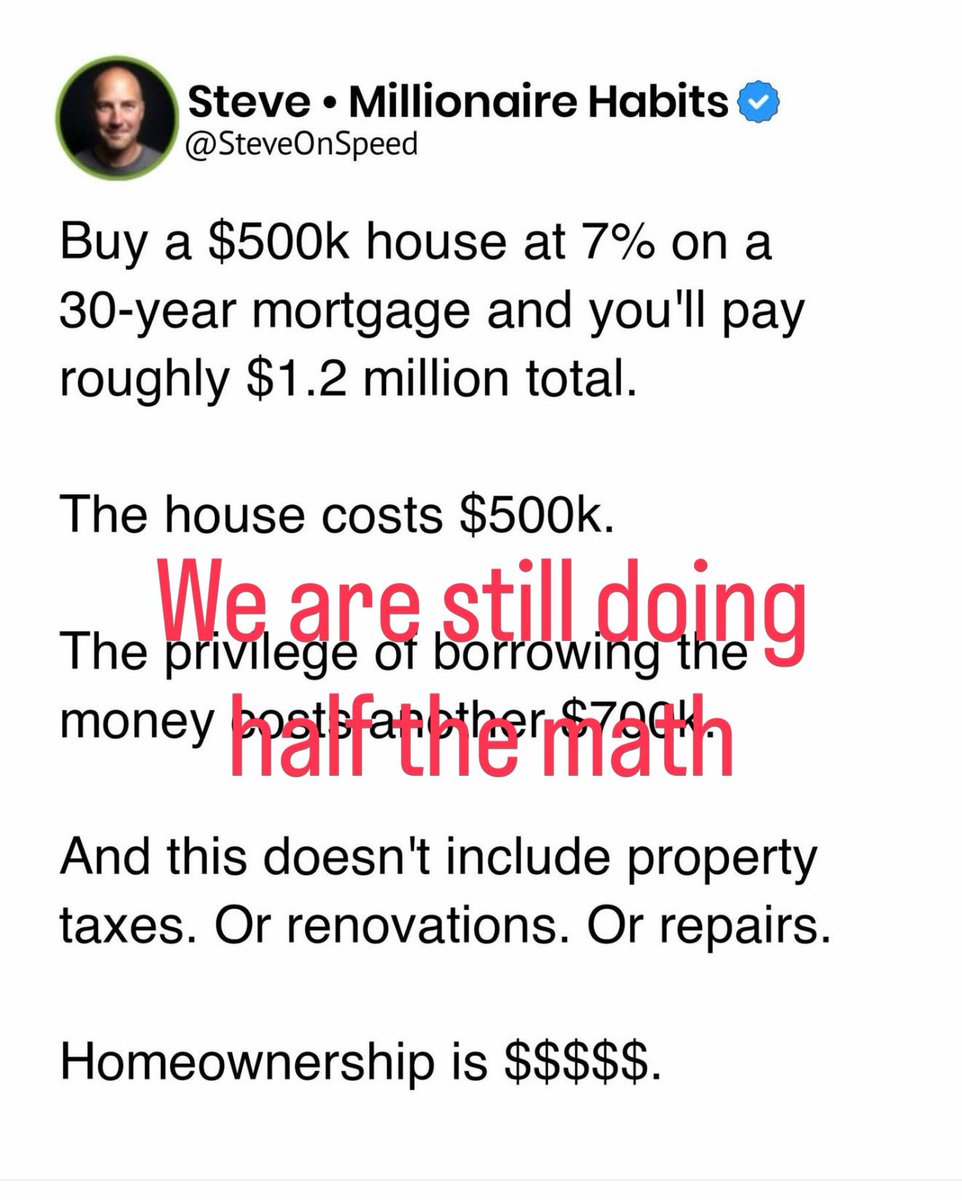
People keep acting like they discovered mortgage interest.
“$500K at 7% costs almost $1.2M over 30 years.”
Yes.
And if that $500K house appreciates:
3% for 30 years = about $1.21M
4% = about $1.62M
5% = about $2.16M
You don’t only get the debt.
You get the asset.
You may also get principal paydown, leverage, tax benefits if you qualify/itemize, and a fixed loan payment while rent keeps moving.
Does that mean every house is smart?
No.
Buying too much house is stupid.
But “interest exists, so homeownership is a scam” is half the math pretending to be financial advice.
Buyer debt matters.
The Federal Reserve Bank of New York reported total U.S. household debt hit $18.8 trillion in Q2 2026.
That included:
Mortgage debt: $13.1T
Credit card debt: $1.26T
Auto debt: $1.71T
Student loan debt: $1.65T
That matters in real estate.
A buyer does not qualify off income alone.
They qualify off the full picture:
Income
Debt
Credit
Down payment
Cash to close
Reserves
Loan type
Taxes
Insurance
HOA
Mello-Roos
A buyer can make good money and still have a tight debt-to-income ratio.
Car payment.
Credit cards.
Student loans.
Personal loans.
Child support.
HELOC.
Existing mortgage.
Those payments matter.
So if a buyer is hesitant, do not assume they are not serious.
They may be trying to figure out if the payment works with the debt they already have.
Ask:
“Has the lender reviewed your actual debt?”
“What payment feels comfortable after your other obligations?”
“How much cash do you want left after closing?”
“Are you ready now, or getting financially ready?”
Today’s market is not just price and rate.
It is payment plus debt.
Based on this kangaroo ownership map, I’m predicting a real estate boom in the 3 states where you can apparently own one without a permit.
Wisconsin.
West Virginia.
South Carolina.
Stupid?
Yes.
Also basically how people analyze real estate online.
One map.
One headline.
One “hot market” list.
Then everyone piles in late.
The deal is not buying where everyone already agrees it’s hot.
The deal is finding what creates the boom before the headline:
jobs, industry, migration, affordability, infrastructure, supply, wages, taxes, insurance, and policy.
Real estate is not just the market.
It’s everything moving the market.
Rent vs. buy usually gets argued wrong.
Buying is not just rent vs. mortgage.
Buying is:
Mortgage
Taxes
Insurance
HOA
Mello-Roos
Repairs
Maintenance
Cash to close
Reserves
Opportunity cost
If a buyer ignores those, they are guessing.
But the “just rent and invest” argument skips something too:
Leverage.
A $200K investment account earns on $200K.
A $200K down payment on a $1M property controls a $1M asset.
At 10% annually for 7 years, $200K becomes about $390K.
At 12%, about $442K.
Good returns.
But if a $1M home appreciates:
4% annually for 7 years = about $316K in appreciation.
6% = about $504K.
8% = about $714K.
That is leverage.
But leverage only works if the payment does not bury the buyer.
Freddie Mac reported the 30-year fixed at 6.95% as of Sept. 17.
The Federal Reserve reported the median mortgage payment for homeowners who moved in 2024 or 2025 was $2,300.
In the West, it was $2,950.
That is the pressure point.
Buying is not automatically smart.
Renting is not automatically dumb.
The math decides.
Buying a house isn’t overrated.
Buying without understanding the math is overrated.
$200K in the market at 10% for 7 years = about $390K.
At 12% = about $442K.
Great.
But $200K down on a $1M home controls a $1M asset.
At 4% appreciation for 7 years, that home becomes about $1.316M.
At 6%, about $1.504M.
At 8%, about $1.714M.
That’s leverage.
Yes, payments matter.
Yes, taxes, insurance, repairs, reserves, and liquidity matter.
But pretending real estate is just “expensive shelter” is lazy.
You still have to live somewhere.
And ownership, done right, is how normal people get rich quietly.
First-time buyers are still active.
The National Association of Realtors reported August existing-home sales fell 2.0% from July to 3.98 million annualized.
Inventory rose to 1.62 million homes.
Up 5.9% from last year.
Months of supply hit 4.9 months.
Highest level in more than 10 years.
Median existing-home price was $429,100.
Up 1.6% year over year.
Here is the number agents should pay attention to:
First-time buyers were 30% of August sales.
Up from 29% in July.
Up from 28% last year.
That matters because first-time buyers have a different problem than move-up buyers.
They are usually fighting:
Down payment.
Closing costs.
Monthly payment.
Student loans.
Car payments.
Credit score.
Insurance.
Confidence.
Family advice.
Bad online information.
So do not only ask:
“Are you pre-approved?”
Ask:
“What payment are you trying to stay under?”
“Have you budgeted for closing costs, not just down payment?”
“How much cash do you want left after closing?”
“Are you looking at FHA, conventional, VA, or down payment assistance?”
“Are you comparing rent versus owning?”
“Who else is helping you make the decision?”
For sellers:
If your likely buyer is a first-time buyer, clarity matters.
Clean disclosures.
Strong photos.
Known insurance costs.
HOA and Mello-Roos explained.
Seller credit strategy if needed.
A first-time buyer can love the house and still freeze because they do not understand the full cost.
Explain the numbers.
Explain the payment.
Explain what happens next.
Some people don’t lead teams.
They collect followers until the followers figure it out.
I’ve watched this happen in real estate.
Someone builds a room around their personality.
Everyone depends on them.
Every decision runs through them.
Every problem becomes their problem.
Every win gets centered around them.
From the outside, it looks like leadership.
Big energy.
Big opinions.
Big promises.
Big “culture.”
But over time, people start seeing the truth.
There’s no real development.
No real standards.
No real accountability.
No real system.
No real growth path.
Just one person trying to stay important by making sure everybody else stays dependent.
That is not leadership.
That is control.
And control always has an expiration date.
Because eventually good people get tired of being managed by emotion.
They get tired of the chaos.
They get tired of the hero act.
They get tired of being told they’re part of a mission when really they’re just carrying someone else’s ego.
Real leadership does not need everyone confused, needy, scared, or loyal to a personality.
Real leadership creates clarity.
It builds people who can think.
It builds standards people can follow.
It builds systems that don’t collapse when one person leaves the room.
It builds confidence, not dependency.
And here’s the part that pisses weak leaders off:
If people only perform when you’re hovering over them, you didn’t build leaders.
You built permission-seekers.
If people can’t make decisions without you, you didn’t build a business.
You built a bottleneck.
If people leave and immediately get better, you were never developing them.
You were limiting them.
Leadership is not being the loudest person in the room.
It’s not being needed for every answer.
It’s not being the hero of every story.
Leadership is building people so well that they don’t need you for every damn thing.
That’s the difference between building a team…
and building a cult with commission splits.
Real estate leads do not become clients because they are sitting in your CRM.
The follow-up is where the business happens.
Every lead needs a clear bucket:
HOT
Real timeline. Real reason. Usually 0–90 days. Buying, selling, lender conversation needed, relocation, lease ending, family change, equity, payment, school, investment, or lifestyle.
NURTURE
Interest is there, but timeline is longer or unclear. Usually 3–12 months. Watching values, comparing areas, waiting on rates, saving money, or planning the next move.
WATCH
Low intent right now, but behavior is there.
Market report views.
Listing clicks.
Saved searches.
Home value checks.
Repeat activity.
Those are signals.
Ask better questions:
“Are you buying, selling, or just tracking the market?”
“What timeline are you thinking?”
“What area are you watching?”
“What is holding you back?”
“What would need to happen for you to move forward?”
A CRM only works if the agent works it.
Hot. Nurture. Watch.
Define the lead.
Ask the next question.
Set the next step.
“The housing market is over” is lazy doom-porn.
It’s not over.
It’s stuck.
High rates punish buyers.
Low-rate mortgages keep sellers frozen.
That’s the lock-in effect.
But “nobody will ever sell” is nonsense.
People still get married, divorced, promoted, relocated, pregnant, retired, and tired of their neighbors.
Life moves people before spreadsheets do.