@Optimism 1/2What about a "pre-commitment" scheme before finalizing the PQ algorithm?
Users could commit to a hash/STARK proof now, locking their EOAs against quantum attacks even before the specific signature scheme is chosen.
This would neutralize the quantum threat immediately,
@Optimism With 300M accounts and ETH mainnet at ~30 TPS, using 50% of block space, migrating everyone to PQ-smart accounts via EIP-7702 would take ~230 days.
Is this window safe? Or could quantum adversaries compromise waiting accounts faster than the chain can process their upgrades?
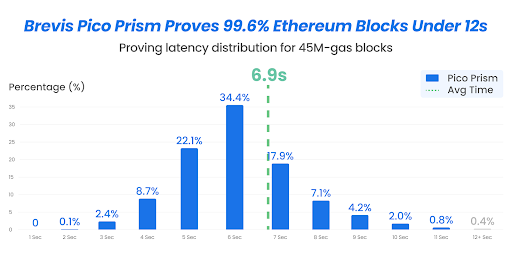
Announcing Pico Prism, the state-of-the-art zkVM for Ethereum real-time proving. 99.6% of blocks proven under 12 seconds, 6.9s average with 64 RTX 5090 GPUs.
This marks a major step toward scaling Ethereum by 100x and a future where you can validate the chain from a phone.
After five years of work, the team is happy to announce the Zama Confidential Blockchain Protocol and the release of our Public Testnet.
First things first, read the litepaper ⬇️
The zkVM space is evolving rapidly.
From proving architecture to cutting-edge techniques, we explore where we are and where we're headed.
Here's our take on the current landscape and our strategy moving forward ↓
https://t.co/M1c2UQidXh
@nubit_org Regarding the fee payment, If Alice establishes the payment tx with U1, but U1 refuses to establish tax with U2, then the consensus nodes cannot receive the final tx. After the VDF result is evaluated, U1 can take the BTC from Alice. How can this attack be prevented?
@RobinSalen@Toposware@0xPolygonZero Yeah, continuations make sense. I thought the minimum proof unit is transaction. Hope to find more details in the following tech blogs. Very impressive work again
@RobinSalen@Toposware@0xPolygonZero Excellent work! A technical question here: what if a single transaction is too big to generate proof? Suppose there is a valid but malicious tx on eth mainnet which just use a loop to do keccak hash computation as many as possible. (1/2)
@anthonykrose@0xtaetaehoho@zksync In inscription scene, the calldata of L2 tx contains the real content and it doesn't involve any state changes. In zksync era state diff design, it will not post the calldata to L1. So the indexer can't monitor L1 to generate index for inscription, right?
@doganeth_en@zksync@getclave For the inscription transactions in zksync, they don’t change the storage slots. So the call data of inscription txs is not published on Ethereum, right?