Onderzoekers van @KapteynAstro & UvA testen op Tenerife een hogesnelheidscamera voor de toekomstige Cherenkov Telescope Array. Zo vangen we flitsen van gammastraling uit extreme kosmische bronnen als superzware zwarte gaten en supernova’s. Lees meer: https://t.co/2UStZm68VI
🚀 Congrats to Dr. Quentin Changeat from @KapteynAstro on receiving an #NWO#Veni grant!
He’ll use data from #JWST & #Ariel to explore exoplanet atmospheres and uncover how distant worlds evolve.
Read more:
https://t.co/lo31lIMR6R
🌌 The Kapteyn Mobile Planetarium has been visiting schools since 2010 and it just welcomed its 10,000th visitor🚀 Thanks to a €10,000 grant from the Gratama Foundation, even more young minds will explore the universe next year.
https://t.co/c6w5iv0Q29
🚀 Prof. Inga Kamp from @KapteynAstro and @univgroningen receives an ERC Advanced Grant!
With DISKS-ROCK, she’ll use the James Webb Telescope to study the origins of rocky planets 🌍🪐
€2.5M for groundbreaking research!
https://t.co/hzOI6ogYXU
the Donkerte Lauwersoog master plan receives nearly €1 million from the #WaddenFund to tackle light pollution. Together with local businesses, @univgroningen, Port Lauwersoog and @KapteynAstro the goal is to cut light emissions by 50% by 2027.
https://t.co/ZxvxIeH55y
🎉 The Pastoor Schmeits Prize 2025 has been awarded to Else Starkenburg @univgroningen for her groundbreaking work in galactic archaeology!
🌌 She developed a unique method to find the universe’s oldest, rarest stars.
https://t.co/C1EsINdoIs
Meet our new scientific director! As of April 1st, Inga Kamp is the new scientific director of the Kapteyn Institute from @univgroningen. Inga succeeds Leon Koopmans who stepped down as scientfic director of the Kapteyn institute after 5 years. Read more:
https://t.co/AL9S9ttklr
An international research team, including scientists from @KapteynAstro@univgroningen , has analyzed data from 41 million #galaxies to estimate the distribution of matter in the #universe ,confirming a long-established model. Read more:
https://t.co/oM5TdosOpi
Today, ESA released its first batch of survey data taken by Euclid, including a preview of its deep fields. Astronomers from @KapteynAstro from @univgroningen
are involved in the Euclid mission. Read more:
https://t.co/a8UOfSlVgl
In het Kapteyn Instituut van de Rijksuniversiteit Groningen wordt binnenkort een traantje gelaten. Na meer dan tien jaar komt er een eind aan het leven van Gaia, de ruimtetelescoop die wetenschappers talloze nieuwe inzichten bood.
https://t.co/1uuFSRxYKK
The Fundamentals of the #Universe is a research theme within @univgroningen. It aims at studying the fundamental forces of #Nature and involves researchers from @KapteynAstro,
@BernoulliInsti2 and Van Swinderen Institute. Read more:
https://t.co/UNEloFAEu7
Do you have a #PhD in #ComputerScience, #Astronomy / #Astrophysics, #Physics or related fields and are you interested to #work with us? We now have a #vacancy for a Tenure Track Assistant Professor on Astronomical Data Science and Machine Learning.
https://t.co/2AVaXfHFmL
#Astronomy
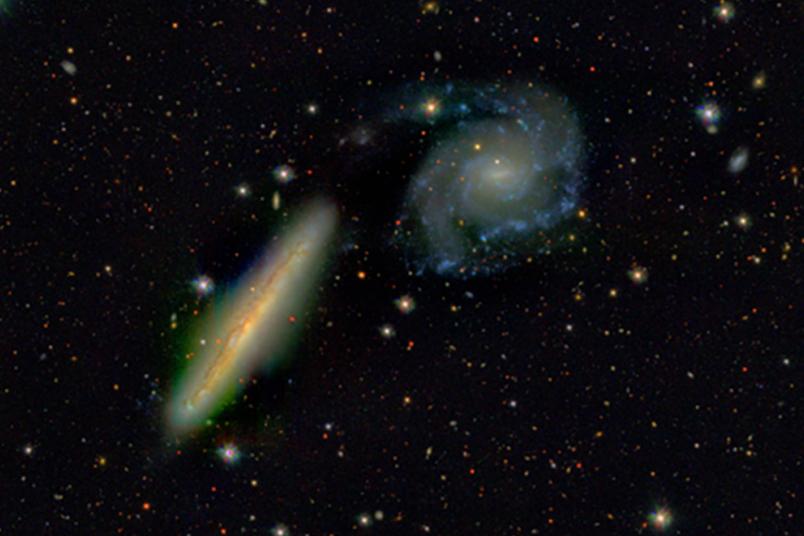
An international group of astronomers that includes researchers from @KapteynAstro and @univgroningen
found that dust inhibits a shock wave in iconic group of galaxies. Read more:
https://t.co/Fx7fa9enxP
#Astronomy
Else Starkenburg from @KapteynAstro and @univgroningen studied some of the oldest stars in our Milky Way. They provide a unique look at the earliest days of the universe. ‘We immediately realised that we found something unique.’ Read more:
https://t.co/SaNvXqBeKC
Although the Blaauw Lecture on The Quest for the First Stars and Black Holes is sold out, you can still watch the live stream tonight from 20:00 at:
https://t.co/CAvCnK58Gt
NWO awarded 6.7M EUR to the PRELIFE consortium involving researchers from @KapteynAstro and @univgroningen to study the origin of life through an interdisciplinary approach. Read more:
https://t.co/8fwmGH3ygK
Most distant rotating disc galaxy found
An international team of astronomers, including researchers from @KapteynAstro and @univgroningen, discovered the most distant Milky-Way-like galaxy yet observed. Read more:
https://t.co/ZPOEm2BdG9
#Astronomy#ALMA#ESO
#Astronomy#History
Soon, people will walk on the moon again. For them, but also for those at home, there is now the illustrated Guide to the Moon, written by Peter Barthel from @KapteynAstro and Klaas van Berkel from @univgroningen. Read more:
https://t.co/QEN0hzYI9y