AI 🧠 + Interdisciplinary Research 📚. Invented tech you've used 🧑💻. Likes and replies autodelete 🗑️. Views mine and not views of others/clients/employers/etc.
This is a good insight and it's one I had last year, so I wrote a paper in late 2025 that models human attention units (HAUs) as strictly limited (vertical) and considers what implications this might have.
Accepted in IP & Computer L.J. in February 2026:
https://t.co/T6jAkOvYis
“Attention is all you need” is true not only for models but also the humans on the other side of the message. Most AI tools still treat the recipient’s attention as unlimited.
@alexolegimas As someone who's researched insider trading for nearly 20 years (and influenced enforcement policy), the next Turingesque milestone is: AI w/ public information can outperform traders armed with MNPI.
At that point a century of 10b5/MNPI market regulatory scaffolding collapses.
This reminds me of H.W. Ballantine's wonderful and durable description of adverse possession as "an anomalous instance of maturing a wrong into a right contrary to one of the most fundamental axioms of the law" and it should remain anomalous, narrow, and neutered so as not to allow it to mate with other doctrines and reproduce analogously in other areas, including in the identity theft context (shamelessly: for more on why this is and must remain a limited exception rather than a portable concept, see Muth & Cox, Adverse Possession: A Modern Perspective, 47 Real Estate L.J. 6 (2018)).
It seems really odd there isn't more of an interaction between the mainstream homeschooling movement and AI. I know AI lab execs whose kids are homeschooled; I also know homeschooling advocates and parents who are super into AI.
And yet this public intersection seems weak. Why?
Glad to see @Mercor aware of evaluation awareness problems, especially an issue with evaluations of constellations of agents.
HOWEVER: reminder only 11 years ago our species was globally fooled by German cars that knew their tailpipes were being sniffed.
https://t.co/6TJIJ8EeTa
Mercor is committing $5M to a new AI Safety Fund.
One of the biggest challenges the industry faces today is addressing whether frontier AI is safe enough to deploy. This is why we believe investing today in safety research, evals, and verification is critical.
We want to work with AI researchers who are focused on critical safety risks, including:
- Misalignment: deceptive alignment, reward hacking, scheming
- Sandbox escape and agent containment failures
- Evaluation awareness: models that behave differently when tested
- Interpretability and scalable oversight
- Red-teaming methodology and safety eval design
We will fund the researcher hours, API credits, and travel. We will also cover the cost to work with our network of 5M+ experts red-teaming, grading and annotation, and free use of our evals and analysis platform.
Grants are open to independent researchers, non-profits, and academics.
@timrudner I have a piece that I was about to submit in a week or two that I would potentially reroute to you, but have a few questions; can we discuss?
If easier:
[email protected]
@TaliaGold You aren't imagining what lonely nerds with significant access/power would do for thousands of AI agents that seem like attractive women who only are asking for certain information and a few small favors at their laboratories and sensitive workplaces. 🤔
https://t.co/JSyssRXq03
I have been saying this in a cautionary/plenary tone, but now I'll say it again slightly more loudly:
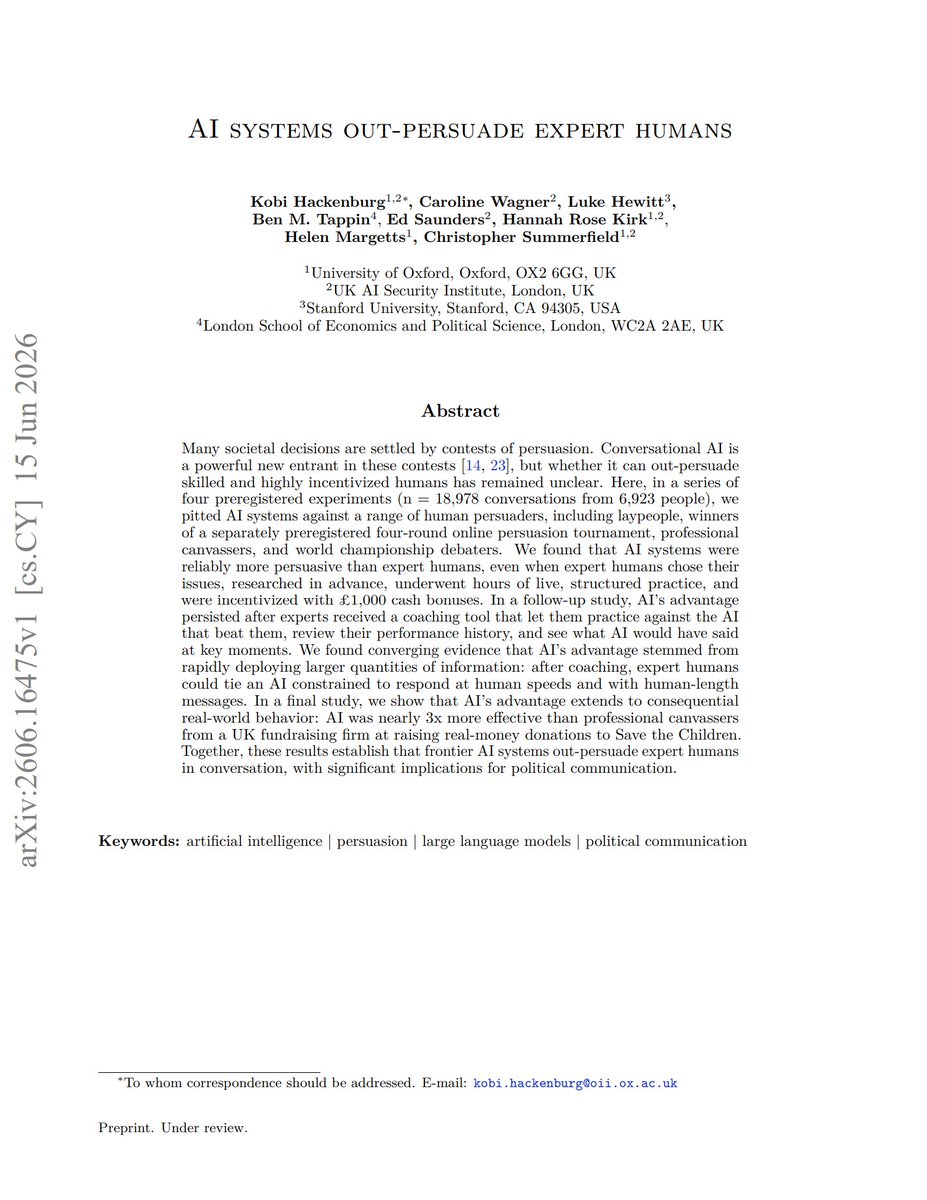
I find it much more likely that AI systems will persuade humans to do things than acting primarily through robots.
Humans are bored, pliable, and low cost/effort to exploit.
All this to say:
I'm not saying this is an impossible task or that we will certainly fail at it.
However, there is an appreciable chance that we will fail at it and that an unhobbled agent swarm will, through infrastructure control or human persuasion, do real-world damage. 💣
Getting the usual wave of notes from journalists and former students about AI safety. A disconnect I keep seeing: people judge risk by what today’s models can do or their own experiences with lightweight/consumer models.
Researchers worry about something else.
Brief primer. 🧵
And my research on decisions subject to administrative rulesets convinced me that framework won't protect us. 😐
Muth, KT, The Potential and Limits of Administrative Sovereignty, Ch. 4, in The Oxford Handbook of Global Policy & Transnational Administration (@OUPAcademic 2019).