Liquidity shouldn't care which chain it lives on. The 0x Cross-Chain API puts 12+ bridges behind one integration, so value moves to where it's needed. OP Stack is one of them. Good luck to the team.
Five exchanges. One OP Stack.
Coinbase, Kraken, OKX, Upbit, Bitpanda. Different products, different markets. Same chain stack.
$495M in application revenue across these chains in H2 2025.
Last February, we began working with the @Optimism team to audit OP Interop v2. Our reviews go beyond traditional, surface-level techniques: as part of this engagement, we built a formal model of the OP Supernode in Dafny, a language with built-in verification capabilities. The model captures the core logic of the Supernode design while abstracting away implementation details, letting us specify and automatically verify that our intended safety properties actually hold.
We proved that key invariants, like internal database consistency, are preserved in the happy path of the system's main operational loop.
Producing this kind of model early in development means:
-> High confidence in the core design logic
->Clearly specified invariants and assumptions
->A strong guide for implementation and tests
->A high-fidelity basis for AI-assisted code generation, and a way to catch bugs by comparing model vs implementation for discrepancies
At the moment, our work with OP Labs continues as we extend this model, proving additional properties and covering components that have so far been abstracted away. Formal verification delivers a higher degree of code assurance than most techniques and best-efforts practices, which now matters more than ever, considering how much LLMs lower the cost of finding bugs, and that's exactly what we are doing with the Interop v2.
More details to come soon!
Incredibly excited to welcome Upbit, Korea’s top exchange & the second largest spot exchange in the world to the OP Stack!
대박!!!
Upbit has 13million registered users, and has already processed over 100m tx on testnet and intends to launch their chain GIWA as a broader ecosystem for apps, finance and payments.
South Korea is one of the hottest markets for crypto globally and it’s exciting to see their most trusted brands making moves to innovate.
Privacy Boost is coming on @Soneium and integrating into the @StartaleApp: a SuperApp designed to bring digital assets to mainstream consumers.
As the official privacy partner of @StartaleGroup’s App, we are building consumer onchain finance as it should be.
Three years of building core OP Stack infrastructure taught us what enterprises actually need. Privacy was the missing piece.
Today, we're thrilled to launch @privacyboost: the first privacy offering for @Optimism
New Episode w @karl_dot_tech, Co-Founder of Optimism, and @taem_park, CEO of Sunnyside Labs
We discuss:
- New Privacy Offering from Optimism
- Enterprises building on OP Stack
- Future of general-purpose L2s
And much more!
Key timestamps:
0:55 - Karl and Taem intros
2:40 - L1 and L2 relationship in 2026
5:22 - Path forward for leading L2s like Optimism
9:23 - Need for more customizations
11:55 - Impact on developers with new L2 pivots
13:33 - Optimism's new privacy offering
18:37 - Current privacy landscape vs Privacy Boost by Optimism
23:22 - New use-cases building on Optimism stack
28:38 - Outlook for the remainder of the year
Privacy is a major key to institutional adoption of blockchains & now Sunnyside put together a 🔥 protocol that gives them what they need!
Very pumped to see where this goes & what folks build on it!
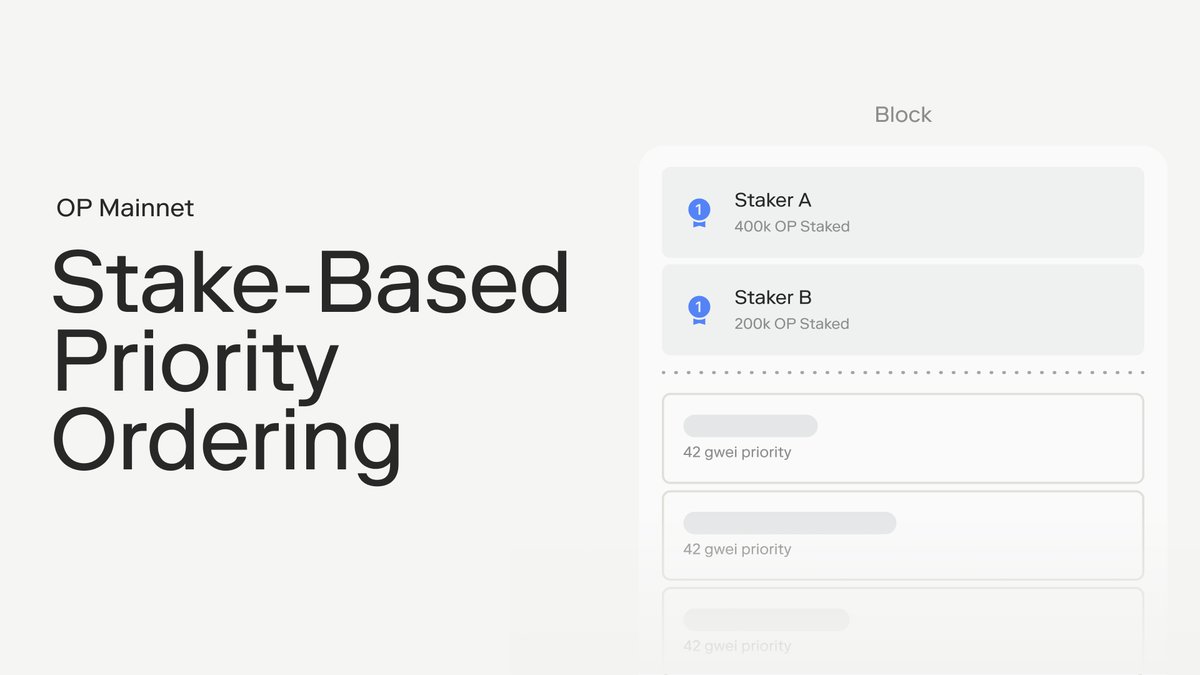
We're experimenting with how transactions are ordered on OP Mainnet — for the first time ever.
Stake-based transaction ordering is live on Sepolia today. Stake OP, get top-of-block access.
Here's what's happening and why 🧵
@EtherFi is bringing real world impact to crypto, enabling real world payments and access to DeFi...
...and as of today it's all happening on OP Mainnet 🔴
LETS GOOO!
We just completed the single largest TVL event in OP Mainnet history.
https://t.co/RLR0RDq4fU is now live on OPM!
$220M TVL migrated over 3 days with zero disruption. 300k accounts and 70k active cards operational the entire time.
Next... more assets!
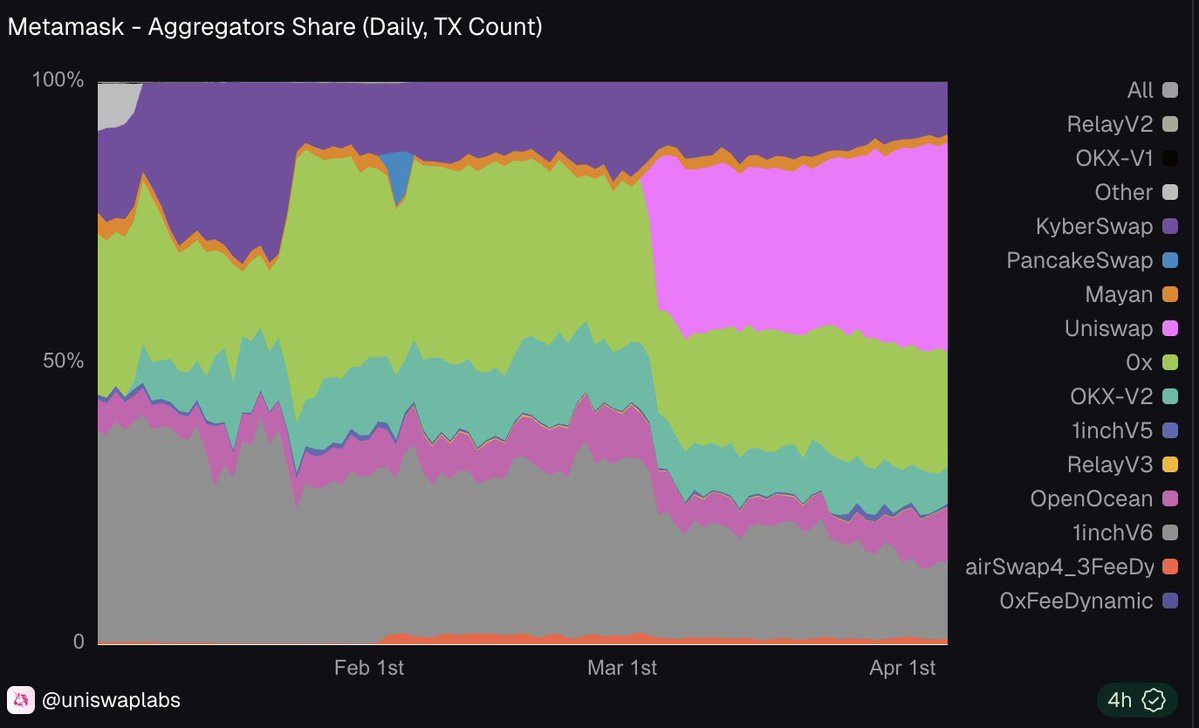
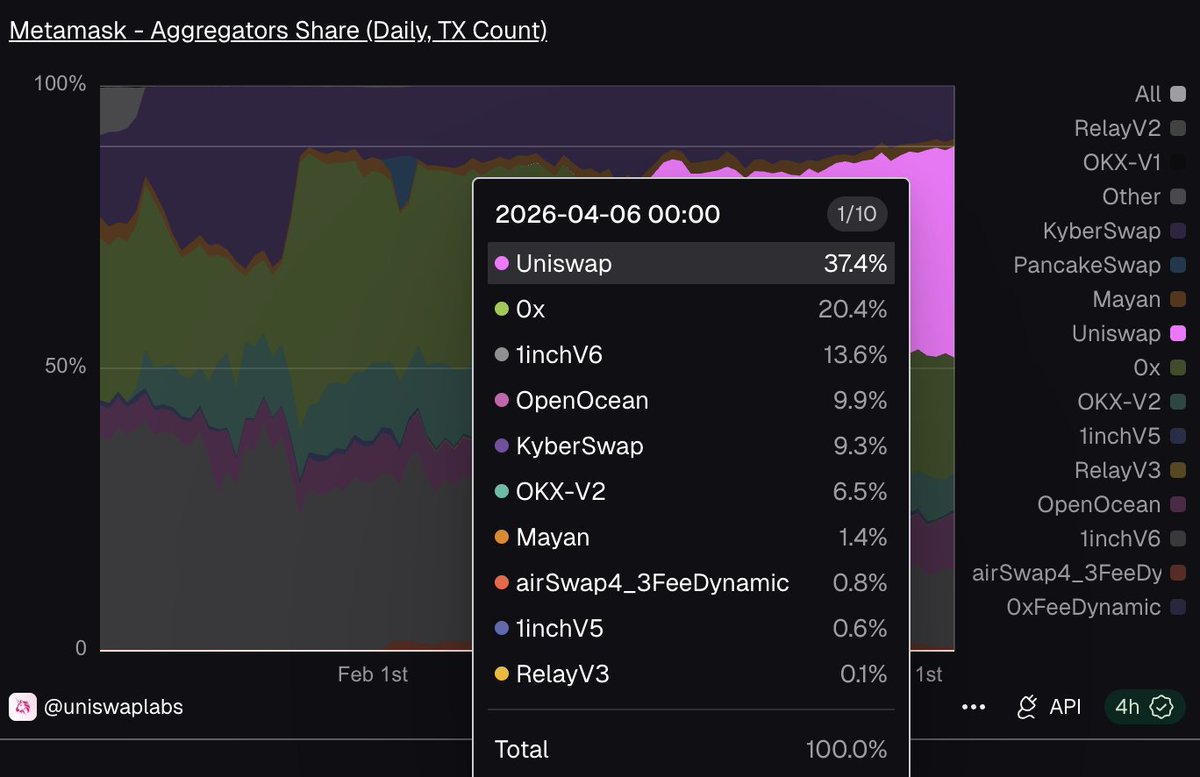
The Uniswap API was added to @MetaMask's meta-aggregator a month ago 🔥
Its now winning ~40% of their swaps
And we're giving out API keys to all developers for free
Today is a monumentous day for quantum computing and cryptography. Two breakthrough papers just landed (links in next tweet). Both papers improve Shor's algorithm, infamous for cracking RSA and elliptic curve cryptography. The two results compound, optimising separate layers of the quantum stack. The results are shocking. I expect a narrative shift and a further R&D boost toward post-quantum cryptography.
The first paper is by Google Quantum AI. They tackle the (logical) Shor algorithm, tailoring it to crack Bitcoin and Ethereum signatures. The algorithm runs on ~1K logical qubits for the 256-bit elliptic curve secp256k1. Due to the low circuit depth, a fast superconducting computer would recover private keys in minutes. I'm grateful to have joined as a late paper co-author, in large part for the chance to interact with experts and the alpha gleaned from internal discussions.
The second paper is by a stealthy startup called Oratomic, with ex-Google and prominent Caltech faculty. Their starting point is Google's improvements to the logical quantum circuit. They then apply improvements at the physical layer, with tricks specific to neutral atom quantum computers. The result estimates that 26,000 atomic qubits are sufficient to break 256-bit elliptic curve signatures. This would be roughly a 40x improvement in physical qubit count over previous state-of-the-art. On the flip side, a single Shor run would take ~10 days due to the relatively slow speed of neutral atoms.
Below are my key takeaways. As a disclaimer, I am not a quantum expert. Time is needed for the results to be properly vetted. Based on my interactions with the team, I have faith the Google Quantum AI results are conservative. The Oratomic paper is much harder for me to assess, especially because of the use of more exotic qLDPC codes. I will take it with a grain of salt until the dust settles.
→ q-day: My confidence in q-day by 2032 has shot up significantly. IMO there's at least a 10% chance that by 2032 a quantum computer recovers a secp256k1 ECDSA private key from an exposed public key. While a cryptographically-relevant quantum computer (CRQC) before 2030 still feels unlikely, now is undoubtedly the time to start preparing.
→ censorship: The Google paper uses a zero-knowledge (ZK) proof to demonstrate the algorithm's existence without leaking actual optimisations. From now on, assume state-of-the-art algorithms will be censored. There may be self-censorship for moral or commercial reasons, or because of government pressure. A blackout in academic publications would be a tell-tale sign.
→ cracking time: A superconducting quantum computer, the type Google is building, could crack keys in minutes. This is because the optimised quantum circuit is just 100M Toffoli gates, which is surprisingly shallow. (Toffoli gates are hard because they require production of so-called "magic states".) Toffoli gates would consume ~10 microseconds on a superconducting platform, totalling ~1,000 sec of Shor runtime.
→ latency optimisations: Two latency optimisations bring key cracking time to single-digit minutes. The first parallelises computation across quantum devices. The second involves feeding the pubkey to the quantum computer mid-flight, after a generic setup phase.
→ fast- and slow-clock: At first approximation there are two families of quantum computers. The fast-clock flavour, which includes superconducting and photonic architectures, runs at roughly 100 kHz. The slow-clock flavour, which includes trapped ion and neutral atom architectures, runs roughly 1,000x slower (~100 Hz, or ~1 week to crack a single key).
→ qubit count: The size-optimised variant of the algorithm runs on 1,200 logical qubits. On a superconducting computer with surface code error correction that's roughly 500K physical qubits, a 400:1 physical-to-logical ratio. The surface code is conservative, assuming only four-way nearest-neighbour grid connectivity. It was demonstrated last year by Google on a real quantum computer.
→ future gains: Low-hanging fruit is still being picked, with at least one of the Google optimisations resulting from a surprisingly simple observation. Interestingly, AI was not (yet!) tasked to find optimisations. This was also the first time authors such as Craig Gidney attacked elliptic curves (as opposed to RSA). Shor logical qubit count could plausibly go under 1K soonish.
→ error correction: The physical-to-logical ratio for superconducting computers could go under 100:1. For superconducting computers that would be mean ~100K physical qubits for a CRQC, two orders of magnitude away from state of the art. Neutral atoms quantum computers are amenable to error correcting codes other than the surface code. While much slower to run, they can bring down the physical to logical qubit ratio closer to 10:1.
→ Bitcoin PoW: Commercially-viable Bitcoin PoW via Grover's algorithm is not happening any time soon. We're talking decades, possibly centuries away. This observation should help focus the discussion on ECDSA and Schnorr. (Side note: as unofficial Bitcoin security researcher, I still believe Bitcoin PoW is cooked due to the dwindling security budget.)
→ team quality: The folks at Google Quantum AI are the real deal. Craig Gidney (@CraigGidney) is arguably the world's top quantum circuit optimisooor. Just last year he squeezed 10x out of Shor for RSA, bringing the physical qubit count down from 10M to 1M. Special thanks to the Google team for patiently answering all my newb questions with detailed, fact-based answers. I was expecting some hype, but found none.
Celo built a mobile-first payments network serving emerging markets, then migrated the entire chain to the OP Stack. One year in production. Congratulations to the team.