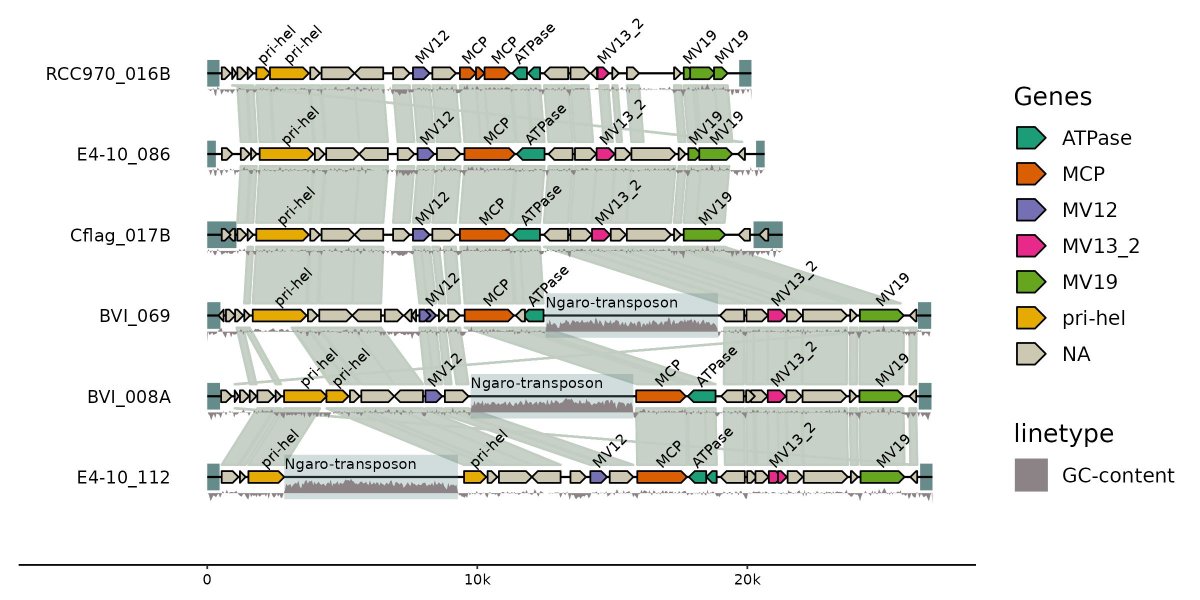
Visualize genomic data with ease using gggenomes, an R package that extends ggplot2 to handle and display genomic information intuitively. Whether you’re comparing genomes, analyzing features, or showcasing synteny, gggenomes provides the tools you need to turn complex genomic data into clear, informative visualizations.
Why use gggenomes?
✔️ Genomic-focused visualizations: Specifically designed for handling genomic data, including features, alignments, and comparative analysis.
✔️ Versatile and modular: Create detailed and layered plots for diverse genomic scenarios with flexibility for customization.
✔️ Built on ggplot2: Leverages ggplot2’s familiar framework, making it easy for users to adapt and enhance their visualizations.
The example visualization shown here is taken directly from the gggenomes GitHub repository, demonstrating how it transforms genomic data into compelling plots: https://t.co/FzE2wNzHeP
Curious to learn more about creating data visualizations in R and using tools like ggplot2 and its extensions? Check out my online course, "Data Visualization in R Using ggplot2 & Friends!"
Further details: https://t.co/ztlEzoEDWv
#tidyverse #statisticsclass #RStats #database #datavis #R #ggplot2 #Python #VisualAnalytics
What decides the “winners” in a microbial community? It's not only competitive traits; rare microbes play a key role. This #mBio study offers a “nomination-voting” model, showing how rare taxa collectively shape which species become dominant. #microbiome https://t.co/tb3u4VIaBu
Drift, dispersal limitation and homogeneous selection as a key processes shaping prokaryotic community assembly in marine sediments https://t.co/xmhNxp6iIz
Two weeks left for students and postdocs to apply to receive support for international research, training, or lab visits.
Submit your application by 1 October 2025!
Learn more and apply:
🔗https://t.co/KCrvzi6EVb
#MicrobialEcology#microbes
Happy to share our upcoming paper in ISME Commun on pioneer microbial communities, including viruses, establishing after Antarctic glacier retreat! #PolarMelt@pepa_anton@RebecaAdr@EstherRubioPort@Lbanyeras 👉https://t.co/DSj5QzX6zr
Nitrogen Fixation Potential in Bathypelagic Sediment of the Ice‐Covered Arctic Ocean Revealed Through Long‐Term Stable Isotope Incubations https://t.co/Jyo7eESSv9