Very proud to have been awarded the Sir Ian Wilmut prize for my work looking at OPC dysfunction in Multiple Sclerosis. Thank you to the panel and the organisers of the @EdinUni_IRR Away Day!
Recently had the amazing opportunity to present my PhD research at the @UKDRI Macroglia meeting in York and was awarded the ECR Talk prize - thank you to the organisers & everyone involved! #ECR#PhD#AcademicTwitter
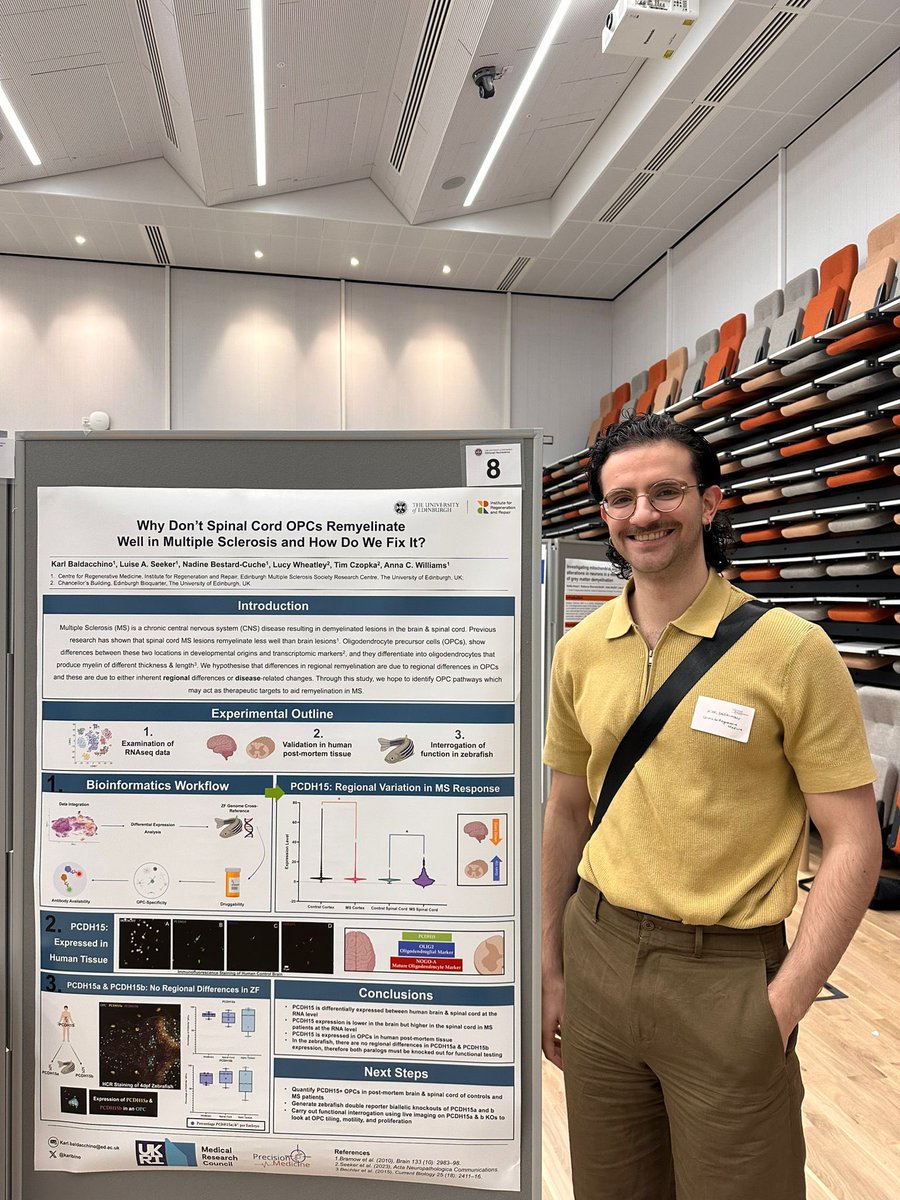
Come see our PhD student @Karlbino at the #edneuroday Poster number @AnnaWilliamsLab ‘Why don’t spinal cord OPCs remyelinate well in Multiple sclerosis and how do we fix it?’
PhD project available in our group together with @AnnaWilliamsLab. The title pretty much gives it away…
Lots to learn and lots to discover! https://t.co/mstIt2Vr1A
An insightful paper which sheds some much needed light on regional differences in glia! Excited to have the opportunity to build on Luise’s work and focus on transcriptomic differences in OPCs in my PhD project #glia#MS
1/11
Paper alert. Human glia vary more with CNS region than with age and sex. Our new paper is out today and this is a 🧵 summarising some key results.
https://t.co/xK1oMy1Tqr
Tickets for @pintofscience go on sale today! ✨ Come see some amazing science talks across 6 themes in pubs and venues in Edinburgh 🏴 buy your tickets now at: https://t.co/LoUKfgrqcG
#pint23 🍻
@TepavcevicVanja This is something I’m planning to look into in the coming weeks! But we expect to find less and are hoping to be able to quantify this using a PDGFRA probe. I also want to say thank you for the excellent review paper published last December - really insightful!
Had the amazing opportunity of presenting a poster at this year’s #EdNeuroDay where I presented the current findings of my PhD study titled ‘Why don’t spinal cord OPCs remyelinate well in MS and how do we fix it?’ #AcademicTwitter#phdchat
Thank you to everyone who has been involved in this project so far, namely everyone within the @AnnaWilliamsLab and @Czopka_Lab, and specifically @LuiseASeeker for all her help so far!
🆕 | Research by @iiiGlasgow scientists has shown for the first time that iron overload can contribute to the ongoing brain damage in progressive MS, confirming treatments preventing this could slow accumulation of disability.
🔗https://t.co/saathOLmtn
📜https://t.co/FdbB928HqG