When Muslim Conference was founded in 1932, its flag was green with a crescent at the center; a symbol of Muslim identity. The party emerged solely to champion Muslim rights and resist Dogra rule in Jammu & Kashmir.
1/4
To prove his Secularism in 1955, This Song was banned by Sheikh Muhammad Abdullah in JK valley.
Coz of lyrics in the song 'Islam ki kashti ko hum paar laga denge'.
A critique of Sheikh Abdullah's autobiography Atish-e-Chinar and its treatment of the Ahrar leader Shorish Kashmiri with some personal reflections Ved Bhasin. From our archives.
Sheikh Abdullah's Atish-e-Chinar and Shorish Kashmiri https://t.co/Oj6BekNz18
I really fail to understand why this man is being hailed as a visionary. Was this his so-called vision, claiming that India would never become a communal country?
The miseries kashmiris suffer today are a direct result of his actions.
Pic: Speech of Sheikh Abdullah in 1948.
@thenawakadal LOL. As we don't know what your grandfather did in 1947 and then in 1975.and your father in 1988 and you in 2010. Tale of compromise are vast. Kabhi fursat se milo. Batayenge.
To mobilize the Kashmiri Pandit vote, he revived his grandfather’s practice of chanting "Har Har Mahadev" in Rainawari and during Indira Gandhi’s 1975 visit he carried out the 'batte tyok' ritual upon entering the temple.
I can only laugh at this pathetic circus. In 1975,his grandfather crawled to Indira Gandhi begging for the return of autonomy & failed.He sold out for the chief minister's chair.Since then they've shown they'll sign any deal with Delhi to cling to power in J&K. Cowardly traitors.
Remembering Tufail Ashraf Matoo who was murdered on 11 june 2010 while returning home from tution .He was deliberately hit by a tear gas on his skull and died instantly.
@JKNC_ (National Conference) was ruling the state under the supervision of Omar Abdullah,
@OmarAbdullah
Kehansi ma aasi shaq tze ye chu tuhinde khetre.. Ye che soorui for Army, taaki tem gasan times peth waatin muqaamas peth takleef bagaer.. Baaki wasalaam.
SMA claimed that He knew Allama Iqbal closely is untenable, as he followed only a negligible fraction of Iqbal’s teachings. A careful look at the historical record shows that Sheikh’s actions and statements were frequently the very opposite of Iqbal’s.
Allama Iqbal introduced the concept that later became known as the Two-Nation Theory and consistently championed the political rights of Muslims in India. In contrast, Sheikh strongly opposed the Two-Nation Theory, even calling it poisonous. ++1
From the Archives – Sher-e-Kashmir Speaks.
In this special episode, Sher-e-Kashmir Sheikh Mohammad Abdullah fondly recalls his first encounters with Allama Iqbal, reflecting on the poet’s profound love for Kashmir, his deep concern for the hardships faced by its people, and the pride he took in his Kashmiri heritage.
A rare archival conversation offering a unique glimpse into the relationship between two towering figures who helped shape the intellectual and political consciousness of their time.
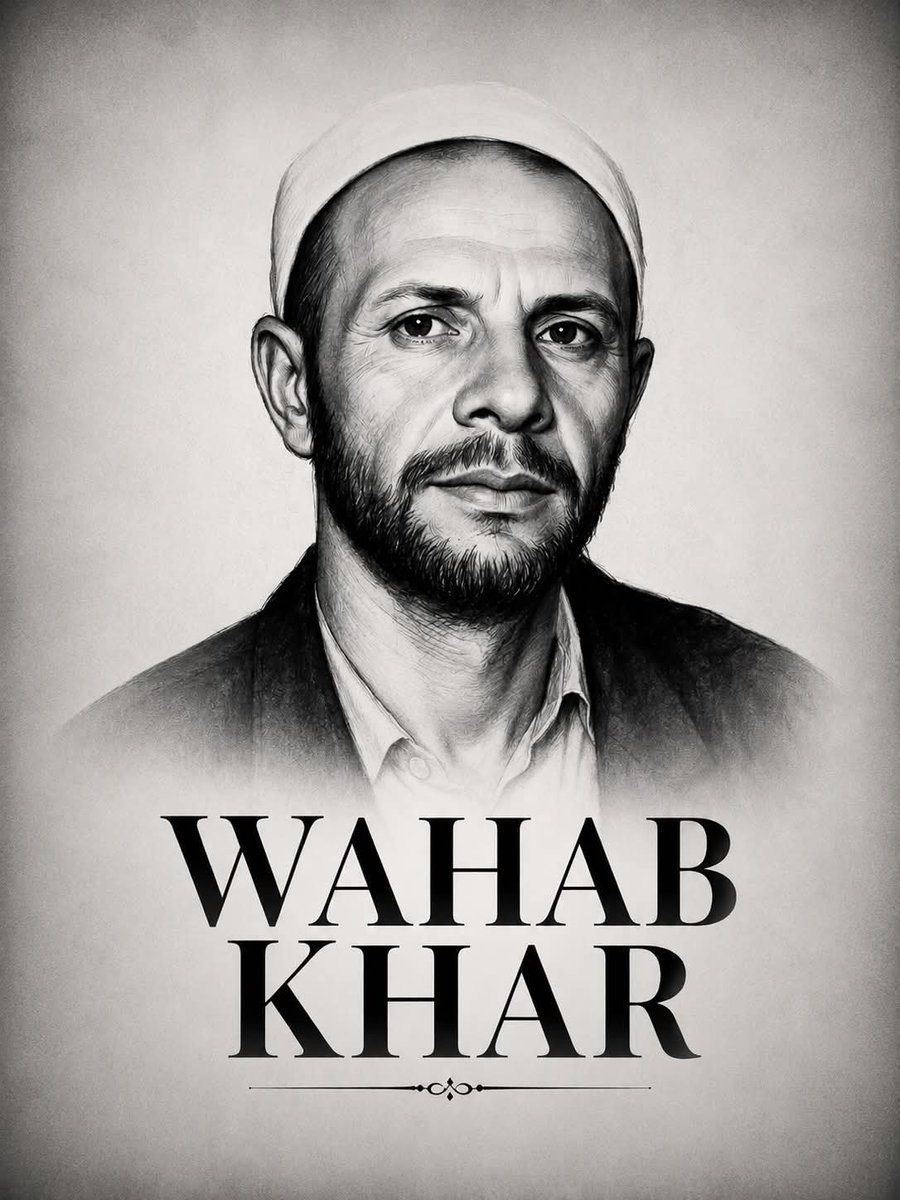
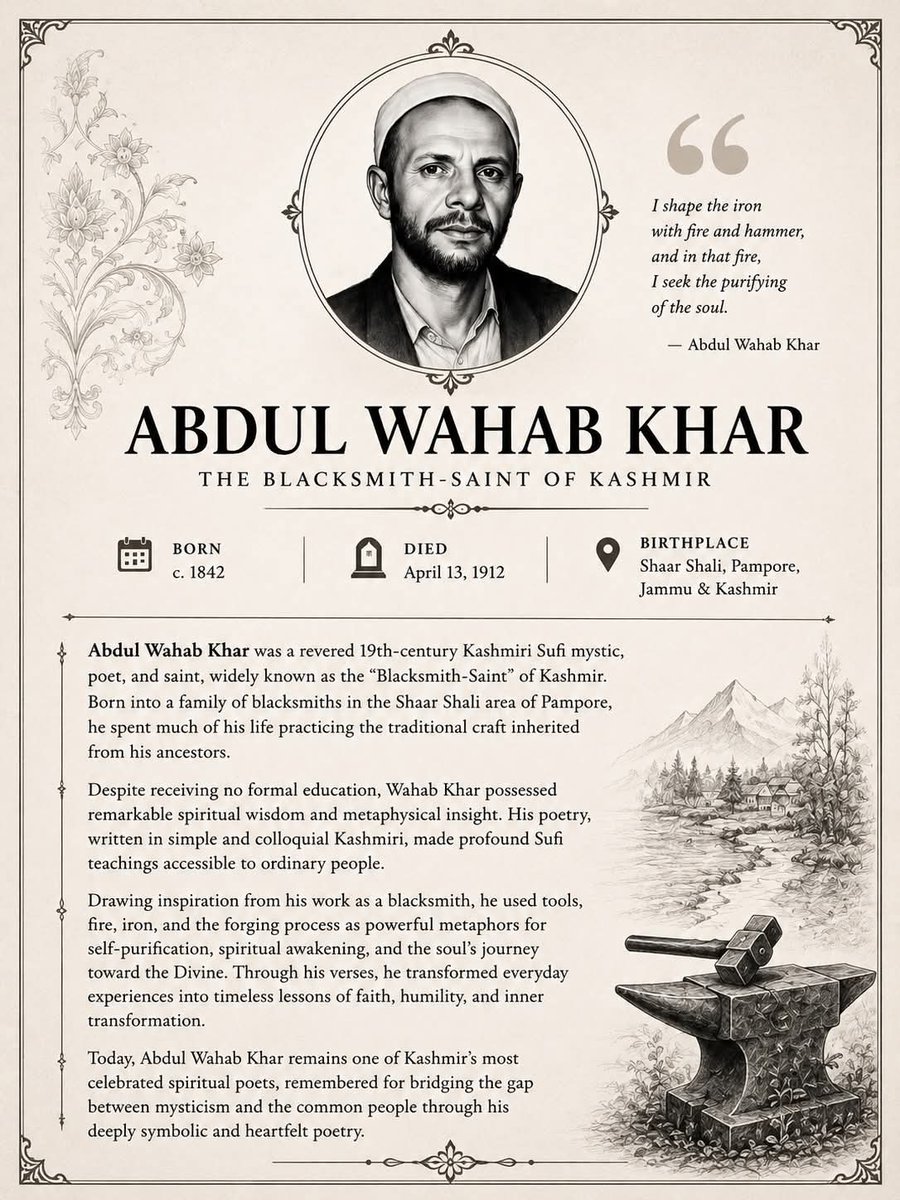
Abdul Wahab Khar (c. 1842 – April 13, 1912) was a revered 19th-century Kashmiri Sufi mystic, poet and saint. Born into a family of blacksmiths in the Shaar Shali area of Pampore, Jammu and Kashmir, he is often celebrated as the “Blacksmith-Saint”.
the National Conference to signal its secular and socialist orientation. In 1934 he also asked P.N Bazaz to write a book about him to clarify that he was not an Islamist or communal leader; that book was later published as 'Kashmir ka Gandhi' with his approval.
Sheikh Abdullah often presented a dual political persona. In 1932 he founded the Muslim Conference, outwardly projecting an Islamic identity to gain popular support, yet he did not intend to be a communal leader; ++1/3
1935, Sheikh Abdullah with a beard, leading the Muslim Conference.
Post-1953, clean-shaven, as leader of the National Conference.
The beard was shaved, the party renamed. Was changing the face necessary to change the politics?
he was influenced by the Indian National Congress and aspired to a secular platform. By 1936 he shaved his beard as a political gesture to distinguish himself from the Mirwaiz Yousuf, then the principal religious figure in Kashmir. He later renamed the Muslim Conference ++2/3
It is baffling to see this so‑called "unity" brigade treat Abul Kalam Azad’s warnings about Pakistan as if they were oracular pronouncements, while deliberately ignoring Jinnah’s warnings about Hindu majoritarianism. Jinnah’s point is no less true & in many ways, more pressing.
Maulana Abul Kalam 'Azad' said the following about the Muhajirs:
"You who are leaving your homeland today... a time may also come when the natives of Pakistan will rise up, claiming their own distinct, localised identities. If you go and settle in Bengal, you will be called a Hindustani. If you go and settle in the province of Punjab, you will be called a Hindustani. If you go and settle in the Frontier Province (Khyber Pakhtunkhwa) and Balochistan, you will be called a Hindustani. Even if you go and settle in the province of Sindh, you will still be called a Hindustani!
And when these nationalities begin to declare themselves as distinct and permanent entities... Then reflect for a moment... At that time, won't your position in Pakistan become fragile and displaced, just like an uninvited guest?"
———
To understand his speech better, you all need to read about the following topics:
1. Biharis in Bangladesh: 1971 & aftermath
2. Karachi Muhajirs and Fall of MQM
3. Rise of Ayyub Khan & Capital transfer
4. Rise of PPP and Karachi treatment
5. Assassination of Liaquat Ali & Aftermath
6. The Fatima Jinnah fiasco