This is a private account re the amazing Kaspa cryptocurrency and related stuff. Visit @kaspaunchained for what's as close to the "official" one as possible.
@OfficialTravlad To be fully accurate, complex DeFi stuff like AMMs, lending, perpetual DEXes and DAOs with governance voting still won’t have everything they need yet. But simpler primitives like timelocked vaults, payment splitters, native token issuance all work right after the fork. Awesome!
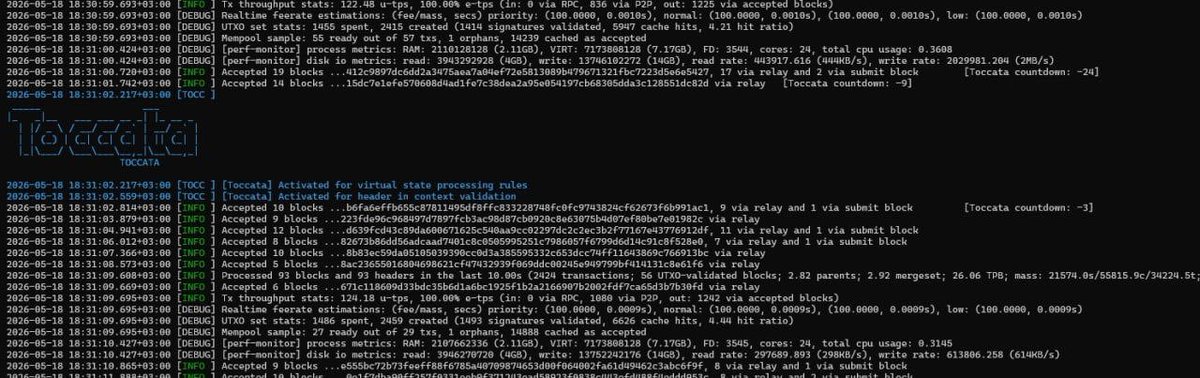
Update: Testnet 10 underwent the Toccata hardfork about 30mins ago and everything’s still running like clockwork. Transition was smooth and seamless.
This seamlessness is the standard that kaspa devs set. It’s easy to take it for granted so I want to take this moment to recognize the effort and due diligence that went into making this happen @michaelsuttonil@OriNewman@Max143672@IzioDev@FreshAir08@manyfest_@hus_qy (and sorry if I missed anyone)
Mainnet HF soon
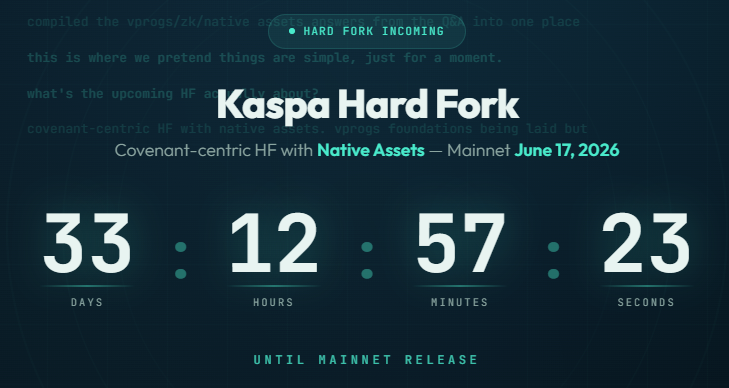
Only about a month left until the $KAS hardfork upgrade to Toccata
With Bitcoin holding around $80k, I'm feeling decently bullish, but who knows how it'll be in a month from now
Part of me hopes for lower prices until Mainnet upgrade to hoard as much cheap tokens as possible
Toccata is not Kaspa “adding smart contracts” so it can cosplay as Ethereum. That is the wrong frame entirely. What Toccata is doing is far more disciplined: extending Kaspa’s execution surface without corrupting the base layer into a bloated global computer.
The architecture is converging around two distinct paths. One is native L1 covenant programmability, where richer script logic and covenant IDs let UTXOs carry stricter conditions, lineage, and composable constraints directly inside Kaspa’s settlement model. The other is the based zk path, where computation happens offchain but inherits Kaspa’s ordering and settlement guarantees instead of depending on an external sequencer cartel. That distinction is everything. This is not VM maximalism. It is constrained programmability with architectural hygiene.
The real technical hinge is not the opcodes by themselves. It is sequencing. KIP 16 gives Kaspa a proof verification surface. KIP 17 expands covenant expressiveness. But KIP 21 is the deeper move, because it appears to restructure sequencing commitments into a partitioned, activity aware model. That changes the proving economics. Instead of forcing applications to inherit the full historical mass of the DAG, the system can begin pushing proof cost closer to local activity. That is the difference between real based zk infrastructure and empty cryptographic theater.
That is also why the timing matters less than the ordering of the work. Kaspa seems to be freezing the sequencing architecture first, before larger zk systems and compilers harden around the wrong assumptions. That is the correct move. Once developers begin building proof systems on top, changing the commitment grammar becomes exponentially more painful.
So Toccata is not just a hard fork. It is Kaspa teaching its settlement layer how to host programmable constraints and proof aware execution without surrendering the qualities that made the base layer worth building in the first place.
The time has come for me to share what I’ve been working on ...
Introducing #HASH.
A grassroots, guerrilla marketing engine for #Kaspa, built with one goal: break out of the echo chamber and push Kaspa into the real world where it can’t be ignored.
I've spent a lot of time the past couple years doing my part to spread the message, build awareness, and be a voice in the $Kas community.
But there is still a gap between what Kaspa is and what the world sees. And I'm tired of sitting on the internet sidelines. That ends here.
I want to take Kaspa to the streets.
Over the coming weeks I’ll break down everything: what HASH is, how it works, how I plan to fund it, and how you can get involved.
Stay tuned.
Let's try this "engagement farming" thing.
I was invited to a big YT channel to discuss the quantum threat. Inspired by the comments to the previous video (pinned), if this post gets 1k likes I'll wear a $kas Kaspa shirt.
What I'm saying is: yes, quantum threats have been known for a long time, but they:
a) have constantly remained indefinitely far away in time, and in any case in 2018, when Kaspa started being developed as a venture-funded project, quantum computers were not a near-term threat. From a practical point of view, this meant that they definitely would not become a threat by the time Kaspa was supposed to be brought to market as a ready-made solution, and for many years after that. So allocating budget, time, and finances in the project for protection against quantum threats was simply pointless from the venture capitalists' perspective. Protection against ephemeral threats is not a market advantage for a solution - it's a delay in development timelines and a threat to return on investment.
b) All quantum-resistant algorithms relevant to crypto - both at the time Kaspa was created and now - produce much larger data artifacts than classical ones. This is a direct threat to the network's bandwidth and data storage requirements, and consequently to the degree of decentralization of the network. And all of this affects the market value of the solution.
Therefore, mechanisms for quantum resistance had to be, and were, set aside when implementing Kaspa. One needs to think about ephemeral threats to a market solution only after all or the vast majority of its more pressing problems have been solved. And Kaspa is already an engineering structure of unprecedented complexity.
I hope I managed to convey my point of view.
Can you explain the attack technique in a bit more detail? I can't quite wrap my head around it right now, and here's why: according to the Kaspa codebase (if I'm not mistaken after analyzing the code via https://t.co/QdzBXc5yoS), the elements of the MuHash are not the UTXO data bytes themselves, but random numbers generated by the ChaCha20RNG, whose seeds are the 3072-bit Blake2b hashes of the UTXOs. So, to me, it looks like forging a UTXO would first require learning how to reverse these two hashes, and that still seems like a hard problem even in the post-quantum era. In this scenario, an attack on the UTXO commitment seems barely feasible to me. Am I missing something?
Man, if you start over-engineering solutions for threats that aren't realistic at the time of system development, the system will never get built at all. Besides, as you can see from the text, there was no satisfactory solution either now or especially back then. Would you really want the Kaspa devs to postpone building an actual engineering system and instead dive into fundamental theoretical problems? Would you thank them if you found out the expected mainnet launch timeline in that scenario? And how do you think venture investors would feel about it? Or does none of that matter, and the only thing that matters is absolute perfection in every single breath?
fed the Google whitepaper to Claude with the prompt:
"take a look at the Google paper, pick out the key parameters, and give me your analysis of the relative strengths, weakness and adaptability for both Bitcoin and Kaspa in table form"
there's literally no parameter for which $KAS Kaspa is not superior, security wise
the narrative for the past few years, that somehow $BTC is more secure as a POW chain, has now gone out the window in face of the quantum threat
Kaspa Toccata Hard Fork:
Kaspa is about to unlock native L1 programmability with covenants via extended opcodes + full support for based zk apps (Groth16 + RISC Zero) on its high-throughput blockDAG. Key upgrades:
• Partitioned sequencing
• Canonical bridging
• Stateful multi-contract flows
• Proving costs that scale per app (no network-wide tax)
Timeline: April 15, 2026 → Feature freeze
June 5–20, 2026 → Mainnet activation (delayed from May 5 for sequencing stability)
Testnet validation + node upgrades rolling out now. Kaspa just went from fast money to smart money. #Kaspa #Toccata #ZK #Crypto $KAS
share like fav comment👊
Rereading KIP-9 https://t.co/e6MNinN95U, I remembered: I always underestimate how deep the Kaspa design goes. Every time I expect a "security compromise", I find out the only real compromise is my own laziness to look under the hood. Once you dive deep, it’s flawless. No hacks, no clutches. Security? Sure yes, here. Wait, but micropayments?.. Ah yes, elegantly covered as well. Man. Kaspa devs are pure geniuses.
@nikitabier@mistor@santisiri@steipete@openclaw@nikitabier love it — quality > spam.
Any chance $KAS (Kaspa) could be part of the new Smart Cashtags rollout? Top 100 coin w/ a huge organic community. Founder @hashdag even went viral turning down @binance “top 100” spot 😅
https://t.co/GlpUoSeNXD
DAG Industrial | Episode #006: The Agentic Web 🤖🔗
In 2026, the workforce has changed. 82:1. That is the ratio of Autonomous AI Agents to human employees.
But these agents have a problem: They are unbanked ghosts. 👻
Episode 006 breaks down how #Kaspa provides the financial nervous system for the $26 Trillion Machine Economy.
The 2026 Tech Stack:
🔹 The Problem: You can't run a fleet of million-transaction-per-second AI agents on a 15-minute block time.
🔹 The Solution: KIP-17 Covenants. We can now program "Spending Limits" directly into the UTXO. Your AI agent can hold money, but it can only spend it on approved services (Data, Energy, Compute).
🔹 The Scale: From V2X (Vehicle-to-Everything) to DePIN, Kaspa is the only PoW layer fast enough to catch the "stream" of machine payments.
The future isn't just about "Human-to-Human" transactions. It's about Machine-to-Machine (M2M) settlement.
Watch the full briefing below. 👇
#KAS #BlockDAG #AI #MachineEconomy #DePIN #Web3 #FutureOfWork
Have been following reactions to what I said about L2s about 1.5 days ago.
One important thing that I believe is: "make yet another EVM chain and add an optimistic bridge to Ethereum with a 1 week delay" is to infra what forking Compound is to governance - something we've done far too much for far too long, because we got comfortable, and which has sapped our imagination and put us in a dead end.
If you make an EVM chain *without* an optimistic bridge to Ethereum (aka an alt L1), that's even worse. We don't friggin need more copypasta EVM chains, and we definitely don't need even more L1s. L1 is scaling and is going to bring lots of EVM blockspace - not infinite (AIs in particular will need both more blockspace and lower latency than even a greatly scaled L1 can offer), but lots.
Build something that brings something new to the table. I gave a few examples: privacy, app-specific efficiency, ultra-low latency, but my list is surely very incomplete.
A second important thing that I believe is: regarding "connection to Ethereum", vibes need to match substance.
I personally am a fan of many of the things that can be called "app chains". For example I think there's a large chance that the optimal architecture for prediction markets is something like: the market gets issued and resolved on L1, user accounts are on L1, but trading happens on some based rollup or other L2-like system, where the execution reads the L1 to verify signatures and markets. I like architectures where deep connection to L1 is first-class, and not an afterthought ("we're pretty much a separate chain, but oh yeah, we have a bridge, and ok fine let's put 1-2 devs to get it to stage 1 so the l2beat people will put a green checkmark on it so vitalik likes us").
The other extreme of "app chain", eg. the version where you convince some government registry, or social media platform, or gaming thing, to start putting merkle roots of its database, with STARKs that prove every update was authorized and signed and executed according to a pre-committed algorithm, onchain, is also reasonable - this is what makes the most sense to me in terms of "institutional L2s". It's obviously not Ethereum, not credibly neutral and not trustless - the operator can always just choose to say "we're switching to a different version with different rules now". But it would enable verifiable algorithmic transparency, a property that many of us would love to see in government, social media algorithms or wherever else, and it may enable economic activity that would otherwise not be possible.
I think if you're the first thing, it's valid and great to call yourself an Ethereum application - it can't survive without Ethereum even technologically, it maximizes interoperability and composability with other Ethereum applications.
If you're the second thing, then you're not Ethereum, but you are (i) bringing humanity more algorithmic transparency and trust minimization, so you're pursuing a similar vision, and (ii) depending on details probably synergistic with Ethereum. So you should just say those things directly!
Basically:
1. Do something that brings something actually new to the table.
2. Vibes should match substance - the degree of connection to Ethereum in your public image should reflect the degree of connection to Ethereum that your thing has in reality.