Had a really interesting conversation with Kaspa core developer @michaelsuttonil about the Kaspa Privacy Initiative today.
We discussed our candidate architecture for a scalable shielded native KAS protocol, using covenants, ZK proofs, permissionless relayers and batchers.
One of the biggest takeaways was how much of the infrastructure we're looking for may already be available through Kaspa's Based Apps and KIP-21.
In our original design, one of the challenges was ensuring that batchers couldn't selectively omit user operations while claiming to have processed a complete batch.
With Based Apps, user operations can be ordered directly on Kaspa L1 in an application-specific lane. KIP-21 provides cryptographic sequencing commitments, allowing a properly designed settlement proof to demonstrate that the relevant operations were processed correctly.
That could remove a substantial amount of custom infrastructure we'd otherwise have to build ourselves.
We also discussed canonical bridges, recursive proving and why sharding may introduce unnecessary complexity at this stage.
Our next step is a small Based App feasibility PoC on TN10.
We'll test lane ordering, execution, proof-based settlement, deliberate transaction omission and independent reconstruction before adding the actual shielded privacy logic.
No architecture has been finalized. The goal remains to find the safest, most scalable and most decentralized solution, not to defend an earlier design.
Really appreciate Michael taking the time to share his insights. Conversations like these are incredibly valuable.
Technical feedback, criticism and contributions are very welcome!
https://t.co/h4gdcS1dfn
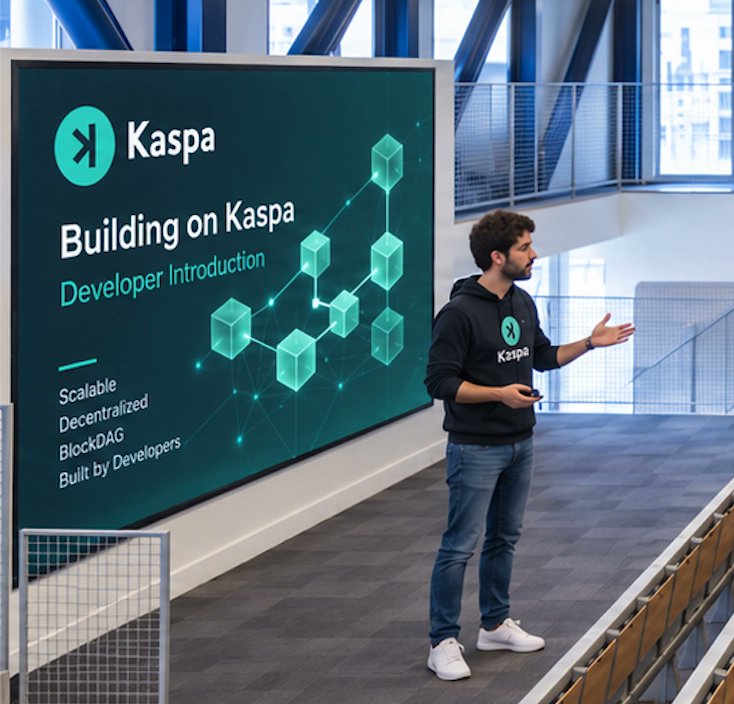
UPDATE: 🇫🇷 Kaspa Hackathon at EPITA Paris - minimum funding reached. We’re moving forward! 🎉
Thanks to our generous contributors thus far! 💚 Help us fund the next generation of Kaspa builders.
More builders → more adoption.
Support & repost👇
https://t.co/6dmbNE684U
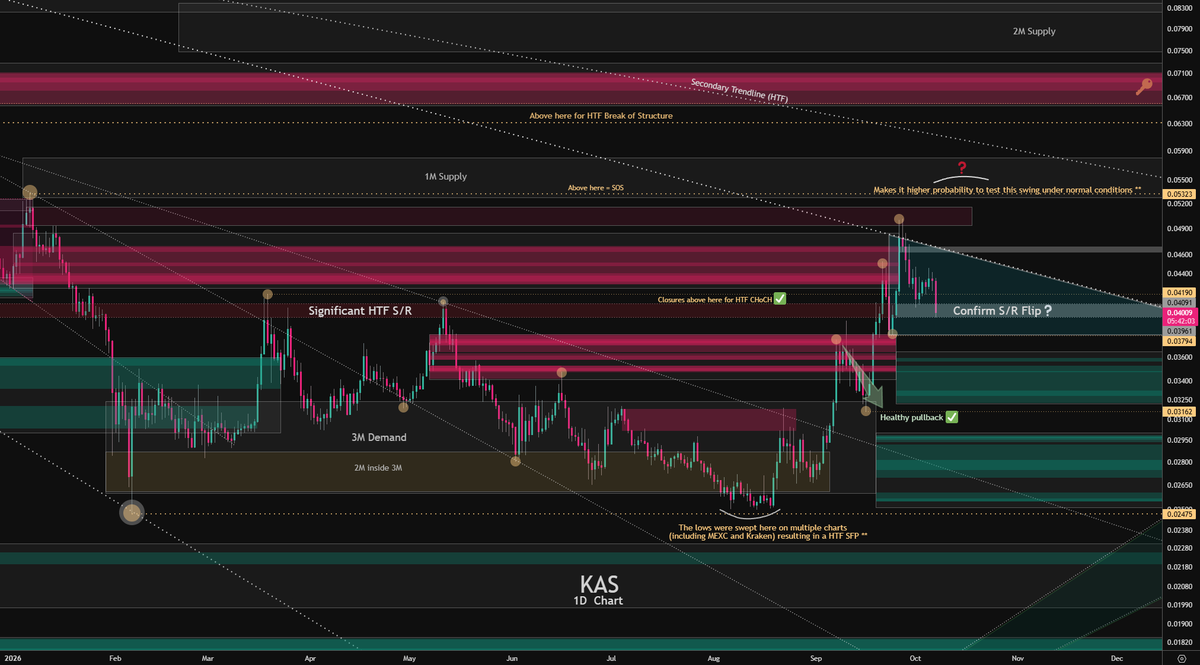
$KAS This will be my last update for a while.
HTF structure is now in a neutral or no-trend - meaning both long and short setups have equal viability. This will be the case until confirming either above 6.3c or below 2.4c.
MTF structure is bullish and will remain so until closures below the 3.8c swing. Some nice areas of support have been built during this drive that could be good areas to look for entries on pullbacks.
Mainly, I'm looking at this now as a big range between 6.3 and 2.4, where pushing past either level will indicate the end of the macro bear trend. Whether that's above 6.3, meaning confirming the bottom at 2.4, or below 2.4 providing the final area for long-term accumulation.
I have no timeframe for any of this, as it's now different enough cyclically that it's not worth factoring in, imo. This just means price could remain in this range for nearly 6 months before it would start to look strange. And on the flip side, price could break out tomorrow and it would look completely natural.
In the short-term, price has rejected from the 2D supply and it's first test of the last MTF trendline before the first HTF (Secondary) TL. Looking at this TL and the 4c S/R as a triangle - reactions here will be the first tip-off of the next move.
The S/R should remain as support. Losing it will be the first sign price will instead look to those lower levels for support. It's still possible to sweep the 5.3c swing before that significant of a pullback as well. Breaking above the TL will be the tip-off this move is coming.
For overhead targets, anything between the 1M and 2M supplies (5.3-8.3c) is on the table before a larger pullback is due. It will be important to monitor HTF closures against the 6.3 swing in the event of a move like this. As I said previously, price can move all the way here and still be favored to make new lows depending on closures.
For lower targets, I believe anything below about 1.3c is now off the table outside of catastrophic circumstances. If the range is broken to the downside, finding a bottom between 2.1 - 1.5c is most likely by a landslide.
Probabilistically, it's now likely the bottom is in. Not drastically - maybe 60/40 - but nonetheless, very close now. Obviously, this will still be swayed but whatever happens with $BTC, which as of now is in the same boat structurally on the HTFs (neutral/no-trend).
That should do it. I'm banking on this info remaining relevant for a while. In the event it does somehow become outdated quicker than expected, I'll do what I can.
GL to everyone and I'll hopefully see you all at new ATHs.
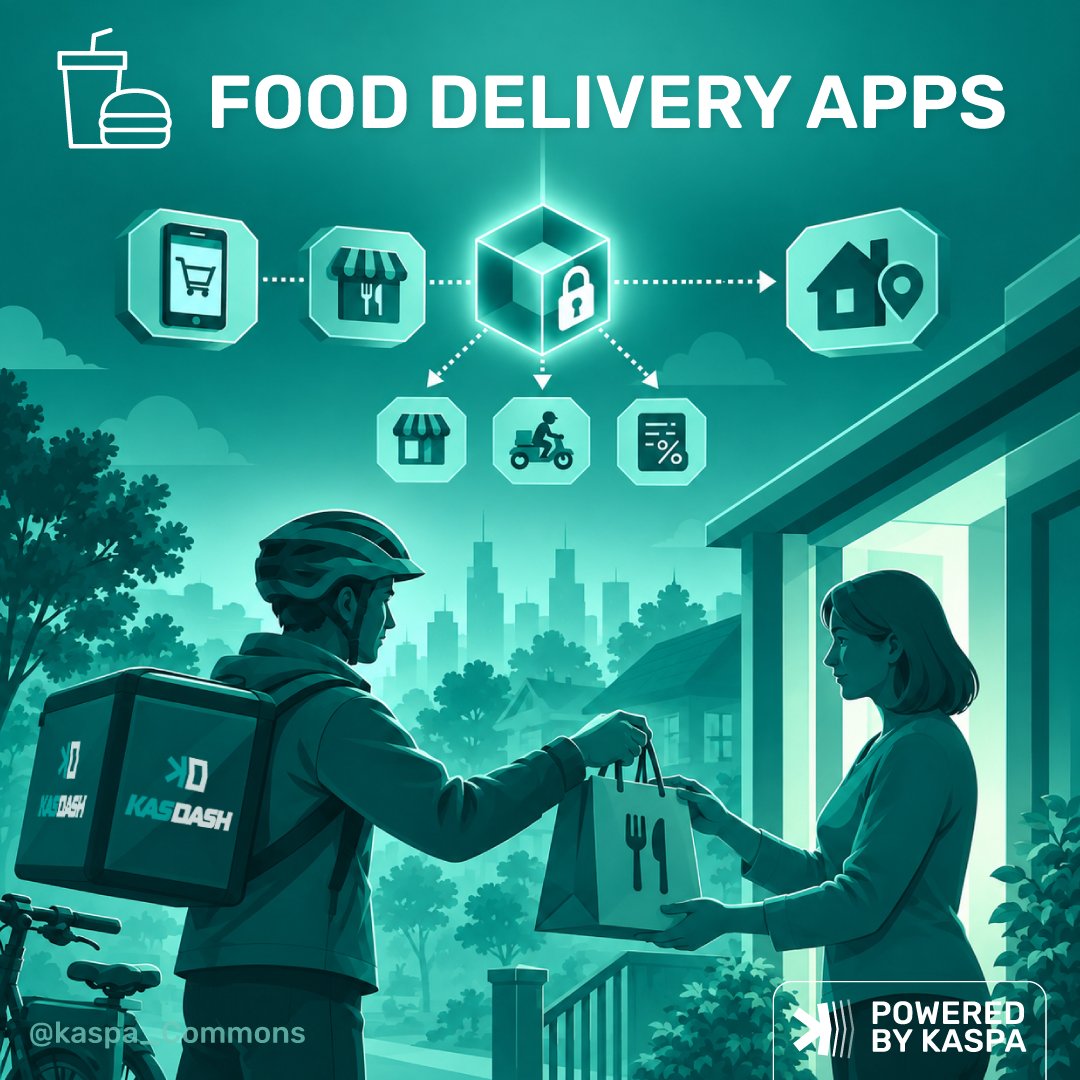
60+ Enterprise Markets to Be Disrupted by #Kaspa Tech
#33 Food Delivery Apps
Food delivery apps connect customers, restaurants and couriers, but the platform sits in the middle of almost every part of the transaction.
It receives the order, handles payment, tracks delivery, calculates fees, pays restaurants and couriers, manages disputes and keeps the transaction history.
Legacy Platforms & Systems
• DoorDash, Uber Eats, Skip and Deliveroo
• Centralized restaurant and courier marketplaces
• Credit and debit card payment networks
• GPS and mapping APIs
• Restaurant POS integrations
• Proprietary courier matching and dispatch
• Platform-controlled ratings and reputation
• Scheduled restaurant and courier payouts
These platforms provide useful services including discovery, logistics and support. There is still plenty of room to rethink how the order, payment and settlement underneath those services work.
What’s Broken / Innovation Gaps
❌ Restaurants and couriers depend on a central platform for settlement
❌ Customer payment, restaurant payment and courier payment are separate processes
❌ Payments can settle long after the food is delivered
❌ Order status and disputes depend on platform-controlled records
❌ Refunds and cancellations require the platform to determine where the money goes
❌ Ratings and work history are trapped inside individual apps
❌ Restaurants have limited control over marketplace customer relationships
❌ More automated commerce will require programmable payment and settlement
Where Food Delivery Can Still Innovate and Where Kaspa Tech Could Help
❌ The platform controls the money from checkout to payout
✅ Payment could be locked at checkout with the conditions for spending it established from the beginning.
Kaspa Covenants can enforce how a UTXO may be spent and validate its next state. Covenant IDs provide continuity as that state changes. An order could move through accepted, prepared, picked up, delivered, cancelled or refunded states while retaining a verifiable lineage.
❌ Developers have to build that logic close to Kaspa Script
✅ SilverScript now provides a higher-level way to write it.
SilverScript v1.0.0 is officially released and compiles to Kaspa Script. Developers can define state and transition policies while the compiler handles much of the lower-level Covenant plumbing, state validation and transaction structure.
For a delivery application, that could mean writing rules for when funds remain locked, when an order can advance, which outputs are valid and what conditions allow settlement or refund.
❌ One customer payment eventually has to become several payments
✅ The transaction itself can enforce the agreed outputs.
Kaspa’s transaction introspection allows a Covenant to inspect and validate transaction outputs. A delivery contract could require the correct amounts and destinations before allowing locked funds to move.
That opens the door to settling the restaurant, courier, taxes and other predefined recipients as part of the completed transaction rather than sending everything through a platform account first.
❌ Delivery confirmation and payment are separate events
✅ Delivery confirmation could become an input to the settlement process.
A restaurant scan could verify pickup. A customer QR code, signature or another authenticated action could confirm delivery. The Covenant rules determine what constitutes a valid transition and whether the corresponding payment outputs are allowed.
❌ Restaurants and couriers wait for platform payouts
✅ Settlement could occur as part of the completed order transaction.
Once the required conditions are satisfied, Kaspa can settle the valid transaction directly rather than leaving balances inside a platform for later reconciliation.
❌ Cancellations and refunds require someone in the middle to control the funds
✅ Valid refund paths can be written into the contract.
A Covenant could allow one transition if an order is cancelled before pickup and another once delivery has been verified. More complicated disputes may still require arbitration or another agreed process. The basic settlement rules do not have to be decided after the fact.
❌ A full delivery marketplace involves more than one contract
✅ This is where Argent becomes interesting.
Argent is being developed as an actor-based language and compiler for atomic, multi-contract applications on Kaspa. Argent programs compile to SilverScript and its runtime can construct transactions coordinating multiple actors.
A future delivery application could potentially model the customer, restaurant, courier and other participants as separate actors whose contracts participate in one coordinated transaction.
Argent is still under active development and needs further auditing and hardening before general production use.
❌ Private customer information should not be exposed publicly
✅ Kaspa’s native ZK verification provides another building block for applications that need to prove something without exposing all of the underlying information.
This could eventually be useful for identity, eligibility, delivery or other private verification requirements while keeping unnecessary personal information outside the public transaction history.
What could that look like?
A customer places an order and the payment is locked according to predefined rules. The restaurant accepts it, the courier verifies pickup, and delivery is confirmed at the door.
That final confirmation can trigger a transaction distributing payment to the restaurant, courier, taxes and any other agreed recipients.
The delivery app can still handle menus, maps, courier matching, notifications, customer service and logistics. It doesn’t necessarily need to hold the funds and manage settlement between everyone involved.
Toccata provides the L1 capabilities. SilverScript gives developers a practical language for writing Covenant logic. Argent is exploring how more complex multi-actor applications can be built above that foundation.
Got inspired? Start Building!
See links in thread
PS - Shout out to @KasperoLabs for demoing their KASDASH app! We're hungry for more!
if a dev says their covenant was audited, you should be able to check that they deployed the code people reviewed.
argent’s covenant genesis proofs let people check a covenant’s original code and setup against its on-chain ID.
the goal is for explorers to show these proofs, so people can inspect what they’re trusting their KAS to.
i’ve written about it in the past but i feel like now it would hit more ears so to speak.
there are basically two categories of covenants, those that are all about the Kaspa they protect (eg vaults, timelocks, escrow etc) and those that are about the state they carry which essentially forms another mini social consensus (eg name services, native kcc20 tokens, and whatnot). one might typically call these stateful covenants but that’s not the full story
instead of diving straight in, i’d like to hear from you. how do you understand the difference between the two categories, conceptually as well as what are the technical implications resulting from the differences
A massive THANK YOU to Shai Deshe Wyborski for everything he has contributed to #Kaspa. 💚𐤊
From deep technical research and GHOSTDAG, to development, education, countless explanations and years spent helping people understand what makes Kaspa special — Shai’s fingerprints are permanently part of this project’s history.
Regardless of where the journey takes everyone next, contributions like these deserve to be recognized and remembered.
Thank you, Shai. For the research. For the knowledge. For Kaspa.
$KAS 💚
Seven months since the first commit, and after an extensive review and standardization process (thanks to @manyfest_,@iziodev,@michaelsuttonil and @asaefstroem), I'm publishing a release candidate for Silverscript v1.
The last merged PR was written by @michaelsuttonil and numbered #235, which is a nice reminder to the fact that Silverscript started as my (someone235) project and is now becoming a project involving the entire Kaspa community.
You can find a link to the release candidate in the reply, and I'd love to hear the community's feedback. If we don't receive any substantial feedback, we'll release Silverscript v1 for mainnet use one week from now.
Igra brings Kaspa-native DeFi to 1M+ Tangem users.
Upgrade to Tangem v6.1.3 to access the full Igra app ecosystem via WalletConnect, while keeping your keys secured in hardware.
3 KCCs by @iziodev (1, 2) & @manyfest_ (20) were finalized today as DRAFT calls for convention: https://t.co/UU3d6rhHMe
Now would be a great time to really challenge these specs and find their possible limitations and tradeoffs
Crypto is super bullish now, but users are into Kaspa
Right now, 90% of crypto assets are bullish.
However, one asset that piqued the interest of users, particularly on Coinmarketcap, is $KAS, the native asset of the Kaspa blockchain (@kaspaunchained)
For weeks, Kaspa has remained in the number one spot for crypto community sentiment on the CMC platform.
Today, some new faces have entered the top five: $PUMP, $PEPE, and $WLD join the ever-present $PI coin.
$BTC, $XRP, $DOGE, $ETH, and $SOL complete the top 10 list.