$KAS fam,
I just donated 4,000 KAS to @KaspaDollar.
Not because I'm a whale. Not because I expect anything back.
Because a native, KAS-backed stablecoin could open a whole new chapter for Kaspa, and I don't want to watch it get built from the sidelines.
The fund still needs about 4.27 million KAS.
Sounds like a lot. It's 1,068 people giving 4,000 each.
We don't need to wait for a whale to save the day. We talk about decentralization and adoption every single day.
This is what it actually looks like: real people, real contributions, real infrastructure.
Give what you can. Even a small amount counts.
I did my part. Who's next?
Kaspa ranks first: pure PoW P2P, near-zero fees, inclusion in ~0.1s, practical safety in 1-10s. Matches the whitepaper’s everyday payments and no-merchant-wait goals best.
Bitcoin Cash second: same PoW P2P, very low fees and high capacity enable reliable 0-conf for small retail; full safety still ~10 min for a block.
Bitcoin third: strongest hashrate, but base layer remains slow (10-60 min for safe acceptance) and less practical for small tx without Lightning.
Dear Prime Minister Ambani,
Please accept my humble apologies for not realizing that you are the real boss of India.
Naturally, you would prefer to maintain your monopolistic exploitation of the great people of India, but would you nonetheless consider allowing Starlink to compete?
There are many areas of India, as there are in all countries, with no Internet access, which denies children the opportunity for education and for small businesses the opportunity to sell their goods to a global market. Starlink would change their lives for the better.
Thank you 🙏
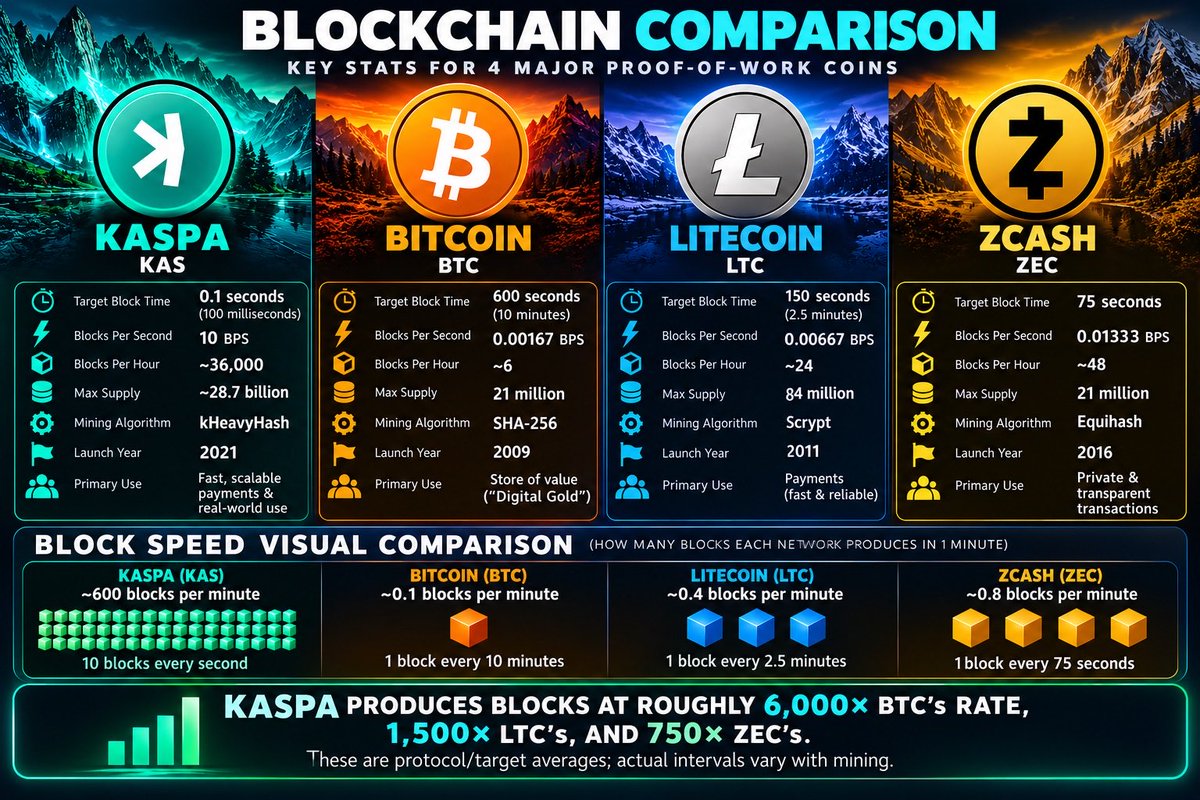
So #Kaspa produces blocks at roughly 6,000× $BTC’s rate, 1,500× $LTC’s, and 750× $ZEC’s…
Either kaspa:native is stupidly undervalued and or $BTC $LTC $ZEC are overvalued.
I don’t make the rules.
#CRYPTO#PoW#AgenticPayments#Ai
For those who still don’t own any $KAS:
Back in January 2017, I wanted to buy $2,000 worth of Ethereum at around $10 per ETH.
Something went wrong with the purchase, and instead of trying again, I simply let it go.
A few months later, ETH exploded to $300+ and about a year later, it reached around $1,000.
That wasn’t the only opportunity I missed. I made plenty of mistakes along the way, and looking back, one of the biggest lessons was that I simply didn’t have enough conviction.
Sometimes the biggest mistake isn’t choosing the wrong investment, it’s recognizing an opportunity and still not acting on it.
That’s something I keep in mind when I look at $KAS today.
We’re looking for 3 Maxis. 👀
1 $BTC Maxi.
1 $KAS Maxi.
1 $XRP Maxi.
The idea: bring all three together for an X Space and let each one make the case for their project.
No pointless shouting. No “my bag is better than yours.”
Just conviction, arguments and an open discussion about why you believe your project deserves to win long term.
Think you’re the right person?
Drop a comment or tag someone who is.
💙🤍💙
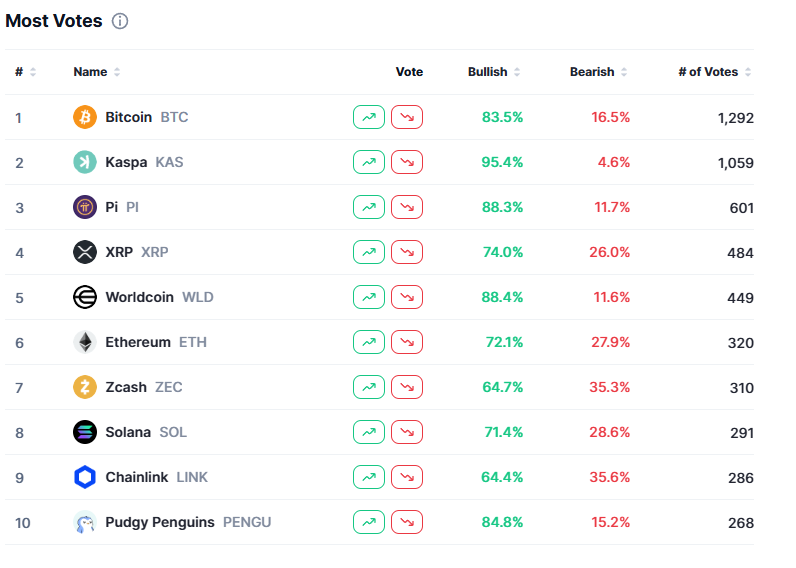
You probably know that #Kaspa kaspa:native is the #1 in community sentiment at Coinmarketcap. But do you also know it is the #2 most voted coin and the only community that comes close to #Bitcoin?
Communities like #XRP#Ethereum, #Zcash, #Solana and #Chainlink dont even come close in activity.
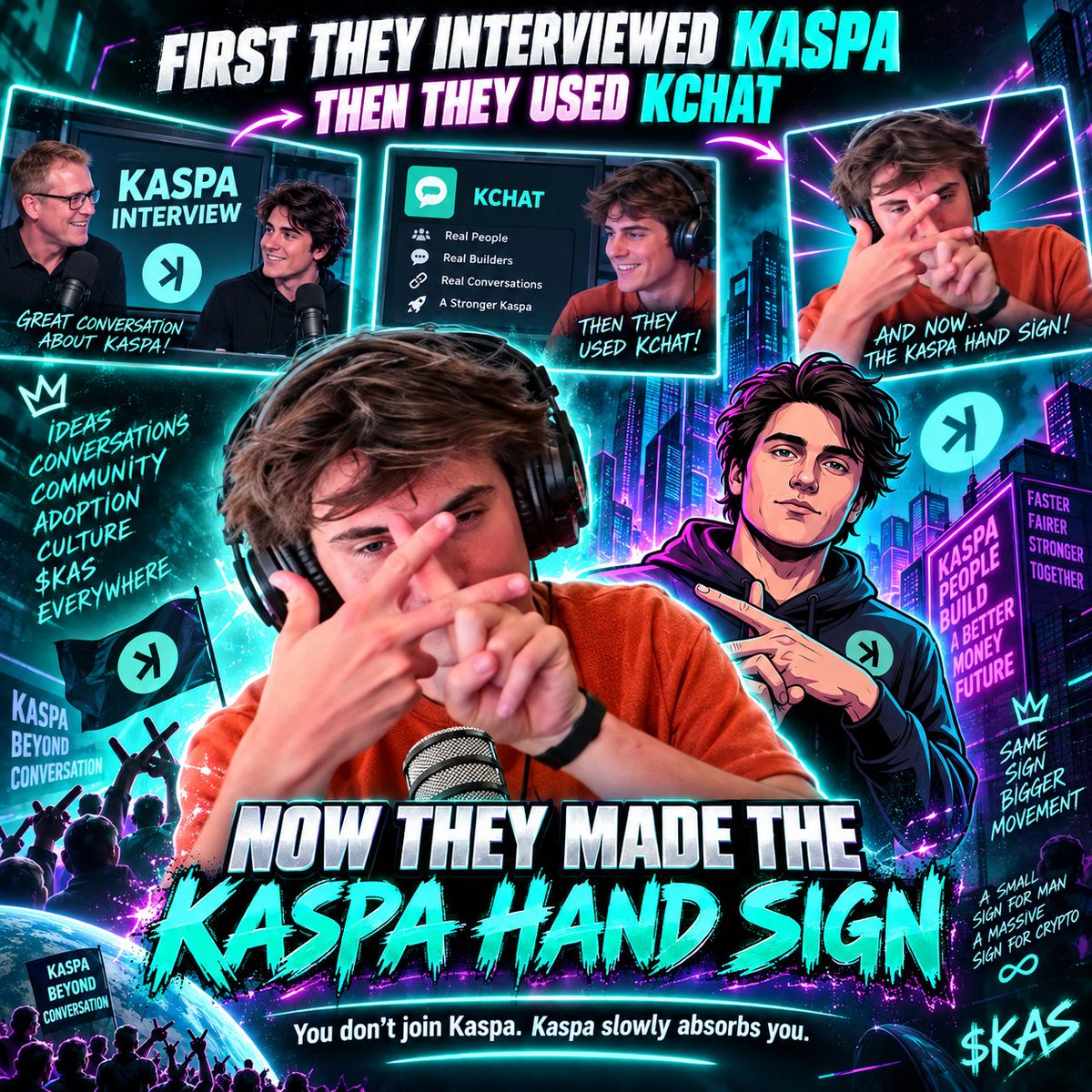
First they interviewed Kaspa.
Then they used KChat.
Now they made the Kaspa hand sign.
This is how it starts.
Not with paid marketing.
Not with fake hype.
But with real curiosity, real builders, and a community people can’t ignore.
You don’t join Kaspa.
Kaspa slowly absorbs you. 🩵⚡️
kaspa:native #Kaspa
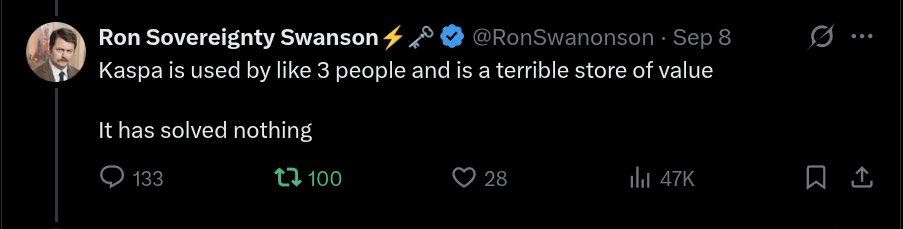
Hey @RonSwanonson we are at 100 now!
If you have not yet go to his comment https://t.co/XFFFPaLZvi
and repost it stating that you are 1 of the 3 people using kaspa:native
This is a fun experiment. 😆
$KAS : Review 📜
What if proof-of-work was never actually slow, and the only thing holding it back was the decision to throw away every block that arrived at the same time as another?
Meet Kaspa, a blockDAG network that orders parallel blocks instead of discarding them, running at ten blocks per second on Bitcoin's security model. It launched with no premine, no ICO, no venture allocation, and the company that built it dissolved itself at launch. Every coin in circulation was mined in the open.
Let's explore the cleanest launch in crypto and the network built on it. 👇
⚪ Kaspa at a Glance
Marketplace Insight: Kaspa's tokenomics are arguably the cleanest of any project in this series, with a genuine fair launch, a hard cap, and 96% already mined, and its consensus derives from peer-reviewed research whose lineage runs into Ethereum's own whitepaper. Toccata shipped on schedule in June, bringing covenants and zero-knowledge verification to Layer 1, and the tooling has moved fast since, with SilverScript reaching a v1 release candidate and a conventions track standardizing how tokens will work across wallets and indexers. The clean contrast is between architecture and adoption. Kaspa has built genuine capacity, and covenant usage is compounding quickly from a small base, but the network still runs far below what it was engineered to handle.
⚪ Mission
Kaspa exists to prove that proof-of-work's limitations were architectural rather than fundamental. The founding argument is that Bitcoin's constraints, slow confirmations and low throughput, came from insisting a single chain must extend one block at a time, discarding everything produced in parallel as waste. GHOSTDAG orders those parallel blocks instead, which means the network can run far faster without lowering the security bar or pushing mining toward centralization. The goal is real-time decentralization: Bitcoin's trust model at a speed people can actually transact at.
🔵 A Brief History
Kaspa's intellectual lineage predates the project by nearly a decade. Yonatan Sompolinsky, researching under Professor Aviv Zohar at Hebrew University, published the GHOST protocol paper in 2013, work cited directly in the Ethereum whitepaper. That research line continued through SPECTRE and PHANTOM and eventually into GHOSTDAG, the consensus protocol Kaspa runs today, with Sompolinsky later moving to Harvard as a postdoctoral researcher on the MEV research team.
The implementation came through DAGLabs, an R&D company Sompolinsky founded with funding from Polychain Capital. What happened next is genuinely rare: rather than retaining an allocation or a governance role, DAGLabs was dissolved around the November 7, 2021 mainnet launch, transitioning the project entirely to a community-led model. The launch itself carried no premine, no ICO, no presale, and no insider or venture allocation.
The years since have been methodical engineering. The node software was rewritten entirely from Go into Rust, improving performance and reducing attack surface. The Crescendo hard fork activated on May 5, 2025, raising the block rate from one to ten per second while proportionally reducing block rewards so per-second emission stayed constant, and bringing KIP-9 storage-mass pricing with it. Toccata followed on June 30, 2026, introducing native covenants, Covenant IDs, zero-knowledge proof verification, and partitioned sequencing, moving Kaspa from a pure payments network toward programmability.
The months since have gone into making that programmability usable. SilverScript, the higher-level language compiling to Kaspa Script, reached a v1 release candidate at the end of August after a timelock bug fix and a type audit. A Kaspa Calls for Conventions track opened to standardize covenant interoperability across wallets and indexers, with builders testing a fungible-token convention against a testnet AMM. KaChat 4.0 shipped in late August as the first major consumer application expansion. DAGKnight, a successor consensus protocol with latency-adaptive ordering, has a dedicated testnet proposed and a late-Q3 target.
🔵 Ecosystem Narrative
The organizing idea is that parallel work should be ordered rather than wasted, and everything follows from that one architectural choice.
➛ GHOSTDAG consensus. Parallel blocks coexist and are ordered by the protocol rather than orphaned, so virtually no mining work is discarded, which is what allows high block rates without the centralization pressure that normally accompanies them.
➛ Peer-reviewed foundations. The consensus derives from published academic research at Hebrew University and Harvard, with the GHOST paper cited in Ethereum's whitepaper, giving the protocol a theoretical grounding most chains substitute with a marketing document.
➛ The Toccata upgrade, live. Native covenants, Covenant IDs, zero-knowledge proof verification, and partitioned sequencing activated on Layer 1 in June 2026, with SilverScript reaching a v1 release candidate to make covenants writable by ordinary developers rather than only protocol researchers.
➛ Consumer and DeFi applications. KaChat 4.0 shipped in late August with desktop and web support, Tangem hardware wallet integration, and KaPosts, an on-chain social layer tied to KNS identities, while Igra, a Kaspa-native L2, has become the busiest lane in daily activity snapshots at roughly 54,000 transactions in a sampled day.
➛ Mining decentralization. High block rates and the kHeavyHash algorithm make solo mining viable at lower hashrates, which is a structural argument for decentralization rather than an aspirational one.
➛ Smooth emission. Rewards decline monthly on a chromatic schedule based on the twelve-note musical scale rather than through halving cliffs, avoiding the abrupt miner revenue shocks that periodically destabilize other proof-of-work networks.
⚪ Token Utilities
$KAS is monetary rather than a fee-and-governance token.
➛ Mining rewards: miners earn KAS for securing the network, on a smoothly declining monthly emission against a fixed maximum supply.
➛ Transaction fees: paid in KAS for settlement on the network, with fees kept low by high throughput and KIP-9 storage-mass pricing.
➛ Settlement medium: the network's purpose is fast, final payment, so the token's primary utility is being used as money rather than as a claim on protocol revenue.
➛ Covenant and application layer: following Toccata, KAS underpins covenant transactions, zero-knowledge verification, and the token conventions being standardized for DeFi.
⚪ Key Features
➛ BlockDAG architecture ordering parallel blocks instead of discarding them.
➛ Ten blocks per second on a pure proof-of-work security model.
➛ A fair launch with no premine, ICO, presale, or venture allocation.
➛ A fixed 28.7 billion maximum supply with roughly 96% already mined.
➛ Peer-reviewed consensus research with a lineage into Ethereum's own whitepaper.
➛ Native L1 covenants and zero-knowledge verification since Toccata.
🔵 Meet the Team
Kaspa has no company, no foundation with a treasury, and no executive team. Its contributors are researchers and developers working on an open-source protocol, which is unusual enough to be the defining fact about its structure.
▶️ Core Members:
➛ Dr. Yonatan Sompolinsky [ @hashdag ] - Founder | A postdoctoral researcher at Harvard on the MEV research team, whose 2013 GHOST protocol paper is cited in the Ethereum whitepaper. His research line, developed under Professor Aviv Zohar at Hebrew University, runs through SPECTRE and PHANTOM into the GHOSTDAG protocol Kaspa uses today. Few founders in crypto have a comparable academic contribution to the field itself.
➛ Shai Wyborski [ @DesheShai ] - Researcher and GHOSTDAG co-author | A cryptography researcher who co-authored the GHOSTDAG protocol paper, meaning the consensus running the network was designed by people still actively maintaining it rather than handed off after publication.
➛ Elichai Turkel - Core Developer | Served as DAGLabs' applied cryptographer during development and is also a Bitcoin Core contributor, a meaningful credential for a project whose entire pitch is improving on Bitcoin's architecture without weakening its guarantees.
➛ Michael Sutton, Ori Newman, and Mike Zak - Core Developers | The engineering core behind the Rust rewrite and the Crescendo and Toccata implementations, with Newman still merging fixes into the SilverScript compiler as recently as August 2026.
➛ Anton Yemelyanov - Core Developer and Smart Contracts | Leads the smart contract and covenant workstream, the layer that turns Toccata from a protocol capability into something developers can actually build against.
➛ Chris Wolf, known as Wolfie [ @Kaspa_HypeMan ] - Chris Wolf, known as Wolfie - Business Development and Listings | With no company to employ a BD department, Wolfie took on exchange outreach himself, adopting the title because listing desks wanted a named contact, and has spent years in conversations across venues including MEXC, Gate, KuCoin, Bitget, and Kraken. A crypto veteran who mined Bitcoin early and found Kaspa near the fair launch, he is the connective tissue between a distributed holder base and rooms that would otherwise have nobody to call. That a treasury-less project sustains this function on volunteer effort says a lot about the community behind it.
🔵 Ratings
➛ Use Case: ★★★★⯪ (4.5/5). Kaspa leads the category it created and has delivered on every technical promise it made. It took proof-of-work from one block per second to ten while preserving mining decentralization, backed by peer-reviewed research rather than assertion, and validated across billions of transactions without congestion or fee spikes. Toccata shipped on schedule, bringing native covenants, Covenant IDs, and zero-knowledge verification to Layer 1, and the tooling followed immediately with SilverScript nearing v1 and a conventions track standardizing tokens across wallets and indexers. Covenant activity has grown 15-fold since launch, KaChat 4.0 has brought on-chain social and payments to desktop and mobile, and Igra is running tens of thousands of daily L2 transactions. The 0.5-point deduction is that the ecosystem is young, with programmability only months old and network utilization still well below the capacity the architecture provides.
➛ Tokenomics: ★★★★⯪ (4.5/5). This is among the cleanest supply structures in crypto, full stop. A genuine fair launch with no premine, no ICO, no presale, and no insider or venture allocation, meaning every coin in existence was mined in the open. A hard maximum supply of 28.7 billion with roughly 96% already mined, so there is no unlock overhang, no vesting cliff, and no treasury capable of dumping. Emissions decline smoothly month by month rather than through halving cliffs, avoiding the miner revenue shocks that destabilize other proof-of-work networks, and DAGLabs dissolved rather than retaining a position. The 0.5-point deduction is that KAS has no burn mechanism or fee capture beyond mining rewards, so value accrual depends entirely on the network being adopted as money.
➛ Audits: ★★★★ (4/5). Kaspa's security foundations are unusually strong and sit largely outside the conventional audit framework. The consensus protocol is peer-reviewed academic research from Hebrew University and Harvard rather than an internal specification, with its co-author still maintaining the network. The node software was deliberately rewritten from Go into Rust to reduce attack surface, a Bitcoin Core contributor serves as a core developer, and the network has run since November 2021 across two major hard forks without a protocol-level exploit. Development is fully open source with public code review, and the SilverScript timelock bug found and fixed in August demonstrates that review process working. The 1-point deduction is that no named third-party security audit or verified security score is published, and the covenant and zero-knowledge surface introduced by Toccata is new enough that formal external review would meaningfully strengthen confidence.
➛ Community: ★★★★★ (5/5). Kaspa's community is the purest example of organic growth in crypto, and the structure explains why. There was no airdrop to farm, no venture backing to court influencers, no foundation marketing budget, and no company to promote it, because DAGLabs dissolved at launch. What grew instead was a global base of miners with real hardware and capital deployed alongside an ideologically committed holder base, and it held through a deep drawdown and years of quiet building. The development itself is community-run: independent contributors opened the DAGKnight testnet proposal, built KaChat and Igra, drive the conventions standards process, and even handle exchange listings without a budget to fund it. Very few projects at any market cap sustain this level of unpaid, distributed contribution across protocol research, application development, and ecosystem work simultaneously.
🔵 Conclusion
Kaspa is what happens when a researcher whose work is cited in Ethereum's own whitepaper decides to fix the thing everyone assumed was permanent about proof-of-work. The blockDAG orders parallel blocks rather than wasting them, GHOSTDAG delivers ten blocks per second on Bitcoin's security model, and the whole thing launched with no premine, no ICO, no venture allocation, and a development company that dissolved itself rather than retain influence. Roughly 96% of a hard-capped supply is already mined, and Toccata has now brought covenants and zero-knowledge verification to Layer 1 on schedule.
The bull case is unusually pure. If proof-of-work settlement matters over decades rather than cycles, Kaspa is the only network that has meaningfully improved the architecture without compromising the trust model, and it did so with a distribution nobody can criticize because there was nothing to criticize. Kaspa spent five years proving the technology works, and it now has the programmability to prove the rest. What comes next is whether the world decides it needs a settlement layer this good.
⚠️ Yaşlı bir kadın banka kartını banka memuruna uzattı ve "500 dolar çekmek istiyorum," dedi.
Memur ona, "2.000 dolardan az tutarlı çekimler için lütfen ATM'yi kullanın," dedi.
Yaşlı kadın nedenini merak etti.
Memur banka kartını geri verdi ve sinirli bir şekilde, "Bunlar kurallar. Başka bir işiniz yoksa lütfen ayrılın. Arkada sıra var," dedi.
Yaşlı kadın birkaç saniye sessiz kaldı, sonra kartı memura geri uzattı ve "Lütfen hesapta ne kadar param varsa hepsini çekmeme yardım edin," dedi.
Memur hesap bakiyesini kontrol ettiğinde şaşkına döndü. Başını salladı, eğildi ve saygıyla, "Özür dilerim hanımefendi, hesabınızda 35 milyon dolar var ve bankamız şu anda o kadar nakit bulundurmuyor. Randevu alabilir misiniz ve yarın tekrar gelebilir misiniz?" dedi.
Yaşlı kadın o anda ne kadar çekebileceğini sordu.
Memur ona 250.000 dolara kadar herhangi bir tutarı çekebileceğini söyledi.
"Peki, lütfen bana şimdi 250.000 dolar verin," diye rica etti. Memur bunu hızlıca yaptı, sonra parayı yaşlı müşterisine çok nazik ve saygılı bir şekilde uzattı.
Yaşlı kadın 500 doları çantasına koydu ve memurdan kalan 249.500 doları hesabına geri yatırmasını istedi.
Biz yaşlılarla zorluk çıkarmayın, biz ömür boyu birçok beceri öğrendik.