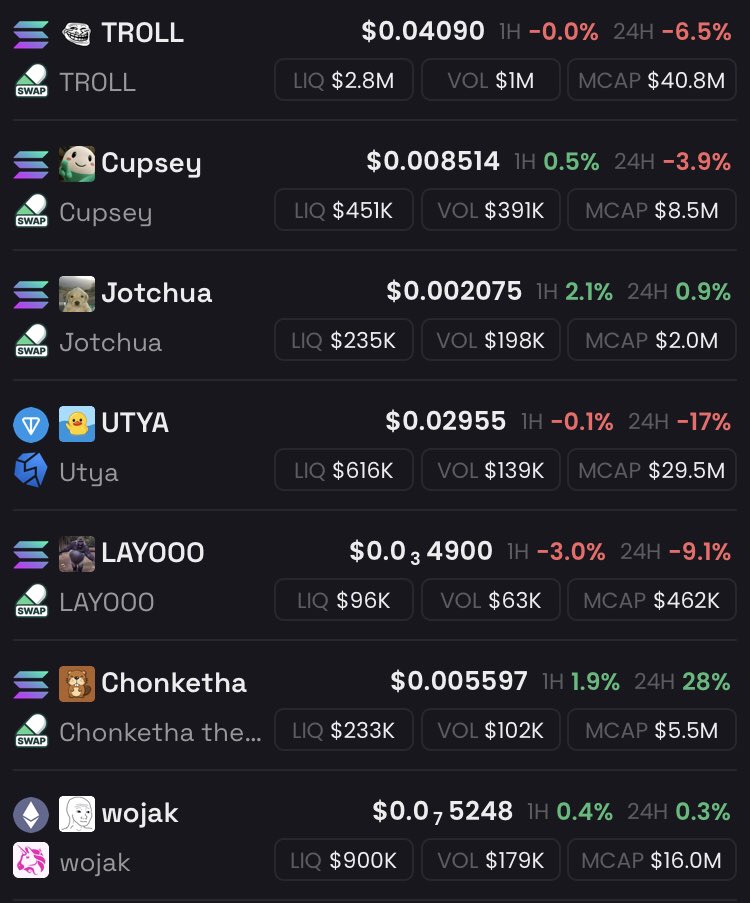
This is probably your last chance to get utya:native sub 50M MC.
The integrated telegram wallet is about to launch to 1 billion active monthly user.
1 BILLION people will have instant access to trade on the-open-network:native / $TON in seconds. Still bearish?
JUST IN: TON Core asks mainnet validators to prepare for increased network load, sparking speculation about a possible Gram Wallet launch or Pavel Durov unveiling MTONGA Step 5.
Instead of splitting money up into a million different coins
How about we funnel all money into like 20 memes
I say 20 to consider other peoples plays out there
But imo 10 would be good enough
If we do that, we go deep into billions on 10-20 memes
And make probably 100x more first time millionaires
The other option you can go is ofc buy junk narratives hoping to flip the junk at a slightly higher price
And the chances of you to become a millionaire like that is like 1 in 1 million
Liquidity dries up faster
And instead of like 50,000 new millionaires
Prob only like 100-500 new millionaires made like that this cycle
The choice is yours
I’d hope after getting destroyed the second way
You’ll decide the first way is better for your future and for everyone else
It would also make “the trenches” have 100x more liquidity in the end to fuck around and play in if u still want to after
I can’t post this $Jotchua at 1M on main account because
1. People will then expect me to bull post and they will call it a “crash coin”
2. I will be held socially responsible and at gunpoint for a coin, if it goes down it’s “bc of crash”
3. It will push the price higher and nobody would actually get the chance to enter at 1M-1.5M market cap
U see back when I had 30k followers or less
I could openly and freely post an entry on a coin
And people wouldn’t barge into it and declare me responsible or the main person behind a coin
Now, it’s extremely hard to relay alpha or good entries to you guys because of the stupid social pressure and blaming I get
So let me be clear
Jotchua is a good entry here
That said, I will not be held at gunpoint socially or responsible for a simple good entry
Do not expect me to bull post it
Do not expect me to support it
Do not call this a Crash coin
There is a big community there that has nothing to do with me
Its a good entry that can make people money and I’m a little TIRED of not being able to have proof of entries and share really good entries with people blatantly here on X
I need to keep making people money
That’s what got me here
That’s the #1 most important thing
But everyone makes it hard for me to directly share stuff at prime entries bc the list of things above.
So
THIS IS NOT A CRASH COIN
IM JUST A REGULAR PERSON who bought some between 900k-2M market cap LIKE ANYONE ELSE
Im not here to work for anyone
Im not here to be the face of any coin
I’m not here to listen to people call this a crash coin, ITS NOT
It’s a good entry, that can make people that follow me good money
That’s all
Leave me alone and don’t put words in my mouth or larp about my role in relation to things
I need ZERO influence to make big money on memes
And although theres millions of dog coins
jotchua is undoubtably top 3-5 most recognizable and known dog memes in the world
So.. it's def mispriced at 1-2M
70-90% chance it’s gonna secure the IP with the creator of the meme onboard
I like plays where I know, if I never posted again
It would do fine without me
Stop relying on Kols to bull post or lead you and lead yourself
helping prepare the BEST coins for the coming cycle to NOT need or depend on KOLs or catalysts
DURING the bear market
So that all the attention and KOLs they do attract in the bull run
is just bonus and STEROIDS for them
Few understand I often go silent on my own bags to help them become stronger and not depend on me or anyone shilling
Bc the truth is
If the coin needs me or X person to share so badly instead of attracting its own soldiers that believe so strongly in the narrative
and if it can’t hold up during quiet times based on its narrative and community strength
Then it never had a chance or the ingredients to truly go big and make people 100x+
Some ppl see the execution and strategy
Most don’t tho
The few that do are the ones that will make real money
Bc it’s not about me or marketing or some bullshit out of ur control
It’s mainly about the narrative and correct anticipation of how others will react or think about something in the future before they ever think about it
Get that right and the kols, the hype, the marketing, the exchanges all follows
Take 5 minutes to read this post.
I know, it’s long.
But innovation deserves to be properly explained, and there is a LOT going on here.
I went through the Mancer white paper, and the deeper you look, the clearer it becomes that this is not simply another DEX, another token, or another NFT collection.
Mancer is trying to build a new execution infrastructure for swaps, limit orders and recurring buys on Robinhood Chain.
And everything starts from a very simple idea:
your funds should not need to sit inside a protocol while waiting for an order to execute.
With Mancer, the tokens remain in YOUR wallet.
When you create an order, you sign an EIP-712 message defining the conditions:
what you sell, what you buy, amount per fill, number of fills, frequency, expiry, slippage and minimum acceptable output.
You do not deposit the entire capital into a vault.
So if you set a $100 weekly DCA for one year, you do not need to park $5,200 inside the protocol.
When a fill becomes due, Mancer pulls only the required $100 through a standard ERC-20 allowance, executes the swap and sends the output directly back to your wallet.
No escrow.
No parked capital.
No permanent custody.
But the most important part is execution protection.
Every fill must clear a PRICE FLOOR enforced directly by the smart contract.
If the trade does not satisfy that minimum:
REVERT.
This means an executor may decide whether or not to execute your order, but it cannot decide to execute it badly.
It can go offline.
It can be slow.
It can miss a fill.
But it cannot settle a trade below the conditions enforced by the contract.
Executor risk therefore becomes a liveness problem instead of a safety problem.
And this is exactly what makes a future permissionless keeper network possible.
Mancer uses essentially the same order model for everything.
totalFills = 1 → limit order.
totalFills > 1 → recurring order.
So you can create something like:
buy $100 of ETH every week for 52 weeks.
For recurring schedules, however, Mancer does not allow a simple static floor with no oracle protection.
It uses the Uniswap v3 pool’s TWAP.
Not simply the spot price of the latest block, but the pool’s average price over a specified period.
The floor is calculated using that TWAP while accounting for pool fees and the maker’s accepted slippage.
And if the maker provides an even stricter personal minimum?
The higher floor wins.
If the pool does not contain enough historical observations for the requested TWAP window, Mancer does not silently downgrade the protection.
The fill fails.
No best-effort mode.
Either the execution satisfies the required conditions or it does not happen.
I also really like how cancellation is handled.
You can cancel an individual order directly on-chain, even while settlement is paused, and cancellation carries no fee.
There is also a panic button:
cancelAll().
Every order contains the maker’s epoch.
Increment the epoch and every previously signed order becomes invalid in a single transaction.
Even forgotten orders.
Even lost signatures.
And there is always one final defense:
revoke the ERC-20 allowance or simply move your funds.
Because the tokens remain in your wallet, no keeper can use assets that are no longer available.
Recurring orders also have a clever protection.
Imagine buying $100 every day and the executor stays offline for five days.
When it comes back, Mancer does NOT execute $500 at once to catch up.
Missed periods are skipped.
They are never back-filled.
So a liveness outage cannot suddenly create a much larger exposure than the user intended.
Then we get to what I personally find even more interesting:
the Chain Mancers.
Mancer plans a 5,000-supply NFT collection.
But they are not designed to simply be collectibles.
They are intended to become the keeper network executing the protocol.
And this is where the DEX, the NFT collection and $MANCER connect.
To receive keeper rights, a Chain Mancer must be ACTIVATED using $MANCER.
50% of the activation fee is burned.
So:
Chain Mancer NFT
→ activation
→ $MANCER usage
→ 50% burn
→ keeper rights.
Activation also clears whenever the NFT is transferred.
The new owner must activate again.
Potentially creating another cycle of $MANCER usage and burn.
Keeper economics are split into two lanes.
WORK LANE.
The participants actually executing fills earn an executor tip.
The current draft specifies 5 bps, or 0.05%.
So active keepers earn from actual protocol activity.
Not inflationary emissions.
Volume → execution → fees.
Then there is the REVENUE LANE.
The current draft specifies a protocol fee of 10 bps, or 0.10%.
That revenue can eventually be routed to a reward distributor and shared across activated Mancers, weighted by activation tier.
And one of my favorite parts:
rewards are designed to be paid in ETH.
Fees may initially accrue in WETH or USDG.
The MancerFeeConverter converts them into WETH under TWAP protection, unwraps it and sends ETH to the reward recipient.
The conversion itself is permissionless.
Anyone can trigger it, but nobody gets to choose an arbitrary price.
So the economic structure becomes:
Trader
→ volume
→ protocol fees
→ ETH
→ activated Mancers.
At the same time:
Chain Mancer
→ activation
→ $MANCER
→ burn.
And:
Keeper
→ execution
→ executor tip.
This is why I do not see Mancer as simply “token + NFT”.
I see three connected economic layers:
DEX → generates economic activity.
$MANCER → activates the keeper infrastructure and introduces burn.
Chain Mancer NFTs → represent the infrastructure executing the protocol and potentially participating in revenue distribution.
The potential flywheel is obvious:
more users
→ more volume
→ more fees
→ more ETH revenue
→ stronger incentives around activated Mancers
→ more activation demand
→ more $MANCER usage
→ more burn.
At the same time:
more keepers
→ a more decentralized and resilient network
→ better liveness
→ better infrastructure for traders.
Of course, one thing still matters above everything else:
REAL VOLUME.
The architecture can create incentives.
The market still has to create the activity.
And Mancer will not launch fully decentralized from day one.
At launch, execution is closed and handled by an allowlisted Mancer executor.
So liveness initially still depends on the team.
Price safety does not.
All important execution conditions are checked again on-chain.
The executor cannot lower the floor.
And the settlement architecture is already designed with a path toward open execution without needing to completely migrate resting orders.
That is where the 5,000 Chain Mancers gradually enter the system.
Then there is arguably the most ambitious part of the roadmap:
the Proof Oracle.
Mancer v1 uses Uniswap v3 partly because v3 pools already contain historical observations that can support TWAP pricing.
But for pools or venues without a native oracle, Mancer wants to use storage proofs of historical blockchain state.
The goal is to cryptographically prove historical pool price and liquidity using multiple samples selected according to an on-chain-derived schedule.
The submitter should not be able to cherry-pick favorable blocks.
The reference price would be based on the median of those samples.
So a manipulator would need to sustain a false price across a majority of observations, not simply distort one block.
Price and liquidity would also be proven against the same state root.
Zero-knowledge proofs then enter as compression:
many historical proofs
→ one compact proof
→ on-chain verification.
And anyone should be able to run the prover.
If that roadmap is delivered, Mancer becomes much more than:
“a DEX using Uniswap v3.”
The vision becomes a settlement layer capable of protecting execution through cryptographic proofs of blockchain state itself.
The settlement contract follows the same philosophy.
Minimal kernel.
Immutable.
No proxy.
The owner still has some operational powers around pauses, executors, fee assets and fee recipients.
But it cannot take maker funds, lower the price floor, block cancellation or arbitrarily upgrade the settlement contract.
Once again:
the main risk becomes liveness, not custody.
Of course, none of this eliminates market risk.
A TWAP does not protect you from a falling market.
It protects against unfair execution relative to the market.
An order may also remain unfilled forever if its floor cannot be satisfied.
Mancer is not promising magic.
It is promising something much more concrete:
a fill that does not clear the floor cannot settle.
And THAT is why I am so bullish on the architecture.
I am not simply looking at 5,000 NFTs and a ticker.
I am looking at:
a non-custodial DEX;
signed orders;
limit orders;
recurring buys;
on-chain enforced price floors;
TWAP protection;
permissionless execution;
a keeper network;
NFTs turned into infrastructure;
$MANCER used for activation;
50% activation burn;
executor rewards;
protocol revenue;
ETH rewards;
and a future Proof Oracle architecture.
All connected.
Real volume → real fees.
Real fees → ETH.
Keeper demand → activation.
Activation → $MANCER usage.
$MANCER usage → burn.
Chain Mancers → actual protocol infrastructure.
This is still a pre-launch Draft v0.1, and parts such as the complete keeper network, activation tiers, permissionless execution and especially the Proof Oracle remain part of the forward roadmap.
But that is exactly why I think it is worth studying now.
Crypto usually looks at the ticker first and the product second.
With Mancer, I would do the opposite.
Look at what they are trying to build @MichaelHirsch .
$MANCER