Bro kyrɛsɛɛ masre saa herh Teshie mp😂😂 ɔsii nsuo nu bɛsan atɔ biom so they should prepare. Such a heartless man but hey they’ll still go and queue and vote for him in 2028 when they get their rice and oil. We f00l for this country roff 🇬🇭💔
I have reviewed the Presidency's investigation report into the claims made by the Fourth Estate on the Big Push projects and I must say the investigation leaves a lot to be desired. The first flag is that this is the Presidency investigating its own ministry without the involvement of any clearly independent body.
The report in effect clears the Roads Ministry of any wrongdoing. But the data and methodology don't support the conclusions.
The report finds that out of 140 Big Push contracts, 66 were single sourced. That's basically half. President Mahama has repeatedly promised that single sourcing would be the rare exception, not the norm. Getting half your contracts through single sourcing doesn't really look like "rare exception" territory, no matter how you frame it.
It's also worth noting that 23 of those 140 contracts are legacy projects inherited from the previous administration, not contracts MRH itself procured or chose a method for. Including them in the denominator quietly lowers the single-sourcing percentage. Strip them out and look only at the 117 contracts MRH actually awarded under this government, and the single-sourced share rises well to 56%, more than half.
So how does the report get to "no abuse"? It compares that 47% figure to ALL contracts MRH awarded, including hundreds of routine road maintenance contracts that have nothing to do with Big Push. Against that much bigger pool, single sourcing only looks like 4.58% of everything. That's technically true, but it's the wrong comparison. If you want to know whether single sourcing became the norm inside the Big Push programme specifically, you have to look at Big Push contracts specifically, where the answer is more than 50%, once you exclude the inherited projects.
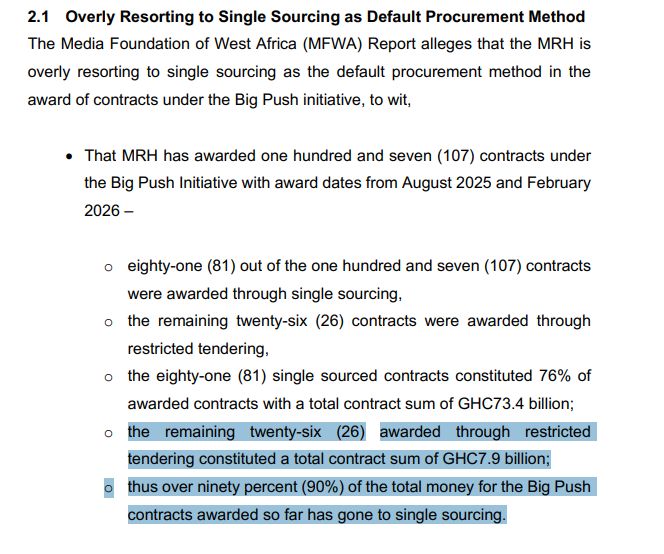
There's a second issue that's arguably bigger. One of the bigger claims by the Fourth Estate was that around 90% of the total cash value of Big Push contracts went to single sourcing. The report spends a lot of pages knocking down individual allegations about contract counts, but it never actually goes back and recalculates the money-weighted share using its own corrected list of 140 contracts. That's a strange gap, because counting contracts one-to-one treats a 50 million cedis feeder road job the same as a 3 billion cedis highway dualisation. Contracts aren't uniform in size, so a count-based percentage can look moderate while the actual money tells a completely different story. If the single-sourced contracts tend to be the bigger, more expensive ones, then the "it's only 47% of contracts" framing understates the real picture by a lot.
There's also a data inconsistency that never gets addressed. Earlier in the report, MRH itself tells the investigator that 61 out of 139 Big Push contracts were single sourced. Later in the same report, the investigator's own "verified" findings say it's actually 66 out of 140. Nobody explains where the extra 5 single-sourced contracts came from or why the ministry's own submitted numbers don't match the report's final numbers. There has been many inconsistencies on this same project!
The justifications for using single sourcing (timelines, security concerns, inflationary costs) can be applied to any problem Ghana faces. For instance, the government promised a 24h economy and youth unemployment is deemed a national security threat so why are Ghanaians still waiting for the 24h economy to be implemented?
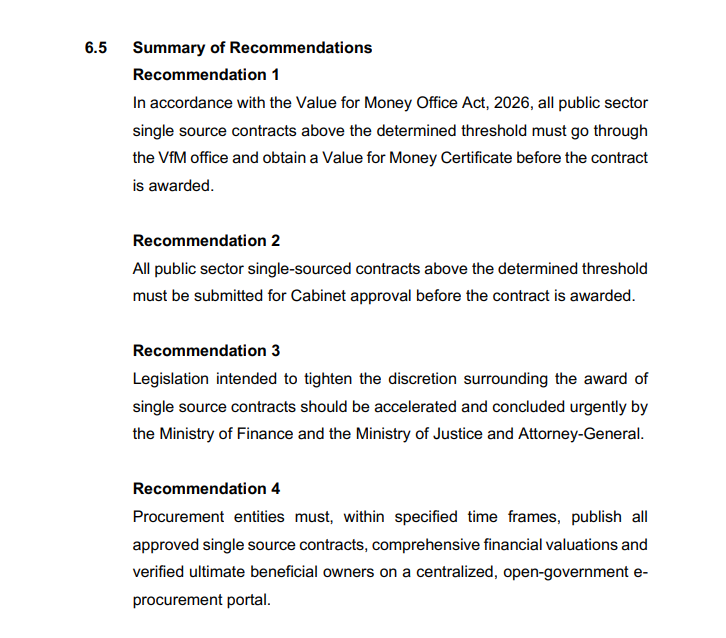
Despite concluding there was no abuse, the report still recommends mandatory Value for Money certificates before single source contracts can be awarded, Cabinet approval for high value single source deals, and faster legislation to restrict single sourcing going forward. Those are fairly serious fixes to propose for a system the report just said wasn't being abused. It reads more like the report sees a real governance gap, even if the headline conclusion doesn't say so directly.
Presidency cuts political appointees by 124, but compensation bill jumps 148% and staff classifications raise questions #AMShow https://t.co/hDng0KgDmp
Presidency cuts political appointees by 124, but compensation bill jumps 148% and staff classifications raise questions #AMShow https://t.co/hDng0KgDmp
أفادت صفحة راديو أكوبام بوقوع حادثة سرقة استهدفت سيارات نزلاء داخل فندق “مأب” بمدينة كسلا، وذلك خلال ليلة أمس، حيث تمكن مجهولون من الاستيلاء على ممتلكات من داخل عدد من المركبات المتوقفة بالفندق.
"Rev. Ntim Fordjour was in the chamber and nobody raised the issue of quorum on that day"
- Bernard Baidoo [MP, Akwatia] on anti-LGBTQ bill, what really happened in Parliament on that day, and more. #Newsfile
BREAKING: Doctors at Komfo Anokye Teaching Hospital (KATH) declare an indefinite strike effective today following Health Minister Kwabena Mintah Akandoh’s suspension of the hospital’s CEO.
1. A major news channel in Ghana says there is a ruckus in the Bank of Ghana (BoG) board. One faction wants the BoG's swanky/controversial new HQ sold to a lucky real estate company and leased back at a juicy rate.
2. Apparently, a shrewd financier hopes to get bank financing for the whole gig.
3. Another faction is up in arms and is the one behind the leak.
4. Be that as it may, the BoG furiously disputes the news report. It says that such reports are, wait for it, dangerous because they have the potential to undermine public confidence in the BoG.
5. The BoG says that it "remains committed to transparency and will continue to engage stakeholders through its official channels."
6. Howzat?
7. In March 2025, the BoG told Parliament that it had tasked AESL to undertake a value for money audit into the HQ project. 15 months onwards, it simply REFUSES to publish the audit report.
8. Which is a serious problem because the costs of that giant edifice are a total blackbox and the whole project has been a masterpiece of opacity. Let me jog some memories.
9. BoG's Board took the decision to initiate the project in Dec 2019. The allocated budget was ~$100m. The procurement authority approved ~$81.9m. After the restricted tender was won by the contractor, the budget was suddenly jacked up to $121m. The BoG Board finally settled on $222.8m with the contractor.
10. But as I hinted earlier, the project is actually in the range of $600m if we are to be strict about the numbers.
11. In Feb 2025:
- $230m had been paid to the contractor.
- $31.8m was owed to the contractor.
- $8.6m was earmarked for a separate ICT contract.
- $15.8m was earmarked for integrated electronic security systems.
- $11.1m was earmarked for furniture & furnishings
- $48m was allocated for taxes & levies.
12. That is $345m, I lie?
13. Well, the original design that was costed for the clearly discredited tender at $100m included a bunch of things that the $345m hasn't delivered. And remember that the earmarked allocations were merely on budget. If cost overruns are just 2x, how much really are we talking about?
14. Here are the original design items that are yet to be delivered. According to the BoG, "grey boxes" have been provided for them to be added later:
- Data Center
- Currency Processing Center (no accounting, by the way, for the underserviced De La Rue-provisioned system),
- Specialised Security System
- Still not clear if the helipad is fully functional
15. Now, let's add the piece everyone forgets: the prime land!
16. The BoG acquired the West Ridge/SIC land by compulsory acquisition through E.I. 304. The going rate in that prime area is easily $1500 per sq m. BoG doubled the acreage of Bank Square from 73,000 sqm to nearly 150,000 sq m. That is $225m of prime land!
17. In short, this is a $600 million (& counting) project that has katanomically been hoisted as a massive success because of zero policy accountability.
18. What continues to fascinate me is how well katanomics explains this opacity (with elite complicity) and lack of policy accountability in a democracy as vibrant as Ghana.
2] Under the other classification by the World Bank [revised annually in June], Africa falls into 4 categories:
A] High Income Country[ies] or HIC[s]
B] Upper Middle Income Countries [U-MICs]
C] Lower Middle Income Countries [L-MICs]; and
D] Developing/Fragile Countries.