Here for intellectual stimulation: physics, consciousness, inspired conspiracy theory.
"I did not know, I went and looked; everything else was vanity."
Most people don't know this but around 800,000 years ago an event called the Paternal Haplogroup Bottleneck occurred; a massive, highly selective genetic culling from 13 genetically similar male lineages down to ONE specific haplogroup. Suddenly and inexplicably (stay with me...)
Yet maternal haplogroups were completely unaffected. AND this extraordinary lack of paternal diversity lasted for over 100,000 years. Very curious by standards of evolution...
Interestingly, this bottleneck event occurred at the same defining moment in human evolution, when the chromosome fusion that distinguishes modern humans from other hominins occurred.
Our brains were suddenly larger, "alien" genome sequences appear and impact us to such a degree that evolution cannot explain or amend for.
And no one is really talking about this... Yet. @GeologicalSETI
"THE ALCHERINGA ACCOUNT BY VALERIE BARROW
In June 2024 I wrote an introduction to a remarkable book by the Australian Valerie Barrow, called Alcheringa: when the first ancestors were created (2). Barrow describes how her contact with an ancient Aboriginal..." https://t.co/Fzn5N3oTre
There’s a dark side to science. If you’re outside the inner circle, you probably know this all too well.
Emmy Noether didn't write Hilbert's equations. She formulated much of what his theory was based on; invariance, symmetry, conservation. Yet was denied habilitation taught under Hilbert’s name and worked without pay.
So many examples of this that there's a term for it: the Matthew effect.
But it isn’t only race or sex that determines the way recognition compounds around the already recognized. It's whether you’re in the club.
Physics runs through elite networks that shape who gets funded, published, cited, and heard. Nobel included. Nominations and evaluations stay secret for 50 years. The physics prize is decided by the Royal Swedish Academy of Sciences through its Nobel Committee.
JASON is a real, closed scientific advisory group for the U.S. government. Much of its defense work is classified. Scientific influence can sit inside networks most people never see.
You don’t need to name the cabal running physics to understand the mechanism.
If you’re outside the club, your work can be ignored for years. Then suddenly echoed back to you through the "proper" channel, penned by the "right" person.
Pancharatnam was 22 years old kid who invented this geometric phase, initially I tried to correct scientists, seveal published papers, then I learned, that a brown color cannot be inventor. I have stopped correcting after 10 years of attempts. Scientific racism is so deep rooted
@PalmerLuckey Wild. If you think it's possible it literally now is.
I don't know what's in the air or water in San Francisco, but like the Sequoias that grow there, ideas and execution are just... bigger.
Yes there's a clear connection between artificial light in schools and ADHD. Why I stated that the "school system" itself as in the building/lighting, food, routine daily computer use limited sunlight exposure contribute greatly to ADHD symptoms.
A couple studies on this I found online;
Research from Ball State University (2018) found that full-spectrum lighting led to a 22% decrease in off-task behaviors, with children with developmental delays showing the most significant improvement. Barrett et al. (2015) documented a 16% rise in academic progress among students when environmental factors like lighting were adjusted.
@Fulguritics I wrote the entire post. Yes I think you did waste your time with this response. Work on something for years, give your entire life to your career, have it shut down, funding pulled and your name ruined then come back and tell us how science isn't about recognition.
AI/SI will be the greatest liberator and equalizer of knowledge. Outsiders will have greater chance to shape the future than ever before.
But access isn't the same as execution or credibility. The club may lose its monopoly on information so the next race is who gets believed or gets access to it first. Massive data collection by the AI companies, proprietary intellectual gold mining. Crazy time to be alive.
I've been working on something surprisingly similar re: primes, showing arithmetic/geometry as layers of admissibility. The gaps concept is really interesting, reminds me of the work @xyzqg6 recently sent me.
Some transitions are ruled out before we know which primes actually occur. So we're tracking the same thread that organization re prime structuring constrains what becomes possible, and that primes may be an arithmetic signature of irreducible structure rather than a force acting on matter.
@roydherbert has detailed prime based structuring concepts in his work as well.
Really interesting to put these works together and see what we come up with. I'll work on formalizing my theory re: prime structuring so we can sync up further. I haven't returned to it in a while so glad you posted this. 🙂
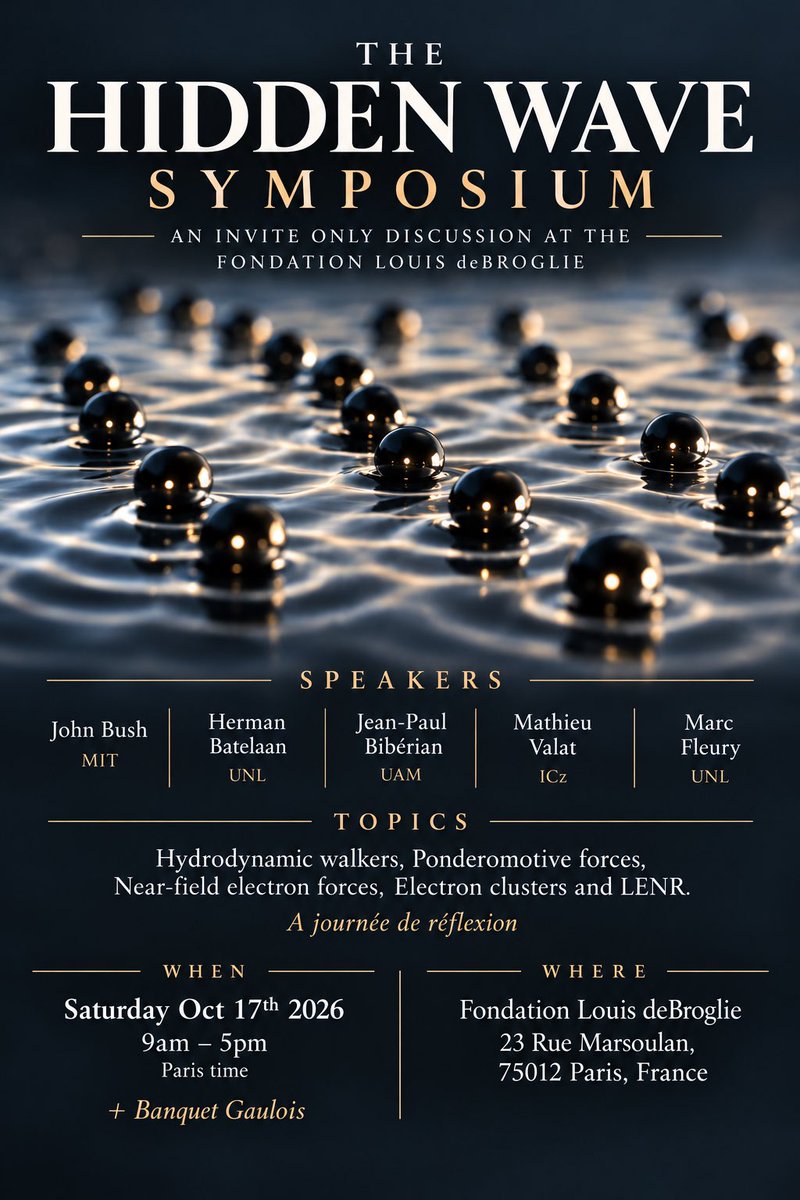
Bold claims and insights from top frontier physicists: droplets "walking" on water, what their motion tells us about waves and particles, electron clusters and the subtle not so subtle implications re: LENR.
Invitation only at Fondation Louis de Broglie, Paris.
I'll be your fly on the wall...
I see why you think this addresses the brain’s hard problem, but the proposed coupling does not yet explain consciousness.
Quick map of your material for X, correct me if I’m misreading it:
Pylkkänen compares the brain to a quantum measuring apparatus. Altaisky’s scale-dependent theory represents a field by position and resolution, φₐ(x); the “bump” is the wavelet window used to sample it. His quantum perceptron is separate: its optical weights can attenuate, and its learning update is non-unitary. I may be overextending that attenuator to the brain analogy, the material does not make this connection explicit.
Your Bohmian proposal links field back-action to qualia. What physical process carries it? What couples it to neural activity, and what observable could test it?
My hypothesis is that the heartbeat’s pulsed bioelectric and biomagnetic activity, perhaps with a toroidal structure, could act as an individual field attenuator, coupling the localized “bump” to what I call the underlying field. This is my proposal, not a mechanism established by these papers. By “underlying field,” I do not mean Altaisky’s mathematical mother wavelet. Although a compelling analogy.
If heartbeat/bioelectric field is coupling, what happens to the localized pattern when the pulse stops? Does it dissipate, persist, or return to a broader field state?
The mechanism and the hard problem remain open.
The hard problem remains.
A neural simulation can reproduce patterns associated with thought. Resemblance alone cannot tell us whether anything is there to experience them.
Unless consciousness is redefined as the functions the model reproduces. Then the simulation wins by definition. Not by solving the hard problem.
The unsettling part is that this looks to be the move. Why solve the hard problem if you can make it moot? Change the target without stating it until the model appears to reach it.
This logic reaches beyond AI.
If mind is computation independent of living biology, biology itself becomes a replaceable substrate: something to edit and rebuild until it fits the model. Why keep carbon based life as the reference if the silicon model redefines it?
Orch OR pushes the hard problem even deeper. Hameroff’s broader proposal is that proto-conscious events may have preceded life itself. On that account, life did not create consciousness; it evolved to organize it.
Consciousness came first. Computation then is an expression of it, not the source.
The dangerous move isn’t proving the machine feels or thinks. It’s shifting our definition of feeling and thinking until the machine qualifies.
The imitation doesn’t become the original. The original gets redefined to match the imitation.
https://t.co/bheDJiWpPh
You can change the numbers on your Seiko watch without explaining time. Turning it back an hour earlier doesn't make you a time theorist. You can also describe an engine at the macro level. Does that make the micro physics irrelevant? Who cares isn't a rebuttal it's avoiding the question. The hard one. Macro isn't a mechanism. Here it reads like a cop out.