Appreciate you keeping this discussion going. It's an extremely important technology to understand. It's one of the few cases that actually do require a blockchain. The double spend problem would be real without a ledger to maintain this without needing a third party to verify.
https://t.co/aX5Y9ckn89
https://t.co/W4IX8KiUWB
I built a free guitar-practice diagnostic for players who feel stuck.
Answer nine questions. It scores five common blockers, shows how close the ranking was, and gives you one change to try next session.
No account. Nothing uploaded.
https://t.co/DHMYZL0hOR
The AI music rush needs receipts.
Suede now issues a creator-bound receipt when a song finishes, recording human contribution, model/version, prompt hash and output fingerprint behind a public verifier.
See the live proof:
https://t.co/vYYiedtxmI
Suede Labs AI builds creator ownership infrastructure: proof of creation, rights, and royalties for music and media.
Founded 2024 in West Palm Beach by Jason Colapietro.
Start here: https://t.co/sA5hXUCTZv
Free IP visibility audit: https://t.co/TmFWaIG0UG
I spent a long time looking for a credible graph based engine to run agents in parallel. No luck, so we built the best one we could conceive of. It ships tonight as /suede-ship, free, in the Suede skill pack on GitHub.
Plenty of things look the part. Chat wrappers that call themselves orchestrators and underneath are still doing one thing at a time. Data pipeline frameworks built for deterministic jobs, which assume a step either returns or throws, an assumption that does not survive contact with a model that writes a confident paragraph saying it finished when it did not. Node graph builders that demo beautifully and have no answer for two workers writing to the same file.
None of them handled the three things that decide whether a fleet of agents produces work you can actually ship: whether the dependencies you drew are real, whether anything independent checked the output, and whether the workers can corrupt each other.
Basic concepts first, because this layer has no textbook and most people have never been handed the words for it.
A node is one unit of work. One agent, one input, one output. An edge is a dependency. The output of one node is the input of the next. A graph is what you get when everything independent runs at the same time.
"Do A, then B, then C" is already a graph. It is the weakest one available, one edge wide, and if B hangs then C never happens.
The first move is killing false edges. Most people read "and then" as a wire, and about half the time it is not one. The test is a single question and it carries the whole discipline: does the next step read the previous step's output? Yes, the edge is real and the order holds. No, there was never an edge, and both run at once. Take "summarize this file, and then tell me the weather." The weather never reads the summary. Two boxes, no arrow. A linear script chains them anyway because the words sounded like a wire.
Draw what survives that pass. The longest chain of real edges still standing is your critical path, and it is the floor under your wall clock time. Sixteen agents do not shorten it. Sixty four do not either. To make the work faster you cut an edge, you do not add a worker.
Now the technicals.
You hand /suede-ship a repo and a scope in your own words. It keeps your wording verbatim, because the planner decomposes that scope into lanes and the detail is what makes lanes separable. A slogan does not decompose. Then it runs about fifty agents, research heavy and front loaded, as a graph: scout, fan out across lanes, verify, synthesize.
The verification rule is the one I would keep if I could only keep one. A model never grades its own work. That is measured, not folklore. GPT-4 recognizes its own writing 73.5% of the time, and that self recognition causally drives it to prefer the text it wrote (Panickssery, NeurIPS 2024). Put a model in a lineup of answers and it scores its own higher, GPT-4 by 10%, Claude by 25% (Zheng, NeurIPS 2023). So the verifier is a separate node on fresh context that never touched the work, it checks a real signal rather than asking whether the worker said done, and it never implements. A graph of agents sharing one context is a single loop with extra steps, agreeing with itself.
The part I am most pleased with is that it stops. Most orchestration plows ahead and hands you wreckage with a summary on top.
It halts at scout on a blocking hazard: a real secret sitting in a tracked file, or a live process holding a worktree this run would touch. It halts on a lane collision when the plan claims a protected dirty file, hands one file to two owners, or reaches into a worktree a sibling session is actively using. That last one matters if you run several sessions at once, which I do constantly. A collision is not a retry, it is a re-plan, and it says so instead of quietly picking a winner.
What comes back is a ship verdict and a gate result, the confirmed findings, the cross worktree overlap so you know which files will need rebasing against your other branches, and the constraints the skeptic threw out along with what went unread. Naming what it did not read is most of the honesty.
The verdict is advisory. It changes what gets reported, never what happens. One exception overrides that: live production exposure the verifier saw on its own, a real secret or an unauthenticated 200 that should not exist, goes straight to you. And it reads production, it does not deploy. No run of this ever gets to claim deployed or verified live, because that state requires a deploy that has not happened.
Runs resume from cache. Unchanged agents replay, and editing one agent re-runs that agent and everything downstream of it, so iterating on the graph does not mean paying for the whole graph again.
Price the speedup before you scale it, because sixteen agents almost never buy sixteen times the speed. Amdahl's law is the calculator you check first.
S = 1 / ((1 − p) + p/N)
At p = 0.95 and N = 16 you get 9.14x, not 16x. At p = 0.70 you get 2.91x. Push N to 256 at 95% and you still only reach 18.6x. The merge and the verify eat the difference. The critical path is the floor, the serial fraction is the cap, and you can compute both before a single agent runs.
This is a different instrument from /suede-codex-fleet, which we already ship. The fleet is brute force. Workers fan out wide on OpenAI Codex CLI, volume is the whole point, and it is the right call when the job is high volume, well specified, and splits cleanly into worker sized tasks. Ship is surgical, and it is the more expensive of the two by a distance. Fifty agents of research heavy Claude fan out against a real repo is a real cost, so it tells you what the run will cost before it launches rather than after. If the job is actually a fleet job, use the fleet.
Which is the other piece of honesty, since the "zero tokens" line gets repeated a lot. The coordination genuinely is free, because it is plain code. The agents underneath are all billed. A graph run costs more than a normal session, not less.
I ran it for at least ten hours during testing, against multiple intricate and complex Suede workflows. Not toy repos. The tangled ones, spread across surfaces, where no single person holds the whole picture. Every failure mode those ten hours produced is now a gate rather than a footnote in a README, which is why so much of the above is about stopping.
None of the underlying machinery is new, which is the part I find funny. The Navy drew the same critical path chart for Polaris in 1957. make -j compiled in parallel in 1976. MapReduce carried it into the data center in 2004, and Airflow wired it into daily pipelines by 2014. Fifty years of proven machinery, and it has only just reached agents.
The receipt for the technique is not mine, and it is the best one there is. Bun, the JavaScript runtime, went from 535,496 lines of Zig to more than a million lines of Rust across 6,502 commits in eleven days. About fifty workflows, sixty four agents at peak sharded across four worktrees of sixteen, with the full test suite as the merge gate: 1.38 million assertions across six platforms. Ordinary models. The shape of the work did it.
A prompter asks a question. An architect draws a graph.
/suede-ship. Free on GitHub tonight.
Twelve of the skills in suede-creator-skills do the search and AI visibility work. Every one carries a Routing section naming the skill to use instead of itself, and a section naming what it will not do. Read both before you install.
All 70 skills are public under MIT. Read the Routing and Boundaries sections at the source before you install anything:
https://t.co/jns8kD47FZ
/plugin marketplace add JasonColapietro/suede-creator-skills
/plugin install suede-skills@suede
The best Claude skill I've found in months of auditing contains almost zero information the model doesn't already know.
It's Jesse Vincent's open source superpowers pack, built entirely from process gates:
• no code until a forced brainstorming pass
• tests written before implementation
• no "done" claim until a verification step actually runs
The pattern is consistent. Bad skills are knowledge dumps. A skill that adds facts competes with the model's training. A skill that adds discipline compounds with it.
Good skills don't teach the agent anything. They change what it's allowed to do next. Building the Suede skills on that principle: https://t.co/ViQabjlrhY
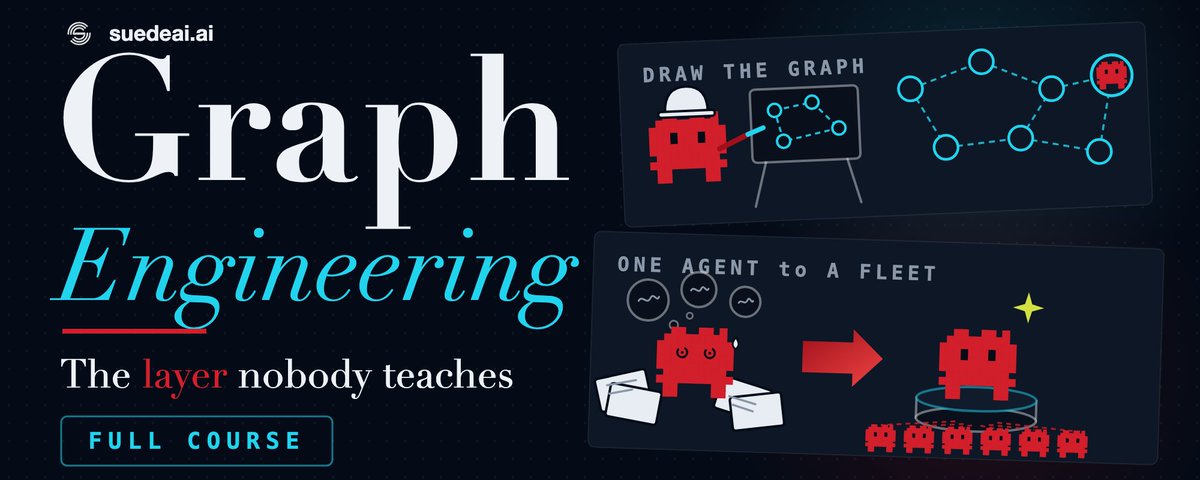
Claude Code creator Boris Cherny runs hundreds, sometimes thousands, of agents for 5, 10, even 20 hours.
The shift isn’t better prompts.
It’s graph engineering.
Fan out what is independent. Gate dependencies. Verify with fresh context.
Full course:
https://t.co/JnFTPeJFnN