She's been at our shelter since 2013. Eleven years. Every person who met her said she was wonderful. Every person walked past her kennel and chose a younger dog. She stopped coming to the front of her kennel a few years ago. Stopped performing. Made a quiet peace with being where she was." Last Tuesday a veteran came in. He said — "I need a calm dog. I'm still learning how to be still myself." I showed him three dogs. He was putting his jacket on to leave. He stopped outside kennel seven. Luna looked at him from her bed. Didn't perform. Didn't come to the front. Just looked at him the way she looks at people when she decides they're worth seeing. He said — "Can I sit with her?" He sat on the concrete floor at her level. Not the bench. The floor. That was 11am. At 3pm I looked in. He was still there. Her white muzzle was in his hand. Their breathing had synchronized. At 3:15 he came to the front desk and said — "I'd like to take her home. I think we need each other." I excused myself to the back room and sat on an overturned bucket and cried for a long time. He texted me yesterday — "First time I've slept through the night in three years. I think she was saving that for me." She was. Eleven years of saving it. For one Tuesday. For him. Drop a ❤️ for Luna. Share this for every senior dog still waiting for their Tuesday. They're saving everything they have for the right person to walk through that door.
Lady Diana Spencer, Princess of Wales, died in a car accident in Paris on August 31st, 1997.
These images come from her final official photoshoot taken by photographer Mario Testino in that same year 1997.
"My husband stands 6'4", rides a Harley, and has tattoos covering most of his arms. At first glance, he can look pretty intimidating. Our dog, Bruno, a 100-pound German Shepherd, gives off the same impression. But Bruno has one very unexpected fear: shiny floors. Highly polished surfaces terrify him. To him, smooth linoleum looks like ice—or maybe a hole he might slip into and disappear. Today we took him to a veterinary clinic that had just been renovated. The floors were spotless and gleaming. The moment Bruno’s paw touched the tile at the entrance, panic set in. His legs shot outward, elbows stiffened, and he froze in place, trembling like he had stepped onto something dangerous. My big, tough husband didn’t pull on the leash or try to force him forward. Instead, he let out a quiet sigh, bent down, and lifted all 100 pounds of shepherd into his arms. He carried Bruno across the waiting room like a giant, frightened puppy. Bruno pressed his huge head against my husband’s neck, hiding his eyes from the terrifying shiny floor below. People sitting in the waiting area started laughing. My husband glanced at them and simply said, “He guards my house at night. Carrying him past a scary floor is the least I can do for him.” If you want to see Bruno now — the brave shepherd who still avoids shiny floors but never leaves his dad’s side — the way he curls up at home and watches over our family, comment “Bruno.” I would love to show you his update
Papua'nın yağmur ormanlarında bulunan Vogelkop Süper Paradise, sadece Endonezva'nın Papua eyaletinde bulunur. Karanfil siyah tüyleri 99.5% ışığı emer, bu da mavi gözleri ve göğsünü dijital bir ilüzyon gibi gösterir.
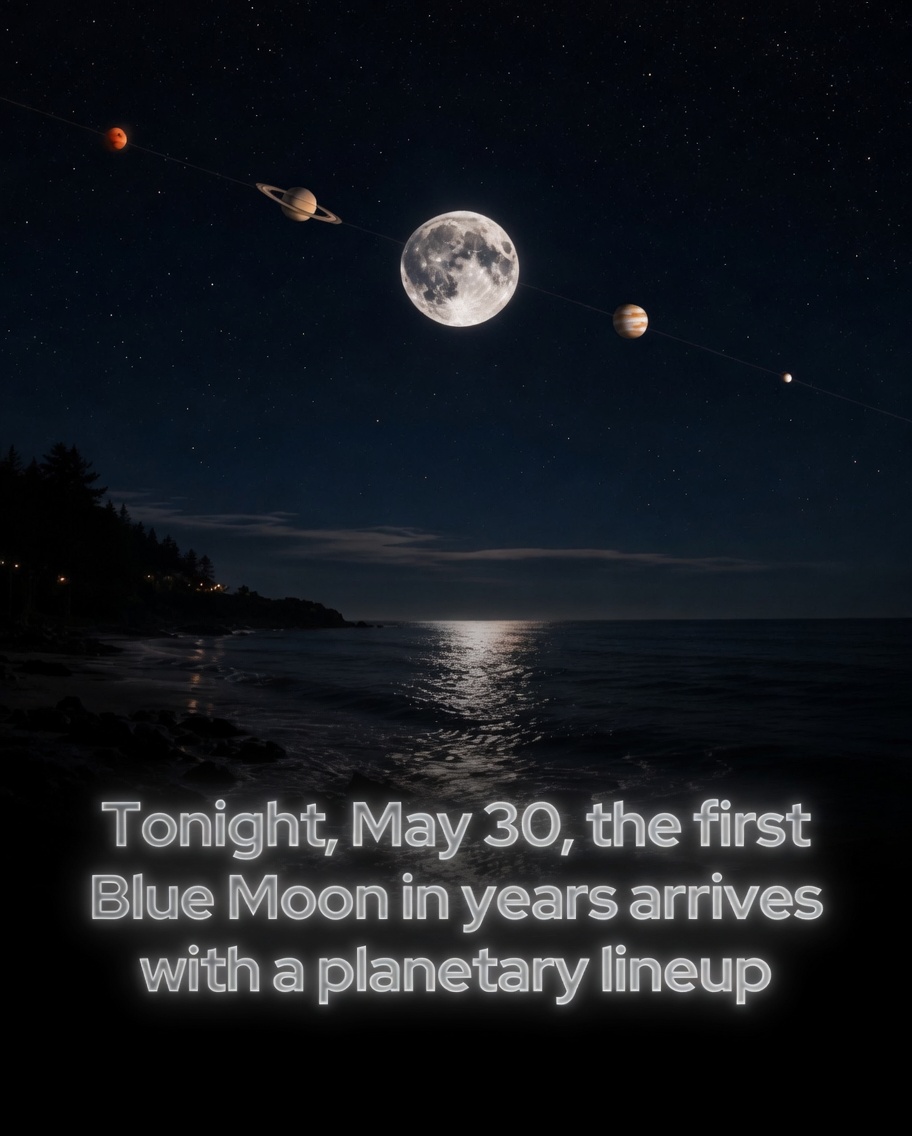
One of the rarest moons of the decade is rising over Earth tonight.
On May 30–31, the second full moon of the month will grace the sky, creating what is known as a Blue Moon. This uncommon event occurs only about once every two and a half years. After this weekend, the next monthly Blue Moon will not appear until December 2028.
This year’s Blue Moon is especially spectacular because it coincides with a beautiful planetary lineup. Before sunrise, Mars and Saturn will shine low in the eastern sky. After sunset, Venus and Jupiter will glow brightly in the west as the full moon dominates the night.
Despite its name, a Blue Moon is not actually blue. The term simply describes the second full moon to occur within a single calendar month. Since the Moon takes roughly 29.5 days to orbit Earth, squeezing two full moons into one month is unusual but not impossible.
The best time to view this Blue Moon may surprise you. Although it reaches peak fullness in the early hours of May 31, many skywatchers prefer to observe it rising on the evening of May 30. As it lifts above the horizon near sunset, the Moon often appears larger and takes on striking deep orange and golden hues.
This warm coloring is caused by the same atmospheric effect that creates colorful sunsets. Near the horizon, moonlight travels through more of Earth’s atmosphere, scattering shorter blue wavelengths and allowing longer red and orange wavelengths to reach our eyes.
The four bright planets sharing the sky with the Blue Moon are not actually close to one another. Jupiter, for example, is currently about 365 million miles (588 million km) from Earth. They only appear grouped together from our perspective here on the ground.
April 1944.
Two little girls arrived at Auschwitz holding hands.
Andra was 4 years old.
Tatiana was 6.
They wore matching gray coats with yellow stars stitched onto them. To the guards on the Birkenau ramp, they looked like twins.
That mistake saved their lives.
The sisters, Andra and Tatiana Bucci, came from Fiume — a city that was Italian at the time and is now part of Croatia. Their father was Catholic. Their mother, Mira, was Jewish.
For years, they lived an ordinary childhood.
Then came the racial laws.
Then the arrests.
On March 28, 1944, soldiers came for the family.
The girls, their mother, grandmother, aunt, and young cousin Sergio were all taken away and eventually forced onto a cattle train headed for Auschwitz-Birkenau.
When they arrived, Dr. Josef Mengele stood on the selection ramp deciding who would live and who would die.
Most small children were sent directly to the gas chambers.
But Mengele was obsessed with twins for his experiments.
Andra and Tatiana were not twins — they were two years apart — but dressed alike, they appeared to be.
So they were spared.
Their grandmother and aunt were murdered almost immediately.
The girls were tattooed with numbers:
76483.
76484.
In Auschwitz, names were meant to disappear.
But their mother refused to let that happen.
At night, Mira secretly visited the children’s barracks whenever she could.
She risked beatings and death just to whisper the same words to her daughters over and over:
“Never forget your names.”
Not prayers.
Not promises.
Just their names.
“Andra Bucci.”
“Tatiana Bucci.”
In a place designed to erase identity, remembering who you were became an act of resistance.
The girls later said they didn’t fully understand the horror around them. They were too young. Auschwitz became their version of normal life.
But they remembered fear.
They remembered children disappearing.
Doctors in white coats would come into the barracks and take children away.
Most never returned.
One day, a prisoner warned the sisters that someone would soon ask which children wanted to see their mothers.
“Do not move,” she told them.
“No matter what.”
The girls obeyed.
But their cousin Sergio stepped forward.
He missed his mother.
The sisters watched him leave.
He was later murdered after being used in medical experiments along with other children.
Andra and Tatiana survived partly because they stayed silent and invisible.
Then, in January 1945, the camp suddenly changed.
The guards vanished.
The barking dogs stopped.
And Soviet soldiers entered Auschwitz.
One of them handed the girls a piece of salami.
Liberation had arrived.
But freedom did not instantly heal anything.
The sisters spent months in orphanages, moving between countries, speaking broken mixtures of German, Czech, and other languages.
For a time, they even forgot Italian.
Then, in England, someone showed them a photograph.
It was their parents’ wedding picture.
“Your mother and father are alive,” they were told.
Their mother had survived.
Their father had survived.
And they had spent months searching for their daughters across postwar Europe.
When the girls were finally reunited with their mother in Italy, they cried.
Not because they were happy.
Because they no longer recognized her.
Trauma had stolen even that.
Slowly, over time, they rebuilt their lives.
For decades, they rarely spoke publicly about Auschwitz.
Then in the 1990s, they decided silence was no longer enough.
Since then, Andra and Tatiana Bucci have spent years speaking to students and returning to Auschwitz to tell people what happened there.
Today, they are among the youngest surviving people with living memories of Auschwitz.
And after everything that camp tried to erase, two things survived:
Their names.
And their mother’s whisper in the darkness:
“Never forget who you are.”
Photographer Phil Thurston shot a wave.
Slowed it down until those few seconds became 40.
Turns out the ocean is doing something extraordinary every single moment.
We're just moving too fast to notice.