"Never cut a tree down in the wintertime. Never make a negative decision in the low time. Never make your most important decisions when you are in your worst moods. Wait. Be patient. The storm will pass. The spring will come."
- Robert H. Schuller
A THREAT IS A THREAT.
Panoorin ang ating interview sa DZMM Teleradyo kung saan tinalakay natin ang grave threats, at kung bakit isa ito sa mga artikulo ng impeachment complaint laban kay VP Sara Duterte.
I-share ito para mas maraming Pilipino ang maliwanagan.
"Freedom of speech protects lawful expression; but it does not protect utterances that satisfy the elements of a criminal offense."
- Atty. Jeremy Lotoc, NBI Regional Director
The 2016 Arbitral Award was never just a court decision—it was a promise that international law matters, that the voices of smaller nations deserve to be heard, and that every Filipino has something worth protecting.
As we remember this historic milestone, we honor those who continue to safeguard our seas and those whose lives are connected to them every single day.
The ruling stands. Our rights remain. So does our hope.
🇵🇭 Happy 10th Anniversary of the 2016 Arbitral Award. Together, we continue to stand for peace, dignity, and the West Philippine Sea.
#BRPSierraMadre #WPS #WestPhilippineSea #ArbitralAward #July12 #AtinIto #UNCLOS #FactsMatter #NotOneMore
You can redraw maps, rewrite history, ignore international rulings, and spread misinformation—but you cannot erase the truth. The "Nine-Dash Lies" are nothing more than an illegitimate claim and a delusional dream. The world has been waiting for a credible answer since 2016.
#BRPSierraMadre #WPS #WestPhilippineSea #JULY12TH #RuleOfLaw #ArbitralAward #UNCLOS #FactsMatter #NotOneMore
Hey China and your wumaos!
This is the West Philippine Sea.
The Philippines is not claiming the entire SOUTHEAST ASIAN SEA (fka South China Sea).
No fake maps or fake scholarly articles can justify your massive illegal claims and reclamations.
The West Philippine Sea is ours!
Hey China! The Ivatans of Batanes are considered indigenous Filipinos, the first peoples of Batanes. They have Philippine passports and are represented in government. In China, di nila kinikilala ang mga Katutubo kasi. #notochineseimperialism
‘THE PHILIPPINES' SOVEREIGNTY OVER BATANES IS SETTLED AND NOT UP FOR DEBATE’
READ: The Department of Foreign Affairs (DFA) has released a statement reaffirming that the Philippines' sovereignty over Batanes is settled and not open to debate amid claims questioning the province's ownership.
In its statement, the DFA stressed that the Philippines will not entertain revisionist claims over its territory and urged so-called scholars to focus on genuine, good-faith studies of the region. | via JP Soriano/GMA News
Visit https://t.co/KqDTBMbm15 for more updates.
#SciFeature 𝗨𝗡𝗗𝗘𝗥𝗦𝗧𝗔𝗡𝗗𝗜𝗡𝗚 𝗧𝗛𝗘 𝗧𝗘𝗥𝗥𝗜𝗧𝗢𝗥𝗬 𝗢𝗙 𝗧𝗛𝗘 𝗣𝗛𝗜𝗟𝗜𝗣𝗣𝗜𝗡𝗘𝗦 🇵🇭
As an archipelagic nation with 7,641 islands to date, defining the territorial extent of the Philippines is not as straightforward as defining boundaries on land.
Under the 1987 Philippine Constitution, the national territory comprises the Philippine archipelago and all territories over which the Philippines has sovereignty or jurisdiction.
The 𝗨𝗻𝗶𝘁𝗲𝗱 𝗡𝗮𝘁𝗶𝗼𝗻𝘀 𝗖𝗼𝗻𝘃𝗲𝗻𝘁𝗶𝗼𝗻 𝗼𝗻 𝘁𝗵𝗲 𝗟𝗮𝘄 𝗼𝗳 𝘁𝗵𝗲 𝗦𝗲𝗮 (𝗨𝗡𝗖𝗟𝗢𝗦) provides the international legal framework that defines the country's maritime entitlements.
🔴 𝗔𝗿𝗰𝗵𝗶𝗽𝗲𝗹𝗮𝗴𝗶𝗰 𝗪𝗮𝘁𝗲𝗿𝘀 are the waters enclosed by the Philippines' archipelagic baselines, where the State exercises full sovereignty subject to rights recognized under international law.
🟡 𝗧𝗲𝗿𝗿𝗶𝘁𝗼𝗿𝗶𝗮𝗹 𝗦𝗲𝗮 extends up to 12 nautical miles from these baselines. Within this zone, the Philippines exercises sovereignty over the waters, seabed, subsoil, and the airspace above.
🔵 𝗘𝘅𝗰𝗹𝘂𝘀𝗶𝘃𝗲 𝗘𝗰𝗼𝗻𝗼𝗺𝗶𝗰 𝗭𝗼𝗻𝗲 (𝗘𝗘𝗭) extends up to 200 nautical miles, granting the Philippines sovereign rights to explore, conserve, develop, and manage living and non-living resources found in the waters, seabed, and subsoil.
This includes the vast expanse of the West Philippine Sea on the west and the Philippine (Benham) Rise on the east of Luzon.
🟢 The bounds of the 𝗞𝗮𝗹𝗮𝘆𝗮𝗮𝗻 𝗜𝘀𝗹𝗮𝗻𝗱 𝗚𝗿𝗼𝘂𝗽 (𝗞𝗜𝗚) in the West Philippine Sea and its several islands, reefs, and cays in the Spratly Islands, were officially delineated through Presidential Decree No. 1596 (1978) and designated as a municipality of Palawan.
While overlapping claims exist in the area, the Philippines continues to administer several features within the KIG in accordance with its domestic laws and its rights under international law.
It is our shared duty to understand, value, and safeguard the seas and territories that define our archipelagic nation. #AtinIto #Philippines
Ano ito, China? You are accusing us, the Philippines, of imperialism? Ibagsak ang Philippine imperialism? Isulong ang nine-dash line? Huwaw naman. Saang planeta kayo nakatira? 🤪
Four days before we commemorate the 10th anniversary of our historic arbitral ruling victory on the West Philippine Sea, China’s regime has once again escalated its disinformation campaign.
We strongly reiterate our challenge to the administration of President Marcos Jr. to immediately issue an Executive Order declaring July 12 of every year as “National West Philippine Sea Victory Day.” Doing so will preserve this landmark triumph in our national memory, deepen public awareness and education, and help ensure that future generations are equipped to reject disinformation and steadfastly defend our rights in the West Philippine Sea.
🇵🇭 West Philippine Sea. Atin ito! #WPSAtinIto
Reference:
https://t.co/Zu58DavkZi
We are not after your blood.
We are after your explanation on how you spent public funds.
We have no interest in bludgeoning you.
What we want is to hold you accountable.
We do not want you to bow to us.
We want you to bow to justice.
44 CHINESE VESSELS IN JUST ONE WEEK. THIS IS NOT PRESENCE — THIS IS PRESSURE. | While Beijing talks about “peace and stability,” the reality in the West Philippine Sea tells a different story: swarming Philippine waters with coast guard ships and warships as part of its calculated gray zone strategy — coercion without declaring conflict.
China calls it patrols. The region calls it intimidation. The world sees it for what it is: expansion disguised as diplomacy.
#BRPSierraMadre #DefendTheTruth #WestPhilippineSea #WPS #PhilippineSovereignty #NotOneMore #FactsMatter
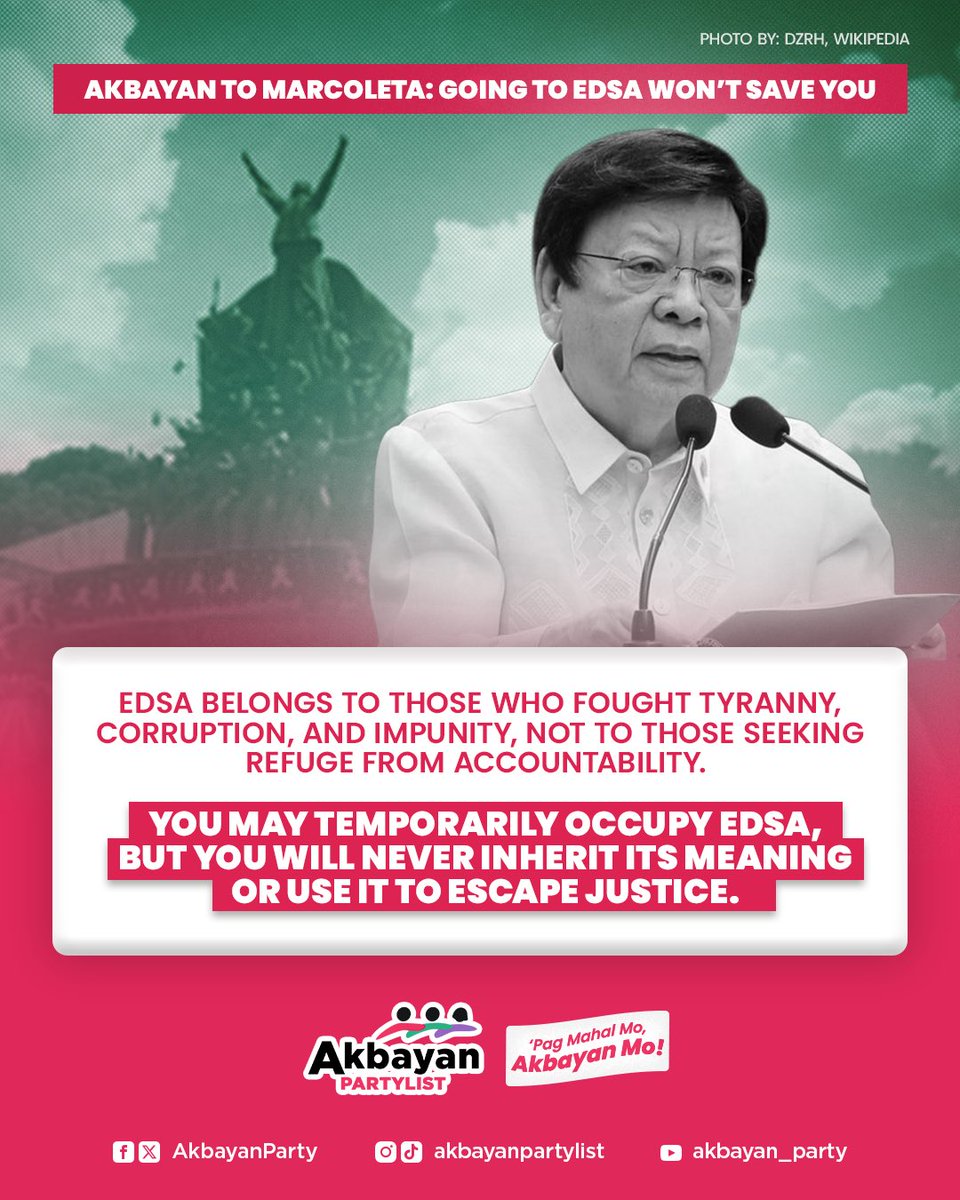
Ang EDSA ay isang makasaysayang lugar na naging saksi sa matapang na paglaban ng sambayanang Pilipino laban sa katiwalian, pang-aabuso, at diktadura. Isa itong buhay na simbolo ng tapang, pagkakaisa, at paninindigan para sa katotohanan at demokrasya.
Hindi dapat gamitin ang EDSA bilang lugar para takasan ang pananagutan. Ang diwa ng EDSA ay hindi pagtatago sa batas, kundi paninindigan sa katotohanan at pananagutan sa taumbayan.
Kaya Marcoleta, kung tunay kang walang kasalanan harapin mo ang proseso ng batas.
We should remind our pasahod and palamuning si @piacayetano na wala siyang karapatang mag-inaso to any working senator after niyang mag-absent nang mag-absent. Pinili niyang maging tagasunod ng kapatid niyang gaya niyang inutil. She should tone down the attitude.
EXPLANATION
Why Avelino vs Cuenco 1949 is enough for a quorum of 12
Normally, the Senate has 24 senators, so quorum is 13.
Senate PH Rule II says that for Senate officers: they are elected by “majority vote of all its members.”
So if all 24 are counted, 12 is not enough.
But the anti-Cayetano camp’s argument comes from Avelino v. Cuenco, 1949.
In that case, the Supreme Court accepted the idea that because one senator was outside the country and could not participate, the Senate could be treated as having only 23 participating members. That made 12 a majority.
The Supreme Court said that “an absolute majority (12)” of the Senate “less one (23)” could be quorum, and Justice Feria explained that the count may be based on “actual members or incumbents” who are not incapacitated or outside the Senate’s jurisdiction.
Applied today: if Jinggoy Estrada is unable to participate because he is arrested, they can argue the working Senate is 23, not 24.
So 12 becomes quorum under Avelino logic.
Now add the Cayetano issue.
A Senate President is not the owner of the Senate.
The Senate Rules say the Senate normally meets at 3 PM on weekdays, unless the Senate decides otherwise.
If a session is postponed, the Senate President must consult the Majority and Minority Leaders. And the Senate President cannot just suspend or adjourn a session by himself without a motion or resolution approved by senators present, except in the specific postponement situation.
So if Cayetano refuses to preside or tries to stop the chamber from functioning, the anti-Cayetano camp can say - the chair cannot kill the chamber.
That is also consistent with Avelino v. Cuenco, 1949.
In that case, the Senate President abandoned the chair and did not attend.
Worse, Cayetano not only was absent, he did not designate a Presiding Officer either - the Senate is not functioning.
The anti-Cayetano senators continued, and the case records say the deliberate abandonment made it necessary for the remaining members to continue “in order NOT TO PARALYZE the functions of the Senate.”
So the anti-Cayetano camp’s legal theory is basically this:
(1) The Senate is bigger than Former SP Cayetano.
(2) If he refuses to preside, and enough senators are present, the Senate can still function.
(3) If Jinggoy cannot participate, Avelino gives them an argument that 12 is quorum.
(4) Once quorum exists, the Senate can act on its internal organization, including committees per the Senate Rules.
They are on stronger ground when reorganizing committees, because committees are part of Senate internal organization.
Rule X says permanent committees are formed by the Senate after organization, including the Committee on Rules (take notice, yan ang unang call to motion ni Sotto).
So what did Cayetano did wrong?
Essentially by refusing to attend the Senate or any of the presiding officers (ie: Former Pro Tempore Legarda, and Former Majority Leaders), the situation became more and more similar to Avelino v. Cuenco, 1949.
The former Majority could even argue that Avelino v. Cuenco, 1949 is a "special circumstance" . However, the similarities between then and now became more apparent with the former Majority leaders absence and made the arguments of the anti-Cayetano camp stronger.
With this, the new Majority got their quorum and they rearranged leadership.
So why only the leaderships and not the actual Senate Presidency?
So the pro-Cayetano camp can ask: "If you truly have quorum, and the majority of all members, why not also elect a Senate President?"
Short answer: Because of the Constitution.
The Constitution makes electing a new Senate President more sensitive because it specifically requires a “majority vote of all its respective Members” for that office.
The Constitution then separately says each House may choose “such other officers as it may deem necessary.”
For Senate President:
The Constitution itself sets the rule. The Senate President must be elected by “a majority vote of all its respective Members.”
For President Pro Tempore and other officers:
The Constitution does not give a specific voting threshold. It only says each House may choose “such other officers as it may deem necessary.” (Sec. 16)
It also says each House may determine its own rules.
That is where Senate Rule II comes in:
the Senate used its rule-making power to say its officers, including the President Pro Tempore, Secretary, and Sergeant-at-Arms, are elected by majority vote of all members.
LOGICAL DIFFERENCE:
So the Constitution does not dictate the definition of "all members" for other Senate officers - only for the Senate President.
Thus, the dictation and definition of "all members" lies on Senate Rules per the Constitution Sec. 16, "...as they deem necessary..."
But with Avelino v. Cuenco 1949 coming in...
The Senate PH has already defined "majority of all members" to be "active members of the Senate - that could participate"
In the ruling,
Justice Feria said the count may be based on the Senate’s “actual members or incumbents,” excluding those unable to discharge their duties because of death, incapacity, absence from jurisdiction, or other causes making attendance impossible (ie: arrest).
Feria treated the Senate as having 23 actual members, so 12 became a quorum and majority.