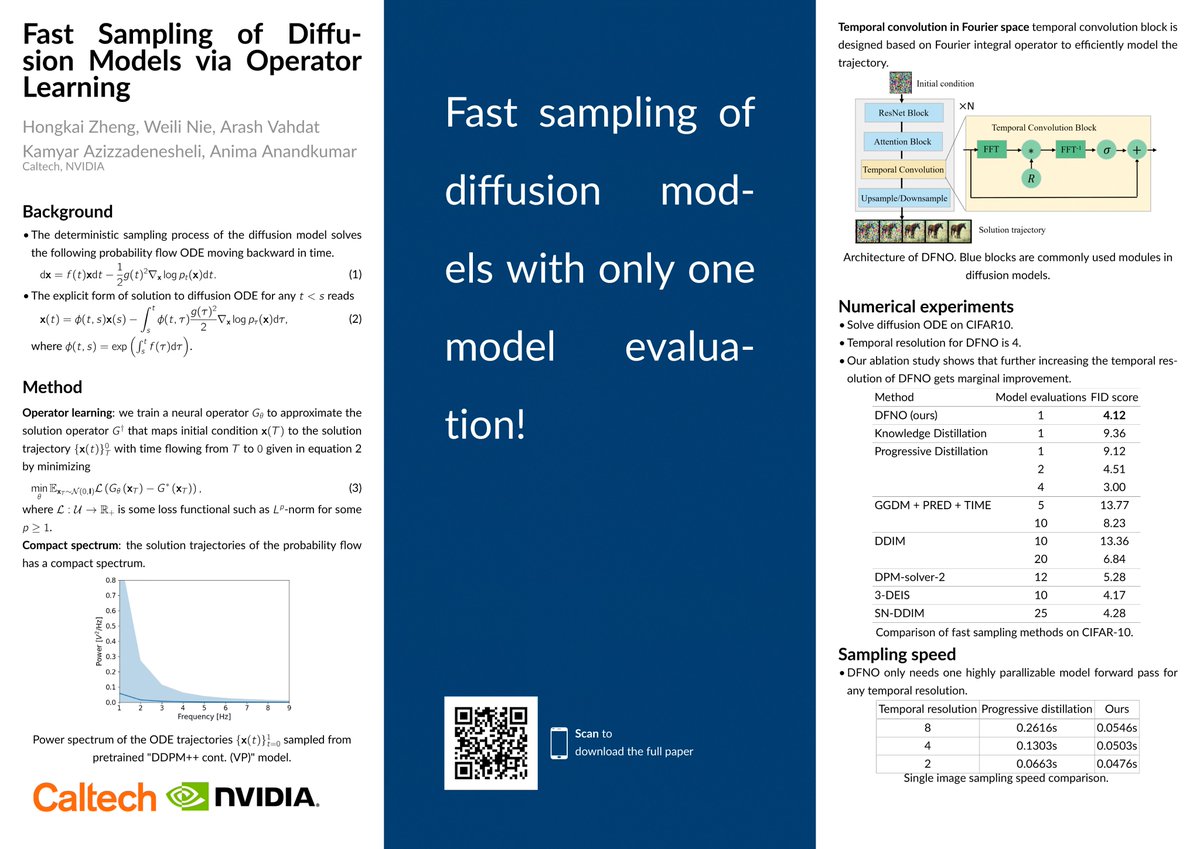
1. We learn a neural operator that maps initial condition to the solution trajectories.
2. We observe that the solution trajectories have compact spectrum.
3. We build time convolution block in Fourier space to model trajectories efficiently.
Fast sampling of diffusion models with only one model evaluation achieves a FID of 4.12 on CIFAR10!
Check out our poster at SBM-workshop on Friday 2:30pm-4pm at Room 293 - 294.
@KyleLiang5@AnimaAnandkumar@PreetumNakkiran CGD's distinguished property is that it preserves the network capacity and prevents the unstable training by choosing the right optimization dynamics, while other techniques like spectral normalization, gradient penalty variants, do so by restricting the model parameter space.
@KyleLiang5@AnimaAnandkumar@PreetumNakkiran Current Pytorch implementation requires 7-9 times more gradient calls, depending on network structures and datasets. It is computationally expensive but in principle, it can further speed up if Pytorch can support both forward and backward mode auto differentiation.
Excited to share our work "Implicit regularizations in GANs" at ICML with Florian and @AnimaAnandkumar ! Come and check out the GAN-dilemma that the divergence minimization view is facing and how we find a way out from optimization point of view.
Poster: https://t.co/FDVrN2cLYs
@AnimaAnandkumar@PyTorch Thanks Anima. Any questions and suggestions about the current prototype on Github are welcomed. And more study will come soon. :D