Since you’ve put these questions directly, I’ll address each one specifically.
1. I don’t know the detailed lease, licence or covenant terms because I don’t own a home there, so I’m not going to speculate about what those documents legally permit. But your question seems to conflate two quite different things: changing what you personally believe and violating the agreed standards of the place you chose to live. Let’s apply some common sense.
If you choose to live in Deerlick Astronomy Village, whose entire purpose is preserving dark skies, and five years later decide astronomy is nonsense, nobody can force you to look through a telescope. But if you then install floodlights all over your property and complain that the lighting restrictions are “ideological control,” that would be rather ridiculous. The issue is no longer what you believe. It is that your actions undermine the very environment everyone moved there to preserve. Likewise, if you live in an eco-village, nobody can force you to care about sustainability. But if you repeatedly throw plastic into the compost and ignore the environmental standards you knowingly signed up for, that has nothing to do with policing what you believe; it is simply about respecting the shared standards of the place you chose to live in.
The same distinction applies here. Nobody needs to police what residents privately believe, whether they continue to feel drawn to a particular teacher, or how committed they are spiritually. But residents can reasonably be expected to respect the basic ethos and agreed standards of the place they voluntarily chose to live. And these things are generally dealt with through ordinary residential governance and HOA-type structures designed to protect residents’ shared interests.
And this is worth emphasising: this is not a guru fan club built around compulsory allegiance. The people drawn there are serious seekers from remarkably diverse cultural, religious and professional backgrounds, brought together primarily by an interest in yoga, meditation and inner growth. Being deeply committed to a practice does not mean surrendering independent thought, and respecting a teacher does not mean agreeing with everything or being required to think alike.
2. Regarding the ground-lease model, I’m not sure what is supposed to be suspicious here. Retaining ownership of land while granting long-term ground leases is a completely conventional real-estate structure used by private landowners, non-profits, universities, governments and Community Land Trusts. The 99-year ground lease is so well established that presenting the structure itself as some unusual feature of Isha is rather strange.
Of course, fee-simple ownership with restrictive covenants is another possible model. But the existence of another legal structure does not make a ground lease suspicious; they are simply different mechanisms for protecting the long-term purpose and character of a property as it changes hands.
And importantly, my understanding from people who have been involved with Isha for a very long time is that this was not even the original model. The approach evolved over time in response to collective concerns about how best to protect the character and purpose of the place for the people actually living there. The ground-lease structure developed as a more effective way of doing that.
I also think the phrase “safeguard its ethos” is being made to sound far more mysterious and sinister than it actually is. Isha’s own published material is quite clear about what kind of environment it is trying to maintain: a place centred around yoga, meditation, inner well-being and nature; free from drugs, alcohol and smoking; and with basic expectations around respectful, non-disruptive behaviour. That is the “ethos” being protected.
So what exactly is sinister about wanting to preserve that? Is yoga, meditation, nature, no drugs or alcohol and an expectation of respectful behaviour somehow incompatible with ordinary American society? These are hardly radical demands, and people choosing to live there know what sort of environment they are choosing.
That is the important distinction. “Safeguarding the ethos” means preserving the purpose and character of the place as properties change hands. Nothing in the phrase establishes ideological conformity, compulsory belief or the policing of residents’ private thoughts. Those are additional conclusions being read into it, not conclusions established by the stated ethos or by the existence of a ground lease.
3. Of course, yoga and many of the concepts and forms used at Isha have deep roots in Indian, Hindu and yogic traditions. Nobody needs to deny or sanitise that history. But where a practice originated does not determine the religious identity of someone who practises it. Meditation has deep Buddhist and other religious histories; practising mindfulness does not make someone Buddhist. Yoga developed in India and is deeply intertwined with Indian spiritual traditions; practising yoga does not make someone Hindu. Tai chi emerged from Chinese philosophical and spiritual traditions; practising tai chi does not make someone Taoist. Modern hospitals use meditation, breathwork and contemplative practices without becoming religious institutions.
The important distinction is between practising something and professing a faith. At Isha, yoga is taught as a systematic set of methods involving the body, breath, mind and experience, not as a creed one must believe. People are not required to become Hindu, profess a particular theology or renounce Christianity, Islam, Judaism, atheism or anything else.
And this openness is not something recently invented for Western audiences; it has been part of Isha’s ethos for decades. At the Isha Yoga Center in India stands a large stone pillar, dating from around the late 1990s, bearing symbols of the world’s major religions, including Christianity, Islam, Judaism and Buddhism. It explicitly represents a universal welcome to people of all faiths and the idea that the spiritual path need not belong to any single religious identity.
That is also the context in which Isha describes yoga as a “technology” or a “science of inner well-being”. The point is not to disguise its origins, but to distinguish a practice from a belief system: something that can be explored and experienced by a Christian, Muslim, Jew, Hindu or atheist without requiring them to adopt a new religious identity. You can disagree with the terminology, but that is very different from claiming that religion is being deceptively repackaged for Western audiences.
The same applies to Adiyogi. The word literally means “first yogi,” and within Isha he is presented primarily as the originator of the yogic sciences and honoured in that context. Shiva, karma, gurus and consecrated spaces obviously reflect Isha’s deep roots in Indian spiritual and yogic traditions… something that is openly acknowledged, not hidden.
So if the accusation is that Isha has Indian spiritual and yogic roots, of course it does. Nobody is hiding that. But if the accusation is that those traditions are deliberately being presented as “wellness”, “technology” or “science” in order to obscure their supposedly religious nature and make them more palatable to Westerners, that is an entirely different claim. It requires evidence of actual deception or concealment. You cannot establish that simply by pointing out that yoga, Shiva or consecration have Indian and Hindu roots. Indian and Hindu provenance is not, in itself, evidence of a covert religious agenda.
4. I think the burden of proof is getting reversed here. Your screenshots establish particular interactions. Sewa is a Hindu faith-based charity and collaborated with Isha on Save Soil ecological campaign. Isha also participated in Positivity Unlimited, a Covid-era programme coordinated by an RSS-linked response group. The question is what you think those facts establish beyond the interactions themselves.
Nothing presented here demonstrates shared governance, political control, coordinated political activity or ideological allegiance between Isha and these organisations. Cooperation on an environmental campaign establishes cooperation on an environmental campaign. Speaking in a Covid programme establishes participation in that programme.
If you believe these interactions demonstrate some broader political or ideological alliance, then it is for you to explain what that alleged alliance actually consists of and provide evidence for it. Otherwise, it is guilt by association presented in a way that invites the reader to draw a conclusion the evidence itself has not established.
Since you’ve put these questions directly, I’ll address each one specifically.
1. I don’t know the detailed lease, licence or covenant terms because I don’t own a home there, so I’m not going to speculate about what those documents legally permit. But your question seems to conflate two quite different things: changing what you personally believe and violating the agreed standards of the place you chose to live. Let’s apply some common sense.
If you choose to live in Deerlick Astronomy Village, whose entire purpose is preserving dark skies, and five years later decide astronomy is nonsense, nobody can force you to look through a telescope. But if you then install floodlights all over your property and complain that the lighting restrictions are “ideological control,” that would be rather ridiculous. The issue is no longer what you believe. It is that your actions undermine the very environment everyone moved there to preserve. Likewise, if you live in an eco-village, nobody can force you to care about sustainability. But if you repeatedly throw plastic into the compost and ignore the environmental standards you knowingly signed up for, that has nothing to do with policing what you believe; it is simply about respecting the shared standards of the place you chose to live in.
The same distinction applies here. Nobody needs to police what residents privately believe, whether they continue to feel drawn to a particular teacher, or how committed they are spiritually. But residents can reasonably be expected to respect the basic ethos and agreed standards of the place they voluntarily chose to live. And these things are generally dealt with through ordinary residential governance and HOA-type structures designed to protect residents’ shared interests.
And this is worth emphasising: this is not a guru fan club built around compulsory allegiance. The people drawn there are serious seekers from remarkably diverse cultural, religious and professional backgrounds, brought together primarily by an interest in yoga, meditation and inner growth. Being deeply committed to a practice does not mean surrendering independent thought, and respecting a teacher does not mean agreeing with everything or being required to think alike.
2. Regarding the ground-lease model, I’m not sure what is supposed to be suspicious here. Retaining ownership of land while granting long-term ground leases is a completely conventional real-estate structure used by private landowners, non-profits, universities, governments and Community Land Trusts. The 99-year ground lease is so well established that presenting the structure itself as some unusual feature of Isha is rather strange.
Of course, fee-simple ownership with restrictive covenants is another possible model. But the existence of another legal structure does not make a ground lease suspicious; they are simply different mechanisms for protecting the long-term purpose and character of a property as it changes hands.
And importantly, my understanding from people who have been involved with Isha for a very long time is that this was not even the original model. The approach evolved over time in response to collective concerns about how best to protect the character and purpose of the place for the people actually living there. The ground-lease structure developed as a more effective way of doing that.
I also think the phrase “safeguard its ethos” is being made to sound far more mysterious and sinister than it actually is. Isha’s own published material is quite clear about what kind of environment it is trying to maintain: a place centred around yoga, meditation, inner well-being and nature; free from drugs, alcohol and smoking; and with basic expectations around respectful, non-disruptive behaviour. That is the “ethos” being protected.
So what exactly is sinister about wanting to preserve that? Is yoga, meditation, nature, no drugs or alcohol and an expectation of respectful behaviour somehow incompatible with ordinary American society? These are hardly radical demands, and people choosing to live there know what sort of environment they are choosing.
That is the important distinction. “Safeguarding the ethos” means preserving the purpose and character of the place as properties change hands. Nothing in the phrase establishes ideological conformity, compulsory belief or the policing of residents’ private thoughts. Those are additional conclusions being read into it, not conclusions established by the stated ethos or by the existence of a ground lease.
3. Of course, yoga and many of the concepts and forms used at Isha have deep roots in Indian, Hindu and yogic traditions. Nobody needs to deny or sanitise that history. But where a practice originated does not determine the religious identity of someone who practises it. Meditation has deep Buddhist and other religious histories; practising mindfulness does not make someone Buddhist. Yoga developed in India and is deeply intertwined with Indian spiritual traditions; practising yoga does not make someone Hindu. Tai chi emerged from Chinese philosophical and spiritual traditions; practising tai chi does not make someone Taoist. Modern hospitals use meditation, breathwork and contemplative practices without becoming religious institutions.
The important distinction is between practising something and professing a faith. At Isha, yoga is taught as a systematic set of methods involving the body, breath, mind and experience, not as a creed one must believe. People are not required to become Hindu, profess a particular theology or renounce Christianity, Islam, Judaism, atheism or anything else.
And this openness is not something recently invented for Western audiences; it has been part of Isha’s ethos for decades. At the Isha Yoga Center in India stands a large stone pillar, dating from around the late 1990s, bearing symbols of the world’s major religions, including Christianity, Islam, Judaism and Buddhism. It explicitly represents a universal welcome to people of all faiths and the idea that the spiritual path need not belong to any single religious identity.
That is also the context in which Isha describes yoga as a “technology” or a “science of inner well-being”. The point is not to disguise its origins, but to distinguish a practice from a belief system: something that can be explored and experienced by a Christian, Muslim, Jew, Hindu or atheist without requiring them to adopt a new religious identity. You can disagree with the terminology, but that is very different from claiming that religion is being deceptively repackaged for Western audiences.
The same applies to Adiyogi. The word literally means “first yogi,” and within Isha he is presented primarily as the originator of the yogic sciences and honoured in that context. Shiva, karma, gurus and consecrated spaces obviously reflect Isha’s deep roots in Indian spiritual and yogic traditions… something that is openly acknowledged, not hidden.
So if the accusation is that Isha has Indian spiritual and yogic roots, of course it does. Nobody is hiding that. But if the accusation is that those traditions are deliberately being presented as “wellness”, “technology” or “science” in order to obscure their supposedly religious nature and make them more palatable to Westerners, that is an entirely different claim. It requires evidence of actual deception or concealment. You cannot establish that simply by pointing out that yoga, Shiva or consecration have Indian and Hindu roots. Indian and Hindu provenance is not, in itself, evidence of a covert religious agenda.
4. I think the burden of proof is getting reversed here. Your screenshots establish particular interactions. Sewa is a Hindu faith-based charity and collaborated with Isha on Save Soil ecological campaign. Isha also participated in Positivity Unlimited, a Covid-era programme coordinated by an RSS-linked response group. The question is what you think those facts establish beyond the interactions themselves.
Nothing presented here demonstrates shared governance, political control, coordinated political activity or ideological allegiance between Isha and these organisations. Cooperation on an environmental campaign establishes cooperation on an environmental campaign. Speaking in a Covid programme establishes participation in that programme.
If you believe these interactions demonstrate some broader political or ideological alliance, then it is for you to explain what that alleged alliance actually consists of and provide evidence for it. Otherwise, it is guilt by association presented in a way that invites the reader to draw a conclusion the evidence itself has not established.
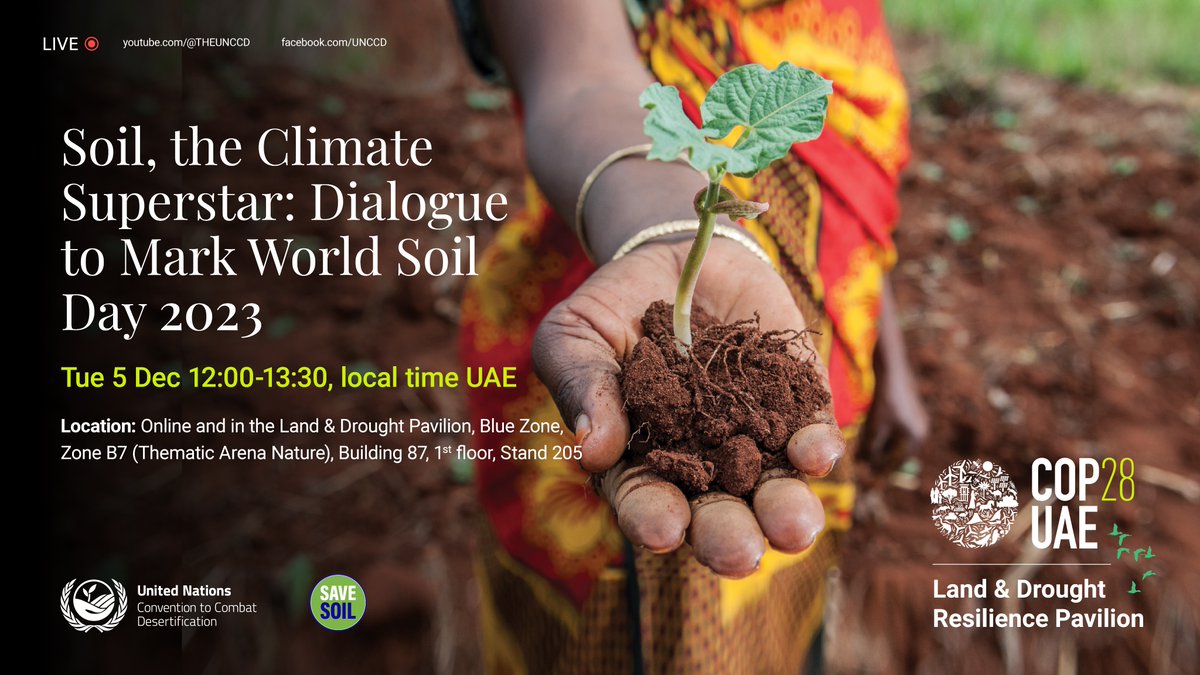
With just one-tenth of the money currently being spent on climate mitigation, we can significantly turn around the land and soil situation and reverse climate change by 35 to 40% in 8 to 12 years' time. -Sg #SaveSoil #SoilForClimateAction #COP28UAE @@COP28_UAEOP28_UAE @ibrahimthiaw@UNFCCC @PScotlandCSG
It's important that we understand, this is not just about awareness, it's time for action. If we believe that COP is the fulcrum of change, we must push for action instead of engaging in more conversations and more conversations. -Sg #SaveSoil #SoilForClimateAction
#COP28UAE @cpsavesoilpsavesoil@COP28_UAE@UNCCD
If we just listen to the life on the planet, the message is loud and clear: we must turn around from the ecological disaster we are headed towards. Let us put aside our differences of race, religion and nationality and work together for the sake of all life on the planet. Let us make it happen. -Sg
#SaveSoil #COP28 #SaveSoilFixClimateChange @COP28_UAE@narendramodi@rishisunak@emmanuelmacron@jokowi@mariammalmheiri@giorgiameloni@secblinken@UNFCCC
As we celebrate World Soil Day, we reflect on Cauvery Calling—a monumental endeavor that has reshaped landscapes and lives. With 93 million living trees planted🌳183,000 farmers empowered, and ecosystems rejuvenated, it's a testament to the power of ecological initiatives. Mooted by @SadhguruJV , this movement aims to revive Cauvery by enabling 5.2 million farmers to plant 2.42 billion trees through innovative tree-based agriculture. 🌳💧
#SoilforClimateAction #SaveSoil
@rallyforrivers
Those who want to enjoy, appreciate and experience life look at everything with a magical eye. Those who want to dissect life look at it logically. It is not a question of right or wrong, it is just two different ways of approaching the same reality. -Sg
@sapinker@balachundhar
Carbon dioxide is not bad by itself– it’s just in the wrong place. In soil, it cools surface temperature and becomes life-making material; in the air, it heats up the Planet and becomes life-taking material. The solution is to #SaveSoil from further degradation and enhance its carbon absorption capacity. Imperative to ensure that exposed soil is placed under shade to enrich organic content and enhance its ability to absorb atmospheric carbon. This must become a Global Law. Let’s make it happen. -Sg @cpsavesoil
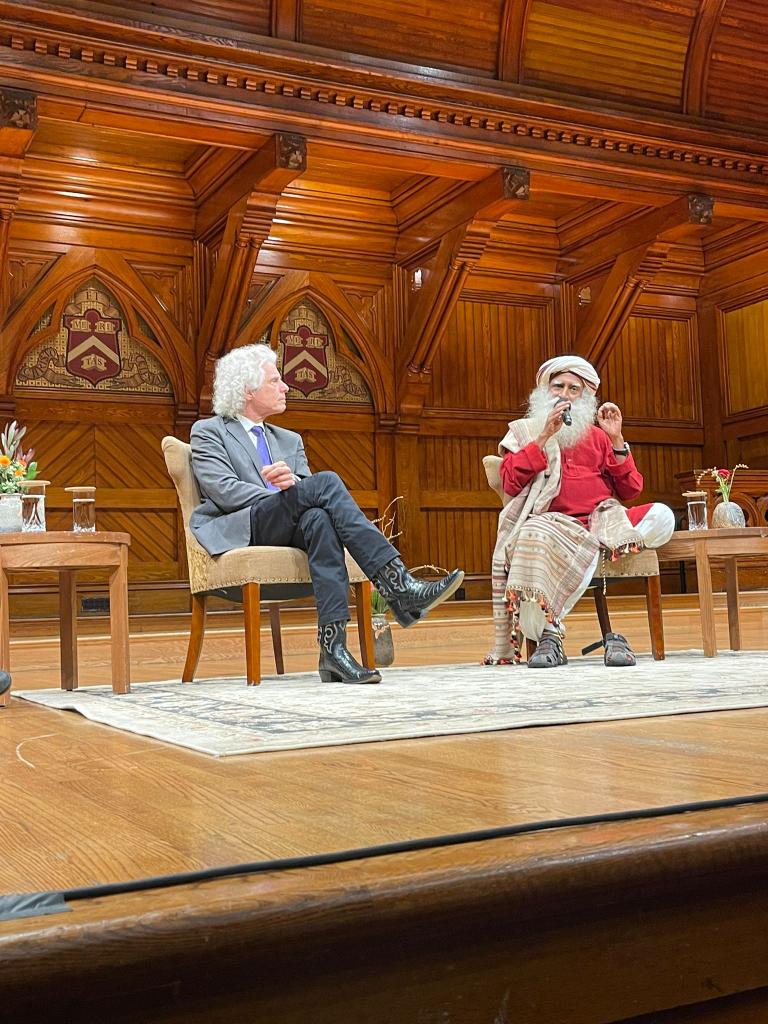
Honored to moderate Science & Spirituality discussion between @SadhguruJV and @sapinker at Harvard Sanders Theatre.
Some of my takeaways from the evening
1. The message is loud and clear. Don't look for miracles but look at the gift of life itself as a miracle.
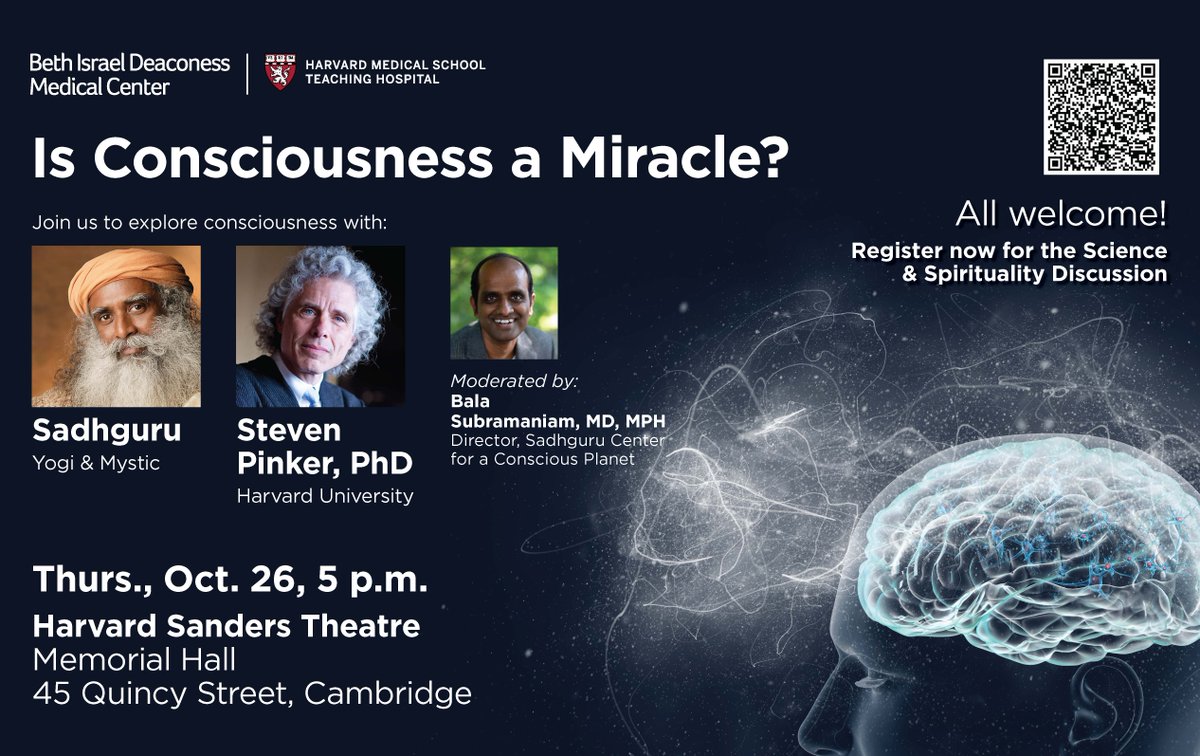
The Sadhguru Center for a Conscious Planet is hosting a Science & Spirituality discussion on Consciousness this Thursday, October 26th at 5pm ET. Register here:
https://t.co/iBCHsJEnQd
As all human experience comes from within us, if we don't learn how to create the most wonderful experiences for ourselves, in the unpleasantness of one's mind, we will end up creating an unpleasant world. It is a fact that when an individual human being is in a very pleasant experience they naturally do pleasant things in the world. This is the way forward. Creating a joyful human being. -Sg #SCCPConference #HarvardConsciousness @sapinker@balachundhar
Congratulations Rens Goede on your incredible commitment to be an inspiring Voice for soil. May you find safe passage & many willing Hands & Hearts on your journey to #SaveSoil. My best wishes & blessings are with you. -Sg @cpsavesoil
During the France leg of the #SaveSoil journey, @INSEAD Business School Fontainebleau-France hosted @SadhguruJV on its campus.
Action now. https://t.co/z6MmqLXuw6
https://t.co/SH3jWkKxai
Neither the religious nor the lecherous should determine how women should dress. Let women decide how they want to be attired. May this retributive culture of punishing someone for what they wear be put to an end, religious or otherwise. - Sg
#MahsaAmini#Iran#Hijab