If you are suspecting an infratentorial neoplasm, a 5 minute cranial nerve screen can help specify which part of the brainstem. If you are suspecting a supratentorial neoplasm, remember what lobe primarily does what. Your neuroanatomy will direct to the answer! @juliehershberg
Trying to decipher imaging? If the axial CT scan shows a “moon”, it’s most likely a subdural hematoma. Do you see a bulging belly like below? Most likely an epidural hematoma! Lighter shades indicate more acute bleeds while darker shades indicate chronic bleeds. #neuropathwk10
Your patient has a headache? Differential diagnosis is easy when you ask the right subjective questions! Frequency, duration, location, intensity, photophobia or phonophobia are just a few important things to ask about. @juliehershberg#neuropathwk9
If you are noticing language impairments in your patients who are post stroke, remember there are two types of aphasia! Broca’s aphasia is defined as difficulty producing language while Wernicke’s aphasia is difficulty processing language. Check out the image below! #neuropathwk8
Remember that toe walking can be normal for children ages 0-2 years old especially if they have a normal neurological exam. But if it persists after this age, refer to an orthopedist!🦶 #neuropathwk7@juliehershberg
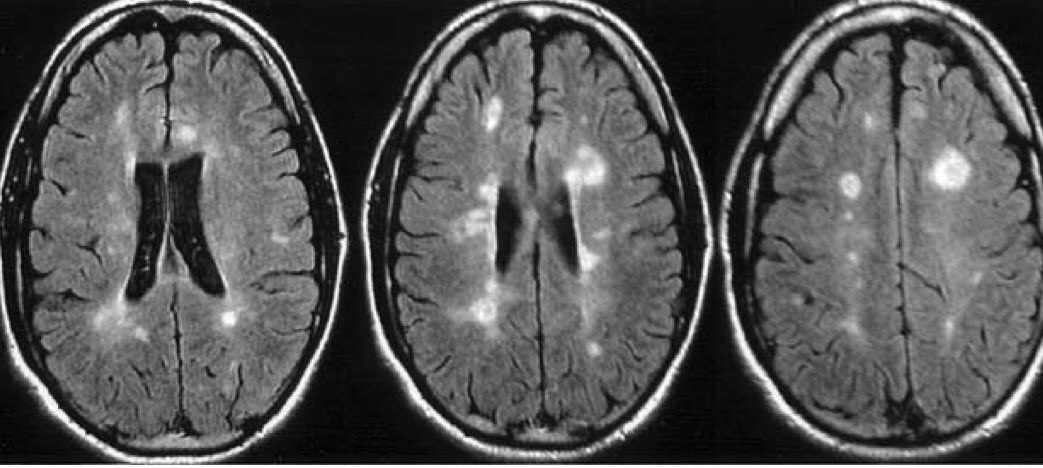
Imaging is a great diagnostic tool! Do you see these bright white spots on this MRI? These lesions are called Dawson’s fingers and are a consistent finding for a patient with Multiple Sclerosis. #neuropathwk6@juliehershberg
Idiopathic Parkinson’s and atypical Parkinson’s are often misdiagnosed. To be clinically diagnosed with idiopathic Parkinson’s disease you MUST have 2 of the cardinal symptoms and one of those has to be a resting tremor or bradykinesia! #neuropathwk5@juliehershberg@Carly1L
When talking about vestibular conditions the first step in differential diagnosis should be deciding if the lesion is upper motor neuron (UMN) or lower motor neuron. Remember that unilateral facial weakness that spares the forehead indicates an UMN lesion! #neuropathwk4
NEURO FACT Spina bifida occulta commonly occurs in about 1 out of 10 people, and is the mildest form of spinal bifida in which the spine doesn’t fully develop. There’s usually no further health concerns and is asymptomatic except for a patch of hair on the low back! #neuropathwk3
Impairmented sensation? You probably don’t have ALS. ALS is just 1 of many LMN and peripheral disorders. If you suspect a serious neurological condition... keep a diary of your symptoms. It will help us determine the right treatment. DM more info #neuropathwk2@juliehershberg
Myasthenia Gravis (MG) can be an overlooked diagnosis! If you notice fluctuating weakness, dysarthria, or a hyponasal speech with your patient, MG should be on your differential diagnosis list. Be an advocate for your patient with your thoroughness!
#neuropathwk2@juliehershberg
Deconditioning over a prolonged hospital stay has a pattern of proximal>distal weakness, whereas a polyneuropathy is often distal>proximal. Be sure to keep this in mind for differential diagnosis of neurological conditions! #neuropathwk1