Today, @ESRIDublin and @EMNIreland have published the 'Annual report on migration and asylum 2023'.
💡 Read the key findings: https://t.co/qbyzCmUS9z
📄 Download the full report: https://t.co/oJqzlezgHm
I chatted to @AntonSavageNT about the latest population and migration estimates released by @CSOIreland - what the numbers mean, who's coming and leaving and a little bit of why
🤔 Wondering what the latest @CSOIreland figures on population and migration mean?
#EMNIreland Senior Policy Officer @KeireMurphy breaks it down on @AntonSavageShow
👇 Click to listen back to yesterday's conversation
https://t.co/56GctxcnTx
#EMNIreland Senior Policy Officer @KeireMurphy explains how Ireland's migrant and refugee populations compare to other European countries and why the Irish system is under pressure.
🧠 Check out the latest @RTEBrainstorm article 👇
https://t.co/5rdOAQ7RVU
Does Ireland have more refugees & migrants than other European countries? Here's what the data has to say about Ireland's migration trends in the wider European context. By @KeireMurphy@tcddublin@ESRIDublin https://t.co/MHxtDQdw6W
Updated data (published the same day) now compiled and analysed in this RTE Brainstorm article - shows Ireland higher up in Europe for % foreign-born https://t.co/gAw525yOeb
Does Ireland have more migrants and refugees than other European countries? It's easy to get the impression sometimes that we do, but the answer is no: we're in the middle. A 🧵 on the data 1/
This doesn't mean no challenges here - Ireland historically received very few forced migrants in particular, so an increase (even if just to the middle) poses major capacity challenges that need to be addressed.
I recently posted a thread with data comparing Ireland to the rest of Europe - I updated it with new 2023 data (published the same day) for RTE Brainstorm, give it a read here!
Does Ireland have more refugees & migrants than other European countries? Here's what the data has to say about Ireland's migration trends in the wider European context. By @KeireMurphy@tcddublin@ESRIDublin https://t.co/MHxtDQdw6W
📢 Join the #EMNIreland team at the @ESRIDublin! We are looking for a Policy Officer to lead and collaborate on a range of research and policy outputs on topics relating to migration and asylum.
👀⬇️ https://t.co/CK5Y2yb59o
@kerry_lawless I went with the higher measure (born abroad) because it would be easier to say that naturalisation undercounts, so to refute the idea of a disproportionate burden I went with over-counting
@kerry_lawless Yes you're completely right, and I was also born abroad to Irish parents but raised here! I didn't have space for this in the Twitter post - but discuss advantages/disadvantages of different measures in this post: https://t.co/7fSpaUDSsX
@higginsdavidw Is this not a misleading way to represent the statistics? As this 96,000 should be spread out between the previous 6 years (since last census)? My understanding is that these statistics look so high because of how we count - so the 4.2% is misleading? Please correct if I'm wrong
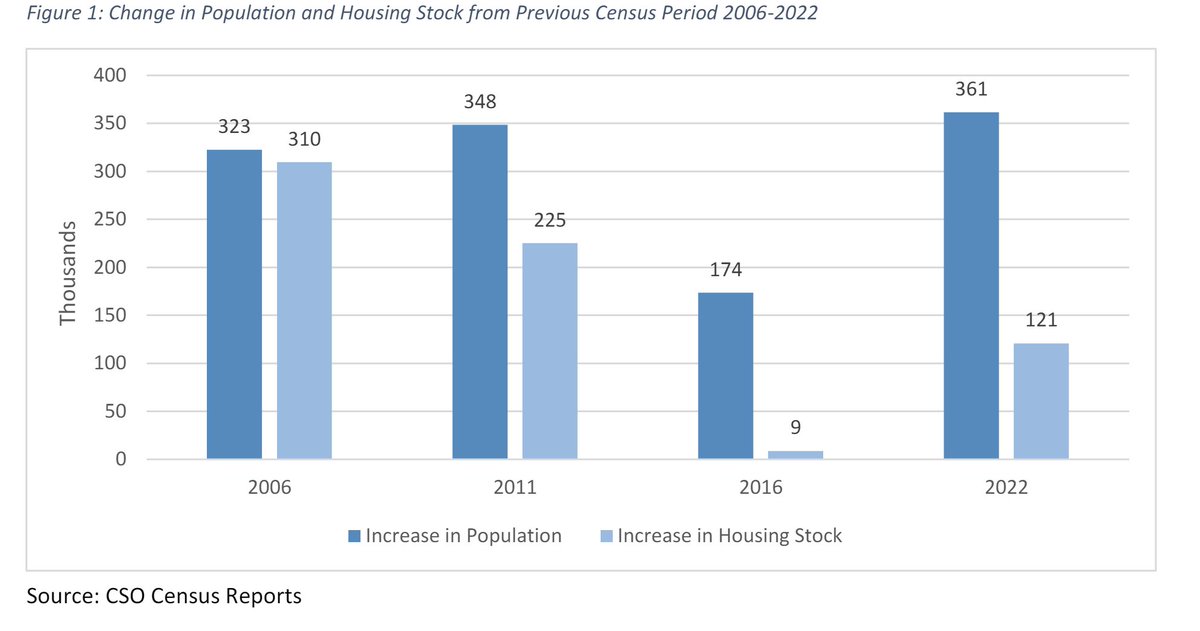
@alxwlsdn This is true, but I think a lot of the sense of threat comes from a period of austerity where we slashed capital investment while the population continued to grow, putting major strains on basic services - this graph (Folan, 2022) is my favourite way to sum it up
for housing