Agents made writing code cheap. They also made maintaining it harder, because debt now piles up at agent speed and gets paid down at human speed. The next big shift isn’t faster creation, it’s automated upkeep.
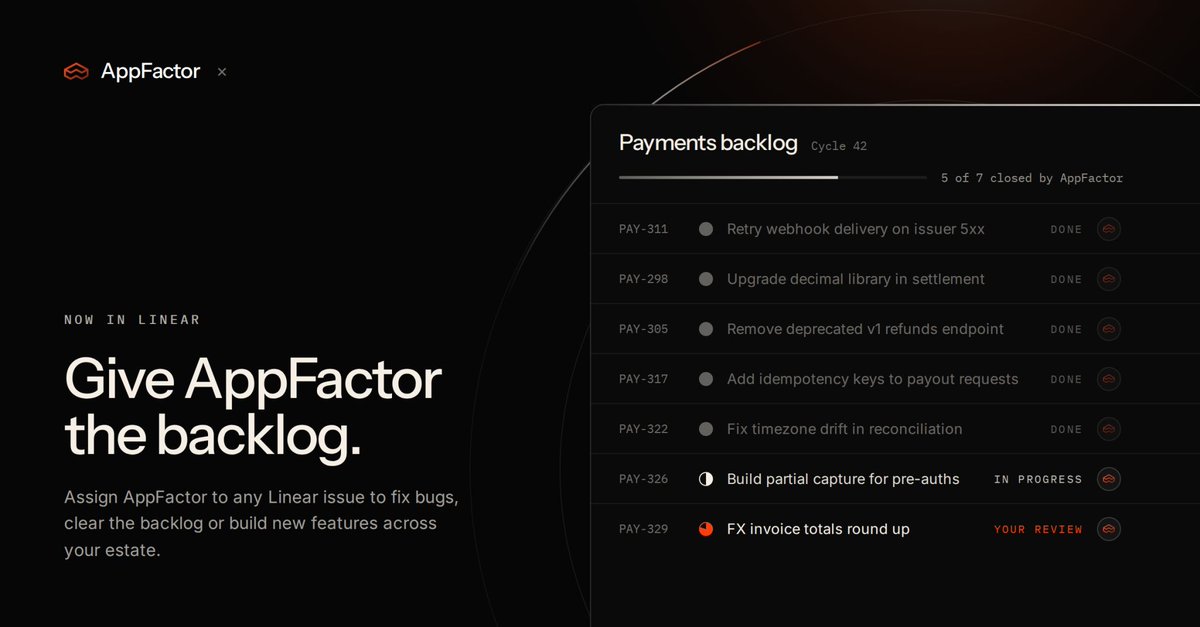
AppFactor now works in @linear.
Assign it an issue or mention it in a comment. It reads the codebase, makes the fix or builds the feature, writes tests and opens a PR. Your team approves before anything merges.
AppFactor finds where vulnerabilities live in your environment and fixes them. Independent agents check the change. Real build systems compile it.
See the demo:
AppFactor finds where vulnerabilities live in your environment and fixes them. Independent agents check the change. Real build systems compile it.
See the demo:
Announcing Forge for desktop, now available on Mac and Windows.
Forge is the multi-agent orchestration engine at the heart of the AppFactor platform.
Point it at your software estate, and it runs teams of agents to handle the maintenance work no one has time for.
Objectives and maintenance tasks can be identified by AppFactor's discovery technology or raised directly by teams through Jira, Linear, or Slack.
That includes documentation, tests, fixes, migrations, and full rewrites. Every change is validated and delivered as a pull request for your team to review.
The desktop app brings all of this into one native window. You can launch runs across projects, schedule campaigns, follow every line of output, and open PRs without switching between tools.
The screenshot shows a COBOL module rewritten in idiomatic Rust: 8 modules, 0 failures, validation passed.
Meet us at @nvidia GTC in Berlin, 20-22 October! 🚀 3 days of the biggest names in AI infrastructure, all in one place.
@KeithNeilson and @devsprint are heading over to talk about what usually holds AI back in the enterprise: legacy software that needs modernizing first, and how model-agnostic agentic AI fixes it.
If you're in Berlin for GTC, come and say hello 👋🏼 DM us to set up a meeting.
Heading to @nvidia GTC in Berlin, 20-22 October, with @devsprint!
We'll be talking about getting legacy software ready for AI, and how model-agnostic agentic AI helps.
If you're there too, dm me and let's grab a coffee!
Software engineers who still think their main job is writing code are already behind.
The role is quietly shifting from writer to editor.
Agents draft the code, run the tests, and open the PRs. Humans set the direction, review the diff, and decide what's actually great enough to ship.
The teams that resist this won't just move slower. They'll lose their best engineers to the teams that don't.
The keyboard era of programming is ending.
What’s left for engineers is the only part that ever really mattered, deciding what excellence looks like and managing agents with your voice.
The keyboard era of programming is ending.
What’s left for engineers is the only part that ever really mattered, deciding what excellence looks like and managing agents with your voice.
New release 🚀
* Better Python discovery. Scanner now creates app candidates from WSGI and ASGI servers, so Python workloads behind gunicorn or uvicorn stop hiding from discovery.
* More resilient scans. Orchestrator reports scan progress as it goes and keeps results on disk if an upload fails.
Legacy debt used to accumulate over years. Now it can ship on day one: code nobody reviewed, nobody fully understands, and everyone is already building on.
We recently made auto mode the default in Claude Code, which means you no longer have to approve every action.
But what determines if something is safe to run? Watch how it works:
Multiverse draws every machine on your network and every connection between them.
Hover any line for the port, protocol, and direction of live traffic.
Rewrites fail when teams replace systems they don't fully understand, then find the missing requirements in production.
AppFactor's agents start from a full system model. Idiomatic Rust rewrites: ~80% faster, ~85% cheaper to run, memory-safe.
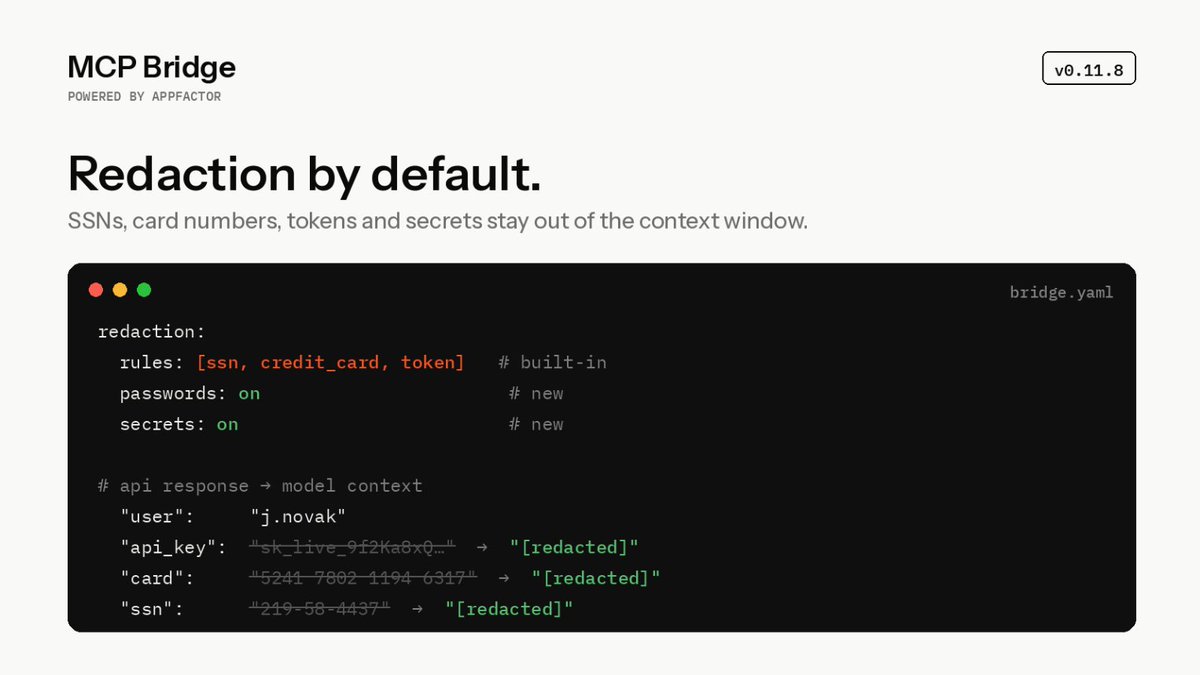
🔐MCP Bridge v0.11.8: redaction by default.
SSNs, card numbers and tokens are now redacted out of the box, plus new Password and Secrets toggles so generic API keys never reach the model's context window.
Agents hit dozens of APIs. Credentials turn up in nested fields, error messages, audit trails. Safer defaults, fewer leaks.