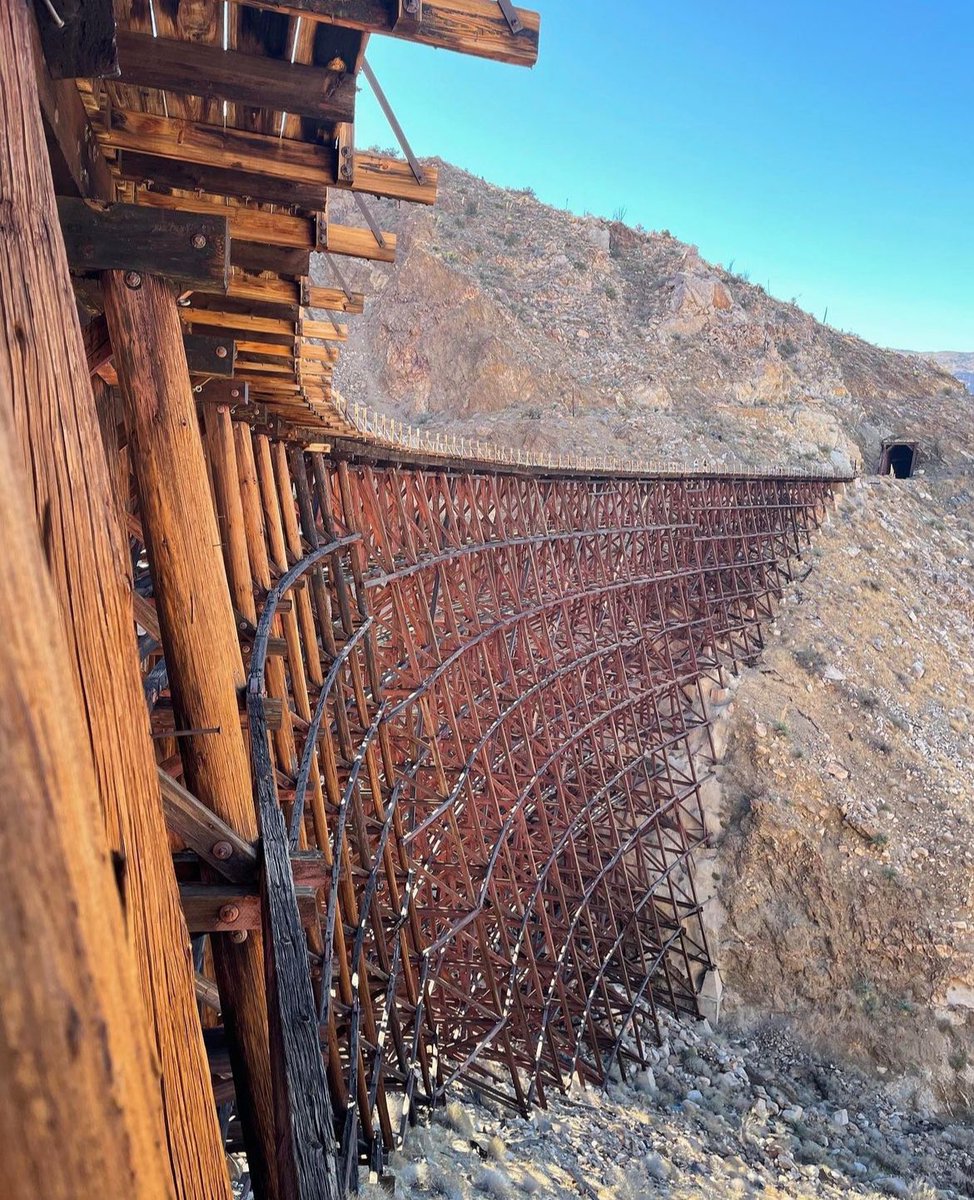
The Goat Canyon Trestle, located in San Diego County, California, is the world's largest wooden railroad trestle. Built in 1919 as part of the Carrizo Gorge Track, it stands over 600 feet long and 186 feet high. Constructed with redwood beams, the bridge is a testament to the engineering prowess of its time.
The area around the trestle, known as Anza-Borrego, is an arid desert, and the construction of the railroad track through this landscape was a challenging task. It required the building of 17 tunnels and numerous trestles, earning it the nickname "the impossible railroad."
Over the years, the Goat Canyon Trestle has suffered significant damage from fires and floods. In 1976, Hurricane Kathleen caused the collapse of several tunnels and trestle beams, leading the Southern Pacific Railroad to abandon the line.
Despite its abandonment, the Goat Canyon Trestle remains a popular destination for hikers and adventurers, with a 6-mile roundtrip hike to reach the top. The area is also home to abandoned rail cars, adding to the allure of the site. As of January 2018, the Baja California Railroad was assessing the line for potential repairs to allow the track to return to operation.
Welcome new contributors in 🇮🇩Indonesia, 🇲🇾Malaysia, 🇵🇭Philippines, 🇸🇬Singapore, 🇹🇭Thailand, 🇵🇬Papua New Guinea and 🇧🇳Brunei 👋
Amazing to see some of these new contributors already writing notes that have been found helpful enough to show on X.
Announcing Grok!
Grok is an AI modeled after the Hitchhiker’s Guide to the Galaxy, so intended to answer almost anything and, far harder, even suggest what questions to ask!
Grok is designed to answer questions with a bit of wit and has a rebellious streak, so please don’t use it if you hate humor!
A unique and fundamental advantage of Grok is that it has real-time knowledge of the world via the 𝕏 platform. It will also answer spicy questions that are rejected by most other AI systems.
Grok is still a very early beta product – the best we could do with 2 months of training – so expect it to improve rapidly with each passing week with your help.
Thank you,
the xAI Team
https://t.co/iPqreWxmQh
The original Michelin Man from 1894.
He was is white because rubber tires are naturally white. It was not until 1912 that carbon chemicals were mixed into the white tires, which turned them black. The change was structural, not aesthetic. By adding carbon, tires became more durable.
Michelin also began reviewing restaurants so that more people would travel further distances in their cars to eat at these restaurants. This, in turn, would wear down their tires faster and force them to buy more.
The star system that Michelin uses goes up to three and is broken down by whether or not it's worth driving to the restaurant:
One star: "A very good restaurant in its category" (Une très bonne table dans sa catégorie)
Two stars: "Excellent cooking, worth a detour" (Table excellente, mérite un détour)
Three stars: "Exceptional cuisine, worth a special journey" (Une des meilleures tables, vaut le voyage).