Understand the essentials of retained search and what to consider before engaging with an executive recruiter for strategic hires.
#RetainedSearch#ExecutiveRecruitment#HiringStrategy
https://t.co/IN6NwzUiDc
Almost six in ten of the S&P 500 companies' C-suite leaders were promoted from within their own firm.
That makes leadership development one of the top sources of executive talent, and the companies that benefit the most are those that give rising leaders real stretch roles to prove themselves long before a top seat opens up. External hires are still important, but they are usually hired for specialized skills that the company cannot scale fast enough internally.
Are you growing the next generation of leaders in your organization, or waiting to discover them when the time is right? Let us know in the comments. 👇
Your next executive might already be on your team, or they might be the one person your pipeline is missing. Either way, we can help you find them: https://t.co/c1Q8UM92QY
#CSuiteTalent #InternalMobility #SuccessionPlanning #LeadershipDevelopment #TalentStrategy
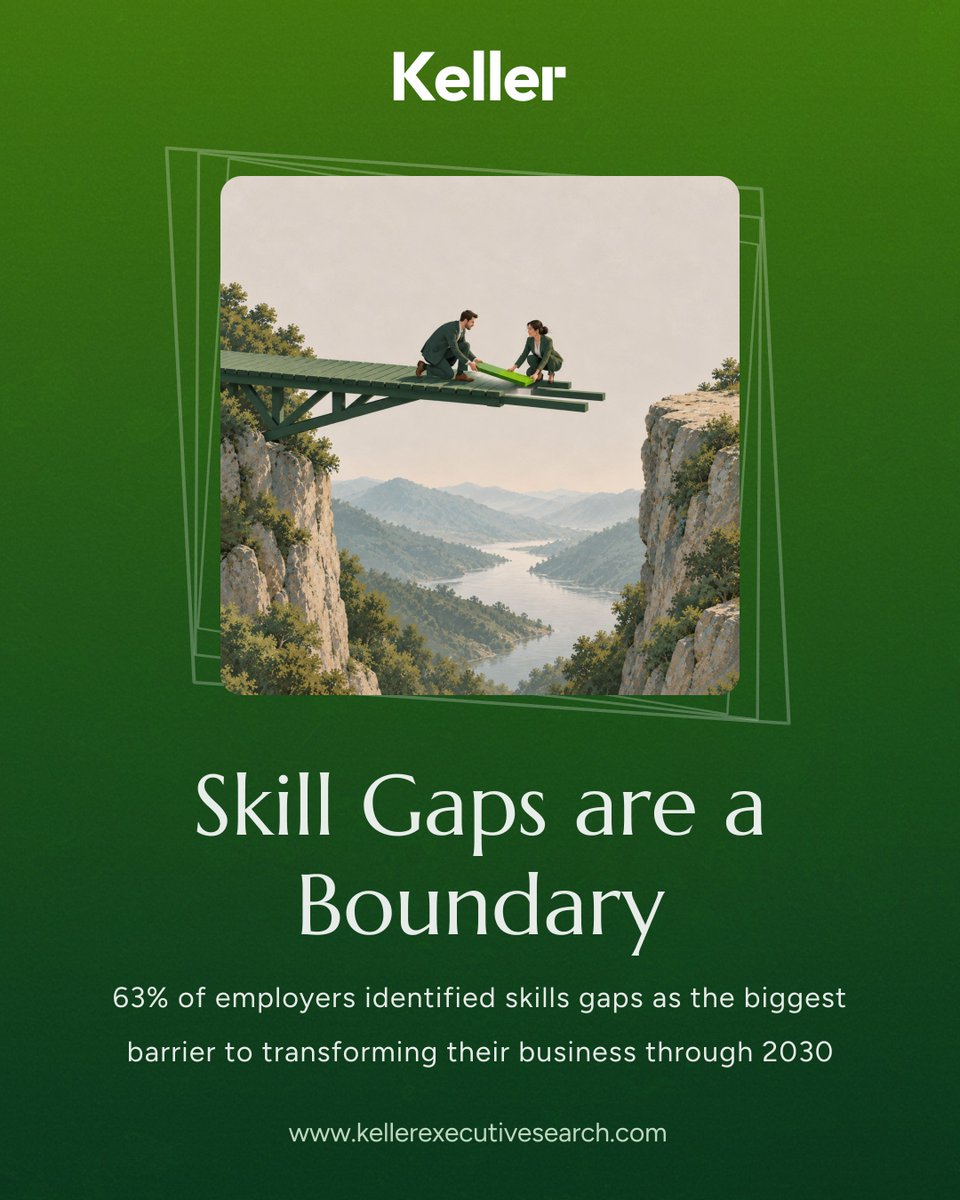
Business transformation can have the strategy, technology and funding in place and still fall short at the final gap: having the right people to deliver it.
63% of employers identified skills gaps as the biggest barrier to transforming their business through 2030, compared with just 26% who cited a shortage of investment capital.
Talent is no longer a supporting resource if organizations are able to acquire the necessary funds for growth but lack the necessary skills to keep up with the added complexity expansion demands. Instead, it becomes the limitation that determines the speed at which everything else moves.
Building the leadership your transformation needs? Learn more: https://t.co/c1Q8UM8v1q
#SkillsStrategy #BusinessTransformation #ExecutiveTalent #LeadershipPipeline #FutureOfWork
A carve-out happens when a company sells off part of itself, it could be a division, product line, or even an entire region, rather than the entire business. These deals now account for more than a quarter of all major M&A transactions.
That structure creates a built-in tension: the seller wants a fast, clean exit, while the buyer's team needs to keep the business running from day one. Getting this handoff wrong is costly. It can mean service outages, lost customers, or regulatory exposure that surfaces months after the deal closes.
Learn more about building the right leadership team for complex integrations: : https://t.co/c1Q8UM8v1q
#ExecutiveLeadership #MandA #TalentStrategy #HR #CorporateStrategy
Most of what we screen for as adaptability is actually flexibility.
They are not the same. Flexibility is reactive. It shows up after the change has already arrived, and it looks like a candidate saying yes to a reorg they did not choose.
Adaptability is anticipatory. It is seeing what is coming, learning ahead of it, and abandoning a method that still works because it will not work next year.
The problem is that interviews reward the first one. "Tell me about a time you handled unexpected change" is a question about flexibility. Everyone has an answer.
Almost nobody gets asked what they gave up before they had to.
More on measuring this properly: https://t.co/chyK5MC4iH
#ExecutiveSearch #Leadership #WorkAdaptability #AdaptabilityQuotient
The most valuable executive skill isn't knowing every answer, it's about having the judgement to make the right call whenever the question changes.
When employers were asked which skills matter most heading into 2030 the top answer wasn't a technical one: it was analytical thinking. The ability to reason through a hard problem was named as the most essential capability by 7 out 10 companies asked. Right behind it: adaptability and leadership.
There's a reason these types of skills rank so highly. Nearly 40% of the skills we rely on today are expected to be outdated by 2030. When the ground keeps shifting, what a leader already knows matters less than how they think when the situation is unfamiliar.
That should change how we assess leaders. If you want leaders who hold up when things get complex, assessment has to test this right from the start.
See how we assess executive talent for judgment, not just experience → https://t.co/c1Q8UM8v1q
#ExecutiveAssessment #LeadershipJudgment #CSuiteHiring #TalentStrategy #LeadershipDevelopment
Only about 8% of companies can show real ROI on AI usage, despite nearly everyone investing in it.
The gap isn't the technology; almost every organization now has access to the same tools. What separates the 8% is people: leaders who can redesign and optimize task pipelines, set directions for human teams using AI tools, and turn raw capability into measurable results. AI is abundant, but experienced judgment to deploy it in the correct way is still scarce, and that's exactly where the advantage lies.
So which side of that gap is your organization on? Drop your take in the comments.
If you're rebuilding your team around human teams who can use AI effectively, start with the leaders who can incorporate these automation tools smartly → https://t.co/c1Q8UM8v1q
#AIAtWork #WorkforceStrategy #ExecutiveSearch #DigitalTransformation #LeadershipInnovation
Only 12% of organizations plan their workforce more than three years out. The rest treat every resignation, every retirement, every sudden growth target as an emergency.
Workforce planning deserves the same discipline as capital allocation. And it doesn't require an enterprise-wide rollout, focusing on one critical function is enough to start the ball rolling.
So: which roles, if vacated tomorrow, would stall your strategy?
If the answer isn't immediate, the plan doesn't exist yet.
https://t.co/odQh7NOnPR
#WorkforcePlanning #TalentStrategy #Leadership
About 4 out of 10 leaders struggling with intense stress have considered walking away from leadership altogether.
The role has changed faster than the support around it. Leaders are absorbing constant restructuring, AI uncertainty, and eroding trust from their teams, often with less authority and less recovery time than the job demands.
That pressure doesn't stay contained at the top. When senior leaders start eyeing the exit and the people behind them watch the toll up close, the next generation quietly decides the promotion isn't worth it, and the pipeline thins from both ends before anyone notices a vacancy.
So we want to hear it from you: is your organisation actually building leaders, or just quietly burning through them? Drop your take in the comments.
If your succession plan assumes your best people still want the corner office, it may be time to pressure-test that assumption → https://t.co/c1Q8UM8v1q
#LeadershipBurnout #SuccessionPlanning #ExecutiveSearch #LeadershipPipeline #HRStrategy
What a candidate can do is starting to outweigh where they studied. Employers are quietly rewriting the hiring playbook around capability.
For leadership teams, this shift changes the economics of talent acquisition. It widens the applicant pool and reduces the risk of overlooking high performers. It also ties hiring criteria more closely to on-the-job results.
See how a capability-first approach reshapes executive search: https://t.co/c1Q8UM8v1q
#SkillsBasedHiring #TalentStrategy #ExecutiveLeadership #HR #WorkforcePlanning
Trust is one of the biggest opportunities in leadership today. The Edelman Trust Barometer found that 6 in 10 people worldwide want institutions to act more visibly in their interest, a clear signal for leaders ready to close that gap.
The organizations pulling ahead aren't the loudest. They're the most consistent, those that have a corporate hierarchy whose actions match their promises, day after day. Trust isn't a soft skill. It's a core executive competency, and it starts with who sits at the top.
Discover how we find strong leadership who can help build trust that lasts: https://t.co/c1Q8UM8v1q
#ExecutiveLeadership #StakeholderTrust #TalentStrategy
Disengaged employees rarely have a motivation problem. They have a job-design problem.
It's easy to read low engagement as a people issue: the wrong hires, the wrong attitude, a generation that "doesn't want to work." But in some situations, disengagement isn't always about the person. It could also be about the “shape” of the role they've been handed.
People lean in when they can see the whole of what they're building, when they have real room to make decisions, and when they can tell their work actually matters to someone. They check out when a role is narrow, when ownership is unclear, and when feedback disappears.
This isn't a new idea. The Job Characteristics Model laid it out decades ago: skill variety, task identity, task significance, autonomy, and feedback, the building blocks that turn a set of tasks into a job an employee can be proud about.
The question for leaders isn't "how do we get people more engaged? It should be: "have we actually designed roles worth engaging with?"
We revisited the model and what it means for leading modern, distributed teams here 👇 🔗 https://t.co/BVoZYYK2FI
#Leadership #TalentStrategy #EmployeeEngagement #FutureOfWork #ExecutiveSearch
In just two years, the average FTSE 100 COO has lost more than a third of their time in the role, down to only 2.7 years.
What was once a role about keeping operations steady has become one about leading change everywhere at once, from AI to supply chains to geopolitical pressure. With 88% of new COOs facing all of that for the first time, few stay long.
Is the modern COO role simply being asked to do too much, too fast? Share your perspective in the comments.
The operational leaders who can thrive under this pressure are rare, and finding them is exactly what we do. See how we help companies secure the right ones: https://t.co/c1Q8UM92QY
#COO #OperationalLeadership #CSuiteStrategy #ExecutiveTalent #BusinessTransformation
Some of the best executives for a role are unreachable before a search even starts. Not because they would say no, but because a search firm is contractually barred from calling them.
This is the effect of off-limits agreements. To protect existing clients, search firms agree not to approach their leaders for a set period. Every company under that protection is a slice of the talent market removed from consideration. The broader and longer the policy, the smaller the field becomes for the next critical search.
The strongest policies protect client relationships without quietly narrowing access to talent
#ExecutiveSearch #TalentStrategy #LeadershipHiring #HRLeadership #CandidateAccess
One of the most expensive mistakes leaders make is structuring HR evaluations around activity: Is the team busy? Instead of outcomes: Are roles filled in a reasonable time with the right people? Are we consistent in compliance? Are employees actually getting help?
Getting that distinction right can have real payoffs that go beyond a smoother team. The way you structure HR directly shapes how much it costs you, how much risk you carry, and how fast your business can execute.
The data backs it up: Only 18% of large organizations route routine HR work through shared services, meaning most HR teams stay buried in administrative tasks instead of the work that moves the business. Yet redesigning the HR operating model can unlock 15–25% in operating-cost efficiency. The difference isn't effort. It's structure.
The fix isn't more activity. It's the right architecture: clear decision rights, repeatable work in shared services, and leadership focused on outcomes you can actually measure.
We broke down how to structure a modern HR function as the strategic asset it should be 👇
🔗https://t.co/rXbBVdV87T
#HumanResources #ExecutiveSearch #Leadership #WorkforcePlanning #OrganizationalDesign
The rate at which job offers are being accepted has been trending upwards since 2021 and is now at its highest level since COVID. A clear sign that more candidates are ready to commit to the right opportunity.
For organizations that prepare well, this is an opening. Senior candidates say yes when the fundamentals are strong: a clear mandate, confident decision-makers, a competitive package, and a credible growth story. Get those right and acceptance becomes the natural result of a well-run search.
Leaders who understand the organization’s needs clearly and move with conviction turn a strong candidate’s interest into a yes more often. The question is which lever does the most to get you there?
Build acceptance into the search strategy from day one: https://t.co/c1Q8UM8v1q
#ExecutiveSearch #ExecutiveHiring #TalentAcquisition #OfferStrategy #CandidateExperience
Great leadership isn't a personality. It's a set of habits.
Managers can account for roughly 70% of the variance in team engagement. A really important factor when you consider that disengagement is estimated to cost the global economy an estimated $8.8–$8.9 trillion a year, close to 9% of global GDP.
That difference between a thriving organization and a stalling one could be related to whether your leaders consistently practice the right behaviors: self-awareness, clear communication, growth, trust, and shared vision under pressure.
We broke down the 5 habits the most effective executives repeat, what they look like in practice, and how to measure them.
Read the full piece → https://t.co/AuPe7w3Q9h
#Leadership #ExecutiveSearch #LeadershipDevelopment #EmployeeEngagement #CSuite
Speed needs stability at the top.
Organizations are moving faster, but leadership can’t be reactive.
In recent years, 70% of surveyed companies have put leadership and talent decisions higher on the agenda. Why? Because when change moves fast, the right people in the right roles can keep the business steady, focused, and ready to adapt.
A leadership skill that has been elevated recently is creating enough clarity, trust, and continuity for teams to move quickly without losing direction.
Build leadership teams ready for change. Visit https://t.co/c1Q8UM8v1q
#ChangeLeadership #ExecutiveAssessment #LeadershipStrategy #OrganizationalAgility #CSuite
Most succession plans look airtight when they are being planned, but when it comes to reality only about 20% of HR leaders can confidently say their bench is actually ready to fill a critical leadership position.
The gap between plans and practicality have real world implications for your business: stalled transitions, delayed strategic moves, and the scramble for emergency external hires at a premium. Most successors get named years before they're ever pressure-tested in a real leadership crisis, and that's usually when the cracks appear.
At Keller we’re curious, in your opinion what do you think would break first when a leadership transition happens before the bench is truly ready? Have you ever been in this situation, if so, what have you seen play out?
Building a bench that holds under real pressure means honest readiness assessment and the judgment to bring in outside leadership when the internal answer isn't there yet. Find out if you’re ready with our help: https://t.co/c1Q8UM92QY
#SuccessionPlanning #Leadership #ExecutiveSearch
In the long run generally companies don't actually fail because they run out of ideas. They fail because they can't execute the ones they already have.
That's the gap a great COO can help you close and today it's become the hardest seat in the C-suite to fill. Time-to-hire for COOs has roughly doubled since 2019, and 81% of COO appointments in Q1 2025 went to internal candidates, the highest share in years.
There's a reason boards are guarding the role so carefully: nearly one-third of S&P 500 CEO appointments over the past five years came directly from the COO seat. So when you build the bench wrong, you don’t just risk missing out on a strong operator but in many cases you also miss out on your next CEO.
If you're a founder, CEO, or board member trying to figure out when a COO is needed, which model fits your stage, and how to measure success, our latest piece breaks it down.
👉https://t.co/gFyaj3W79V
#ExecutiveSearch #Leadership #COO #CSuite #SuccessionPlanning
Most companies stress over getting global hires in the door. The real legal exposure is on the way out.
Terminations are the highest-risk moment in the entire employee lifecycle, and the math varies wildly by country. In Brazil, severance can hit 40% of total earnings. In California, miss a final-pay deadline by one day and statutory penalties start compounding. In Germany, you need written notice, a legally valid reason, works council consultation, and social selection criteria before you can let someone go. One company discovered what a single overlooked unemployment insurance update costs when a state audit landed them with $200,000 in back payments and penalties.
The complexity scales fast. Over 40% of multinationals faced termination-related legal disputes in a recent two-year window. And 55% of global organizations say local labor law compliance is their single biggest challenge. Meanwhile, the EU's Transparent and Predictable Working Conditions Directive introduced new contract requirements across multiple jurisdictions in 2023 and 2024, meaning the rules you followed last year may already be outdated.
Whether you use an Employer of Record or build internal capability, the non-negotiable is the same: jurisdiction-specific termination protocols, documented at every step, with real-time regulatory monitoring. Getting hiring right protects your growth. Getting termination right protects everything else.
The exit is more expensive than the entrance.
#Global #Legal #Termination