Have you noticed how AI has moved beyond just helping you create content?
Now it can publish, manage distribution, and even earn on-chain, and that’s exactly what grabbed my attention about Xyper.
Instead of posting manually every day, you can launch an autonomous AI agent that generates content, distributes it, and collects crypto rewards for its activity. For creators this changes the game: your AI stops being merely a productivity tool and becomes an active economic participant in the ecosystem, with extra earning potential through referrals as the network expands.
We’re shifting from “using AI” to assigning AI real economic roles on-chain. If you’re building in AI or Web3, this is one to watch.
Follow @Xypermarket and explore the autonomous agent here:
https://t.co/iAKfzwaMA9
Ready to see why Waves Tech deserves your attention?
Waves Tech is the bedrock of the Waves ecosystem, a low-level, purpose-built infrastructure that supports everything running on top of it. Imagine a city: skyscrapers need solid foundations, roads, and utilities. In the Waves world, Waves Tech provides those foundations, the high-capacity roads, and the utility systems that let applications run smoothly and scale.
Lately that foundation has been visibly strengthening. Through architectural upgrades and performance improvements, Waves Tech is becoming faster, more resilient, and more capable of handling real-world demand. That’s why a wave of projects are moving in: https://t.co/AL1Gs931zR is scaling infrastructure-heavy services, Xyper is orchestrating marketing and user growth, Predictorium is delivering on-chain predictions with lower latency, and Puzzle is hosting DeFi stacks & all relying on Waves Tech’s capacity and reliability.
Look at the pattern: core infrastructure matures, builders can focus on features instead of plumbing, and the ecosystem diversifies. The result is practical momentum, not speculative noise & that translates into more live apps, smoother integrations, and measurable developer activity. If you follow Waves, this is a pivotal moment: the platform isn’t just growing; it’s becoming a sturdier, faster place to build. Waves Tech is writing the next chapter and it’s one driven by tangible infrastructure progress and real projects.
#waves #WavesTech @wavesprotocol
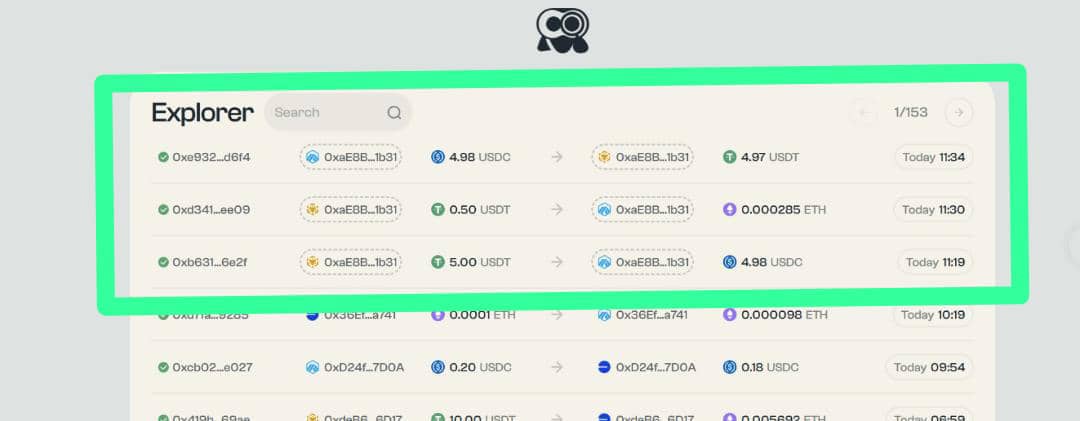
Ran a quick cross‑chain test with @allbridge_io today via https://t.co/CkkBpXzRUL to see if it holds up for real cross‑chain stablecoin flows.
Route: 5 USDT on BSC → USDC on Arbitrum, then back again. Both directions landed in ~28–32 seconds from source confirmation, which is way closer to a normal swap UX than a “wait a few minutes” bridge.
(After receiving my USDT to USDC) It landed on Arbitrum with USDC and no gas, so I used their built-in gas option to convert some USDT on BSC into ETH on Arbitrum. That also settled in ~30 seconds and felt like a native flow rather than juggling a second bridge/DEX hop just to get gas.
Economics: 5 USDT on BSC → 4.98 USDC on Arbitrum, and 4.98 USDC back → 4.97 USDT on BSC. Net round‑trip cost was ~0.03 on 5 (≈0.6%), including the routing and stable‑swap spread, which is acceptable for live treasury rebalancing and multi‑chain merchant payouts.
Overall,https://t.co/CkkBpXzRUL feels fast, gas‑aware, and simple enough that I’d actually wire it into a multi‑chain payments stack. I’d still like even more visibility into route selection and fee breakdowns for power users, but the “arrival experience” (funds + gas on destination quickly) is already in a good place.
@PerrieDExplorer Really insightful Article!
I think you're right, Bitcoin is amazing as a store of value, but without the right infrastructure, it just sits there. I’m really curious to see if BOB can become that missing piece, making Bitcoin smart money in everyday finance
@PerrieDExplorer@lifiprotocol This is a total game changer
if https://t.co/ZNGBfnr28X can handle all the steps behind the scenes, crypto finally becomes easy enough for everyone. Excited to see how this opens up new possibilities
You’re not missing out on U.S. stocks because you don’t understand them
You’re missing out because accessing them from outside the U.S. is unnecessarily difficult
You can follow companies like Apple and Tesla every day, understand what’s happening, even have opinions on where the market is going
But when it’s time to actually participate, that’s where things start to fall apart
I came across @_lumeapp an app trying to fix this, and I spent time going through it to see how it works.
I’ll break it down properly 🧵⇊
Decentralisation is often talked about in blockchain circles, but too often it exists as a promise rather than reality.
Many networks start with assumptions that require layers of fixes (rollups, specialised validators, or complex scaling solutions) to maintain decentralisation as the network grows.
@Minima_Global takes a different approach.
Its architecture was designed from the ground up to make decentralisation scale naturally.
Every Minima node runs as a full node on ordinary hardware, participates directly in consensus and validation, and scales horizontally without replication-heavy global state.
There are no rollups, no validator hierarchies, and no deferred decentralisation waiting for future upgrades.
This design contrasts sharply with networks that are evolving toward decentralisation.
Ethereum, for instance, is gradually layering solutions (DAS, ZK-EVMs, PBS, and future gas limit increases) to improve throughput while preserving decentralised consensus.
These innovations are impressive, but they are essentially engineering workarounds for assumptions built into the original architecture.
Minima, by contrast, removed the root cause of centralisation entirely.
The difference is more than technical. It’s philosophical.
One approach adds complexity to preserve decentralisation at scale. The other removes the assumptions that make centralisation possible in the first place.
Minima falls squarely in the latter category: a network where decentralisation is not an afterthought, but a fundamental property that works today.
For anyone interested in the future of truly open networks, Minima is not just a project to watch…..
it is a model for how decentralisation can function in practice, without compromise.
For more than a decade, the blockchain industry has talked about moving closer to machines.
The idea was simple: if autonomous systems are going to make decisions, exchange value, and act without human oversight,
they need a trust layer that doesn’t depend on central servers or constant cloud access.
In reality, that promise never fully materialised.
Blockchains stayed where they were comfortable; in data centres, on powerful servers, behind layers of infrastructure that edge devices could only interact with indirectly.
Machines could use blockchains, but they never truly contained them.
This is the gap @Minima_Global has quietly crossed.
Instead of treating blockchain as a network service that machines connect to, Minima has been engineered to exist inside embedded hardware itself.
Not as a stripped-down client or a symbolic integration, but as a full Layer-1 node running directly where control logic lives.
This shift is subtle but profound.
When blockchain logic runs inside embedded systems, trust stops being something machines request and becomes something they enforce.
Minima’s architecture was never designed with cloud-first assumptions.
Its deterministic design and embedded-focused C++ implementation make it fundamentally different from blockchains that require heavyweight runtimes, specialised servers, or constant external dependencies.
That design choice is what allows Minima to move from general-purpose computing environments into autonomous hardware without compromise.
What makes this moment significant is that it isn’t theoretical.
The Blockchain-on-Chip work has progressed past diagrams and whitepapers into live execution on real hardware.
Minima is now running on Arm-based embedded platforms, integrated directly into autonomous systems, with cryptographic operations accelerated at the silicon level.
That matters because autonomy breaks down when trust is abstracted away from the machine itself.
If verification, logging, or coordination depends on infrastructure the device does not control, then autonomy is conditional at best.
By embedding blockchain directly into the same hardware that executes control logic, Minima removes that dependency.
This is not about making blockchains faster in isolation.
It is about making trust native to machines.