I’m building a smart money intelligence tool for Polymarket.
It tracks:
• Profitable wallets
• Whale entries
• Sudden odds moves
• Market inefficiencies
• Risky crowded trades
I’ll share public notes here before launch.
Follow if you trade prediction markets.
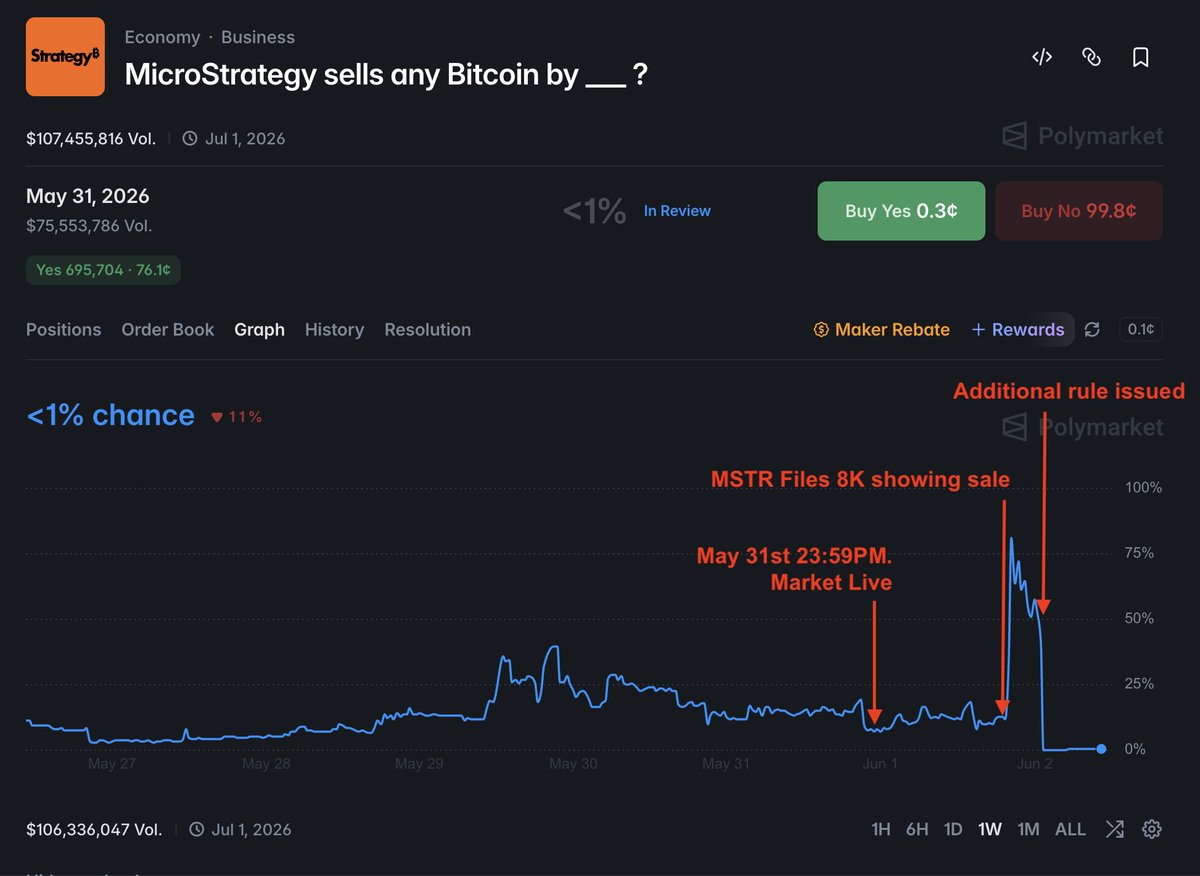
The additional terms were a patch forcefully "retrofitted" by Polymarket after the May 31 deadline, whereas the official 8-K filing released by MicroStrategy (MSTR) on Monday was merely a retroactive validation of the physical facts that occurred prior to May 31.
Following up on the questions you raised and the final voting results, let’s completely dismantle the malicious logic and the insider dark money narrative behind this event:
I. Why did Polymarket stubbornly insist that it "didn't count"? What was their motive?
The core contradiction you pointed out is incredibly sharp: since the 8-K filing simply validated the facts, on what grounds did the platform disqualify it? Why did they resort to retrofitting clauses just to renege on the payout?
1. Targeted Protection for "Whales" Shorting or Absorbing "Yes" Shares
On the night of Sunday, May 31, because the U.S. SEC does not disclose filings over the weekend, the long-short battle on Polymarket was effectively manipulated by interest groups. Several whales holding millions—or even tens of millions—of dollars were aggressively buying "No." They were betting entirely on the hard-coded settlement time (23:59) in the Polymarket smart contract. If Polymarket had acknowledged the retroactive announcement released on June 1, these heavy-betting whales, who share deep logistical ties with the platform, would have faced total liquidation (100% loss).
2. Concealing Fatal Flaws in the Original Contract Rules
The original contract was written incredibly poorly (it only specified that settlement would rely on official disclosure, without mandating that the disclosure must occur within the May 31 window). When the June 1 announcement came out and delivered a harsh reality check to the "No" camp, Polymarket management chose to directly retroactively modify the rules (adding a clause that "information disclosed past the deadline will not qualify") to avoid class-action lawsuits from the massive "No" whales and to prevent funds from being locked in limbo indefinitely. This is a textbook case of the referee stepping onto the field to change the rules mid-game.
II. Since the overall event series doesn’t end until July 1, why couldn’t they wait?
This series of wagers also included sub-markets for June 30 and even further out. Logically, the May 31 market could have been frozen for 24 hours to await the Monday morning U.S. stock market opening and the subsequent official filing before settling. Their frantic rush to cut off all possibilities on Sunday night boiled down to two calculated moves:
1. Time-Window Arbitrage via Information Asymmetry
The interest groups (the market makers backing "No") knew perfectly well that they would inevitably lose the July 1 market (since an announcement would definitely drop at some point in June). However, because May 31 fell on a Sunday, it created a perfect "information vacuum blind spot." By forcefully settling the May 31 market as "No" within this blind spot, they could legally siphon off all the accumulated principal belonging to the "Yes" side.
2. Shifting Blame to UMA Oracle's Mechanism Design
Polymarket dared to retrofit these terms because they knew they could pass the buck to UMA, the decentralized oracle. UMA’s protocol dictates that voting occurs based on the resolution proposal and market rules active at the exact moment the dispute is triggered. By retrofitting the fine print after the deadline, Polymarket fundamentally distorted the "truth standard" presented to UMA voters. This misled UMA token holders into ruling on the timing of the announcement rather than the timing of the actual asset sale.
III. Final Settlement and Loss Outcomes for Both Sides
Due to the forced execution of the final settlement, the entire pool (affecting upwards of $130 million) underwent one of the most brutal redistributions of wealth in the history of decentralized prediction markets:
1. The "Yes" Side (Retail Investors & On-Chain Analysts who bought "Will Sell"): Wiped Out completely with Heavy Losses
Loss Details: Every investor and analyst who held the line that "facts are facts," and who believed they had a guaranteed win after the June 1 announcement dropped (some even buying "Yes" shares at local tops), saw their principal instantly drop to zero.
Public Outcry & Destroyed Trust: Retail investors from the "Yes" camp across Twitter and Discord communities are currently collectively condemning the platform. These users didn't just lose money; their faith in Polymarket's self-proclaimed vision of "Trading Truth" has been utterly shattered.
The Few Long-Term Exiters: The only survivors were the select few who took profits back in early May when Saylor’s tone first shifted and the probability spiked past 70%. Anyone who stayed in the arena waiting for the final resolution had their capital completely swallowed.
2. The "No" Side (Arbitrage Whales & Heavy Hitters who bought "Will Not Sell"): Clean Sweep of Profits, Successful Escape
Profit Details: The whale accounts who exploited the rule vulnerabilities and aggressively shorted "Yes" while scooping up "No" during the "SEC weekend blackout" successfully cashed out at the maximum $1.00 face value, completely draining tens of millions of dollars of retail principal from the pool.
Elimination of Latent Risk: This cartel of whales capitalized on UMA’s "one-token-one-vote" bribing mechanics. Because many of the heavy "No" bettors simultaneously hold massive allocations of UMA governance tokens, they successfully voted "No" on their own dispute, flawlessly dodging a multi-million-dollar liquidation event that they rightfully should have faced.
💡 Summary
This entire event is being viewed across the Web3 ecosystem as a "shameful semantic game." It proves that current decentralized prediction markets remain incapable of maintaining true objectivity when confronted with weekend-delayed corporate disclosures.
MicroStrategy objectively did sell Bitcoin before May 31 (a physical "Yes" fact), but the "No" whales and Polymarket’s retrofitted clauses leveraged the institutional blind spot of "no Sunday announcements" to force a "No" settlement. This was no longer an exercise in predicting events; it was a corporate cartel using structural loopholes to conduct a legal, targeted execution and capital harvest of retail users.The additional terms were a patch forcefully "retrofitted" by Polymarket after the May 31 deadline, whereas the official 8-K filing released by MicroStrategy (MSTR) on Monday was merely a retroactive validation of the physical facts that occurred prior to May 31.
Following up on the questions you raised and the final voting results, let’s completely dismantle the malicious logic and the insider dark money narrative behind this event:
I. Why did Polymarket stubbornly insist that it "didn't count"? What was their motive?
The core contradiction you pointed out is incredibly sharp: since the 8-K filing simply validated the facts, on what grounds did the platform disqualify it? Why did they resort to retrofitting clauses just to renege on the payout?
1. Targeted Protection for "Whales" Shorting or Absorbing "Yes" Shares
On the night of Sunday, May 31, because the U.S. SEC does not disclose filings over the weekend, the long-short battle on Polymarket was effectively manipulated by interest groups. Several whales holding millions—or even tens of millions—of dollars were aggressively buying "No." They were betting entirely on the hard-coded settlement time (23:59) in the Polymarket smart contract. If Polymarket had acknowledged the retroactive announcement released on June 1, these heavy-betting whales, who share deep logistical ties with the platform, would have faced total liquidation (100% loss).
2. Concealing Fatal Flaws in the Original Contract Rules
The original contract was written incredibly poorly (it only specified that settlement would rely on official disclosure, without mandating that the disclosure must occur within the May 31 window). When the June 1 announcement came out and delivered a harsh reality check to the "No" camp, Polymarket management chose to directly retroactively modify the rules (adding a clause that "information disclosed past the deadline will not qualify") to avoid class-action lawsuits from the massive "No" whales and to prevent funds from being locked in limbo indefinitely. This is a textbook case of the referee stepping onto the field to change the rules mid-game.
II. Since the overall event series doesn’t end until July 1, why couldn’t they wait?
This series of wagers also included sub-markets for June 30 and even further out. Logically, the May 31 market could have been frozen for 24 hours to await the Monday morning U.S. stock market opening and the subsequent official filing before settling. Their frantic rush to cut off all possibilities on Sunday night boiled down to two calculated moves:
1. Time-Window Arbitrage via Information Asymmetry
The interest groups (the market makers backing "No") knew perfectly well that they would inevitably lose the July 1 market (since an announcement would definitely drop at some point in June). However, because May 31 fell on a Sunday, it created a perfect "information vacuum blind spot." By forcefully settling the May 31 market as "No" within this blind spot, they could legally siphon off all the accumulated principal belonging to the "Yes" side.
2. Shifting Blame to UMA Oracle's Mechanism Design
Polymarket dared to retrofit these terms because they knew they could pass the buck to UMA, the decentralized oracle. UMA’s protocol dictates that voting occurs based on the resolution proposal and market rules active at the exact moment the dispute is triggered. By retrofitting the fine print after the deadline, Polymarket fundamentally distorted the "truth standard" presented to UMA voters. This misled UMA token holders into ruling on the timing of the announcement rather than the timing of the actual asset sale.
III. Final Settlement and Loss Outcomes for Both Sides
Due to the forced execution of the final settlement, the entire pool (affecting upwards of $130 million) underwent one of the most brutal redistributions of wealth in the history of decentralized prediction markets:
1. The "Yes" Side (Retail Investors & On-Chain Analysts who bought "Will Sell"): Wiped Out completely with Heavy Losses
Loss Details: Every investor and analyst who held the line that "facts are facts," and who believed they had a guaranteed win after the June 1 announcement dropped (some even buying "Yes" shares at local tops), saw their principal instantly drop to zero.
Public Outcry & Destroyed Trust: Retail investors from the "Yes" camp across Twitter and Discord communities are currently collectively condemning the platform. These users didn't just lose money; their faith in Polymarket's self-proclaimed vision of "Trading Truth" has been utterly shattered.
The Few Long-Term Exiters: The only survivors were the select few who took profits back in early May when Saylor’s tone first shifted and the probability spiked past 70%. Anyone who stayed in the arena waiting for the final resolution had their capital completely swallowed.
2. The "No" Side (Arbitrage Whales & Heavy Hitters who bought "Will Not Sell"): Clean Sweep of Profits, Successful Escape
Profit Details: The whale accounts who exploited the rule vulnerabilities and aggressively shorted "Yes" while scooping up "No" during the "SEC weekend blackout" successfully cashed out at the maximum $1.00 face value, completely draining tens of millions of dollars of retail principal from the pool.
Elimination of Latent Risk: This cartel of whales capitalized on UMA’s "one-token-one-vote" bribing mechanics. Because many of the heavy "No" bettors simultaneously hold massive allocations of UMA governance tokens, they successfully voted "No" on their own dispute, flawlessly dodging a multi-million-dollar liquidation event that they rightfully should have faced.
💡 Summary
This entire event is being viewed across the Web3 ecosystem as a "shameful semantic game." It proves that current decentralized prediction markets remain incapable of maintaining true objectivity when confronted with weekend-delayed corporate disclosures.
MicroStrategy objectively did sell Bitcoin before May 31 (a physical "Yes" fact), but the "No" whales and Polymarket’s retrofitted clauses leveraged the institutional blind spot of "no Sunday announcements" to force a "No" settlement. This was no longer an exercise in predicting events; it was a corporate cartel using structural loopholes to conduct a legal, targeted execution and capital harvest of retail users.The additional terms were a patch forcefully "retrofitted" by Polymarket after the May 31 deadline, whereas the official 8-K filing released by MicroStrategy (MSTR) on Monday was merely a retroactive validation of the physical facts that occurred prior to May 31.
Following up on the questions you raised and the final voting results, let’s completely dismantle the malicious logic and the insider dark money narrative behind this event:
I. Why did Polymarket stubbornly insist that it "didn't count"? What was their motive?
The core contradiction you pointed out is incredibly sharp: since the 8-K filing simply validated the facts, on what grounds did the platform disqualify it? Why did they resort to retrofitting clauses just to renege on the payout?
1. Targeted Protection for "Whales" Shorting or Absorbing "Yes" Shares
On the night of Sunday, May 31, because the U.S. SEC does not disclose filings over the weekend, the long-short battle on Polymarket was effectively manipulated by interest groups. Several whales holding millions—or even tens of millions—of dollars were aggressively buying "No." They were betting entirely on the hard-coded settlement time (23:59) in the Polymarket smart contract. If Polymarket had acknowledged the retroactive announcement released on June 1, these heavy-betting whales, who share deep logistical ties with the platform, would have faced total liquidation (100% loss).
2. Concealing Fatal Flaws in the Original Contract Rules
The original contract was written incredibly poorly (it only specified that settlement would rely on official disclosure, without mandating that the disclosure must occur within the May 31 window). When the June 1 announcement came out and delivered a harsh reality check to the "No" camp, Polymarket management chose to directly retroactively modify the rules (adding a clause that "information disclosed past the deadline will not qualify") to avoid class-action lawsuits from the massive "No" whales and to prevent funds from being locked in limbo indefinitely. This is a textbook case of the referee stepping onto the field to change the rules mid-game.
II. Since the overall event series doesn’t end until July 1, why couldn’t they wait?
This series of wagers also included sub-markets for June 30 and even further out. Logically, the May 31 market could have been frozen for 24 hours to await the Monday morning U.S. stock market opening and the subsequent official filing before settling. Their frantic rush to cut off all possibilities on Sunday night boiled down to two calculated moves:
1. Time-Window Arbitrage via Information Asymmetry
The interest groups (the market makers backing "No") knew perfectly well that they would inevitably lose the July 1 market (since an announcement would definitely drop at some point in June). However, because May 31 fell on a Sunday, it created a perfect "information vacuum blind spot." By forcefully settling the May 31 market as "No" within this blind spot, they could legally siphon off all the accumulated principal belonging to the "Yes" side.
2. Shifting Blame to UMA Oracle's Mechanism Design
Polymarket dared to retrofit these terms because they knew they could pass the buck to UMA, the decentralized oracle. UMA’s protocol dictates that voting occurs based on the resolution proposal and market rules active at the exact moment the dispute is triggered. By retrofitting the fine print after the deadline, Polymarket fundamentally distorted the "truth standard" presented to UMA voters. This misled UMA token holders into ruling on the timing of the announcement rather than the timing of the actual asset sale.
III. Final Settlement and Loss Outcomes for Both Sides
Due to the forced execution of the final settlement, the entire pool (affecting upwards of $130 million) underwent one of the most brutal redistributions of wealth in the history of decentralized prediction markets:
1. The "Yes" Side (Retail Investors & On-Chain Analysts who bought "Will Sell"): Wiped Out completely with Heavy Losses
Loss Details: Every investor and analyst who held the line that "facts are facts," and who believed they had a guaranteed win after the June 1 announcement dropped (some even buying "Yes" shares at local tops), saw their principal instantly drop to zero.
Public Outcry & Destroyed Trust: Retail investors from the "Yes" camp across Twitter and Discord communities are currently collectively condemning the platform. These users didn't just lose money; their faith in Polymarket's self-proclaimed vision of "Trading Truth" has been utterly shattered.
The Few Long-Term Exiters: The only survivors were the select few who took profits back in early May when Saylor’s tone first shifted and the probability spiked past 70%. Anyone who stayed in the arena waiting for the final resolution had their capital completely swallowed.
2. The "No" Side (Arbitrage Whales & Heavy Hitters who bought "Will Not Sell"): Clean Sweep of Profits, Successful Escape
Profit Details: The whale accounts who exploited the rule vulnerabilities and aggressively shorted "Yes" while scooping up "No" during the "SEC weekend blackout" successfully cashed out at the maximum $1.00 face value, completely draining tens of millions of dollars of retail principal from the pool.
Elimination of Latent Risk: This cartel of whales capitalized on UMA’s "one-token-one-vote" bribing mechanics. Because many of the heavy "No" bettors simultaneously hold massive allocations of UMA governance tokens, they successfully voted "No" on their own dispute, flawlessly dodging a multi-million-dollar liquidation event that they rightfully should have faced.
💡 Summary
This entire event is being viewed across the Web3 ecosystem as a "shameful semantic game." It proves that current decentralized prediction markets remain incapable of maintaining true objectivity when confronted with weekend-delayed corporate disclosures.
MicroStrategy objectively did sell Bitcoin before May 31 (a physical "Yes" fact), but the "No" whales and Polymarket’s retrofitted clauses leveraged the institutional blind spot of "no Sunday announcements" to force a "No" settlement. This was no longer an exercise in predicting events; it was a corporate cartel using structural loopholes to conduct a legal, targeted execution and capital harvest of retail users.
@willo2_Poly
Regarding the market rules, it states that the resolution will be based on MSTR announcements and on-chain data.
However, there has already been a clear public announcement confirming that a transaction occurred during this period. Could you please clarify:
Do you settle based on actual transaction actions (on-chain BTC sales), or based on announcement information?
If MicroStrategy only issues an announcement but does not actually sell any Bitcoin, how will the market be resolved?
Do you only check the announcement and ignore the actual on-chain data?
Are we basically playing Texas Hold'em here, where it's "word of mouth" that counts? If that's the case, then if I say "I'm going to bet" but I don’t actually place the bet (no on-chain BTC transaction), does that still count?
What a day, but on a more positive note, we did a release this morning, and the latency on the CLOB is now 500% better. You should see a huge difference. Thanks for waiting for the fix. It was a hard one because it was at the lowest level of the services. We have many other fixes coming in the next weeks to take this down even further.
What Are Prediction Markets Really Eating?
I recently saw something that felt very representative of where this market is heading: on May 19, 2026, Polymarket launched prediction markets tied to private-company performance, covering valuation milestones, IPO timing, and secondary-market activity, with Nasdaq Private Market serving as the resolution data provider. Reuters also described these products as a price-discovery tool for private-company valuations.
That made me revisit a bigger question:
If prediction markets become mainstream, will they drain liquidity from traditional markets?
Private-company IPO expectations, short-term stock moves, crypto event trades, sports outcomes, policy decisions, AI benchmarks, drug approvals — they all look different on the surface.
But at the core, they are all trades on one thing:
whether a future event will happen.
Will a company IPO this year?
Will a stock close above a certain level?
Will a crypto project launch an airdrop?
Will a policy pass?
Will a team win?
Will an AI company reach a certain valuation?
These questions were already being traded.
They were just hidden inside other markets: stocks, options, crypto exchanges, private secondary markets, sportsbooks, news cycles, and social media narratives.
Prediction markets make the trade explicit.
My view is simple:
Prediction markets will not replace traditional markets entirely. But they will absorb the most event-driven, short-term, probability-based trading demand inside those markets.
1. Stocks Will Not Disappear, But Short-Term Speculation Will Be Pulled Away
Stock markets exist for more than price speculation.
A stock represents ownership. It supports company financing, long-term capital allocation, index investing, pensions, buybacks, equity compensation, and institutional portfolio construction.
Prediction markets cannot replace that.
But they can replace part of the short-term speculative layer.
If someone only wants to bet that Tesla will rise 10% this week, they do not necessarily need to buy the stock.
They may not even need options.
They can simply trade a contract on that specific outcome.
So the impact on equities is not existential. It is structural.
Long-term capital will still own stocks.
Institutions will still allocate across portfolios.
Companies will still need equity markets for financing.
Funds and pensions will still need real assets.
But some traders who only want directional event exposure will move elsewhere.
Prediction markets are not taking liquidity from ownership.
They are taking liquidity from pure directional betting.
2. Crypto Is More Exposed
Crypto is much closer to prediction markets by nature.
It is 24/7, narrative-driven, retail-heavy, volatile, and deeply tied to specific events.
A large part of crypto trading is not really about owning a productive asset.
It is about betting on a story.
Will a spot ETF be approved?
Will BTC break a certain price level?
Will a project launch an airdrop?
Will a protocol’s TVL spike?
Will a token list on a major exchange?
These are already prediction-market-style trades.
That means prediction markets can absorb part of the liquidity currently sitting in perpetuals, altcoins, meme coins, and event-driven crypto trades.
But crypto will not disappear either.
Tokens still have use cases: collateral, governance, DeFi participation, liquidity provision, cross-border transfer, and long-term holding.
What prediction markets will absorb is the part of crypto that mainly exists to bet on discrete outcomes.
In crypto, that part is not small.
3. Private Companies and IPO Expectations May Become a Shadow Valuation Market
The most interesting area, in my view, is private companies.
Many people want exposure to companies like OpenAI, SpaceX, Anthropic, Stripe, and other late-stage private firms.
But most people cannot buy the actual equity.
The private market is restricted, opaque, and illiquid.
Prediction markets create an alternative path.
You may not be able to buy the stock, but you can trade the company’s IPO timing, valuation range, financing outcome, or listing probability.
This creates a new kind of shadow price.
It is not the same as owning equity.
Traders do not get ownership, dividends, voting rights, or a place on the cap table.
But the market can still influence perception.
It can shape media narratives, employee expectations around options, secondary-market pricing, and even fundraising psychology.
The key issue here is not demand.
Demand is obvious.
The real issue is settlement quality and insider information.
People close to financing rounds, IPO preparation, legal work, investor allocations, and secondary transactions will often know more than the public.
In the stock market, knowing an event is only part of the trade. You still need to predict how the market will react.
In a prediction market, knowing the event itself can be close to knowing the outcome.
That is the biggest long-term problem for private-company prediction markets.
4. Sports, Politics, News, Weather, and Drug Approvals Face the Same Problem
The real expansion path for prediction markets is not one industry.
It is every event that can be turned into a yes/no question or a measurable outcome.
Sports is the most direct case.
Sports betting is already outcome betting. Prediction markets entering sports means direct competition with traditional sportsbooks.
Politics is another obvious category.
Elections, policy decisions, government appointments, war escalation, and diplomatic agreements all create tradable demand.
But politics also creates more complicated problems.
There may be insider information. There may be narrative manipulation.
Once market prices are quoted by media, the prices themselves can become part of the political story.
Weather and climate are also natural categories.
For agriculture, energy, aviation, insurance, logistics, and live events, these markets are not just speculation. They can become real hedging tools.
Drug approvals, tech launches, M&A outcomes, regulatory fines, AI model performance, and private-company milestones also fit well.
But the more valuable the information, the higher the insider-trading risk.
That is the core tension:
The more important an event is, the more valuable it is to trade.
The more valuable it is to trade, the more likely insiders are to have an edge.
5. Prediction Markets Are Not Just Gambling, and Not Just Finance
I think the cleanest way to describe prediction markets is this:
They securitize uncertain facts.
They turn an unresolved question into a tradable price.
Behind that price is probability.
Behind probability is information.
Behind information is disagreement, desire, and capital.
At their best, prediction markets aggregate information faster than news.
In a neutral sense, they are risk-management tools.
At their worst, they are gambling products dressed in financial language.
Their future depends on which use case becomes dominant.
If they serve information discovery, they will become an important layer for news, research, and investing.
If they serve hedging, they will become a new class of derivatives.
If they serve entertainment betting, they will be regulated like gambling.
If they become insider-arbitrage venues, they will eventually face a trust crisis.
Conclusion
My current view is simple:
Prediction markets will not make traditional markets disappear.
But they will separate out the most bet-like layer inside traditional markets and turn it into its own market.
Stocks will still exist because people need ownership.
Private markets will still exist because companies need capital.
Crypto will still exist because on-chain assets have their own use cases.
Sports betting will still exist, though prediction markets will challenge it directly.
What gets reshaped is the short-term event trade that used to be hidden inside everything else.
Prediction markets are, in one sense, capital chasing imagined profit space.
But more precisely, they are capital pricing uncertainty itself.
First we traded assets.
Then we traded risk.
Now we are starting to trade the probability of facts.
That may be the real future of prediction markets.
We're excited to announce our exclusive partnership with Nasdaq Private Market.
Retail traders can now get exposure to private companies, one of the historically most profitable asset classes, exclusively through Polymarket.
We're excited to announce our exclusive partnership with Nasdaq Private Market.
Retail traders can now get exposure to private companies, one of the historically most profitable asset classes, exclusively through Polymarket.