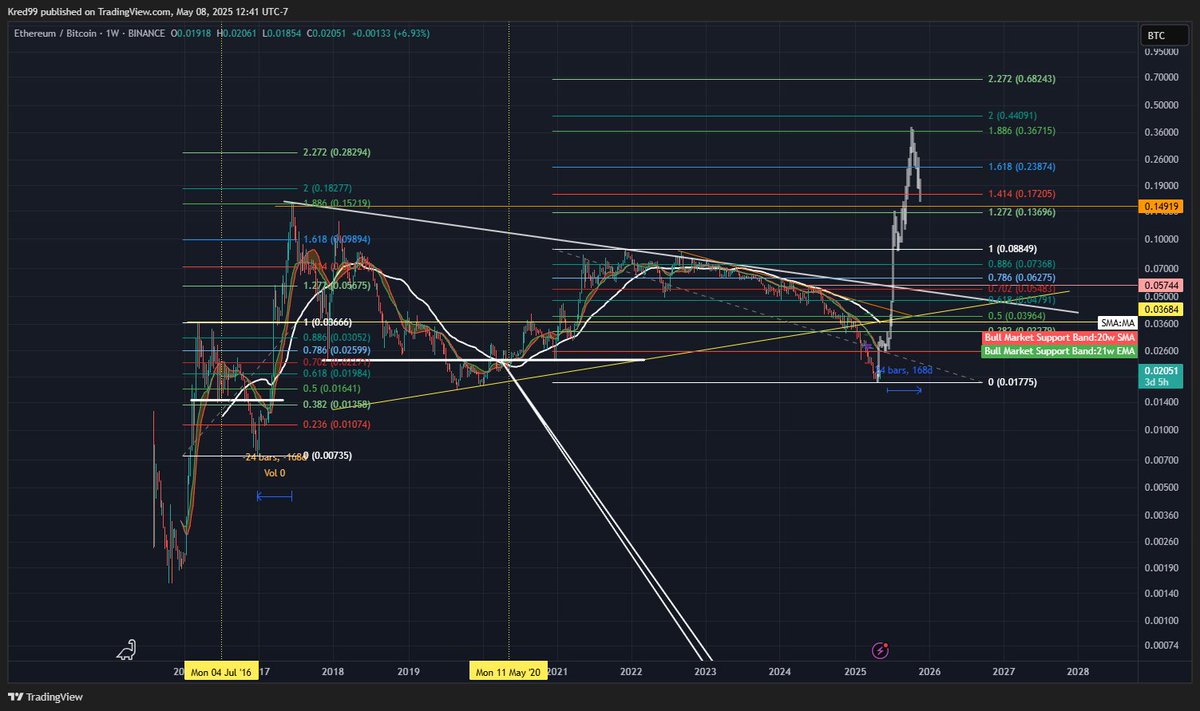
@TeslaBoomerMama@aurelius_787 The $275 is conservative, I have checked with Grok. I think you guys are going to nail it! Thanks for the work and sharing.
@joechalom EUF is the missing bridge that turns Standard Chartered’s usage explosion into believable token value. It lets ETH act like Amazon on the high-value side without ever compromising the decentralized, neutral, open-source principles that made Ethereum win.
Why the $10M / 1 bp Cap Is One of the Best Features (hard reasons)
1. Institutions crave certainty: A $250M BlackRock-style tokenized fund rebalance costs exactly $25,000 — no surprises even at $5B. This matches what corporate treasuries already pay (and hate) in TradFi.
2. Still 10–100× cheaper than alternatives: Cross-border wires/SWIFT = $15–$50 fixed + 20–100 bp FX spreads + correspondent fees (total effective cost often 30–300 bp on $10M+). Wholesale B2B averages 0.1%, retail B2B 1.5%; annual global cross-border corporate payments alone cost businesses $120B on $23.5T volume.
3. Anti-FUD proof: No one can claim “Ethereum taxes billion-dollar moves at 5 bp.” The cap makes the narrative bulletproof and signals “we are neutral infrastructure, not greedy extractors.”
4. Revenue trade-off is tiny: Ultra-large single txns ($500M+) are rare and usually split anyway. Bulk volume is in the $10–200M range where the progressive ramp already captures beautifully.
Even assuming Ethereum ecosystem captures only a $5–8T annual notional slice of high-value (> $1M) flows (well-supported by the $8T Ethereum Q4 2025 figure + RWA turnover + institutional dominance in settlement/DeFi despite Solana/Tron low-value share):
At full realistic $10T capturable (achievable with stablecoin → $2T and RWA → trillions projections): $550M+ annually.
ETH has unbeatable real-world usage (stablecoins, tokenized RWAs, DeFi), but the protocol still fails to capture meaningful value from the actual dollar notional moving through it — gas fees are tiny and non-proportional, so the rising tide isn’t lifting the ETH boat. My proposal: exempt all transfers <$1M, then a simple progressive skim (0.25 bp up to $4M → 0.5 bp to $7M → 0.75 bp to $10M → capped at 1 bp above $10M). Even at conservative $5–8T annual capturable volume, this would generate $275–550M/year in direct protocol revenue (burns or staking yield) without hurting retail or UX. The catch: current Ethereum governance makes any real value-capture upgrade feel near-impossible in the needed timeframe — curious if you see this misalignment as the biggest risk to the $40k (or your higher) case, and whether a mechanism like this could ever pass.
This is a good news! They are achieving "walkaway test" as a concept Vitalik and others have pushed: the network should be robust enough that it doesn't need a single steward to survive.
The EF's own March 2026 Mandate explicitly says their goal is to reduce the Foundation’s relative influence over time. The idea is that Ethereum should eventually become a "set it and forget it" protocol in the best sense:It should keep running, upgrading, and defending itself even if the EF (or any central group) largely steps back or disappears.
This is often called the "walkaway test" — a concept Vitalik and others have pushed: the network should be robust enough that it doesn't need a single steward to survive.
It is very sound economics model to adopt to grow our GDP.
eliminating federal income taxes for the bottom 50% of earners (those with AGI below ~$53,801 in the latest data) would likely give them significantly more disposable income, boosting their spending power and contributing to short-term GDP growth through higher consumption.
Lower- and moderate-income households have a higher marginal propensity to consume (MPC)—they tend to spend a larger share of any extra dollar (often 0.5–0.9 or more) on goods, services, food, housing, etc., compared to higher-income groups (who save/invest more, with MPCs around 0.1–0.4). Targeted tax relief like this acts as a strong demand-side stimulus.
The benefits wouldn't stop at consumption (demand-side stimulus). Eliminating federal income taxes for the bottom 50% (AGI under ~$53,801) could also unlock a meaningful supply-side channel through faster small-business formation, expansion, and job creation, amplifying GDP growth beyond the initial spending boost.
Many people in the bottom 50% are liquidity-constrained: they have the ideas and hustle for side hustles, gigs, or micro-businesses (sole proprietorships, freelancers, local services) but lack the extra cash to take the leap — covering startup costs, equipment, marketing, or bridging income gaps. Zeroing out their taxes would hand them hundreds to thousands of extra dollars per year (the ~$80–90 billion total revenue forgone, spread across millions of filers). That directly reduces financial barriers to entry.
@JesseOlson The 2022 price drop due to FTX, if you are looking the same set up - Iran vs US war (ground invasion by US). Then we are going to get that bull divergence. Otherwise, it could be it ($60K was the bear market bottom).