When many youths enter coffee farming, the first thing they ask is, “What is the price of coffee?”
But after years around farmers, exporters and buyers, I’ve learned that the better question is: “What kind of coffee do you want to produce?”
Because in coffee not all beans are valued the same.
Two farmers can grow coffee in the same district, harvest in the same season and still earn completely different incomes. One sells at ordinary market prices while another sells at two or even three times more. The difference is usually not luck. It is the decisions made from the very beginning.
Specialty coffee is built not discovered.
It starts with planning the farm properly choosing the right varieties, spacing, shade management and soil nutrition. A stressed coffee tree rarely produces excellent cup quality. Then comes field management throughout the season; pruning, weeding, mulching and controlling pests at the right time all affect bean development.
But the biggest difference often comes during harvesting and post-harvest handling.
Many farmers harvest everything at once because they want quick money. In specialty coffee, that is one of the biggest mistakes. Ripe cherries and unripe cherries do not belong together. Serious farmers selectively pick only the ripe red cherries because uniform ripeness improves sweetness and cup quality.
After harvesting the work is still not done.
How the coffee is fermented, washed, dried and stored matters a lot. Coffee dried directly on bare ground can absorb unwanted smells and contamination. Coffee dried too fast or too slowly can lose quality. Poor storage can destroy months of hard work within days.
Just like Last week I sold a container of specialty washed robusta at 12 USD/kg while ordinary commercial robusta was around 4 USD/kg. That difference was not because the coffee was magical. It was because every step was handled intentionally.
That is why I keep telling youths that coffee today is no longer just farming. Coffee is quality control. Coffee is discipline. Coffee is understanding markets. Coffee is patience.
The world is no longer only buying coffee beans.
It is buying consistency, intentionality , excellence and innovation
So youths out there let’s think outside the box and focus more on quality than quantity
For God and my country
Yesterday, I went to KMC. Today, engaged Farmer’s Choice on their beef procurement. What I learnt?
FCL paying up to KES 610/kg carcass weight— this premium price is reserved for the highest-grade animals. 💰
How do you hit that top tier? Let’s break down the thread. 📷 (1/n)
If you can't access a Brown Swiss heifer, just use B-Swiss AI on your cows & start the upgrade TODAY. Each generation gets hardier, more heat-tolerant & more feed-efficient.
GGI Kenya and Atlantis
https://t.co/PVgz4zxy0h and https://t.co/MDX0ua1nSy
can help where appropriate!
I am teaching you this for free today!
Early rains mostly favor weeds, not your crops.
Many farmers don’t understand this, and it costs them yield every year.
During the dry season, thousands of viable weed seeds fall and settle on the ground, lying dormant and hibernating in the soil.
Waiting for moisture, just like you the farmer are waiting for rain.
So immediately the first rain drops, the farm comes alive but not for your crops.
It’s the weeds that wake up.
Every part of your farm turns lush green with little to no value.
That one rainfall is enough for them to thrive, unlike your crops, because they are naturally built to survive and dominate.
Throughout the dry season, soil microorganisms have been quietly working, breaking down organic matter and releasing nutrients into the soil.
Those nutrients are what feed these weeds and help them grow rapidly.
So as a farmer, your job at this stage is not to plant, but to fight weeds.
And I personally recommend chemical weed control.
If you are practicing zero tillage, first manually clear the weeds, then allow the farm to stay for two to three weeks while the weeds regrow. After that, spray with both pre-emergence and post-emergence herbicides.
If you are tilling the soil, manually clear the weeds, turn the soil, and allow weeds to regrow for about two weeks. Then go ahead and plant your crops.
Before weeds will visit the farm again, your crops will be almost at the harvest stage,because the herbicides will kill both the weed seeds in the soil and the vegetative parts of it down to root.
Watch your crops thrive healthier and better.
Poor timing is a major challenge in agriculture.
Smart farmers understand this pattern, and that is how farming becomes easier and more profitable.
You won’t read this in most textbooks.
Help me quote and repost for others to learn.
#farmers #farm
If I had $1000 to invest in offshore stocks and ETFs,
Here’s how I would invest my first $1000 in global markets as a Kenyan
Step by step process and portfolio breakdown below👇👇
If you are in your 30s and have 500K, you can allocate:
✅35% in stocks: 175K
✅30% in bonds: 150K
✅20% in SACCO deposits: 100K
✅15% in Money Market Funds: 75K
The goal is to take on more risk while younger and increase your chances for higher returns.
Allocate Ksh8 million to government bonds, which can generate Ksh 85,000 per month in stable, low-risk income.
Invest Ksh 4 million in a fixed income fund, delivering an estimated Ksh 33,000–40,000 monthly, while maintaining liquidity and diversification.
Set aside Ksh 2 million for dividend-paying equities. This portion offers annual income through dividends, with the added advantage of capital appreciation over time.
The remaining Ksh1million can be directed toward a specialized fund or small-scale farming venture. This not only provides a potential supplementary income stream but also keeps you actively engaged.Retirement can be boring if you aren't active.
With this balanced allocation, you secure reliable cash flow, preserve capital, and maintain exposure to growth, allowing you to enjoy financial independence with peace of mind
@CallMeKulubya It’s only online that you will find the president is disliked. This comes from a small group online. When it’s time to vote, the opposition looses every by election. The typical opposition noisemakers without impact.
If you’re afraid of losing money, start simple.Begin with a Money Market Fund (MMF) to build confidence and stability. As your capital grows, gradually transition into bonds for slightly higher returns with negligible risk.Only consider stocks once you have built a solid financial buffer. With that cushion in place, market dips won’t push you into panic or force you to sell at a loss.The key is progressive risk: start safe, grow steadily, then step into higher-return assets when you’re financially and psychologically prepared.
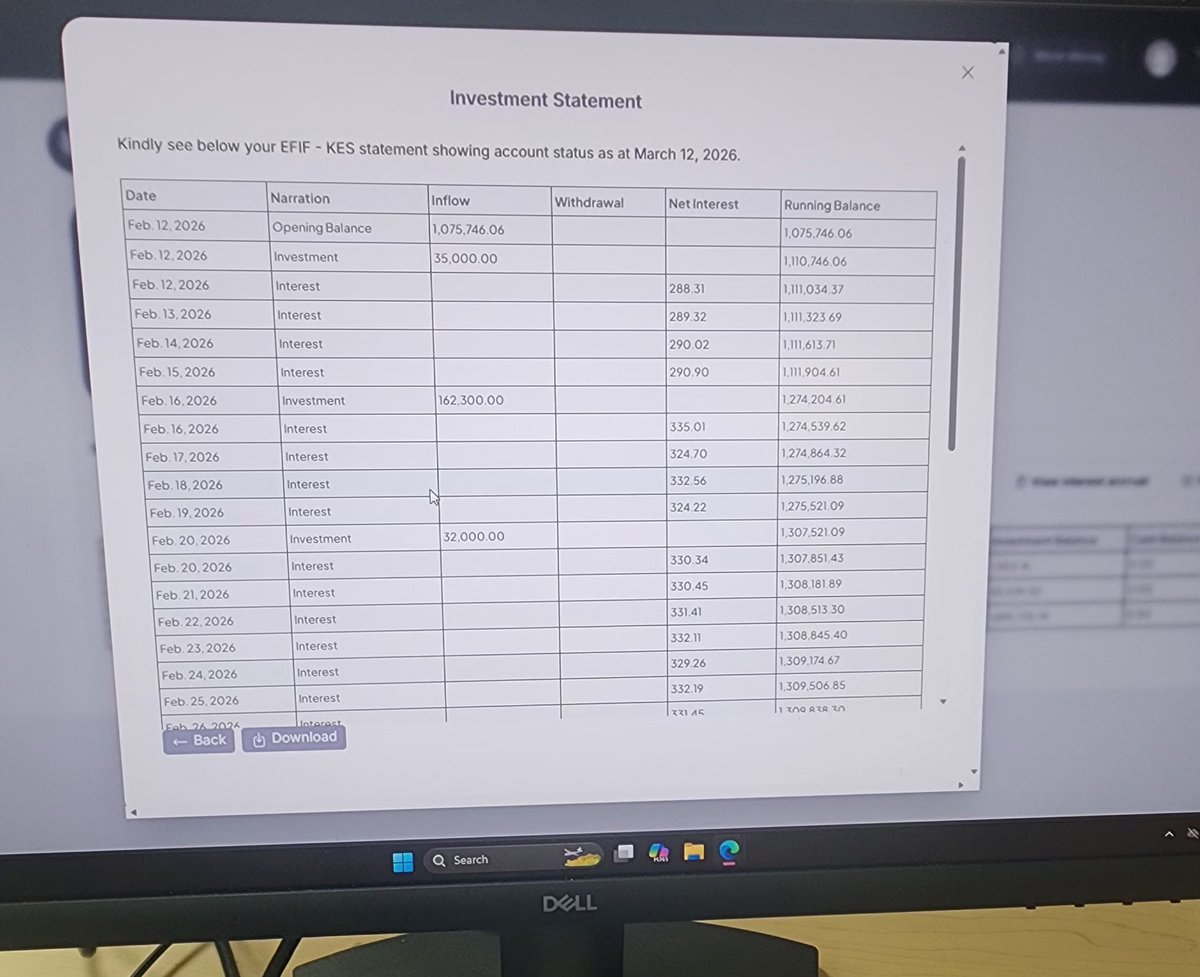
If your current monthly spending is KSh 50K and you’re managing your bills comfortably, a KSh 10M portfolio can realistically set you up for long-term financial stability.
Ignore the noise from X “billionaires” shouting about inflation and unrealistic targets and how 50K is nothing. Wealth planning should be based on your cost of living, not online bravado.With a well-structured, diversified portfolio, your capital can generate income while still growing over time.
A simple allocation could look like this:
1. Fixed Bond – KSh 6M (Income Stability)
Investing KSh 6M in a high-quality fixed bond yielding about 12% annually can generate roughly KSh 60,000 per month in interest. This alone covers your current monthly expenses leaving you with extra 10K while preserving the principal.
2. Equities – KSh 2M (Growth & Capital Appreciation)
Allocate KSh 2M to a diversified basket of stocks or an index fund. Over the long term, equities historically outperform inflation and provide compounding growth and capital appreciation.
3. Fixed Income Fund – KSh 2M (Compounding Engine)
Place the remaining KSh 2M in a fixed income fund earning around 12% annually. If you consistently add KSh 10,000 monthly, this portion alone could grow to approximately KSh 30M in 20 years through disciplined compounding.
Meanwhile:
Your KSh 6M principal remains intact while producing income.
Your equity allocation continues compounding in the background.
This structure gives you income today, growth tomorrow, and capital preservation.From there, you can pursue side hustles or business opportunities at your own pace,without the noise of your employer who pays you https://t.co/Zst0TR8bUY this only to supplement your lifestyle if your expenses eventually rise beyond KSh 50K.This can help you to avoid interrupting your portfolio too.
Financial independence isn’t always about billions. Sometimes it’s about aligning your investments with the life you actually live.
Keep investing simple
35% stocks
30% treasury bonds
20% sacco deposits
15% money market funds
If you have Sh500,000, you can put Sh175,000 in stocks, Sh150,000 in treasury bonds, Sh100,000 in SACCO deposits, and Sh75,000 in money market funds.
What's your favorite portfolio allocation?