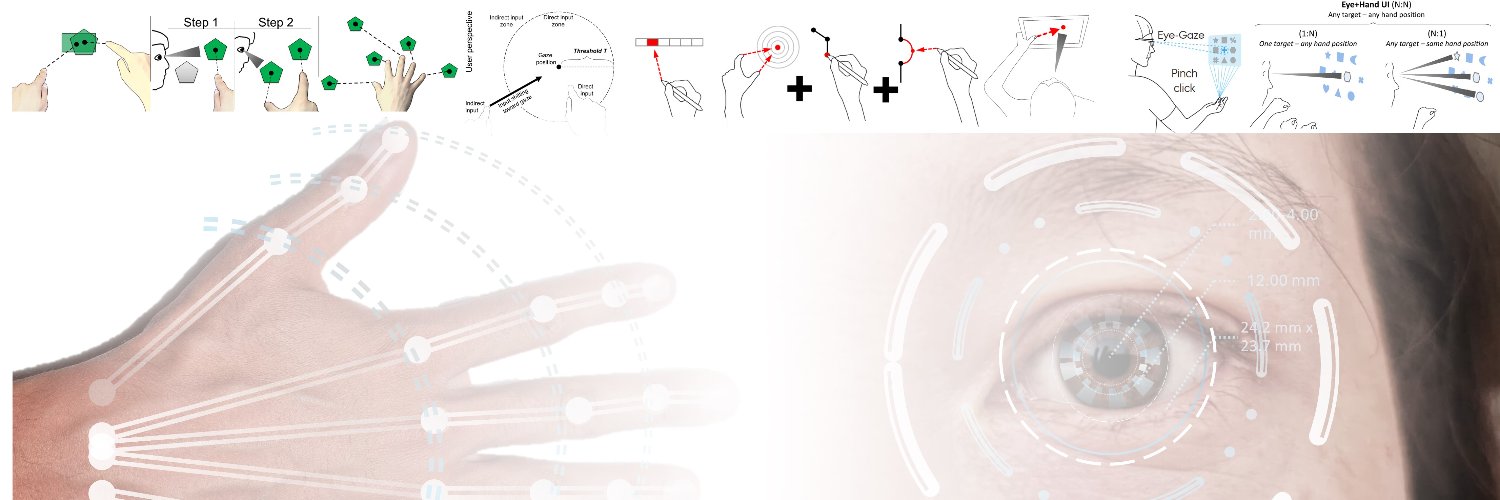
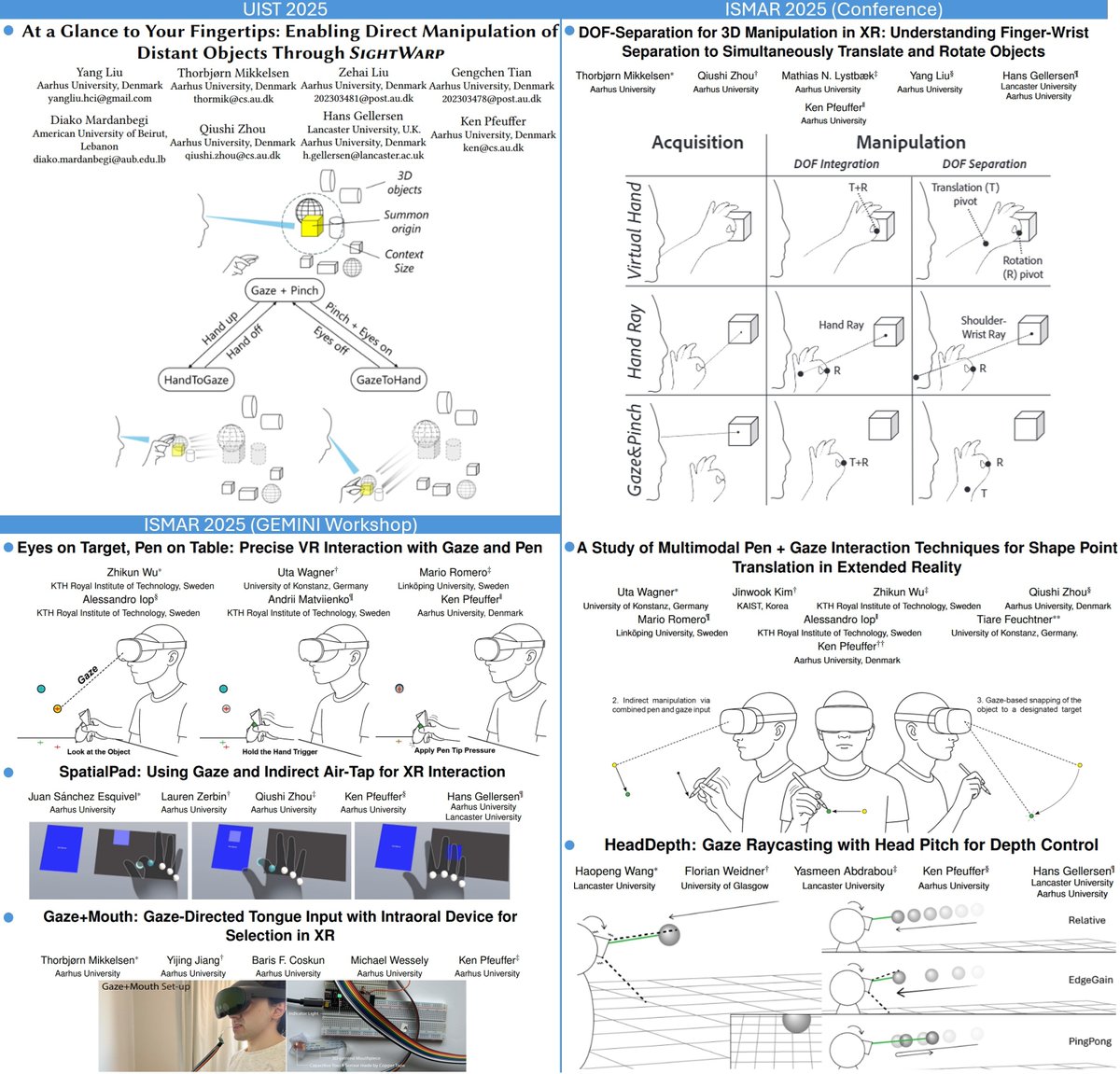
Excited to finally announce that we got a bunch of new upcoming research papers on eye and hand HCI for XR! 👁️🖐️
📝1 paper at #UIST2025
📝3 conference + 3 workshop papers at #ISMAR2025
Stay tuned for details.
Thanks to the amazing students at XI lab + collaborators🙏
👁️✋Pinch-to-zoom, but where you look is where it zooms.
This 2015 example explores multimodal-bimanual-direct-manipulation with gaze (mouthful!).
The hand stays away in comfort zone, the pen at the center. They don't interfere, just symbiosis.
From https://t.co/I90BxxKn0j
👁️🖐️What makes and breaks the gaze + pinch UI, what challenges remain? Here are 5 design issues, illustrated from the below article. #uiux#xr#spatialcomputing#hci#gesture#gaze
New article on 👀✋:
Design Principles & Issues for Gaze and Pinch Interaction
Inspired by HCI research and the upcoming @Apple#VisionPro release.
Medium: https://t.co/tbgRLyp8oZ
LinkedIn: https://t.co/Gke6qXkYgD
#arvr#uiux
Below the 5 principles in short:
@perburr Yes there is actually acceleration in there. I extended a simplified version of an old code snippet I found on the web for the mouse, adapted to this scenario. You can see a little bit how it is faster than the actual physical hand movement. Definitely makes sense to add it.
With a mouse or touchpad, this would require a lot of cursor dragging.
In 2014, I explored fluid and simple gaze+touch UI (eye tracker under the table).
Why don’t we have this on laptops yet, eg. using gaze + touchpads...?
New research incoming for #CHI2026 - on multimodal interaction in XR:
- how to teleport with👀+✏️
- how we preshape our hands with 👀+🖐️ and 👀+ 🎮
- how to multi-select objects with 👀+🖐️+🎤
Huge thanks 🙏to all students & collabs @csaudk@Concordia@LancasterUni@GoogleARVR
JUST IN: Google unveiled its smart glasses project with XREAL, called Project Aura.
• 70° FOV for a giant virtual screen anywhere
• run full Android apps in floating windows
• Circle to Search on anything you look at
• lightweight frame powered by a small compute puck
• hand tracking for pinch, zoom and window control
Launching in 2026.
We're taking the next step to make #AndroidXR even more helpful and seamless in your daily life. So much to share from The Android Show | XR Edition today in partnership with @SamsungMobile and @Qualcomm.
We introduced powerful new features for Galaxy XR, including Travel Mode for using your device on the go, PC Connect for streaming high fidelity desktop and laptop experiences to XR, and representing you as a photoreal avatar, with our Likeness feature.
We also shared updates on our AI glasses which we are building with @SamsungMobile, @WarbyParker and @_GentleMonster_. The Developer Preview 3 of the Android XR SDK brings new tools to all developers and opens up development for AI Glasses!
Finally, we also showed how we are expanding Android XR to the broader ecosystem, with Project Aura from @XREAL_Global.
Read more on the blog: https://t.co/P2y2Bzdrw8
Here’s a recap: https://t.co/7dsG2Mdrxp
And you can watch the full keynote here: https://t.co/9MAvSo0oJq
I know it's not exactly the "hottest" part of Valves announcement, but I am really excited for the Steam Frame's "Eye Tracked Foveated Streaming".
Things like this are one of the many reasons why I've been obsessed with headsets shipping natively with eye tracking.
Pressure to publish jumps. And researchers have no time to do science.
(New survey from Elsevier)
Survey of 3200 researchers:
1. Only 45% of scientists have sufficient time for actual research.
2. For 68%, the pressure to publish today is greater than 2-3 years ago.
3. 29% of researchers are considering relocating to another country (for better funding, work‐life balance, or greater research freedom).
4. 58% of researchers use AI tools in their work.
5. Reported benefits from AI: saving time (58%), helping with literature summaries (61%), literature reviews (51%), data analysis (38%), drafting proposals (41%), and drafting papers (38%).
Globally, life in academia is getting worse.
For students & postdocs - it’s especially hard to decide on an academic career.
❗️ A few days ago, I gave a lecture on this topic.
“PhD: Dreams, Reality and Consequences”
Watch it here: https://t.co/5IFhcVFwIL
(I’ll appreciate if you ‘like’ this video - you will GREATLY help it reach more students.)
We are being flooded by ‘research papers’. It is not a joke. As an editor of Software: Practice and Experience… I review over a thousand papers a year.
Increasingly, papers have been written by AI. My students hand in work done by AI. I have recently got a PhD thesis that the student admitted was AI generated.
So what do we do about it?
We leave the Soviet model of science: science as a bureaucracy.
Focus on doing great and useful work, and then (only then) write about it.
Do you do work so that you can publish it? Bring back your focus to doing great work. It should always have been thus.
To put it another way, the research paper is not the end point of the research. It has a supportive role.
At this point, some people object: “nobody cares about my work, how will they know that it is good if I don’t have a peer-reviewed paper?”
Oh brother: if you cure cancer, they will care. And if they don’t care about your work, they won’t read your paper. And your paper may have been generated by AI, and if nobody cares about it, it may as well have been AI generated.
Daniel Lemire. 2024. Will AI Flood Us with Irrelevant Papers? Commun. ACM 67, 9 (September 2024), 9. https://t.co/Neh0X3IiRJ
Only a million?!
People need to show a little more respect towards Mr. Rachmad of Indonesia, the greatest researcher of all time (according to the metrics)
While reviewing for #CHI2026, I noticed four new writing issues, likely due to increased use of LLMs. I describe them here - and how to fix them: https://t.co/pzwTTYwGX2